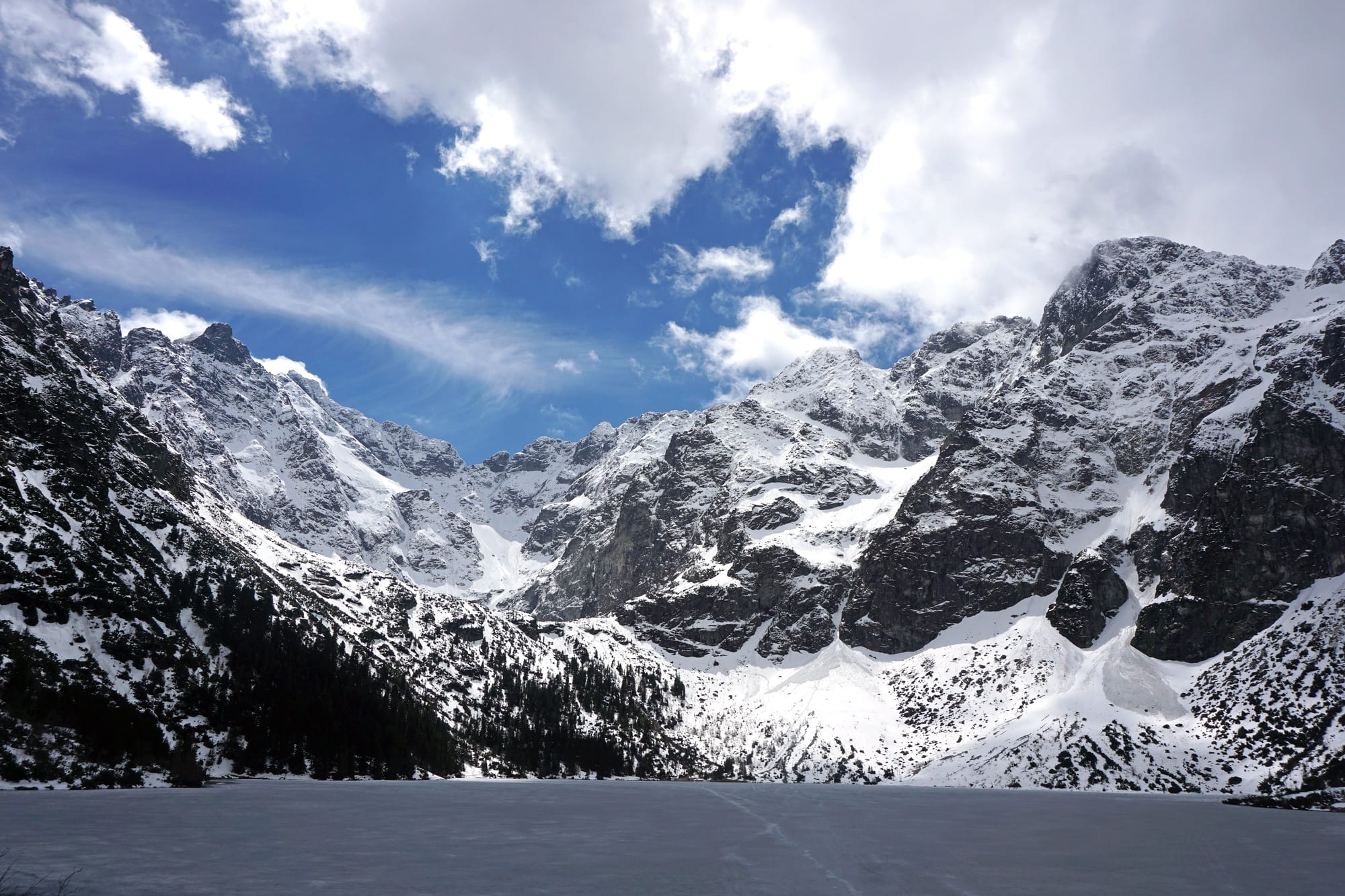
A frozen, snow-covered mountain lake below steep rocky peaks streaked with snow, with conifer forest on the left

Poland

Kraków & Lesser Poland

Morskie Oko, the largest lake in the Tatras, frozen beneath the High Tatra peaks in Tatra National Park. (kallerna / Wikimedia Commons · CC BY-SA 4.0)

Poland's southern heartland on the upper Vistula, rising from the royal city of Kraków through the Carpathian foothills to the granite peaks of the Tatras — the old seat of Polish kings, home of the Wieliczka salt mine, the Auschwitz-Birkenau memorial, the highland town of Zakopane and John Paul II's birthplace at Wadowice.

Explore Kraków & Lesser Poland

History

Lesser Poland, Małopolska, was the land of the Vistulans, a Slavic tribe absorbed into the Piast state in the late 10th century. Kraków became the seat of the Polish rulers in the 11th century, and survived the Mongol raid of 1241 to be refounded under Magdeburg law in 1257, with the grid of streets and central square that still define it. Kings were crowned in Wawel Cathedral from 1320, Casimir the Great founded the university in 1364, and the Jagiellonian era of the 15th and 16th centuries — when Copernicus studied here — made Kraków a Renaissance capital. Salt from Wieliczka and Bochnia was one of the crown's richest revenues.

The court moved to Warsaw around 1596, but Kraków remained the coronation and burial city of kings. After the Partitions it became a small free city, then part of Austrian Galicia, whose relative autonomy after the 1860s let Polish scholarship and art flourish here.

In the Second World War Kraków was the seat of the German occupation's General Government, its Jewish community was destroyed, and at Oświęcim the Germans built Auschwitz-Birkenau, where about 1.1 million people, most of them Jews, were murdered. The communists answered the city's conservatism by building the steel town of Nowa Huta from 1949. In 1978 the Archbishop of Kraków, Karol Wojtyła of Wadowice, became Pope John Paul II. Since 1989 tourism has made Kraków the country's leading destination.

Culture & Customs

Kraków thinks of itself as Poland's cultural capital: the city of the Jagiellonian University, of Wawel's royal tombs and of writers such as Wisława Szymborska and Czesław Miłosz, who both lived and died here. A trumpeter plays the hejnał from St Mary's tower every hour, stopping mid-note in memory, by legend, of a watchman shot by a Tatar arrow. The Lajkonik, a bearded rider on a hobby horse, parades through the streets a week after Corpus Christi, and the December contest of szopki, glittering nativity scenes modelled on Kraków's churches, is on UNESCO's intangible heritage list. The Jewish Culture Festival fills Kazimierz each summer.

The south belongs to the górale, the highlanders of Podhale around Zakopane, with their own dialect, fiddle music, felt trousers embroidered with parzenica patterns and wooden houses. In the late 19th century artists and writers made Zakopane a retreat and Stanisław Witkiewicz created the "Zakopane style" of timber architecture from local forms.

Catholicism is especially strong here. Wadowice and the pilgrimage sanctuary of Kalwaria Zebrzydowska draw large crowds, and Kraków's Łagiewniki is the centre of the Divine Mercy devotion.

Daily Life

Kraków has about 800,000 residents plus a large student population, and the region about 3.4 million. Tarnów, Nowy Sącz and Oświęcim are the other main towns; Zakopane has fewer than 30,000 people but receives millions of visitors. Kraków's economy has shifted from Nowa Huta's steelworks to universities, IT and business-services centres employing tens of thousands, and to tourism.

The foothills are a patchwork of small farms, orchards around Łącko and Nowy Sącz, and holiday houses. Many highland families rent rooms to visitors and have long histories of emigration to Chicago.

In the city, days follow the student rhythm — cafés busy late, evenings in Kazimierz and on the riverbanks. Current issues are overtourism and short-term rentals in the old centre, traffic on the Zakopianka road and air quality: Kraków banned coal and wood heating in the city in 2019, and the valley's winter smog has improved since.

Food

Kraków's street symbol is the obwarzanek krakowski, a ring of braided bread sprinkled with poppy or sesame seeds, sold from street carts and protected by EU designation. Zapiekanka, a long toasted open baguette with mushrooms and cheese, is the late-night snack of Kazimierz's Plac Nowy. Wadowice is famous for the kremówka, a cream slice John Paul II remembered fondly from his youth.

The highlands have the region's most distinctive food. Oscypek is a smoked sheep's-milk cheese pressed into decorated spindle-shaped moulds, protected by EU designation, sold grilled with cranberry jam from street stalls; bryndza podhalańska is a soft sheep's cheese, and żętyca the whey left from cheesemaking. Kwaśnica, a sauerkraut soup with pork ribs, and moskole, oat or barley flatbreads, fill up hikers.

The Łącko area distils śliwowica łącka, a strong plum brandy, and Lesser Poland's foothills also produce apples and plums, and a growing number of small wineries.

Attractions & Natural Wonders

Kraków's Old Town, among the first places inscribed as a UNESCO World Heritage Site in 1978, centres on the Main Market Square, with the Cloth Hall, the Rynek Underground museum beneath the square and St Mary's Basilica with Veit Stoss's carved altarpiece. The Royal Route leads to Wawel Hill's castle, cathedral and Dragon's Den cave. Kazimierz keeps synagogues, cemeteries and cafés; across the river, Schindler's Factory tells the story of occupied Kraków. Nowa Huta and the Benedictine abbey at Tyniec lie on the edges of the city.

South-east of Kraków, the Wieliczka salt mine shows kilometres of chambers and the Chapel of St Kinga, carved in the salt; the Bochnia mine nearby shares its UNESCO listing. West, the Auschwitz-Birkenau Memorial and Museum at Oświęcim preserves the brick blocks of Auschwitz I and the vast camp at Birkenau, while Wadowice has John Paul II's family home, and Kalwaria Zebrzydowska its UNESCO-listed pilgrimage park of chapels. North of Kraków, Ojców National Park has limestone gorges and Pieskowa Skała castle.

In the south, Zakopane is the base for the Tatras, with Krupówki street, the Gubałówka funicular and the Kasprowy Wierch cable car. Trails lead to Morskie Oko, the Valley of Five Polish Ponds, Giewont and Rysy, Poland's highest peak. To the east, the Pieniny offer Dunajec rafting, Niedzica castle and the Three Crowns massif, and the region's UNESCO-listed wooden churches include Dębno and Binarowa.

Cities in Kraków & Lesser Poland

Planning basics

Budget

Kraków is Poland's most visited city and one of its priciest for short-stay accommodation, especially around the Main Square and in Kazimierz, though food and transport remain reasonable. Zakopane is expensive in the ski season, at New Year and in summer holidays, while the smaller towns and the Beskid villages are cheap.

Daily Budget Midrange
USD 130–260 (Old Town or Kazimierz hotel, restaurant meals, Wieliczka and museum tickets)
Daily Budget Shoestring
USD 55–90 (hostel, milk bars and street food, trams and minibuses)

Book Auschwitz-Birkenau entry and Wieliczka tours online in advance, and stay just outside the Old Town ring for lower prices.

Safety

Lesser Poland is safe. In Kraków the main risks are pickpockets in the Main Square, Kazimierz and at the station, and aggressive club touts, inflated bar bills and drink spiking in nightlife streets. In the Tatras, sudden storms, lightning on exposed ridges, avalanches in winter and crowds on narrow chained sections cause regular accidents.

Ignore street touts in Kraków at night, start Tatra hikes early, turn back before afternoon storms, and note the TOPR mountain rescue number. Check current official travel advice before travelling.

Climate

Kraków lies in the Vistula valley and has a slightly more continental climate than the national average, with warm summers and cold winters, and winter smog can still settle in the valley on still days. The Carpathian foothills are wetter, and the Tatras have a true mountain climate, with snow from November to April at altitude and the warm, gusty halny wind blowing down the valleys.

Summer
warm in Kraków, 20–28°C; cooler in Zakopane, with frequent afternoon thunderstorms in the mountains
Winter
cold, around −5 to 2°C in Kraków; deep snow and hard frosts in Zakopane and the Tatras

Transportation

Kraków has a busy international airport at Balice, linked to the centre by train, and fast trains run to Warsaw. Wieliczka is a short suburban train ride away; Oświęcim and Wadowice are reached by bus or train, and Zakopane by bus or car on the often-congested Zakopianka road, with slower trains. Private minibuses serve many foothill towns.

Take a bus rather than a car to Zakopane on winter weekends, and use the minibuses from Zakopane to the Morskie Oko trailhead.

Best Time to Visit

May, June and September are best for Kraków and for walking in the Tatras and Pieniny, before and after the summer crowds; high trails are usually clear of snow from about late June to early October. July and August are busy everywhere. December brings Kraków's Christmas market and nativity-scene contest, and January to March is the ski season around Zakopane.