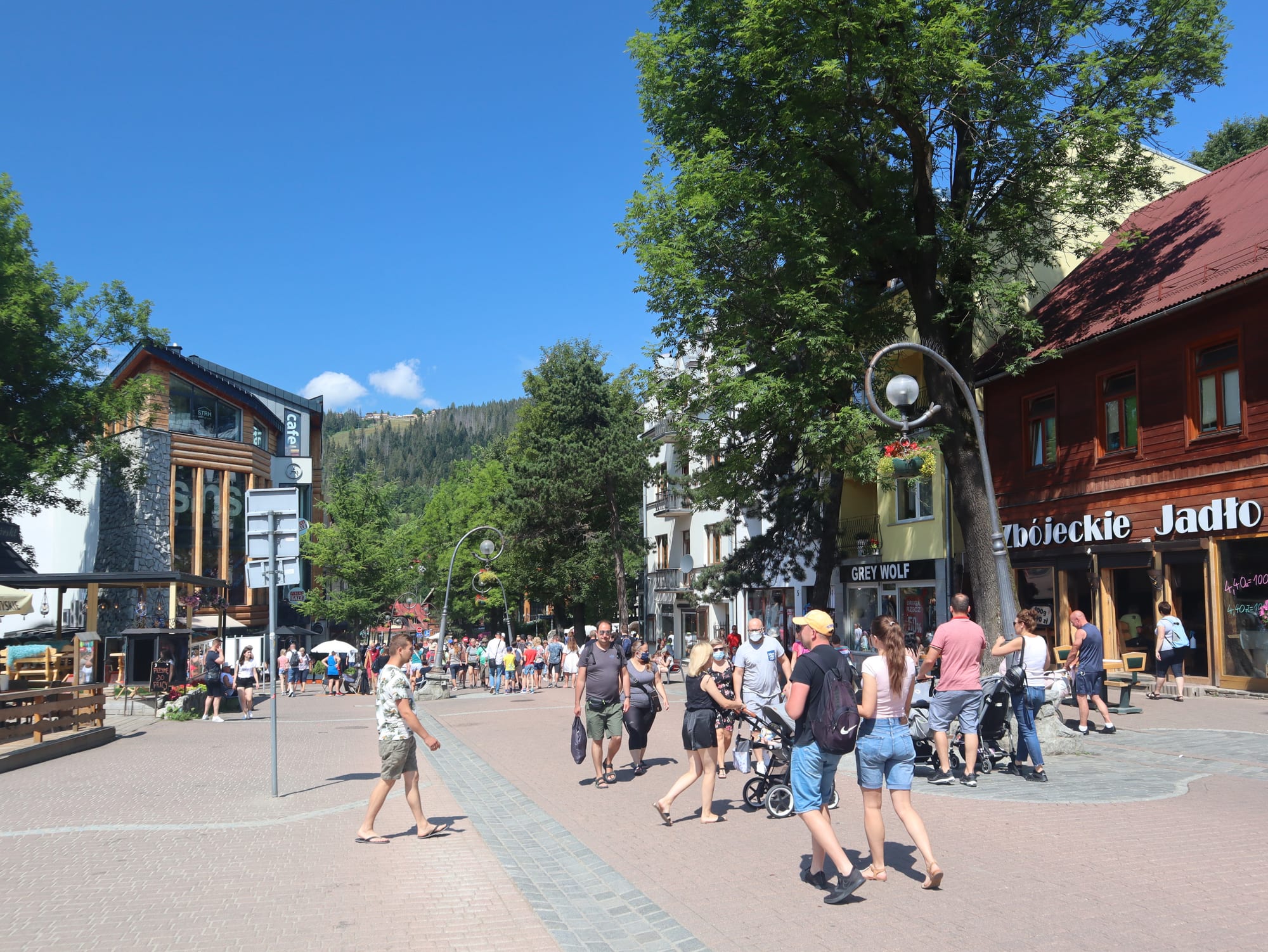
A pedestrian street with wooden-fronted shops and old lamp posts under tall trees, with a forested hill behind

Kraków & Lesser Poland, Poland

Zakopane

Krupówki, the main pedestrian street of Zakopane, near its junction with Nowotarska Street. (Cybularny / Wikimedia Commons · CC0)

A mountain town in the Podhale region of southern Poland, in a valley between the Tatras and Gubałówka Hill. A small highland village until the late 19th century, it grew into a health resort, an artists' retreat and the country's 'winter capital', and today it is the centre of Goral culture and the main base for hiking and skiing in the Polish Tatras.

Neighbourhoods

  • Krupówki and the town centre
    • First-time visitors
    • Shopping
    • Nightlife

    The town centres on the crossing of Krupówki and Kościuszki streets. Krupówki, once a narrow path towards Kuźnice, is now a pedestrian street of shops and restaurants, with the Tatra Museum near its lower end and the funicular up Gubałówka a short walk away. In the winter and summer seasons it is crowded with visitors.

    Open in Maps
  • Kościeliska Street and Pęksowy Brzyzek
    • Historic district
    • Wooden architecture
    • Quiet walks

    An older part of the village, west of Krupówki, where the small wooden church of 1847 stands beside the Old Cemetery at Pęksowy Brzyzek. Along Kościeliska Street and the lanes around it are traditional highland houses and the first buildings in the Zakopane Style, including Villa Koliba.

    Open in Maps
  • Kuźnice and the edge of the Tatras
    • Hiking
    • Skiing
    • Close to the mountains

    A district at the southern edge of town, at the foot of the mountains, with the lower station of the cable car to Kasprowy Wierch and the start of several trails into Tatra National Park. Local buses and minibuses run up from the centre, and the area is quieter in the evening than Krupówki.

    Open in Maps

Things to do

Museums and the Zakopane Style

  • Tatra Museummuseum

    One of the oldest museums in Poland, founded in 1889, covering the history, ethnography and nature of the Polish Tatras from its main building on Krupówki, built in 1913–24 to a design by Stanisław Witkiewicz and Franciszek Mączyński.

    Open in Maps
  • Museum of Zakopane Style at Villa Kolibamuseum

    The first building ever put up in the Zakopane Style, built in 1892–93 to Witkiewicz's design and named after the Goral word for a shepherd's hut, now a branch of the Tatra Museum.

    Open in Maps
  • Villa Atmamuseum

    The wooden chalet where the composer Karol Szymanowski lived, now a museum devoted to him run by the National Museum in Kraków.

    Open in Maps
  • Old Cemetery at Pęksowy Brzyzeklandmark

    The town's oldest cemetery, dating from the 1850s, where Stanisław Witkiewicz, Kazimierz Przerwa-Tetmajer, Władysław Hasior and the storyteller Sabała are buried under tombstones of carved wood, stone and metal.

    Open in Maps

Mountains, lifts and viewpoints

  • Gubałówkaviewpoint

    The hill on the north side of town, reached since 1938 by a funicular from near Krupówki, with wide views of Zakopane and the Tatra ridge.

    Open in Maps
  • Kasprowy Wierchviewpoint

    A peak of 1,987 metres on the Slovak border, reached by a cable car completed in 1936 and one of Poland's main ski areas.

    Open in Maps
  • Wielka Krokiewattraction

    The big ski jump opened in 1925 on the slope of Krokiew mountain, a regular venue of the Ski Jumping World Cup, with a stadium for about 40,000 spectators.

    Open in Maps
  • Nosalviewpoint

    A 1,206-metre limestone hill next to the town, named for its nose-shaped rocks and used for skiing.

    Open in Maps
  • Giewonttrail

    The massif that rises above the town, 1,894 metres at its highest peak, regarded as the symbol of Zakopane and the subject of many legends.

    Open in Maps

Into the Tatras

  • Kościeliska Valleytrail

    A long valley of the Western Tatras, reached by road from Zakopane, running about 9 kilometres from the village of Kiry towards the main ridge, with the Ornak mountain refuge halfway up.

    Open in Maps
  • Morskie Okotrail

    The largest lake in the Tatras, at the foot of the Mięguszowiecki Summits deep in Tatra National Park, and the start of the climb to Rysy.

    Open in Maps
  • Tatra National Parkpark

    The national park that covers the Polish Tatras, headquartered in Zakopane, with a network of marked trails for hiking, scrambling, climbing and ski touring.

    Open in Maps

Seasonal events

  • International Festival of Mountain Folkloresecond half of August

    A dance and music festival held every year for more than half a century, at which folk groups from mountain regions compete for gold, silver and bronze ciupagi, the highlanders' long-handled axes.

  • Ski Jumping World Cupwinter

    Rounds of the World Cup on Wielka Krokiew, which has drawn some of the largest crowds in ski jumping since the early 2000s.

Eat and drink

Long-standing places and food districts in Zakopane. Hours, ratings and directions come from your maps app, always current.

Zakopane classics

  • Oscypek stalls on Krupówkimarket

    The summer market along Krupówki sells oscypek, the smoked cheese of salted sheep's milk made in the Tatra region, often pan-fried and served with cranberry jam, alongside fruit, meat and souvenirs.

    Open in Maps
  • U Wnukarestaurant

    Highland cooking on Kościeliska Street in a house said to have held the first restaurant in Zakopane, opened around 1850.

    Open in Maps

Food streets

  • Restaurants on Krupówkineighborhood

    Wooden highland-style inns, fried-fish counters and bars fill the main street; trout is the town's speciality fish.

    Open in Maps

Experience Zakopane

History

The first written records of Zakopane date from the 17th century and describe a mountain glade called Zakopisko; in 1676 the settlement had just 43 inhabitants. It remained a poor highland village for two centuries. The first church, the small wooden one beside today's Old Cemetery, was built in 1847. In the second half of the 19th century the physician Tytus Chałubiński helped make its mountain air famous, Zakopane officially became a spa in 1886, and in 1889 Władysław Zamoyski bought the Zakopane estates at auction to save the Tatra forests. The railway arrived on 1 October 1899, and by the end of the century the population had reached about 3,000.

The early 20th century made it Poland's leading mountain resort. The Wielka Krokiew ski jump opened in 1925, the Kasprowy Wierch cable car was completed in 1936 and the Gubałówka funicular in 1938, and by 1930 about 60,000 tourists came each year. The town hosted the Nordic World Ski Championships in 1929 and 1939 and, also in 1939, the Alpine World Ski Championships — the first held outside the Alps.

German troops entered Zakopane on 4 September 1939. In March 1940 officers of the Soviet NKVD and the German Gestapo met for a week at Villa Tadeusz to coordinate the suppression of Polish resistance, and the Gestapo held prisoners in the basement of a building that opened as the Palace Museum in March 2024. The town was an underground staging point between Poland and Hungary, and in 1944, during the Warsaw Uprising, the Germans deported thousands of Varsovians here. The occupation ended in January 1945. Later in the 20th century the Tatra National Park was founded and the town expanded to serve ever larger numbers of visitors.

Culture & Customs

Zakopane is the centre of Goral culture — the culture of the Polish highlanders, with its own speech, music, costume, food and architecture. From the late 19th century it also drew writers, painters and musicians, above all in the Young Poland period, who saw the highlands as a source of Polish identity. Stanisław Witkiewicz turned the motifs of Carpathian wooden building into the Zakopane Style, first used at Villa Koliba in 1892–93 and later for villas, a chapel at Jaszczurówka and the Tatra Museum. The composer Karol Szymanowski lived at Villa Atma, the poet Jan Kasprowicz at Villa Harenda, and the painter and playwright Witkacy, Witkiewicz's son, was part of the same circle.

Witkiewicz himself, the writer Kazimierz Przerwa-Tetmajer and the sculptor Władysław Hasior lie in the Old Cemetery at Pęksowy Brzyzek, among carved wooden and stone tombstones, alongside the highland storyteller Sabała. The town's museums and galleries — the Tatra Museum and its branches, the Władysław Hasior Gallery and the Kornel Makuszyński Museum among them — keep this history in view.

Winter sport is the other identity. Zakopane has hosted world championships and many World Cup ski-jumping weekends, and the ski jumper Kamil Stoch, a three-time Olympic champion, was born here. Christmas and New Year are celebrated in highland style, with dances, decorated horse-drawn sleighs called kuligs, and roast lamb. Each August the International Festival of Mountain Folklore brings dance groups from mountain regions around the world.

Daily Life

About 25,000 people lived in Zakopane in 2024, making it the second town of Podhale after Nowy Targ, but it receives well over two million visitors a year, and almost everything in its economy turns on them. Many highland families rent rooms to visitors, and private landlords still meet arriving trains and buses to offer them; restaurants, shops, lifts and guiding make up much of the rest.

The town lies 800 to 1,100 metres above sea level, and its houses spread up the slopes in every direction from the junction of Krupówki and Kościuszki streets, from old wooden farmsteads to modern villas built in highland style. Life follows two high seasons: winter, when the ski areas on Kasprowy Wierch and Gubałówka fill up, especially around Christmas and in February; and summer, when hikers, climbers and day visitors crowd the trails and Krupówki is crowded with visitors to its shops and restaurants.

The pressures of that popularity are part of daily life: traffic jams on the road from Kraków on fine weekends and holidays, and overcrowded trails in the national park in summer.

Food

Highland food in Zakopane is built on sheep's milk. Oscypek is a smoked cheese of salted sheep's milk, made only in the Tatra region by a shepherd known as a baca and pressed into decorated moulds; it is often pan-fried and served with cranberry jam, and the genuine cheese is made from May to September. Imitations made from cow's milk are sold under similar names. Bryndza podhalańska, a soft sheep's cheese from Podhale, has protected status under EU law, and żętyca is a milk drink made in the region.

Restaurants in wooden highland-style buildings serve the hearty dishes of Lesser Poland: kwaśnica, a sauerkraut soup with potatoes and ribs; placek po zbójnicku, "robber's pancake", potato pancakes with goulash on top; and góral tea, tea laced with alcohol, against the cold. Trout is the town's speciality fish, and fried-fish eateries around town serve a quick, cheap meal.

In summer the market along Krupówki sells oscypek, fruit, vegetables and meat alongside highland clothing and leather goods, and cheese is sold in town every day. Wooden inns on and around Krupówki present highland cooking, often with live music, and a few old houses on Kościeliska Street keep a quieter version of the same tradition.

Planning tools

Budget

Zakopane is one of the more expensive places in southern Poland when it is busy: around Christmas and New Year, in the February ski holidays and in the summer, rooms and restaurant prices rise and need booking well ahead. Out of season it is good value, private rooms are plentiful, and the mountains themselves cost little beyond the national park's entry fee and the lifts.

Daily Budget Midrange
USD 130–260 (guesthouse or hotel, highland restaurant meals, cable car and funicular tickets)
Daily Budget Shoestring
USD 55–90 (hostel bed or private room, milk bars and grilled oscypek, minibuses to the trailheads)

Book rooms only through reliable channels, check restaurant bills for added music or service charges, and use minibuses rather than a car to reach the trailheads.

Best Time to Visit

June to September for hiking; September is quieter than July and August, when the trails are crowded. January to March is the ski season, and the town is at its busiest around Christmas and in February. Spring and late autumn are wet and quiet.

Suggested Number of Days

Two or three days cover the town and a first look at the mountains. Allow four to six days for longer hikes in the Tatras or a full ski holiday, and keep a spare day because mountain weather often changes plans.

First Visit
2–3 days
With Surroundings
4–6 days

Transportation

The centre is walkable. Local buses and many privately run minibuses — most leaving when full — run from near the railway station to the valleys, the Kasprowy Wierch cable car at Kuźnice and the road to Morskie Oko. The funicular climbs Gubałówka from the edge of the centre. Taxis are available, and roads into and around town are badly congested on busy weekends.

Most minibuses leave from in front of the railway station and depart when full; the same vans bring hikers back down in the evening.

Airport & Station Connections

The nearest airport is Kraków's John Paul II International Airport at Balice, west of Kraków. From Kraków, buses run via Nowy Targ at least hourly and take about two hours, trains take two to three and a half hours, and the drive takes about an hour and a half but much longer on fine weekends. Direct trains also come from Warsaw, including night trains. The railway station, opened in 1899, is about 500 metres east of the centre.

Walkability

The town is compact and easy to walk, with Krupówki pedestrianised and the station, the funicular and the main museums within a short distance of each other. The town sits between 800 and 1,100 metres above sea level, so many side streets climb steeply, and they can be icy and snow-covered in winter. Kuźnice and the valley entrances are better reached by bus.

Safety

Poland is a safe country with low violent crime. Zakopane's problems are mostly petty: fake holiday-lodging listings at peak times, extra charges added to restaurant bills, costumed figures on Krupówki demanding money for photographs, and imitation oscypek made from cow's milk. The greater risks are in the mountains, where the weather changes quickly, afternoon thunderstorms and lightning are common in summer, snow can be deep in winter, and the popular trails are often overcrowded.

Keep to the marked trails, as national park rules require, start early, carry warm and waterproof clothing even in summer, and turn back if a storm builds. Check current official travel advice before travelling.

Climate

A mountain climate, much cooler and wetter than the lowlands; the town is almost 3°C colder than northern Kraków. Winters are frosty and snowy, and the warm halny wind sometimes blows down from the mountains. Summers are cool to warm and rarely hot, with sudden changes of weather.

Summer
cool to warm — averages around 15°C, with more than 100 mm of rain a month from May to August and frequent afternoon storms
Winter
frosty and snowy — averages around −5°C, though the halny wind can push temperatures above 10°C

Local Customs

A tip of around 10 per cent is usual in restaurants, and thanking the waiter while handing over the money is taken to mean that no change is wanted. Handshakes are common, but never with gloves on. Drinking alcohol in public outside venues that serve it is illegal. Many highlanders keep their own dialect, music and dress, and churches are places of worship first.

In Tatra National Park, keep quiet, take all rubbish away and do not disturb the animals; the park charges an entry fee.

Common Payment Methods

Poland uses the złoty (PLN), not the euro. Cards and contactless payment are accepted almost everywhere, including on Krupówki, but a little cash is useful for minibuses, market stalls, cheese sellers and mountain huts. ATMs are easy to find in the centre.