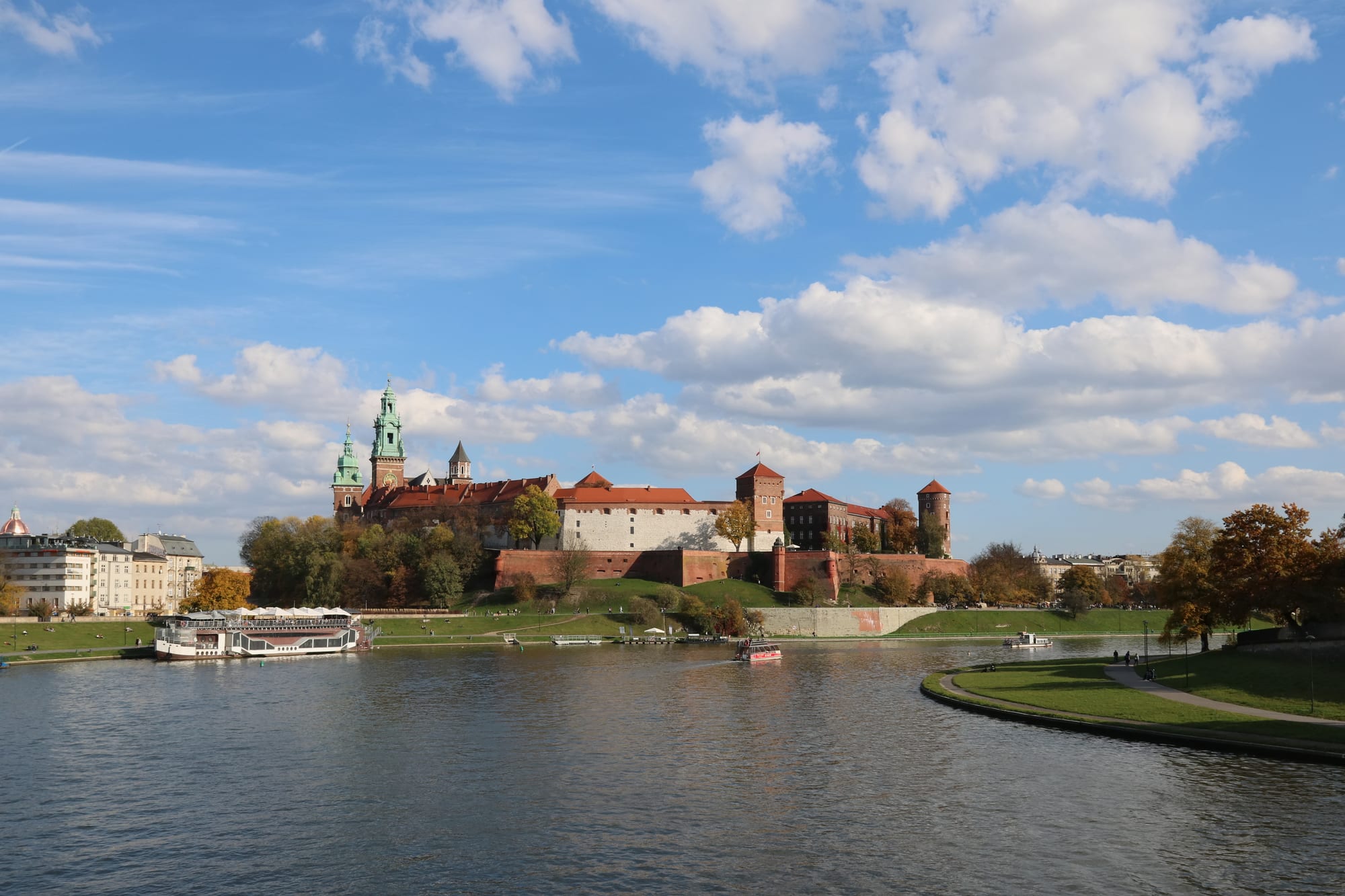
Wawel Castle and Cathedral with green copper domes and brick walls on a hill above the Vistula, with grassy banks and a river boat

Kraków & Lesser Poland, Poland

Kraków

Wawel Hill, with the royal castle and cathedral, seen across the Vistula in Kraków. (Ingo Mehling / Wikimedia Commons · CC BY-SA 4.0)

Poland's second city and former royal capital, on the Vistula in the south of the country — the seat of Polish kings from 1038 until the court left for Warsaw around 1596, and home of the Jagiellonian University. Its walled Old Town, Wawel Hill and the old Jewish quarter of Kazimierz survived the Second World War and now draw millions of visitors a year.

Neighbourhoods

  • Old Town
    • First-time visitors
    • Historic district
    • Nightlife

    The medieval core inside the ring of the Planty park, laid out around the 200-metre-square Main Market Square. Some six thousand historic sites, the Cloth Hall, St Mary's Basilica and the university's old colleges are packed into its grid of streets, which are busy late into the night.

    Open in Maps
  • Wawel and Stradom
    • Historic district
    • Riverside

    The crag at the southern tip of the Old Town, crowned by the royal castle and the cathedral where many Polish kings are buried, and the quieter streets of Stradom between Wawel and Kazimierz, along the Vistula boulevards.

    Open in Maps
  • Kazimierz
    • Best for food
    • Nightlife
    • Jewish heritage

    Founded as a separate town by Casimir the Great in 1335, including the historic Jewish quarter. Synagogues, Renaissance houses, bars around Plac Nowy and Jewish-themed restaurants, bookshops and cafés make it the city's liveliest district in the evening.

    Open in Maps
  • Podgórze
    • Wartime history
    • Quiet and residential

    A separate town on the southern bank of the Vistula until 1915, where the Germans set up the Kraków Ghetto in 1941. Schindler's factory is here, and the Father Bernatek footbridge, opened in 2010, links it with Kazimierz.

    Open in Maps
  • Nowa Huta
    • Architecture
    • Local life

    The socialist-realist steel town built east of the centre after the war, with apartment blocks around repeated courtyards and wide tree-lined avenues; its centre is now regarded as a monument of its era.

    Open in Maps

Things to do

Royal Kraków

  • Main Market Squarelandmark

    The great medieval square at the heart of the Old Town, about 200 metres across, surrounded by townhouses, churches and cafés.

    Open in Maps
  • Cloth Halllandmark

    Sukiennice, the long trading hall in the middle of the Main Square and one of the best-known buildings of the historic centre.

    Open in Maps
  • St Mary's Basilicalandmark

    The brick Gothic church on the Main Square, from whose tower a trumpeter plays the hejnał every hour, breaking off mid-note.

    Open in Maps
  • Wawel Castlelandmark

    The royal residence whose chambers hold period furniture, paintings and 16th-century tapestries woven in the Netherlands and Flanders, with the Crown Treasury and Armoury and the largest collection of Ottoman tents in Europe.

    Open in Maps
  • Wawel Cathedrallandmark

    The coronation and burial church of Polish kings, whose tower holds the great Sigismund Bell.

    Open in Maps
  • St Florian's Gate and the Barbicanlandmark

    The medieval gate and the Barbican fortification beside it, the starting point of the Royal Coronation Route through the Old Town to Wawel.

    Open in Maps

Museums and Jewish heritage

  • Rynek Undergroundmuseum

    A museum beneath the Main Square that recreates the medieval city with holograms, projections and excavated objects.

    Open in Maps
  • Czartoryski Museummuseum

    A princely collection with works by Leonardo da Vinci, Holbein and Rembrandt.

    Open in Maps
  • National Museummuseum

    Founded in 1879, the largest museum in Poland, with its main building on 3 Maja Street and nine divisions around the city.

    Open in Maps
  • Oskar Schindler's Enamel Factorymuseum

    The Podgórze factory where Schindler employed Jews from the ghetto and saved them from the camps, now a museum of the city under German occupation.

    Open in Maps
  • Old Synagoguemuseum

    The oldest synagogue building still standing in Poland, in the Jewish quarter of Kazimierz, now a museum.

    Open in Maps
  • Museum of Municipal Engineeringmuseum

    Old trams, cars and buses in a former tram depot in Kazimierz.

    Open in Maps

Parks and the river

  • Planty Parkpark

    The ring of gardens, 4 km long, laid out in 1822–30 where the city walls once stood around the Old Town, a walkway popular with Cracovians.

    Open in Maps
  • Błonia Parkpark

    A historic meadow of 48 hectares, about 700 metres west of the Old Town.

    Open in Maps
  • Father Bernatek Footbridgeviewpoint

    Kładka Bernatka, the footbridge over the Vistula between Kazimierz and Podgórze.

    Open in Maps

Markets

  • Plac Nowymarket

    Kazimierz's market square, with a round market hall known as the Okrąglak at its centre, whose food stalls include zapiekanka counters with a cult following.

    Open in Maps
  • Hala Targowamarket

    A historic market hall in the Grzegórzki district, listed as a monument in 2024.

    Open in Maps

Music, sport and nights out

  • Kraków Philharmonicattraction

    The concert hall of 1931, the city's principal venue for classical music.

    Open in Maps
  • Juliusz Słowacki Theatreattraction

    One of the city's best-known theatres and an institution of national significance.

    Open in Maps
  • Tauron Arena Krakówattraction

    The city's large indoor arena, with room for about 18,000 at concerts and 15,000 at sports events.

    Open in Maps

Short trips from the city

  • Wieliczka Salt Mineattraction

    Centuries-old salt workings with an underground lake, chapels and statues carved from rock salt, on UNESCO's first list of 1978 and now listed together with the Bochnia mine.

    Open in Maps
  • Auschwitz-Birkenaumuseum

    The memorial and museum at Oświęcim on the site of the Nazi German concentration and extermination camp where about 1.1 million people died, including 960,000 Jews.

    Open in Maps

Seasonal events

  • Jewish Culture Festivallate June or early July

    Nine days of concerts, workshops and lectures in the old Jewish quarter of Kazimierz, organised since 1988 by the Jewish Culture Festival Society.

  • Lajkonika week after Corpus Christi, May or June

    A bearded rider dressed as a khan on a hobby horse parades from Zwierzyniec to the Main Market Square, recalling legends of Kraków's defence against the Tatars.

  • Szopka contestfirst Thursday of December

    A competition of glittering nativity scenes modelled on Kraków's historic buildings, inscribed on UNESCO's intangible heritage list in 2018.

  • Christmas marketDecember

    The Christmas market held every year on the Main Market Square.

Eat and drink

Long-standing places and food districts in Kraków. Hours, ratings and directions come from your maps app, always current.

Kraków classics

  • Obwarzanek krakowskimarket

    A braided ring of bread sprinkled with poppy or sesame seeds, sold from street carts all over the centre, protected by EU geographical indication.

    Open in Maps
  • Zapiekanka on Plac Nowymarket

    A long open-faced baguette toasted with mushrooms and cheese and served hot with ketchup, sold in the round market hall in Kazimierz, whose stands have a cult following.

    Open in Maps
  • Milk barsrestaurant

    Bar mleczny, cafeterias from the communist era that serve simple Polish lunches for very little and sell no alcohol.

    Open in Maps

Food districts

  • Kazimierzneighborhood

    The old Jewish quarter is the city's main eating and drinking district, with Jewish-themed restaurants, cafés and streets of bars around Plac Nowy and Szeroka.

    Open in Maps
  • Old Townneighborhood

    Cellar restaurants and cafés around the Main Square and its side streets, busiest with visitors.

    Open in Maps

Experience Kraków

History

Kraków began as a fortified settlement of the Vistulans on Wawel Hill around the 8th century; legend credits its founding to Krakus, who built it above the cave of the Wawel dragon. First recorded in 965 as a trading centre, it was taken into the Piast realm by Mieszko I and became the seat of Polish monarchs in 1038. Sacked by the Mongols in 1241, it was rebuilt under Magdeburg law in 1257 with the grid and great square that still define it. Casimir the Great founded the neighbouring town of Kazimierz in 1335 and the university in 1364, and under the Jagiellonians Kraków was a Hanseatic trading city and a Renaissance capital; the first work printed in Poland appeared here in 1473.

In 1596 Sigismund III moved the capital to Warsaw, though kings were still crowned and buried on Wawel. Swedish pillage in the 1650s and a plague in 1707 that killed 20,000 weakened the city, and in 1794 Tadeusz Kościuszko launched his insurrection on the Main Square. After the Partitions it was a small free city and then part of Austrian Galicia, and by the early 20th century it had electric trams and had grown into Greater Kraków.

In the Second World War Hans Frank ruled the German General Government from Wawel. Of a population of about 250,000, some 56,000 were Jews; in March 1941 they were confined to a ghetto in Podgórze and later sent to Płaszów and the extermination camps. Soviet forces entered on 18 January 1945, and the communists built the steel town of Nowa Huta. In 1978 the historic centre was among the first sites on the UNESCO World Heritage List, the same year the city's archbishop became Pope John Paul II.

Culture & Customs

Kraków sees itself as Poland's cultural capital. The Jagiellonian University, one of the oldest in the world, keeps Copernicus's manuscript of De revolutionibus in its library; the Academy of Fine Arts is the oldest in Poland; and the city has the National Stary Theatre, the Juliusz Słowacki Theatre, an opera and a philharmonic. Festivals run through the year, from the Baroque music of Misteria Paschalia and the contemporary Sacrum-Profanum to the Jewish Culture Festival in Kazimierz.

Old customs are kept with care. A trumpeter plays the hejnał from St Mary's tower every hour and stops mid-note; the Lajkonik, a rider dressed as a khan on a hobby horse, parades after Corpus Christi; and in December craftsmen compete with szopki, glittering nativity scenes built in the shape of Kraków's historic buildings. The city is more devout than most of Poland: in 2017 about half of Catholics in the archdiocese attended Mass weekly, against a national average of 38 per cent.

Jewish history is central to the city's sense of itself. Before the war Kraków had at least 90 synagogues and a community of 60,000–80,000; today Kazimierz's synagogues, cemeteries and festival keep that memory present. A Cracovian is known in Polish as a krakowianin or, informally, a krakus.

Daily Life

Kraków had a population of about 817,000 in 2025, with some 1.4 million in its metropolitan area, and it is growing: the figure was about 775,000 in 2019. The city is young, with around 60 per cent of residents under 45, and immigration has risen sharply — by 2019 foreigners were estimated at up to a tenth of the population.

Universities, the offices of some 50 large multinational companies and tourism are now mainstays of the economy. In 2019 the city counted more than 14 million visitors, 3.3 million of them from abroad.

Most people live outside the Old Town, in the 19th-century streets around it, in Podgórze and in the large estates of Nowa Huta and the northern districts, and travel by tram. Students set much of the rhythm, with cafés busy late and evenings spent in Kazimierz and along the river. Air quality has long been the city's great complaint: Kraków often had some of Europe's worst winter smog from coal heating, and from September 2019 solid fuels were banned in small heating installations in the city.

Food

Kraków's street symbol is the obwarzanek krakowski, a braided ring of bread sprinkled with poppy or sesame seeds and sold from carts across the centre; it holds EU Protected Geographical Indication status, and the city also claims the bagel as its own invention. The zapiekanka, a long open-faced baguette toasted with mushrooms and cheese and served hot with ketchup, has been a Polish street food since the 1970s, and the stands in the round market hall on Plac Nowy in Kazimierz have a cult following.

Milk bars, the bar mleczny cafeterias of communist times, still serve simple Polish meals at very low prices and sell no alcohol. Kazimierz's restaurants range from Jewish-themed places around Szeroka Street to the bars that fill the streets around Plac Nowy, and the Old Town's restaurants spread out from the Main Square into its side streets.

From the highlands to the south comes oscypek, a smoked cheese of salted sheep's milk made only in the Tatra Mountains region. Wadowice, John Paul II's home town, is known for the kremówka, a cream cake he recalled eating there with friends after his final school exams.

Planning tools

Budget

Kraków drew more than 14 million visitors in 2019 and is one of Poland's priciest cities for short stays, especially around the Main Square and in Kazimierz, but food and transport remain reasonable. Milk bars, obwarzanki and zapiekanki keep eating costs low, and walks through the Old Town, Planty and Kazimierz are free; Wieliczka and the Wawel collections are the main paid costs.

Daily Budget Midrange
USD 130–260 (Old Town or Kazimierz hotel, restaurant meals, Wieliczka and museum tickets)
Daily Budget Shoestring
USD 55–90 (hostel bed, milk bars and street food, trams)

Book Auschwitz-Birkenau entry and Wieliczka tours online in advance, and look at Podgórze or the far end of Kazimierz for cheaper rooms.

Best Time to Visit

May, June and September are the most comfortable, before and after the summer crowds; the Jewish Culture Festival falls in summer. July and August are busy and can be hot. December brings the Christmas market and the nativity-scene contest, while winter visits are quieter but colder, with occasional smog.

Suggested Number of Days

Three or four days suit the city itself, and a longer stay allows the salt mine, the memorial at Oświęcim and the mountains to the south to be added; each of those takes most of a day.

First Visit
3–4 days
With Surroundings
5–7 days

Transportation

The Old Town is largely closed to traffic, and trams and buses cover the rest of the city on one ticket system. Ride-hailing apps operate widely, and scam taxis have been reported near the main railway station.

Use Uber or Bolt rather than street taxis, and buy and validate tram tickets before travelling.

Airport & Station Connections

Kraków John Paul II International Airport, the second busiest in Poland, is about 11 km west of the city, and direct trains reach Kraków Główny station in about 20 minutes. Katowice airport, about 80 km away, is another option. Fast trains link Kraków Główny with Warsaw and the other main Polish cities.

Walkability

The centre is compact and flat: the Old Town, Wawel and Kazimierz are all within a short walk of each other, and the Planty and the Vistula boulevards make pleasant links. Trams are needed for Nowa Huta, Błonia and the outer districts. Cobbles and crowds slow progress in summer.

Safety

Poland is a safe country with low violent crime. In Kraków the main risks are pickpockets in crowds, at the stations and on buses and trains to and from the airport, and late-night brawls in nightlife streets; a known scam involves strangers inviting visitors to a club where the bill for drinks is many times what was expected.

Ignore street touts at night, never leave a drink unattended, check bar bills, and use taxi apps. Check current official travel advice before travelling.

Climate

A semi-continental climate, with temperatures close to Warsaw's for much of the year but more rainy days in the colder months, and winter smog from coal heating.

Summer
warm, with hot days above 30°C increasingly common
Winter
cold, with average temperatures still below 0°C

Local Customs

A tip of around 10 per cent is usual in restaurants, and saying thanks while handing over the money is taken to mean 'keep the change'. Drinking alcohol in public outside bars and their terraces is illegal. Kraków is more religious than the national average, and Wawel Cathedral, St Mary's and the Kazimierz synagogues are places of worship and memory.

Proof of age is strictly required to buy alcohol (the legal age is 18). Dress modestly in churches and synagogues, and behave quietly at Auschwitz-Birkenau and other memorial sites.

Common Payment Methods

The currency is the złoty (PLN), not the euro. Cards and contactless payment are accepted almost everywhere, including on trams and buses, and ATMs are easy to find; carry a little cash for obwarzanek carts and market stalls.