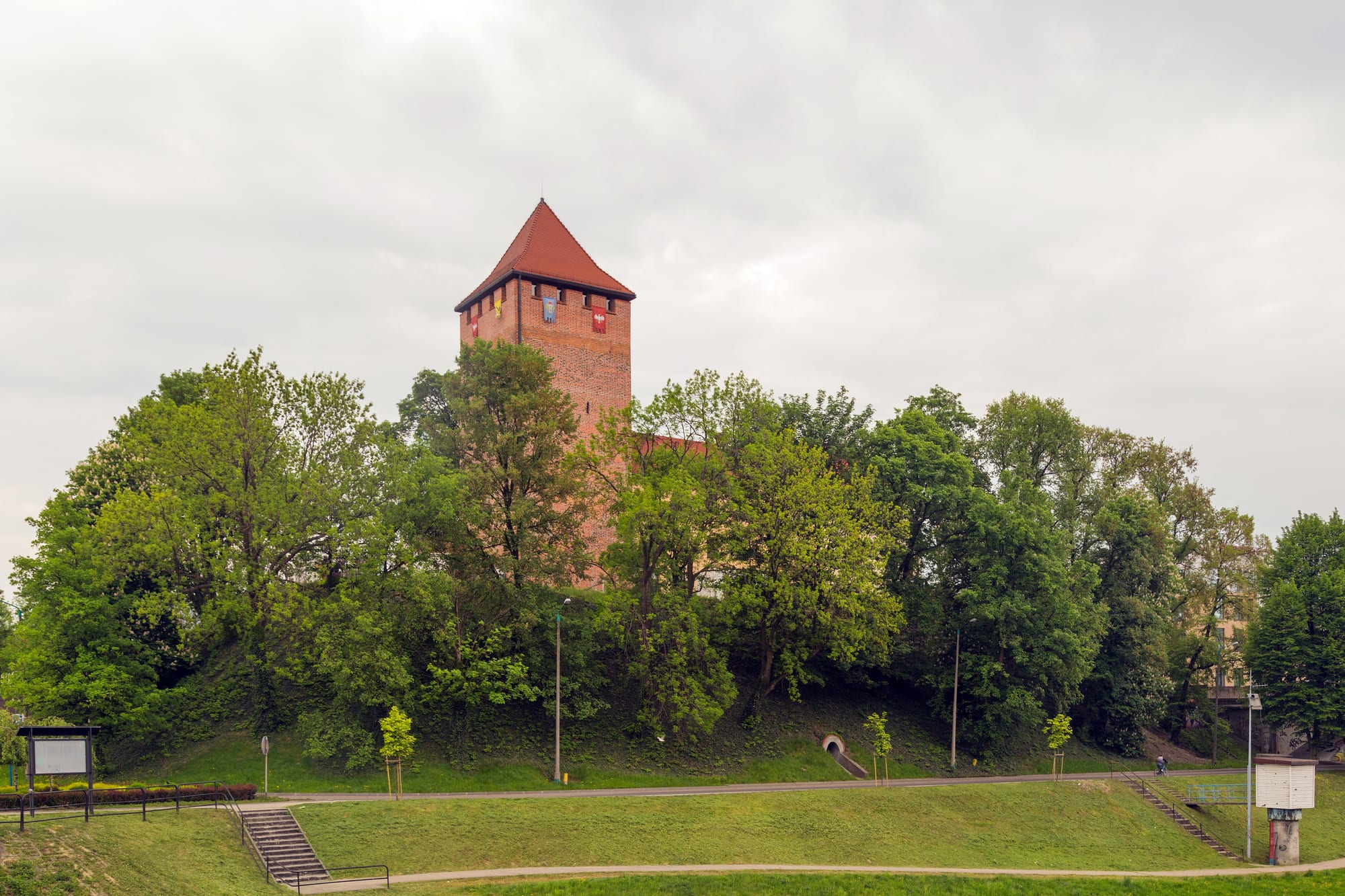
A tall red-brick Gothic tower with a pointed red roof rising above a wooded hill, with grassy river embankments below

Kraków & Lesser Poland, Poland

Oświęcim

The Gothic defence tower of Oświęcim Castle on its hill above the Soła river. (Marcin Konsek / Wikimedia Commons · CC BY-SA 4.0)

A town of about 35,000 people at the meeting of the Vistula and Soła rivers in southern Poland, a ducal and royal town for centuries and once one of the centres of Jewish life in Poland. Under German occupation its name, Auschwitz, was given to the largest Nazi concentration and extermination camp, whose preserved site is now a memorial and museum visited by millions.

Neighbourhoods

  • The Old Town
    • Historic district
    • First-time visitors
    • Places to eat

    East of the Soła, around the Main Market Square, whose buildings were largely rebuilt after fires in the 19th century and so share a similar style. The castle on its hill, Jan Skarbek Square with the last surviving synagogue, the town hall museum and most cafés and restaurants are a few minutes' walk apart.

    Open in Maps
  • The west bank and the Memorial
    • Memorial visits
    • Close to the railway station

    Across the river, the railway station stands in the north-west of town, within about two kilometres of both main parts of the former camp: Auschwitz I in the former army barracks and Birkenau in the village of Brzezinka. Buses and taxis link the station, the two sites and the Old Town.

    Open in Maps

Things to do

The Auschwitz-Birkenau Memorial

  • Auschwitz-Birkenau State Museummuseum

    The memorial and museum founded in 1947 on the site of Auschwitz I and Auschwitz II-Birkenau, where about 1.1 million people, about 960,000 of them Jews, died; a UNESCO World Heritage Site since 1979.

    Open in Maps

The old town

  • Oświęcim Castlelandmark

    A castle on a hill above the Soła with a 13th-century Gothic defence tower and two tunnels beneath it, one of them dug by the Germans in 1940–44 as a shelter.

    Open in Maps
  • Auschwitz Jewish Centermuseum

    A Jewish museum on the history of the town's pre-war community, beside the Chevra Lomdei Mishnayot Synagogue, the only synagogue in the town to survive.

    Open in Maps
  • Jan Skarbek Squarelandmark

    A square in the Old Town, renamed in 1992 after the parish priest Jan Skarbek, who was known for his friendly relations with the town's Jewish community.

    Open in Maps
  • Jewish Cemeterylandmark

    A cemetery established in 1784, destroyed during the war, partly restored by returning survivors and fully restored in the 1990s.

    Open in Maps
  • Mural Trailattraction

    A collection of murals on buildings in the town centre, painted since 2010 by artists including Edward Dwurnik and Rafał Olbiński, most of them carrying messages of peace and tolerance.

    Open in Maps

Sport and short trips

  • Unia Oświęcim ice hockeyattraction

    One of the most successful clubs in Polish ice hockey, nine times national champions, most recently in 2024, playing at the Hala Lodowa MOSiR ice rink.

    Open in Maps
  • Energylandiaattraction

    The largest amusement park in Poland, at Zator to the east, with nineteen roller coasters and a water park.

    Open in Maps
  • Wadowiceattraction

    The small town on the Skawa river where Karol Wojtyła, later Pope John Paul II, was born.

    Open in Maps

Seasonal events

  • Anniversary of the liberation of Auschwitz27 January

    The day the camp was liberated in 1945, now International Holocaust Remembrance Day, marked with commemorations at the memorial.

  • March of the Livingspring, on Yom HaShoah

    Thousands of participants from around the world, many of them students, walk in silence from Auschwitz to Birkenau on the Jewish Holocaust Remembrance Day.

Eat and drink

Long-standing places and food districts in Oświęcim. Hours, ratings and directions come from your maps app, always current.

Places to eat

  • Restaurants around the Main Market Squareneighborhood

    The square and the streets around it hold most of the town's restaurants, cafés, pizza places and pubs.

    Open in Maps
  • Café at the Auschwitz Jewish Centercafe

    A café in the house of Shimson Kleuger, the last Jewish resident of Oświęcim, next to the synagogue on Jan Skarbek Square.

    Open in Maps
  • Chata na Zaborskiejrestaurant

    A restaurant on Zaborska Street, south-east of the town centre.

    Open in Maps

Experience Oświęcim

History

Oświęcim is one of the oldest castellan seats in Poland, recorded as a fortified settlement from the 12th century. It was destroyed in the Mongol invasion of 1241, rebuilt, and given a town charter around 1272. From 1315 it was the capital of the Duchy of Oświęcim under a local branch of the Piast dynasty, which came under Bohemian overlordship in the 14th century; in 1457 King Casimir IV Jagiellon bought the rights to the town, and in 1564 the duchy was formally joined to the Kingdom of Poland. On the trade route towards Silesia and Moravia, the town traded in salt from Wieliczka; German-speaking merchants called it Auschwitz.

The Swedish invasion of 1655 burned the town and began a long decline. In 1772 it passed to Austria as part of Galicia, and in the 19th century it became an important railway junction; fires in 1863 and 1881 destroyed much of the centre. On the eve of the Second World War about 8,000 Jews lived here, less than half the population.

In 1939 Germany annexed the town directly into the Reich, and from 1940 the Polish army barracks on its edge became the Auschwitz concentration camp, later expanded into the extermination camp at Birkenau and the labour camp at Monowitz beside a new IG Farben chemical plant. Some 17,000 local people were expelled. About 1.1 million people were killed in the camps, most of them Jews deported from across Europe. The Red Army reached the town on 27 January 1945. After the war the chemical works became the main employer, and in 1947 the camp sites were preserved as a state museum.

Culture & Customs

Before the war Oświęcim was a Jewish as well as a Polish town — in Yiddish it was Oshpitzin — and the Auschwitz Jewish Center keeps that history alive through its museum, the restored synagogue, begun around 1913, and the house of Shimson Kleuger, the last Jewish resident, who died in 2000. The square outside is named after Jan Skarbek, the parish priest honoured for cultivating good relations between the town's faiths. Pope John Paul II visited in 1979 and Pope Benedict XVI in 2006.

Culturally the town sits on a borderland. It is often regarded as part of Upper Silesia, and its local speech is counted as the eastern edge of the Silesian dialect, coloured by the Lesser Poland dialect. Since 2010 the town has commissioned the murals of its Mural Trail, painted for the Life Festival Oświęcim, which was held from 2010 to 2018 to promote peace and tolerance.

Sport is a source of pride. KS Unia, founded in 1946, built a strong ice hockey tradition, and TH Unia Oświęcim has been Polish champion nine times, most recently in 2024; the town has also produced figure skaters, swimmers and an Olympic pentathlon champion. Beyond the memorial, it remains an ordinary town whose residents go about everyday lives under the weight of its wartime name.

Daily Life

About 35,600 people lived in Oświęcim at the start of 2024, making it the fourth- largest town in Lesser Poland. The town has large housing estates, such as Chemików, as well as an old centre east of the Soła and districts on both banks; the Main Market Square, the castle hill and the riverside paths are the centre of town life.

The chemical works on the eastern edge of town, run by Synthos since 2007, are still a major employer, although jobs there fell from about 10,000 under communism to around 1,500 by the mid-1990s; electrical machinery and building materials are made here too. The memorial, visited by more than two million people in 2019, has become a large source of income for local businesses, from guides and drivers to cafés and guesthouses.

Many visitors come on organised tours from Kraków or Katowice and see only the memorial, so the Old Town keeps a local feel. Trains link the town with Kraków, Katowice and Czechowice-Dziedzice.

Food

Oświęcim eats in the style of southern Poland, between the cooking of Lesser Poland and Silesia. Kotlet schabowy, a thinly pounded pork loin cutlet coated in breadcrumbs, is popular across Poland, alongside pierogi, bigos and soups such as żurek, a sour soup made from fermented flour, served with potatoes, egg, bacon and white sausage. From the Silesian side come rolada, beef roulade with Silesian dumplings and red cabbage, and at Christmas makówki, a poppy-seed dessert.

Simple meals dominate. Zapiekanka, an open-faced sandwich of a halved roll topped with tomato sauce, mushrooms and cheese, is a common Polish street food, and pizza places and cafés are spread around the market square, alongside a pub that brews its own beer and restaurants serving traditional Polish food. The café in the Kleuger house at the Auschwitz Jewish Center offers a place to sit and reflect after a visit to the memorial.

Bakeries follow the national calendar: the favourite sweets on Fat Thursday, before Lent, are pączki, Polish doughnuts, and faworki, thin fried pastries.

Planning tools

Budget

Oświęcim is cheaper than Kraków for rooms and meals, and entry to the memorial itself is free, although an entry pass is required for every visitor. Many visitors come on a day trip from Kraków, so the main costs are transport and a guided tour; staying overnight in the town is good value.

Daily Budget Midrange
USD 120–220 (town-centre hotel, restaurant meals, a guided memorial tour, castle and Jewish Center entry)
Daily Budget Shoestring
USD 50–85 (hostel bed, zapiekanka and milk-bar meals, regional trains and local buses)

Book memorial entry passes online well before the visit, and allow at least half a day for the two sites.

Best Time to Visit

The memorial is open all year. Late spring and early autumn are the most comfortable for the long walks across Birkenau; summer brings the biggest crowds and the most school groups, and winter visits are cold, windy and grey but quieter. Around 27 January and on Yom HaShoah the memorial hosts major commemorations.

Suggested Number of Days

Most people need a full day: the memorial alone takes most of it, and the town's own sights need a few more hours. Two or three days allow an unhurried visit and time for the nearby towns, and many visitors prefer not to see too much on the same day.

First Visit
1 day
With Surroundings
2–3 days

Transportation

The Old Town's sights are close together and easily walked. The two main parts of the memorial lie about two kilometres from the town and from each other; local buses and taxis run between the station, the sites and the centre, and a free bus connects Auschwitz I and Birkenau.

Expect a great deal of walking once at the sites, especially at Birkenau, whose grounds are very large.

Airport & Station Connections

The nearest airports are Kraków's John Paul II International Airport at Balice and Katowice Airport. Trains from Kraków run about hourly and take around an hour, and direct trains from Katowice take about 50 minutes; buses from Kraków run at least every half hour and take about an hour and a half. The railway station is about two kilometres west of the Old Town. By car the town lies on National Road 44 between Kraków and Katowice.

Walkability

The Old Town is compact and flat, and the castle, the market square, Jan Skarbek Square and the riverside are within a few minutes of each other. The walk to the station or the memorial crosses the Soła and takes longer; within the memorial, Birkenau's grounds alone involve long walks on open ground.

Safety

Poland is a safe country with low violent crime. Oświęcim is a quiet town and crime against visitors is rare. The memorial site is large and exposed, so cold, wind and rain in winter and heat in summer are the practical concerns, along with crowds at peak times.

Wear comfortable shoes and clothing for the weather, and carry water in summer. Check current official travel advice before travelling.

Climate

A humid continental climate with four distinct seasons. The town lies in the Oświęcim Basin, with an average annual temperature of 7–8°C, high rainfall spread through the year, and fog so common that it is considered one of the town's trademarks.

Summer
warm, humid and frequently cloudy, with occasional hot, dry spells; the highest temperature on record is 33°C
Winter
cold and windy, with snow cover and occasional thaws; the record low is −29.7°C

Local Customs

The memorial is a place of mourning and remembrance, and visitors are expected to behave quietly and respectfully on the site. A tip of around 10 per cent is usual in restaurants. Handshakes are common, but never with gloves on. Drinking alcohol in public outside venues that serve it is illegal.

Keep voices low at the memorial and follow the instructions of guides and staff throughout the visit.

Common Payment Methods

Poland uses the złoty (PLN), not the euro. Cards and contactless payment are accepted almost everywhere, including in most restaurants and shops in the town; a little cash is useful for buses, small cafés and market stalls. ATMs and exchange offices are found around the Main Market Square.