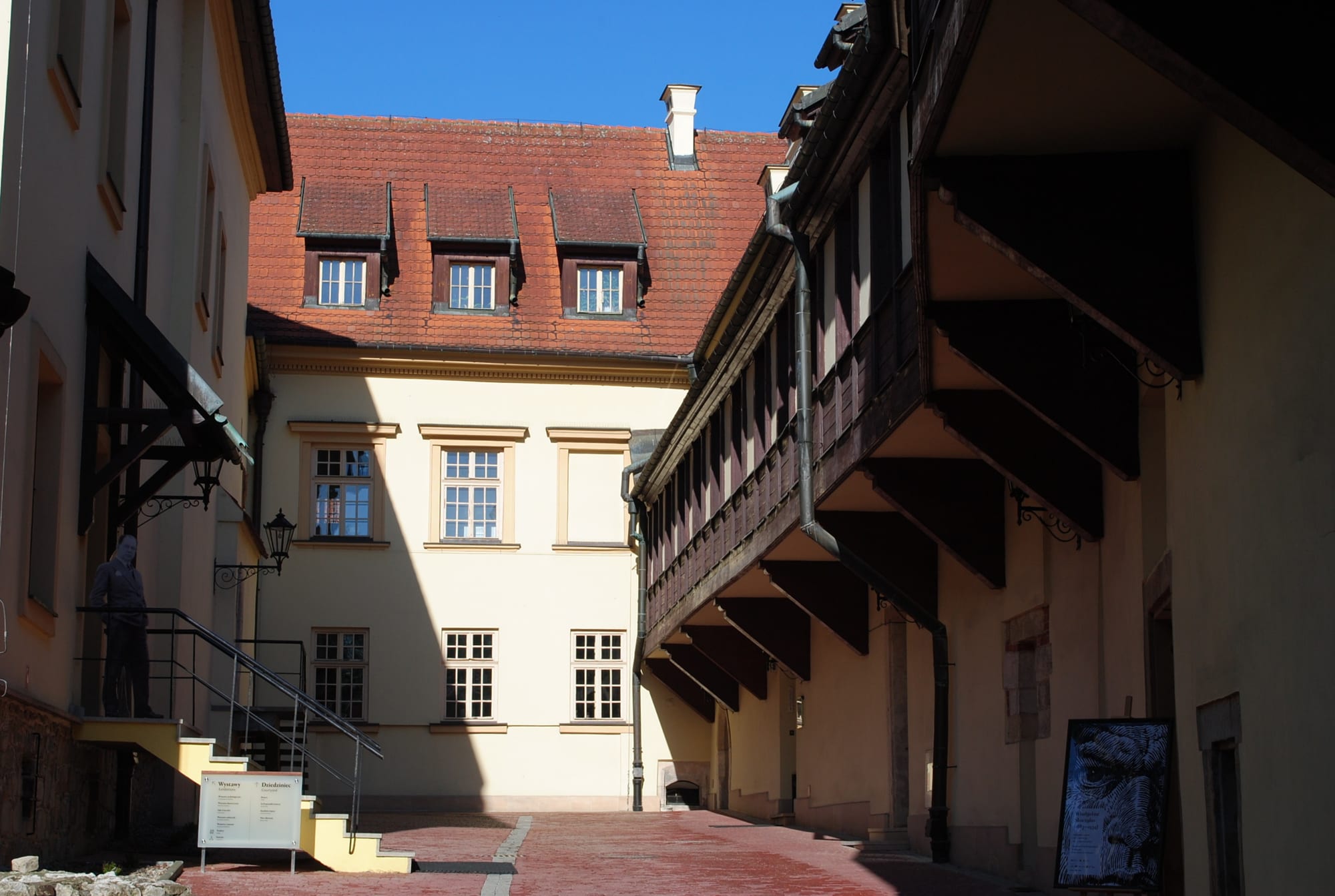
A sunlit courtyard between pale buildings with red-tiled roofs and a wing with dark wooden galleries

Kraków & Lesser Poland, Poland

Wieliczka

The courtyard of the Saltworks Castle in Wieliczka, the former seat of the royal salt-mine administration. (Marek Mróz / Wikimedia Commons · CC BY-SA 4.0)

A historic town 13 km south-east of Kraków, founded in 1290 on one of Europe's great salt deposits. For more than seven centuries the royal salt mine beneath it shaped the town's fortunes; mining stopped in 1996, and the mine's carved chapels and chambers are now a UNESCO World Heritage Site, while the town itself has become part of Kraków's metropolitan area.

Neighbourhoods

  • The Market Square and the Saltworks Castle
    • Historic district
    • Museums
    • Places to eat

    The historic core, listed as a national monument in 1994, spreads around the Market Square and the Saltworks Castle, the former seat of the salt-mine administration, built from the late 13th century. St Clement's Church stands opposite the castle, and cafés, restaurants and shops line the streets around the square.

    Open in Maps
  • Around the mine and St Kinga's Park
    • First-time visitors
    • Close to public transport

    The area around the mine entrance on Daniłowicza Street, a short, well-marked walk from the end of the railway line from Kraków. St Kinga's Park holds a graduation tower, and souvenir stands selling bags of salt from the mine cluster near the entrance.

    Open in Maps

Things to do

The salt mine

  • Wieliczka Salt Mineattraction

    Worked from the 13th century until 1996, the mine reaches a depth of 327 metres and has more than 287 kilometres of passages; the visitor routes pass four chapels, an underground lake and dozens of statues carved by miners from the rock salt.

    Open in Maps
  • Chapel of St Kingalandmark

    One of the four chapels carved in the rock salt, on the Tourist Route, and used for private functions including weddings.

    Open in Maps

The old town

  • Saltworks Castle and Kraków Saltworks Museummuseum

    The former seat of the salt-mine management, added to the UNESCO listing in 2013, now home to the Kraków Saltworks Museum, with the largest collection of salt cellars in Poland.

    Open in Maps
  • St Clement's Churchlandmark

    The parish church opposite the castle, rebuilt in 1804–06 in Josephinian Baroque style on the foundations of the old church, plain outside and richly decorated within.

    Open in Maps
  • St Sebastian's Churchlandmark

    A small larch-wood church on a steep hillside among centuries-old trees.

    Open in Maps
  • Graduation tower in St Kinga's Parkattraction

    A timber graduation tower over which brine trickles and evaporates, with a viewing platform at the top.

    Open in Maps

Short trips from the town

  • Krakówattraction

    Poland's former royal capital, whose Old Town shares with the salt mine the distinction of being the country's first World Heritage Sites, a short train ride to the north-west.

    Open in Maps
  • Niepołomice Castlelandmark

    A royal castle built for Casimir the Great in the 14th century as a hunting retreat and later rebuilt in Renaissance style, sometimes called the second Wawel.

    Open in Maps
  • Niepołomice Forestpark

    A large forest between the Vistula and Raba rivers, made up of several protected areas that once formed a single primeval forest.

    Open in Maps
  • Bochnia Salt Mineattraction

    One of the oldest salt mines in the world, established in 1248 and part of the same royal salt company, with an underground chapel that has train tracks running through it.

    Open in Maps

Seasonal events

  • Siuda BabaEaster Monday

    An old folk custom in which a local man dressed as a shabbily clothed woman with a soot-blackened face goes from house to house with companions in traditional costume; Wieliczka is one of the last places where it survives.

Eat and drink

Long-standing places and food districts in Wieliczka. Hours, ratings and directions come from your maps app, always current.

Places to eat

  • Restaurants around the Market Squareneighborhood

    Cafés and restaurants in the historic houses of the old town, a few minutes' walk from the mine entrance.

    Open in Maps
  • Salt from the minemarket

    Shops and stands around the mine sell bags of salt from Wieliczka, the town's most typical edible souvenir.

    Open in Maps

Experience Wieliczka

History

Salt was produced at Wieliczka from upwelling brine as early as Neolithic times, and the deposit grew in importance after the Polish capital moved to Kraków in the 11th century. The Mongol invasion of the 13th century halted progress, and German settlers who came afterwards called the place Gross Salz, "great salt", from which the Polish names Wielka Sól and later Wieliczka derive. After rock salt was found in 1252, shafts were sunk, and in 1290 the future king Przemysł II granted the town its privileges. The mine belonged to the royal salt company, the Żupy Krakowskie, and it brought huge revenues to the state.

A plague in 1651 killed much of the population, and during the Swedish Deluge of 1655–60 the mine was plundered and burned. In 1772 Wieliczka passed to Austria, and apart from a brief spell in the Duchy of Warsaw after 1809 it remained in Galicia until 1918. German, Hungarian, Croatian and Transylvanian miners settled here, Chopin visited in 1828, and in the 1846 Kraków uprising miners seized control of the mines. Industrialisation turned the town into a small city with miners' colonies and its own power plants.

German troops entered on 7 September 1939. The Jewish population of around 1,500 was persecuted, a ghetto in the Klasno district held as many as 11,000 people, and in August 1942 the Jewish population was rounded up and about 700 were shot in a nearby forest; very few survived. Salt production ended in 1996 because of falling prices and flooding. The mine was on UNESCO's first World Heritage list in 1978, and the Saltworks Castle was added in 2013.

Culture & Customs

The mine is the town's culture as much as its industry. Generations of miners carved statues, reliefs and whole chapels from the rock salt, among them the Chapel of St Kinga, named after the 13th-century Hungarian princess who became Grand Duchess of Poland and is a patron saint of Poland. Its chambers have drawn visitors for centuries — Copernicus, Goethe, Alexander von Humboldt, Chopin, Mendeleyev and Baden-Powell among them — and they are still used for concerts, weddings and private events. In 1995 the film music of Zbigniew Preisner was recorded in one of the chapels.

Above ground, the town keeps a strong Catholic and folk tradition. Wieliczka and the nearby village of Lednica Górna are among the last places where Siuda Baba is performed on Easter Monday: a man dressed as a ragged woman with a soot-blackened face goes from door to door with companions in traditional Kraków costume, collecting donations. The old wooden church of St Sebastian and St Clement's Church reflect centuries of parish life tied to the mine.

The town's football club is Górnik — "miner" — Wieliczka, and the miners' heritage is visible in the street names, the colonies of workers' housing and the Kraków Saltworks Museum in the castle.

Daily Life

About 28,400 people lived in the town in mid-2025, and around 70,000 in the wider municipality, which since 1999 has formed part of the Kraków metropolitan area. The town lies in a valley between two ridges, with the A4 motorway close by, and Kraków is less than half an hour away by train.

The salt mine remains central to the local economy even though it no longer produces salt commercially, and the tourist trade supports guides, restaurants, shops and guesthouses in the centre. Wieliczka is also the headquarters of the Polish sportswear company 4F. Its residents have included Magdalena Bendzisławska, a 17th-century barber-surgeon who was probably Poland's first woman surgeon, and, today, the chess grandmaster Jan-Krzysztof Duda.

The historic centre around the Market Square is busy with visitors by day, especially in summer, while the newer housing estates and the villages absorbed into the town in the 20th century are quiet and residential. The interwar years added new residential districts and absorbed nearby villages to house a growing population.

Food

Wieliczka eats in the style of Kraków and Lesser Poland. Kotlet schabowy, a thinly pounded pork loin cutlet coated in breadcrumbs, is one of the region's own dishes, now popular across Poland, and the town's restaurants serve it alongside pierogi, bigos and soups such as żurek, a sour soup made from fermented flour and served with potatoes, egg, bacon and white sausage. The obwarzanek krakowski, a braided ring of bread boiled and sprinkled with salt and sesame or poppy seeds before baking, is the street snack of neighbouring Kraków.

Salt itself is the town's signature product. Bags of salt from the mine are sold in shops and stands around the entrance, and the Tourist Route includes a restaurant deep underground, among the chambers.

On Fat Thursday, before Lent, the favourite sweets are pączki, Polish doughnuts, and faworki, thin fried pastries; at Easter, families sit down to a festive breakfast of cold meats, żurek and cakes.

Planning tools

Budget

The guided mine tour is the main expense of a visit. Food and rooms in the town cost less than in central Kraków, and many visitors simply come for the day by train or bus.

Daily Budget Midrange
USD 130–240 (town or Kraków hotel, restaurant meals, salt-mine tour and Saltworks Museum entry)
Daily Budget Shoestring
USD 55–90 (room in Kraków or a guesthouse, bakery and milk-bar meals, regional train or city bus)

Tours can sell out or involve long waits on busy days, so it pays to book a tour time online before travelling.

Best Time to Visit

The mine can be visited all year, and its temperature hardly changes with the season, so it suits wet or cold days. Spring and autumn are the quietest; summer and holiday weekends bring long waits and large groups. Easter Monday brings the Siuda Baba custom to the town's streets.

Suggested Number of Days

Half a day is enough for a first underground visit, and a full day allows time for the town's museums and old centre as well. Two days leave room for the neighbouring towns and countryside at an unhurried pace.

First Visit
Half a day to 1 day
With Surroundings
2 days

Transportation

The town is small enough to explore on foot, and the mine, the castle and the Market Square are all within walking distance of each other. Kraków city buses and regional trains connect the town with Kraków, and local buses link the outlying districts.

Only small bags are allowed on the mine tours and lockers are limited, so it is easiest to travel light.

Airport & Station Connections

Regional trains from Kraków Główny take about 24 minutes to Wieliczka Rynek-Kopalnia, the end of the line, a short walk from the mine. Kraków city buses take about 40 minutes, and the drive takes around half an hour. The nearest airport is Kraków's John Paul II International Airport at Balice, 11 km west of Kraków, from which trains run into the city centre.

Walkability

Compact and easy on foot, though the town lies in a valley between two ridges and some streets climb steeply. Underground, the Tourist Route is a walk of about two kilometres that starts with several hundred steps down, with a lift back to the surface; there is an option for visitors with reduced mobility.

Safety

Poland is a safe country with low violent crime. Wieliczka is a quiet town where crime against visitors is rare; the usual care with bags is wise in the crowds around the mine entrance. Underground, the Miners' Route is a guided tour through mostly unimproved galleries with little or no light.

Wear sturdy shoes with good grip, bring a warm layer for the mine, and keep with the guide's group at all times. Check current official travel advice before travelling.

Climate

A temperate climate with warm summers and cold winters, an average annual temperature of 7.4–8.0°C and 650–800 mm of rain a year. The valley floors often have fog and temperature inversions. Underground, the air on the Tourist Route stays at 17–18°C all year, and on the Miners' Route at 14–16°C.

Summer
warm on the surface; 17–18°C on the mine's Tourist Route
Winter
cold, with snow lying for 56–84 days a year; the mine stays at 17–18°C

Local Customs

Kinga Chapel and other chambers in the mine are still used for weddings and private functions. A tip of around 10 per cent is usual in restaurants. Handshakes are common, but never with gloves on. Drinking alcohol in public outside venues that serve it is illegal. Catholic holidays are widely observed, and Christmas and Easter are family occasions.

Keep voices down in the underground chapels, and check holiday opening days before planning a visit around Easter or Christmas.

Common Payment Methods

Poland uses the złoty (PLN), not the euro. Cards and contactless payment are accepted almost everywhere, including at the mine ticket office and on Kraków's buses; a little cash is useful for souvenir stands and small bakeries. ATMs are found around the Market Square.