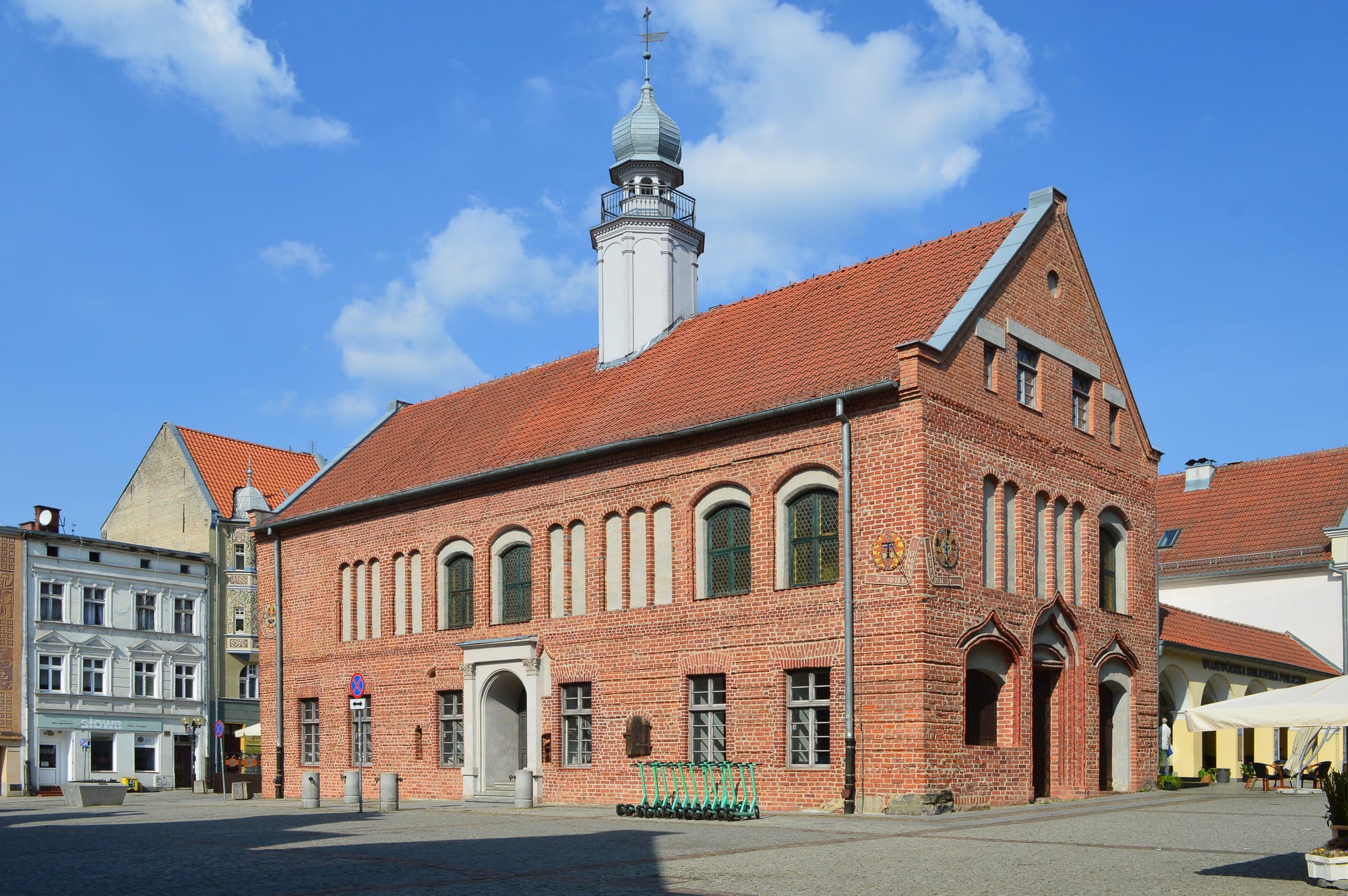
A red-brick Gothic town hall with a white baroque tower and stepped gables on a sunny cobbled square

Masuria & the Northeast, Poland

Olsztyn

The Old Town Hall on the market square of Olsztyn's Old Town. (Scotch Mist / Wikimedia Commons · CC BY-SA 4.0)

The capital of the Warmian-Masurian Voivodeship and the largest city of Warmia, on the Łyna river among forests and fifteen lakes. Founded by the Warmian cathedral chapter in 1353 around a brick castle where Nicolaus Copernicus later served as administrator, it was the German town of Allenstein until 1945 and is now a university city with a walled Gothic old town.

Neighbourhoods

  • Old Town
    • First-time visitors
    • Historic district
    • Best for food

    The walled historic core above the Łyna, entered through the High Gate, with the market square and its Old Town Hall, the Co-Cathedral of St James and the castle of the Warmian chapter. Its streets and squares are the setting for the summer festival programme and hold many of the city's cafés and restaurants.

    Open in Maps
  • The city centre and the station
    • Close to public transport
    • Shopping

    The area outside the old walls with the New City Hall, the main post office, Central Park and the main railway station, served by the city's trams.

    Open in Maps
  • Kortowo
    • Students and nightlife
    • Lakes and parks

    The southern district best known for the campus of the University of Warmia and Mazury. Each May it hosts Kortowiada, one of the largest student festivals in Poland.

    Open in Maps
  • Lake Ukiel and the north-west
    • Lakeside
    • Beaches
    • Quiet and residential

    The districts of Dajtki, Gutkowo and Likusy around Lake Ukiel, the largest lake in the city, with a municipal beach and guesthouses.

    Open in Maps

Things to do

Famous landmarks

  • Olsztyn Castlemuseum

    The 14th-century brick castle of the Warmian cathedral chapter, where Copernicus lived as administrator in 1516–1521 and drew an astronomical table in 1517; it houses the region's main museum.

    Open in Maps
  • Co-Cathedral of St Jameslandmark

    A 14th-century Gothic church, regarded as one of the finest Gothic monuments in Poland, with a Gothic, Renaissance and Baroque interior.

    Open in Maps
  • Old Town Halllandmark

    The town hall on the market square, built in the mid-14th century.

    Open in Maps
  • High Gatelandmark

    The surviving Gothic gate of the town walls, known until the mid-19th century as the Upper Gate, where the historian Wojciech Kętrzyński was imprisoned in 1863.

    Open in Maps
  • Jerusalem Chapellandmark

    A small chapel built in 1565.

    Open in Maps
  • Mendelsohn Houselandmark

    The Jewish tahara house, a funeral chapel built in 1911–1912 to a design by Erich Mendelsohn, an architect born in the city; it has been restored.

    Open in Maps

Museums and science

  • Gazeta Olsztyńska Housemuseum

    The rebuilt headquarters of the Polish-language newspaper founded in 1886, reopened as a museum in 1989 on the Fish Market square.

    Open in Maps
  • Planetariummuseum

    A modernist planetarium with mosaics by Stefan Knapp, opened in 1973 for the 500th anniversary of Copernicus's birth.

    Open in Maps
  • Museum of Naturemuseum

    The city's museum of natural history.

    Open in Maps

Lakes and green spaces

  • Lake Ukielbeach

    The largest of the lakes inside the city limits, also called Krzywe, with a municipal beach on its shore.

    Open in Maps
  • Municipal Forestpark

    A forest of about 1,050 hectares within the city, used for walking and recreation and containing two peat-bog flora reserves.

    Open in Maps
  • Castle Parkpark

    The park beside the castle of the Warmian chapter, one of the city's historic green spaces.

    Open in Maps

Music, sport and nights out

  • Stefan Jaracz Theatreattraction

    A theatre founded in 1925, home of the international Demoludy theatre festival.

    Open in Maps
  • Warmia-Masuria Philharmonicattraction

    The city's concert hall and orchestra.

    Open in Maps

Short trips from the city

  • Gietrzwałdattraction

    A village west of Olsztyn and a Roman Catholic pilgrimage site since two girls reported apparitions of the Virgin Mary there in 1877.

    Open in Maps
  • Olsztynekattraction

    A small Masurian town south-west of the city with an open-air museum of rural buildings.

    Open in Maps
  • Lidzbark Castlelandmark

    The 14th-century castle and palace of the prince-bishops of Warmia at Lidzbark Warmiński, one of the finest Gothic castles in the region.

    Open in Maps
  • Święta Lipkalandmark

    A village with a Baroque pilgrimage church consecrated in 1693, known also for its pipe organ.

    Open in Maps

Seasonal events

  • KortowiadaMay

    The University of Warmia and Mazury's student festival in Kortowo, held since 1958 and lasting four or five days.

  • Olsztyn Artistic Summermid-June to mid-September

    Olsztyńskie Lato Artystyczne, a season of concerts and shows in the amphitheatre below the castle and in the Old Town's streets and squares, held since 1996.

  • Olsztyn Blues Nightssecond weekend of July

    An international blues festival held as part of the Artistic Summer.

  • Demoludyannually

    An international theatre festival organised by the Stefan Jaracz Theatre, with performances, concerts, readings and workshops.

Eat and drink

Long-standing places and food districts in Olsztyn. Hours, ratings and directions come from your maps app, always current.

Food districts

  • Old Town restaurants and cafésneighborhood

    The market square and the streets around the castle and cathedral, with the largest choice of restaurants, cafés and bars, many with outdoor tables in summer.

    Open in Maps
  • Milk barsrestaurant

    Bar mleczny, the traditional Polish milk bar, serving simple, inexpensive dishes such as soups and pierogi.

    Open in Maps

Experience Olsztyn

History

The Warmian cathedral chapter built its castle here from 1346 and granted town rights in October 1353; the German name Allenstein comes from Alna, the Old Prussian name of the river, and Polish settlers rendered it as Olsztyn. Polish forces took the town in 1410 and 1414, and in 1454 the townspeople rose against the Teutonic Knights and recognised the Polish king; the Second Peace of Thorn confirmed it as part of Poland in 1466, within the Prince-Bishopric of Warmia. From 1516 to 1521 Nicolaus Copernicus lived in the castle as administrator and organised the defence that held off a Teutonic siege in 1521.

A golden age of crafts and trade on the Warsaw–Königsberg route was halted in the 1620s by a fire and an epidemic, followed by Swedish raids in 1655 and 1708 and the plague and cholera epidemics of 1710. Prussia annexed the town in 1772. It grew again from 1818, and became the capital of a government region in 1905, while remaining a Polish centre: the Gazeta Olsztyńska newspaper was founded here in 1886. In the 1920 plebiscite the city voted overwhelmingly to stay German, and under Nazi rule its Polish activists were persecuted, arrested and killed.

On 22 January 1945 the Red Army plundered and burned the city. Polish administration began in May, the remaining Germans were expelled in October, and settlers arrived from Vilnius, Grodno and Volhynia. A match factory and later a tyre plant drove post-war growth, and in 1956 the city held Poland's largest demonstration in support of the Hungarian Revolution. Since 1999 Olsztyn has been the capital of the Warmian-Masurian Voivodeship.

Culture & Customs

Copernicus is the city's most celebrated resident: his astronomical table survives in the castle, a monument to him stands in the city, and the planetarium opened in 1973 for the 500th anniversary of his birth. The castle museum and the Gazeta Olsztyńska House, which tells the story of the Polish community under German rule, keep the city's divided past in view, as does the restored funeral chapel designed by Erich Mendelsohn, born in the city, for the Jewish community.

Summer is festival season. The Olsztyn Artistic Summer, held since 1996, runs from mid-June to mid-September with concerts and shows in the amphitheatre below the castle and in the Old Town's squares, including the international Olsztyn Blues Nights. The Stefan Jaracz Theatre, founded in 1925, holds the international Demoludy festival; there are also a puppet theatre and the Warmia-Masuria Philharmonic. Each May the student festival Kortowiada takes over the university district, and it is one of the largest student events in Poland.

Olsztyn is a seat of the Catholic Archdiocese of Warmia, and Warmia's Catholic tradition sets it apart from formerly Protestant Masuria to the east. Volleyball is the leading sport: Indykpol AZS Olsztyn has been Polish champion five times. Many families came from the lost eastern borderlands after 1945.

Daily Life

About 167,000 people lived in Olsztyn at the end of 2023. The city has been ranked highly among Polish cities for quality of life, income, employment and safety. It is the administrative centre of the voivodeship and home to the University of Warmia and Mazury, founded in 1999 and now one of the largest universities in north-eastern Poland, whose campus at Kortowo gives the city a large student population.

The tyre factory founded in 1967, now Michelin Polska, is the largest employer in Warmia and Masuria, and food processing and furniture making are the other main industries.

Nature is close to everyday life: forests cover about a fifth of the city, mostly in the Municipal Forest, and fifteen lakes lie inside the city limits, with a municipal beach on Lake Ukiel. Since 2015 a new tram network has reshaped commuting between the large residential districts and the centre, and two more lines were added at the turn of 2024. There are plans to replace the main railway station building.

Food

Olsztyn's restaurants serve the Polish repertoire: pierogi, filled dumplings; bigos, a long-cooked stew of cabbage and meat; kotlet schabowy, the breaded pork cutlet; gołąbki, cabbage leaves stuffed with meat; and soups such as żurek and barszcz. In restaurants a soup may be followed by herring, prepared with cream, oil or in aspic. Vodka, which may have originated in Poland, is drunk clear or as żubrówka, flavoured with bison grass and made in Białystok in the neighbouring province. Placki ziemniaczane, potato pancakes, and kotlet mielony, a minced-meat cutlet, are canteen standards.

Masuria, to the east, is known among Poles for its smoked fish, sold at stalls near the lakes. Mushrooms are used widely in Polish cooking, in soups such as zupa grzybowa and in pierogi with sauerkraut.

The Old Town around the market square and the castle has the city's densest cluster of restaurants, cafés and bars. The bar mleczny, the milk bar, a type of cheap canteen first opened in Warsaw in 1896, still serves simple dishes in Polish cities.

Planning tools

Budget

Olsztyn is one of the cheaper regional capitals in Poland, with inexpensive hotels, canteens and restaurants. Costs rise a little in summer and around big events such as Kortowiada, and for anyone hiring a car to explore the lakes and castles around the city.

Daily Budget Midrange
USD 100–200 (city-centre hotel, restaurant meals, museum tickets, a hire car for day trips)
Daily Budget Shoestring
USD 45–75 (hostel or guesthouse, canteens and bakeries, trams and buses)

The city makes a practical base for Warmia's castles and pilgrimage churches.

Best Time to Visit

June to September, when the Artistic Summer fills the Old Town and the castle amphitheatre with concerts and the lakes are warm enough for swimming. May brings the student festival. Winters are cold, with frost and snow, but the museums, theatres and concerts carry on.

Suggested Number of Days

One or two days are enough for the Old Town, the castle and a lake. Three to five allow time for the castles, pilgrimage villages and lakes of Warmia and western Masuria; a car makes the longer stay far easier.

First Visit
1–2 days
With Surroundings
3–5 days

Transportation

Olsztyn's tram network opened in December 2015, and two more lines were added at the turn of 2024; five lines connect the station, the centre and the big residential districts. A bus network of about 36 lines, including suburban and night routes, covers the rest.

Buses and trams are the easiest way to the lakes and Kortowo; a car is useful for day trips into the countryside.

Airport & Station Connections

Olsztyn Główny, the main station, has trains to Warsaw, Gdańsk, Białystok, Kraków, Poznań, Szczecin and other cities and to towns across the region. Olsztyn-Mazury Airport at Szymany, 58 km south of the city, has a limited number of flights; many travellers fly to Warsaw or Gdańsk instead.

Walkability

The compact Old Town is best on foot, and it is a short walk or tram ride from the centre and the station. The city is spread out among forests and lakes, so Kortowo, Lake Ukiel and the outer districts are easier by tram or bus, although paths through the Municipal Forest and along the Łyna make good walks.

Safety

Poland is a safe country with low violent crime. Olsztyn has long ranked well among Polish cities for safety and quality of life; the usual care with bags at festivals and in nightlife areas is all that is normally needed.

Check for ticks after forest walks and swim only at supervised beaches. Check current official travel advice before travelling.

Climate

A cool climate on the border between oceanic and continental, with an average annual temperature of about 7°C.

Summer
mild to warm — July averages about 17°C
Winter
cold — January averages about −3°C, with frost and snow

Local Customs

A tip of around 10 per cent is usual in restaurants. Drinking alcohol in public places outside licensed venues is illegal and can bring a fine. The cathedral and churches are places of worship: dress modestly and stay quiet during services. Olsztyn is a student city, and the mood of the Old Town changes with the academic year.

Signs at the main sights are often in several languages, elsewhere usually in Polish only.

Common Payment Methods

Poland uses the złoty (PLN), not the euro. Cards and contactless payment are widely accepted, and cash machines (bankomat) are common; carry a little cash for markets and small shops.