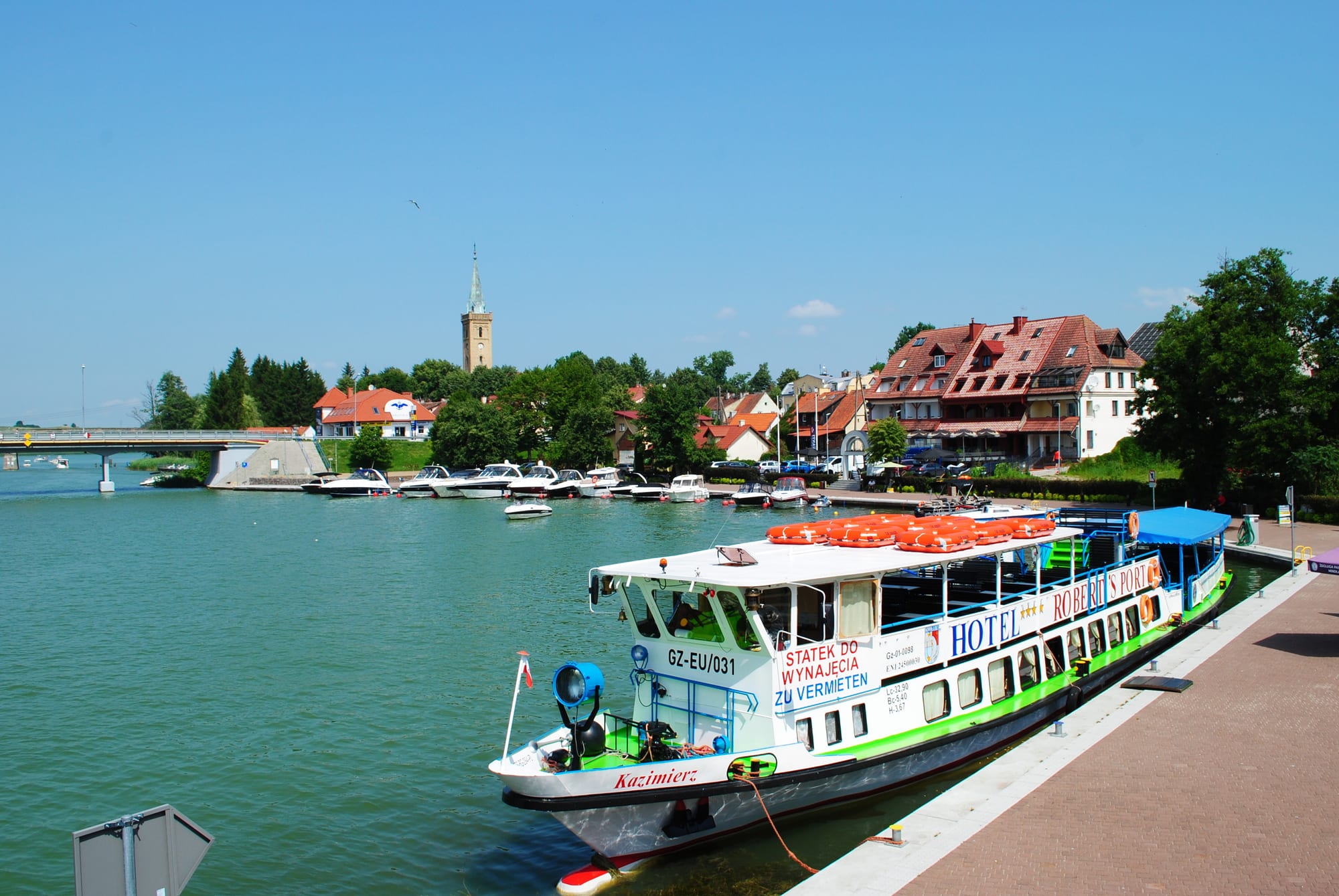
A white excursion boat moored at a lakeside promenade, with motorboats, red-roofed houses and a church tower beyond

Masuria & the Northeast, Poland

Mikołajki

The marina on the lakefront in Mikołajki in July 2021. (Marek Mróz / Wikimedia Commons · CC BY-SA 4.0)

A small resort town in the middle of Masuria, on the narrows between Mikołajskie and Tałty lakes close to Śniardwy, Poland's largest lake. Once a Masurian fishing town of Polish-speaking Protestants under Prussian rule, it survived the Second World War almost undamaged and is now one of the region's busiest tourist centres and often called the sailing capital of Poland.

Neighbourhoods

  • The lakefront and marina
    • First-time visitors
    • Sailing and boat trips
    • Nightlife

    The waterfront along the narrows between Mikołajskie and Tałty lakes, with the marina, the quay for the lake excursion boats, the road bridge and the footbridge. In summer it is the busiest part of town, lined with boats, cafés and restaurants.

    Open in Maps
  • The old town streets
    • Historic district
    • Quiet and residential

    The cobbled streets around Plac Wolności and 3 Maja Street, with the post office, 19th- and early 20th-century houses and the town's two historic churches. Michała Kajki Street, the longest in town, keeps low early 20th-century houses and several guesthouses.

    Open in Maps

Things to do

In the town

  • Holy Trinity Churchlandmark

    The classicist Lutheran church of 1842, designed by Karl Friedrich Schinkel, with wooden galleries, a coffered barrel vault and a tower added in 1880.

    Open in Maps
  • Museum of the Polish Reformationmuseum

    A museum devoted to the Reformation in Poland, in a town with a long Lutheran history.

    Open in Maps
  • The Fish Kingattraction

    A figure of the King of the Vendaces, the legendary fish-king of Masuria, chained to a pillar of the road bridge between the two lakes.

    Open in Maps
  • Footbridge over the narrowslandmark

    A footbridge across the strait between Tałty and Mikołajskie lakes, built in 2016 in place of an older crossing, in a shape meant to recall ice yachts.

    Open in Maps

Lakes and nature

  • Mikołajskie Lakepark

    A glacial lake about 6 km long beside the town, joined to Tałty Lake under the town bridge and to Śniardwy in the south-east, with birds such as bittern, goldeneye and black-throated loon.

    Open in Maps
  • Śniardwypark

    Poland's largest lake, about 114 square kilometres and 22 km long, once also the largest lake in Prussia and in Germany.

    Open in Maps
  • Łuknajno Lake Nature Reservepark

    A shallow lake just north-east of the town, a reserve since 1937 and a UNESCO Biosphere Reserve and Ramsar site since 1977, known for its mute swans — up to 2,000 gather there during the moult.

    Open in Maps
  • Masurian Landscape Parkpark

    One of Poland's largest landscape parks, established in 1977 and covering part of the Mikołajki municipality.

    Open in Maps

Eat and drink

Long-standing places and food districts in Mikołajki. Hours, ratings and directions come from your maps app, always current.

Food in Mikołajki

  • Lakefront restaurantsneighborhood

    The restaurants and summer cafés along the marina and the waterfront.

    Open in Maps
  • Smoked fishmarket

    Masuria is known for its smoked fish, sold at stalls near the lakes and even from small boats on the water.

    Open in Maps

Experience Mikołajki

History

Mikołajki was first recorded as Nickelsdorf in 1444, a church settlement named after St Nicholas — Mikołaj in Polish — in the lands of the Teutonic Order. The knights built a manor and an inn here and held a monopoly on fishing, exporting the catch; in 1515 the first permanent bridge was built across the narrows, and travellers paid a toll to cross. After the Thirteen Years' War the area remained with the order as a fief of the Polish crown, and from 1525 it belonged to the Lutheran Duchy of Prussia. Like the rest of Masuria it was settled by Polish speakers from neighbouring Masovia, and in 1539 its people were almost all Poles; Protestant pastors are recorded from 1552.

The settlement received town rights in 1726 as Nikolaiken, and a fire destroyed much of it three years later. Fishing on Śniardwy kept it prosperous, and the region's whitefish were popular across East Prussia. In 1837 only 271 of its 1,963 inhabitants spoke German day to day, and in 1898 a Polish candidate won half the town's votes, yet in the 1920 plebiscite the town voted 1,800 to none to remain in Germany.

Mikołajki was one of the few Masurian towns not destroyed in the Second World War. After 1945 its German-speaking population was expelled and replaced by Poles, mostly from the lost eastern borderlands, and the town quickly became one of the best-known holiday places of the Great Masurian Lakes. In 1986 its radiological station was the first in Poland to detect contaminated air from the Chernobyl disaster.

Culture & Customs

Life in Mikołajki revolves around the water. The town's location on the lakes has made it the sailing capital of Poland, and in summer the marina fills with yachts, motorboats and the white excursion boats that cross the lakes. In winter, when the lakes freeze, ice sailing draws visitors as well. Since 2005 the Rally of Poland, one of the oldest car rallies in the world, has been based in the town, including a stage at the Mikołajki Arena.

The town's Protestant past is still visible. The Lutheran Holy Trinity Church was designed by Karl Friedrich Schinkel and dates from 1842, and the town has a Museum of the Polish Reformation. The Catholic Church of Our Lady of the Rosary was built in 1910 as a Protestant community hall, and Protestant and Jewish cemeteries survive. The main street is named after Michał Kajka, a Masurian poet.

Local legend has its own symbol: the King of the Vendaces, a fish figure chained to a pillar of the bridge, is the legendary king of Masuria. The town is twinned with Villard-de-Lans in France and Varėna in Lithuania, and its football club, Kłobuk Mikołajki, plays in the lower leagues.

Daily Life

About 3,300 people lived in Mikołajki in 2025, fewer than the roughly 3,900 recorded in 2012. It is the seat of an urban-rural municipality in Mrągowo County, and from 1975 to 1998 it belonged to the former Suwałki Voivodeship.

Tourism dominates the economy. The town has about 1,500 hotel beds plus several hundred more in guesthouses and private rooms, and the quay of the Masurian shipping company. In July and August the town fills with sailors, families and day-trippers, and the marina and the waterfront are crowded; outside the season the town is much quieter.

Most residents live in single-family houses and pre-war apartment blocks along the main roads — Mrągowska, Kolejowa and Ełcka streets carry national road 16 through the town — and in the older streets around Plac Wolności. Since 2016 a new footbridge has linked the two sides of the narrows for people on foot, and a railway viaduct of 1911 still spans Mrągowska Street.

Food

Fish from the lakes has long been part of the town's livelihood, and a fishing enterprise still operates here. The knights held a monopoly on the catch, and the whitefish of the region were especially popular across East Prussia. Today Masuria is known among Poles for its smoked fish, sold at stalls near the lakes and even from small boats on the water.

Restaurants serve the familiar Polish repertoire: pierogi, the filled dumplings; bigos, the stew of cabbage and meat; kotlet schabowy, the breaded pork cutlet; and gołąbki, stuffed cabbage leaves. Mushrooms are used widely in Polish cooking, in soups such as zupa grzybowa and in pierogi. In restaurants a soup may be followed by a starter such as herring, served in cream, in oil or in aspic.

Most places to eat are along the lakefront and the marina, from summer fish bars to restaurants with terraces over the water, with more in the old town streets behind.

Planning tools

Budget

Mikołajki is one of the more expensive places in the north-east in July and August, when the marina and lakeside hotels fill with sailors and families; boat charters are the main extra cost. Out of season prices fall and many guesthouses are quiet.

Daily Budget Midrange
USD 110–220 (lakeside hotel, restaurant meals, a lake cruise or yacht hire)
Daily Budget Shoestring
USD 45–75 (campsite or guesthouse room, fish bars and canteens, regional buses)

Book yacht charters and summer rooms well ahead.

Best Time to Visit

June to early September for sailing, swimming and lake cruises, with July and August busiest. Spring and September are quieter and good for birdwatching and walks around Łuknajno. In winter the lakes often freeze, and ice sailing on them is a well-known attraction.

Suggested Number of Days

One or two days are enough for the town itself. Many visitors stay longer and use it as a base for sailing and exploring the lakes; the weather on the water decides how much is possible.

First Visit
1–2 days
With Surroundings
4–7 days

Transportation

The town is small and walkable. National road 16 between Olsztyn and Ełk runs through it, and route 609 leads south to Ukta. In summer, tourist boats of the Masurian shipping company sail from the marina across the lakes. A car or a bicycle is the easiest way to reach the surrounding villages and the reserve at Łuknajno.

Watch weather forecasts before going out on Śniardwy, Poland's largest lake.

Airport & Station Connections

Most visitors arrive by car or regional bus, on national road 16 via Mrągowo from Olsztyn. Olsztyn-Mazury Airport at Szymany is the nearest airport, with a few flights; Warsaw and Gdańsk have the region's main airports. Sailors also arrive by water along the chain of the Great Masurian Lakes.

Walkability

Very walkable: the marina, the old streets, the churches and the bridges are all within a few minutes of each other. Paths along the shore lead out of town, and Łuknajno is just beyond the north-eastern edge.

Safety

Poland is a safe country with low violent crime. In Mikołajki the main hazards are natural: changing weather on the big lakes, thin ice in winter, and ticks in forests and meadows.

Wear a life jacket on the water, never go onto the ice without checking local conditions, and check for ticks after walks. Check current official travel advice before travelling.

Climate

A cool climate on the border between oceanic and continental. In nearby Mrągowo the average annual temperature is about 7°C, and the lakes often freeze in winter.

Summer
mild to warm — in nearby Mrągowo July averages about 17°C
Winter
cold — in nearby Mrągowo January averages about −3.5°C, with frozen lakes in hard winters

Local Customs

A tip of around 10 per cent is usual in restaurants. Drinking alcohol in public places outside licensed venues is illegal and can bring a fine. Churches are places of worship: dress modestly and stay quiet during services.

Respect quiet hours at marinas and campsites, and keep away from nesting birds at Łuknajno.

Common Payment Methods

Poland uses the złoty (PLN), not the euro. Cards and contactless payment are accepted almost everywhere; carry a little cash for small stalls, boat-hire kiosks and rural guesthouses.