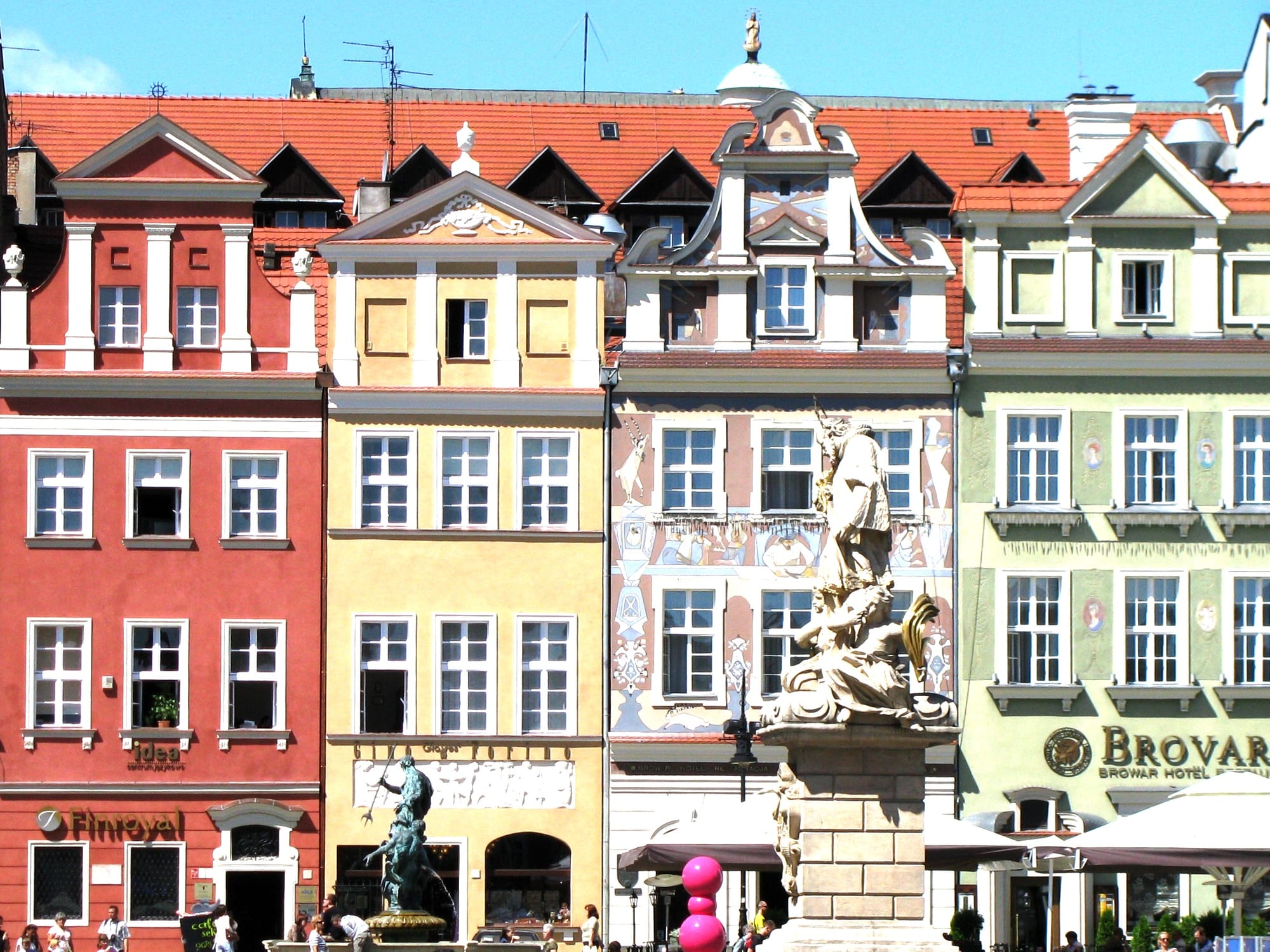
Tall painted townhouses in red, yellow and green with ornate gables, a stone statue and a fountain in front

Poznań & Western Poland, Poland

Poznań

Colourful merchants' houses and a fountain on the Old Market Square in Poznań. (Scotch Mist / Wikimedia Commons · CC BY-SA 3.0)

The capital of Greater Poland, on the Warta roughly midway between Warsaw and Berlin, where the first Polish cathedral was built after Mieszko I's baptism. A trading and fair city with a Renaissance town hall and a German-built imperial district, it is now one of Poland's most prosperous cities, a major university centre and home to the country's biggest industrial fair.

Neighbourhoods

  • Old Town
    • First-time visitors
    • Historic district
    • Nightlife

    The town chartered in 1253 on the left bank of the Warta, centred on the Old Market Square with its Renaissance town hall and painted merchants' houses. The Fara church, museums, many pubs, clubs and cafés fill the surrounding streets.

    Open in Maps
  • Ostrów Tumski and Śródka
    • History
    • Quiet and residential

    The island between two branches of the Warta where the Polish state's first cathedral was built, now a quiet precinct of churches and clergy houses with the Porta Posnania heritage centre on the far bank. Facing it, Śródka is a small historic district named after its old Wednesday market.

    Open in Maps
  • Imperial District and the city centre
    • Architecture
    • Culture
    • Close to public transport

    West of the Old Town, the district laid out after 1903 on the site of the old fortifications around the Imperial Castle, Adam Mickiewicz Square, the Grand Theatre and the university, along Święty Marcin, the main street. The main station and the Stary Browar centre are close by.

    Open in Maps
  • Jeżyce
    • Best for food
    • Art Nouveau
    • Local life

    A district north-west of the centre with streets of early 20th-century Art Nouveau tenements, an open-air market and a cluster of restaurants serving world cuisine around the market and Dąbrowskiego Street.

    Open in Maps
  • Łazarz and Wilda
    • Local life
    • Markets
    • Quiet and residential

    Older residential districts south and south-west of the centre, added to the city in 1900, with Art Nouveau streets and neighbourhood markets.

    Open in Maps

Things to do

The Old Town

  • Poznań Town Halllandmark

    A Renaissance town hall rebuilt in 1550–60 by Giovanni Battista di Quadro, with a three-storey loggia and a clock where two mechanical goats butt heads daily at noon; goats were first added to the clock in 1551.

    Open in Maps
  • Old Market Squarelandmark

    The heart of the Old Town, with the town hall and a row of colourfully painted 16th-century merchants' houses with an arcade at its centre.

    Open in Maps
  • Poznań Faralandmark

    The Baroque parish basilica begun in the mid-17th century and consecrated in 1705, known for its monumental Corinthian columns.

    Open in Maps
  • Poznań Croissant Museummuseum

    A museum on the Old Market Square devoted to St Martin's croissants and how they are made.

    Open in Maps

Ostrów Tumski and the first Polish capital

  • Poznań Cathedrallandmark

    The Gothic Archcathedral of Sts Peter and Paul, on the site of Poland's first cathedral, where early Piast rulers including Mieszko I and Bolesław the Brave were buried.

    Open in Maps
  • Porta Posnaniamuseum

    A modern heritage centre across the river from the cathedral, telling the story of Ostrów Tumski and the beginnings of the Polish state.

    Open in Maps

The Imperial District and museums

  • Imperial Castlelandmark

    Built in 1905–10 for Kaiser Wilhelm II, later used by the university and adapted as a headquarters for Hitler; since the 1960s it has been a cultural centre with a cinema, art galleries, a puppet theatre and summer concerts in its courtyard.

    Open in Maps
  • Monument to the Victims of June 1956landmark

    A monument erected in 1981 on Adam Mickiewicz Square in memory of the victims of the workers' revolt of June 1956.

    Open in Maps
  • National Museum in Poznańmuseum

    One of the city's best-known landmarks and its principal art museum.

    Open in Maps
  • Stary Browarattraction

    A shopping, arts and business centre opened in 2003 in a former brewery, with awards for its architecture.

    Open in Maps

Forts, lakes and parks

  • Fort Winiarypark

    The 19th-century Prussian citadel north of the centre, the last point to fall in the Battle of Poznań in 1945, now a large park.

    Open in Maps
  • Fort VIImuseum

    One of the outer ring of 19th-century forts, used by the Nazis as a concentration camp and now a memorial museum.

    Open in Maps
  • Lake Maltapark

    An artificial lake of 1952, about 2.2 km long, used for international rowing and canoe championships, with a year-round ski slope, the Termy Maltańskie pools and the Maltanka park railway to the New Zoo.

    Open in Maps
  • Poznań Old Zoopark

    One of the oldest zoos in Poland, founded in 1874, about 2 km from the Old Market Square.

    Open in Maps

Short trips from the city

  • Kórnik Castlelandmark

    A castle in Kórnik, south-east of Poznań, housing a museum and the Kórnik Library.

    Open in Maps
  • Wielkopolska National Parkpark

    A national park just south of the city.

    Open in Maps
  • Gniezno Cathedrallandmark

    The brick Gothic cathedral of Poland's first capital, the shrine of St Adalbert, with bronze doors from the 12th century.

    Open in Maps

Seasonal events

  • Anniversary of June 195628 June

    Commemorations on Adam Mickiewicz Square of the workers' revolt of 1956.

  • Malta Festivallate June to early July

    An international theatre festival with dozens of performances, in the streets as well as in theatres and other venues.

  • Bread FestivalSeptember

    Bakers from Poznań and Greater Poland offer tastings on the Old Market Square.

  • St Martin's Day11 November

    A procession of horses led by St Martin parades along Święty Marcin street past the Imperial Castle, and St Martin's croissants are sold all over the city.

  • Betlejem PoznańskieAdvent, until 23 December

    A Christmas market with a live nativity scene, craft and food stalls, concerts and an international ice sculpture festival.

Eat and drink

Long-standing places and food districts in Poznań. Hours, ratings and directions come from your maps app, always current.

Poznań classics

  • Rogal świętomarcińskicafe

    St Martin's croissant, filled with white poppy seed, nuts, raisins and candied fruit and coated with icing and nuts — protected in the EU since 2008 and eaten above all on 11 November.

    Open in Maps
  • Pyry z gzikiemrestaurant

    The local dish of boiled potatoes — pyry in the Poznań dialect — with gzik, quark mixed with sour cream and onion or chives.

    Open in Maps

Markets and food districts

  • Jeżyce Marketmarket

    An open-air market in Jeżyce, surrounded by restaurants focused on world cuisine on Dąbrowskiego and Szamarzewskiego streets.

    Open in Maps
  • Plac Wielkopolski marketmarket

    An open-air market a few minutes' walk from the Old Town.

    Open in Maps
  • Old Town bars and milk barsneighborhood

    Pubs, clubs and cafés around the Old Market Square, and a few surviving milk bars serving cheap meals.

    Open in Maps

Experience Poznań

History

For centuries before Poland's conversion, Poznań was a stronghold of the Polans between the Warta and Cybina rivers, on what is now Ostrów Tumski. Mieszko I built one of his main fortresses here, his baptism in 966 may have taken place here, and the first cathedral in Poland was raised on the island, where Mieszko I and Bolesław the Brave were buried. After Bohemian forces sacked the town in 1038 the capital moved to Kraków. In 1253 Duke Przemysł I chartered a new town on the left bank under Magdeburg law, and it grew on the trade routes from Lithuania and Ruthenia to western Europe.

The population of the conurbation fell from about 20,000 around 1600 to about 6,000 around 1730, and settlers from Bamberg and the Netherlands were brought in to rebuild the devastated suburbs. Prussia took the city in 1793, and for most of the next 125 years it was German Posen, made into a fortress city with a citadel and two rings of forts. Poles formed their own societies and opened the Polish Theatre in 1875, while the Kaiser built a new imperial district around his castle. After 1918 the city returned to Poland, and the university was founded in 1919 and the International Fair in 1924.

Under Nazi rule Poznań was capital of the Wartheland; Poles were executed, expelled and used as forced labour, and most of the city's Jews were murdered. The Battle of Poznań in 1945 left much of the Old Town in ruins. In June 1956 a workers' protest at the Cegielski factory became a revolt against communist rule, crushed by the army with 67 dead according to official figures. Rebuilt, Poznań became capital of the Greater Poland province in 1999.

Culture & Customs

Poznań people, Poznaniacy, are attached to their local dialect, with its many German loanwords, which survives in phrases such as pyra for potato, and in the radio and newspaper monologues of Stary Marych, a fictional old Poznań man. The noon butting of the two goats on the town hall, a tradition since 1551, is the city's best-loved ritual, and St Martin, patron of the main street, is treated as an unofficial patron of the city: on 11 November, which is also Independence Day, a horseback St Martin leads a parade past the Imperial Castle and the whole city eats croissants.

The cultural scene is large for the city's size. Besides the Grand Theatre, the Polish Theatre and the Polish Dance Theatre, Poznań is home to a growing number of alternative theatre groups, and the Malta Festival brings theatre to the city each summer. The Henryk Wieniawski Violin Competition is held every five years, and concerts by the Poznań Nightingales are especially popular. The city's rappers are mostly supporters of Lech Poznań, whose football team often plays in European competitions.

Faith and memory are part of local identity: the cathedral on Ostrów Tumski as the cradle of the Polish state, the monument to June 1956, and the Greater Poland Uprising of 1918. Rowing and canoeing on Lake Malta, the Poznań Marathon and field hockey all have strong local followings.

Daily Life

Poznań had about 540,000 inhabitants in 2023, the fifth-largest city in Poland, and more than a million live in its metropolitan area. The city's population has fallen since its 1990 peak as families moved to fast-growing suburbs such as Tarnowo Podgórne and Suchy Las. Around 140,000 students study at nearly 30 universities and colleges, among them Adam Mickiewicz University, and students make up a large share of the city's population.

The economy is among the strongest in Poland, often described as second only to Warsaw's. The Poznań International Fair is the country's biggest industrial fair; Volkswagen, GlaxoSmithKline, Amazon, Bridgestone and other foreign firms have plants or headquarters in and around the city; and Allegro, the energy company Enea, the Żabka convenience chain and the brewer of Lech beer are based here. Poznań has one of the highest concentrations of foreign residents in Poland, most of them workers from Ukraine.

People live in the older districts of Jeżyce, Wilda, Łazarz and Górczyn, with their tenements and neighbourhood markets, or in the large estates of prefabricated blocks built from the 1960s in Rataje, Winogrady and Piątkowo. Weekends are spent at the lakes inside the city limits — Malta, Rusałka, Strzeszyn and Kiekrz — and in the forests on its edge.

Food

Greater Poland cooking leans on potatoes, with flour dishes, groats and sauerkraut. Pyry z gzikiem is the local signature: boiled potatoes with gzik, quark mixed with sour cream and onion or chives. Roast duck comes with apples, red cabbage and dumplings, and czernina is a soup made with duck blood.

That day belongs above all to the rogal świętomarciński, St Martin's croissant. Its filling must by law contain white poppy seeds, sugar, crumbs, egg, margarine, raisins, nuts and fruit in syrup or candied fruit, and it is coated with icing and nuts. Advertisements for it date back to 1860, and a popular legend credits a confectioner who, in 1891, answered a priest's call to feed the poor. Since 2008 the name has been protected in the European Union, and a museum on the Old Market Square is devoted to them.

Everyday eating is cheap and varied: a few surviving milk bars serve cheap meals, open-air markets operate at Jeżyce, Łazarz, Plac Bernardyński and Plac Wielkopolski, and Jeżyce has become a district of restaurants serving world cuisine. Lech beer is brewed in the city, and in summer the Old Market Square hosts a festival of Greater Poland cooking, while September brings a bread festival.

Planning tools

Budget

Poznań is moderately priced: cheaper than Warsaw, with reasonable restaurants and transport. Hotel prices rise during the big trade fairs at the Poznań International Fair, when rooms are hard to find. Milk bars and markets keep food costs low.

Daily Budget Midrange
USD 120–230 (Old Town hotel, restaurant meals, museum tickets, a trip to Kórnik or Gniezno)
Daily Budget Shoestring
USD 45–80 (hostel, milk bars and bakeries, trams and buses)

Check the trade-fair calendar before booking; day and week public transport tickets cover every tram and bus line.

Best Time to Visit

May to September for the Old Town's outdoor tables and the lakes, with the Malta Festival at the turn of June and July. 11 November brings the St Martin's Day parade and croissants, and Advent the Christmas market and ice sculptures. Winters are mild by Polish standards, with little snow.

Suggested Number of Days

Two or three days cover the Old Town, Ostrów Tumski and the Imperial District at a comfortable pace. Four or five allow for the castles, national park and cathedral towns of Greater Poland as well. Trade-fair weeks make rooms scarcer rather than sights busier.

First Visit
2–3 days
With Surroundings
4–5 days

Transportation

A compact city with a good tram and bus network run by MPK, including the Pestka fast tram line opened in 1997; ten minutes on a tram covers a few stops in the centre outside rush hour. Cycling is easiest in the western districts and hardest in the Old Town and inner districts, where bike lanes run beside heavy traffic.

Cycling on pavements is illegal, and city guards fine cyclists on Głogowska Street near the main station.

Airport & Station Connections

Poznań–Ławica Airport, one of the oldest in Poland, is about 5 km west of the centre, linked by city buses. Poznań Główny is a major rail junction on the Berlin–Warsaw line, with trains to both capitals in about three hours. The coach station sits beneath the railway station in the Avenida shopping centre, and the A2 motorway passes south of the city.

Walkability

The Old Town, the Imperial District and the main station lie within a comfortable walk of each other, and Ostrów Tumski is a short walk east across the river. Jeżyce, Łazarz and Lake Malta are reached easily by tram. Paths run along the Warta between the Old Town side and the cathedral island.

Safety

Poland is a safe country with low violent crime. In Poznań crime, including petty crime, is low, but strangers on the Old Market Square who invite visitors to a bar or club may lead them to overpriced places or try to steal card details.

Watch bags around Poznań Główny and in Old Town crowds, and check bar bills. Check current official travel advice before travelling.

Climate

A transitional climate between continental and oceanic, with mild winters, warm summers and rainfall among the lowest in Poland. July is the rainiest month, with short, heavy storms, and sunshine hours are among the highest in the country.

Summer
warm — July averages about 18°C, and days often reach 30°C
Winter
mild for Poland — January averages about −1°C, and snow is rare

Local Customs

A tip of around 10 per cent is usual in restaurants, though not everyone leaves one. A 'dzień dobry' (good day) is a common greeting. The local dialect mixes in German words, and a potato is a pyra.

Men remove hats in churches, and the cathedral and Fara are places of worship first; on St Martin's Day the city celebrates, but 11 November is also Independence Day.

Common Payment Methods

The currency is the Polish złoty (PLN), not the euro. Cards and contactless payment are widely accepted; carry a little cash for markets and small bakeries. ATMs are plentiful in the centre.