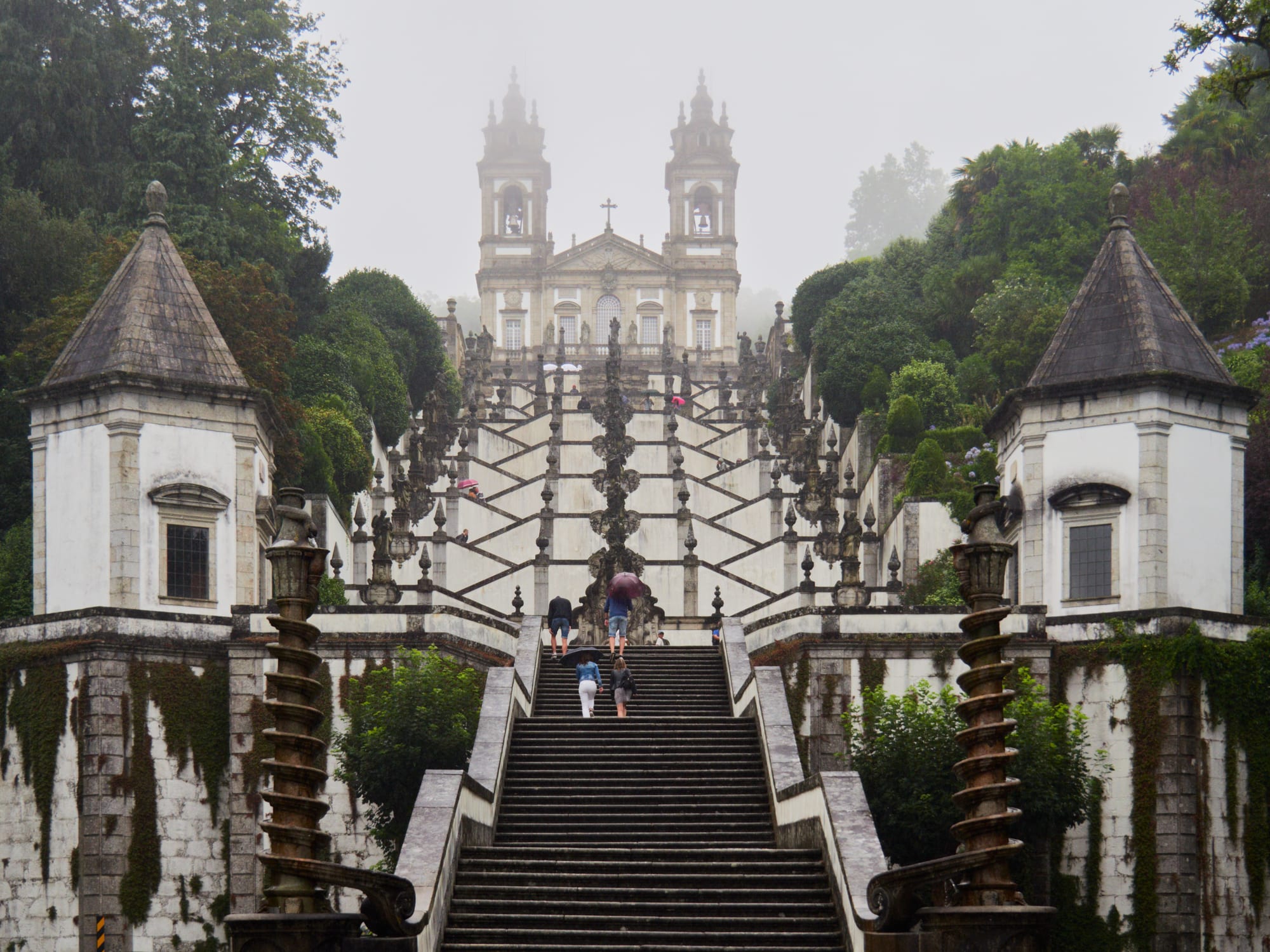
A zigzag Baroque stairway of white walls and statues climbing a wooded hill to a twin-towered church in light mist

Porto & the North, Portugal

Braga

The stairway and church of the Sanctuary of Bom Jesus do Monte, on the hills east of Braga. (lumoplank / Wikimedia Commons · CC0)

The capital of the Minho, founded by the Romans as Bracara Augusta and seat of Portugal's oldest archdiocese, whose archbishops ruled the town for centuries and filled it with churches. Today it is a young, fast-growing university and technology city of about 210,000 people, with the Baroque stairway of Bom Jesus do Monte on the hills to the east.

Neighbourhoods

  • The Sé and the historic centre
    • First-time visitors
    • Historic district
    • Churches

    The medieval city that grew up around the cathedral, held for centuries by the archbishops. Rua do Souto and the lanes around the Sé and the old Archiepiscopal Palace lead to the Arco da Porta Nova, the Baroque gate in the old walls, with churches, chapels and palaces close together.

    Open in Maps
  • Avenida Central and the Arcada
    • Cafés
    • Close to public transport
    • Evenings out

    The long central avenue laid out on the old Campo de Santa Ana, with fountains and the arcade of the Arcada on Praça da República. It is the city's meeting place, lined with cafés.

    Open in Maps
  • University district
    • Students and nightlife
    • Budget eating

    The area around the University of Minho's Braga campus, with plenty of bars and cheap restaurants. Wednesday is the traditional academic night, when students fill the clubs.

    Open in Maps
  • Bom Jesus and Sameiro
    • Views
    • Pilgrimage sites
    • Parks

    The wooded hills east of the city, home to the Bom Jesus do Monte sanctuary in Tenões, with its park and funicular, and higher up, the Marian shrine of Sameiro with its view over the city.

    Open in Maps

Things to do

Churches and sanctuaries

  • Braga Cathedrallandmark

    The Sé, rebuilt from the late 11th century and altered many times since, the seat of the Primate Archbishop and one of the most important buildings in Portugal; a National Monument since 1910.

    Open in Maps
  • Sanctuary of Bom Jesus do Montelandmark

    A pilgrimage church at the top of a monumental Baroque stairway that climbs 116 metres through a wooded park, listed as a UNESCO World Heritage Site in 2019.

    Open in Maps
  • Bom Jesus do Monte Funicularattraction

    Opened in 1882 beside the stairway, the oldest funicular in the world worked by water balancing: water is loaded into the upper car so that its weight draws the lower one up.

    Open in Maps
  • Sanctuary of Sameiroviewpoint

    One of the most visited Marian shrines in Portugal, on a hilltop more than 350 metres above the city, with a celebrated view over Braga and the Minho valley.

    Open in Maps
  • Chapel of São Frutuosolandmark

    A pre-Romanesque chapel in the form of a Greek cross, built by the Visigoths in the 7th century as the tomb of St Fructuosus, who founded a monastery on the site in 656, a contender for the oldest chapel in Portugal.

    Open in Maps

Palaces, museums and the old city

  • Arco da Porta Novalandmark

    André Soares's late 18th-century Baroque and Neoclassical arch on the western gate of the medieval walls.

    Open in Maps
  • Raio Palacelandmark

    An 18th-century late Baroque and early Rococo town house by André Soares, a notable work of the northern Baroque.

    Open in Maps
  • Biscainhos Museummuseum

    A palace in the old town, the Casa dos Biscainhos, now open as a museum.

    Open in Maps
  • Fountain of the Idollandmark

    A Roman spring shrine of the 1st century carved in the granite rock, with Latin inscriptions to a local Gallaecian god.

    Open in Maps
  • Castle keeplandmark

    The surviving keep of the castle of King Dinis, by Rua do Castelo, the rest of which was demolished in 1905; it is a National Monument.

    Open in Maps
  • Theatro Circoattraction

    A revivalist theatre opened in 1915, restored by the city and reopened in 2006, with plays, films, music and dance.

    Open in Maps

Sport and short trips

  • Estádio Municipal de Bragaattraction

    Sporting Braga's 30,000-seat stadium, built for Euro 2004 and nicknamed A Pedreira, the Quarry, because it was carved into a hillside.

    Open in Maps
  • Monastery of Tibãeslandmark

    The former mother house of the Benedictines of Portugal and Brazil, near the city, known for the exuberant Rococo interior of its church.

    Open in Maps

Seasonal events

  • Holy Weekthe week before Easter, March or April

    The city's most famous religious season, with processions through the old town, officially declared of interest to tourism in 2011.

  • São Joãothe night of 23–24 June

    The St John festival, recorded since 1515; on the night of 23 June the people of Braga come out into the streets.

Eat and drink

Long-standing places and food districts in Braga. Hours, ratings and directions come from your maps app, always current.

Braga classics

  • Bacalhau à Narcisarestaurant

    Braga's own salt cod: fried pieces of cod with thin slices of potato and onion fried in the same olive oil, with bay leaves and cloves.

    Open in Maps
  • Pudim Abade de Priscoscafe

    A rich pudding from a recipe passed on by the abbot of Priscos, made with bacon fat and fifteen egg yolks.

    Open in Maps

Food districts and cafés

  • Avenida Central and the Arcadaneighborhood

    The cafés under the arcades and along the avenue, the place to sit and watch the city go by.

    Open in Maps
  • University bars and restaurantsneighborhood

    The streets around the campus, full of bars and inexpensive restaurants that cater to students.

    Open in Maps

Experience Braga

History

The Callaici Bracari, a Celtic people of the Castro culture, held the hill forts of this region before Rome. The Romans founded the civitas of Bracara Augusta in 16 BC; it grew through the 1st and 2nd centuries and around the end of the 3rd became the capital of the Roman province of Gallaecia. After 410 the Suebi made it the capital of their kingdom, and their king Rechiar was the first Germanic ruler in Europe to accept Catholic Christianity. Its archbishops later claimed primacy over the whole Spanish church and still hold the title of Primate.

After a period of decline around the time of the Muslim conquest, the bishopric was restored in 1070 and the cathedral rebuilt, and between 1093 and 1147 Braga was the seat of the Portuguese court. Afonso Henriques rewarded the archbishops' support by giving them the city as a near-personal fief, a status that lasted until the Republic and earned the area the nickname "Paiz Bracarense". Missing out on the wealth of the Discoveries, the city was transformed instead by its archbishops: Diogo de Sousa turned the medieval town into a Renaissance city in the 16th century, and in the 18th the archbishops of the House of Braganza employed André Soares and Carlos Amarante to rebuild it in Baroque style.

French troops under Soult took the town in 1809. The castle was demolished in 1905, apart from its keep, and in May 1926 General Gomes da Costa marched from Braga on Lisbon in the coup that ended the First Republic. After decline in the 20th century, the city bounced back from the 1980s with rural migration, and Bom Jesus was listed as a World Heritage Site in 2019.

Culture & Customs

Braga has been the seat of Portugal's oldest archdiocese for centuries, and its calendar still turns on the church. Holy Week is its most famous season, with processions through the old town that were declared of interest to tourism in 2011, and the city is a stop on the Portuguese Way to Santiago. On the hills east of the centre, the stairway of Bom Jesus do Monte and the shrine of Sameiro — the largest Marian sanctuary complex in the country after Fátima — draw pilgrims and visitors alike.

São João is the other great occasion. Its first records date from 1515, when the city council first took on its organisation, though many of its elements are older; on the night of 23 June, the eve of St John's Day, the people of Braga come out into the streets.

The University of Minho has given the city a younger face. Braga was European Youth Capital in 2012, students fill the bars around the campus on Wednesday academic nights, and the restored Theatro Circo of 1915 is the main stage for theatre, film, music and dance. Football means Sporting Braga, nicknamed the Arsenalistas for shirts resembling Arsenal's, who reached the Europa League final in 2011 and play in a stadium carved out of a quarry. Their rivalry with Vitória of Guimarães, the Derby do Minho, divides the region.

Daily Life

The municipality had about 213,000 residents in 2025, and its urban area is the third most populous in Portugal after the Lisbon and Porto metropolitan areas. It is a young place by Portuguese standards: around a third of its people were recorded as under 25. Growth between 1991 and 2001 came mainly in the older suburban parishes. Alongside Portuguese residents there are Brazilians, Africans from the former colonies, Chinese and Eastern Europeans, and a new wave of Brazilian immigration has continued into this century.

The economy has moved well beyond the church. Software firms such as PRIMAVERA BSS, the International Iberian Nanotechnology Laboratory, and automotive electronics centres run by Bosch and Aptiv have made Braga one of the country's technology centres, closely tied to the University of Minho; construction and metalworking remain important too. Many of the city's extra homes are temporary residences, mostly for students, migrant workers and professionals working in the city.

Growth has brought strain. The city faces a housing crisis and needs better public transport and infrastructure — the central issues of the 2025 municipal elections. Daily life is built around the café, the long lunch and the evening stroll along Avenida Central, and TUB buses tie the outer parishes to the centre.

Food

Braga's best-known dish is bacalhau à Narcisa, also called bacalhau à Braga: fried pieces of salt cod served with thin slices of potato and onion fried in the same olive oil, flavoured with bay leaves and cloves. Despite the name, the recipe was created by Dona Eusébia, who kept the name of the tavern she took over from a woman called Narcisa; the dish is also known as bacalhau à minhota.

The city's famous sweet is the pudim Abade de Priscos. It is one of the few recipes the abbot of Priscos passed on to the public, a rich pudding unusual for including bacon fat as well as fifteen egg yolks and a glass of port, and it was a finalist in the 7 Wonders of Portuguese Gastronomy. Like the rest of the north, the city also eats rojões, sarrabulho and caldo verde, and drinks vinho verde with meals.

Eating out divides between the traditional restaurants of the old town, the cafés around Avenida Central and the Arcada, and the cheaper bars and restaurants around the university, which keep prices down for the city's large student population.

Planning tools

Budget

Braga is cheaper than Porto for rooms and meals, and many visitors base themselves here to save money while visiting Porto by train. The funicular and the museums are the small extra costs. Holy Week and São João are the busiest times of year.

Daily Budget Midrange
USD 120–220 (central hotel, restaurant dinners, museum entries, the funicular)
Daily Budget Shoestring
USD 50–85 (hostel or cheap guesthouse, prato do dia lunches, city buses)

Book well ahead for Holy Week and São João, and use the city buses rather than a car to reach Bom Jesus.

Best Time to Visit

April to June and September are the most comfortable months. Holy Week, in March or April, and São João in late June are the city's great occasions, crowded and atmospheric. Summers can be very hot, since the city lies some distance from the sea, and winters are wet, with frost on clear nights.

Suggested Number of Days

One full day covers the old town and the hill sanctuaries; two allow the museums and evenings at an easier pace. Three or four days leave time for Guimarães and the countryside around the city. Bom Jesus and Sameiro lie outside the centre, which adds travel time.

First Visit
1–2 days
With Surroundings
3–4 days

Transportation

The historic centre is walkable. The city bus company, TUB, runs a dense network of about 76 lines covering the municipality, divided into three fare zones, including the route up to Bom Jesus. From the foot of the hill the water-powered funicular or the stairway lead up to the church.

To reach Guimarães or Viana do Castelo, the bus is usually quicker than the train, which means changing lines.

Airport & Station Connections

Porto Airport is about 50 km away, roughly 40 minutes by public transport or 50 minutes by the airport coach. Urban trains run from Porto, and Braga is a northern terminus of some Alfa Pendular and Intercidades trains from Lisbon and Coimbra. Rede Expressos coaches arrive from across the country.

Walkability

The old centre, the cathedral and Avenida Central are close together on mostly flat, partly pedestrianised streets. Bom Jesus and Sameiro lie outside the centre and well above it, so most visitors take the bus and then the funicular or the stairway.

Safety

Portugal is one of the safest countries in Europe, with low violent crime. Braga is a calm and busy provincial city; the crowds of Holy Week and São João are the times to keep a closer eye on belongings.

Watch bags in festival crowds, and take care on the steep stairway at Bom Jesus when the stone is wet. Check current official travel advice before travelling.

Climate

A warm-summer Mediterranean climate shaped by the Atlantic, whose humid westerly winds funnel up the valleys and bring about 1,450 mm of rain a year, most of it from autumn to spring. Being inland, Braga has noticeably hotter summers than the coast; annual mean temperatures lie between about 12.5 and 17.5°C.

Summer
warm to hot and drier than the rest of the year; the highest temperature recorded is 42.2°C
Winter
cool and wet, with frost on about 29 days a year; the lowest temperature recorded is −7°C

Local Customs

Tipping is not generally expected; a euro or two after a full meal is appreciated. Braga has a long religious tradition, and its churches are busy working places of worship. Football rivalry with Guimarães in the Derby do Minho is fierce.

Dress modestly in churches and be quiet and discreet during services and Holy Week processions.

Common Payment Methods

Portugal uses the euro. Cards are widely accepted, and Multibanco cash machines are common in the centre. Carry a little cash for small cafés, pastry shops and buses.