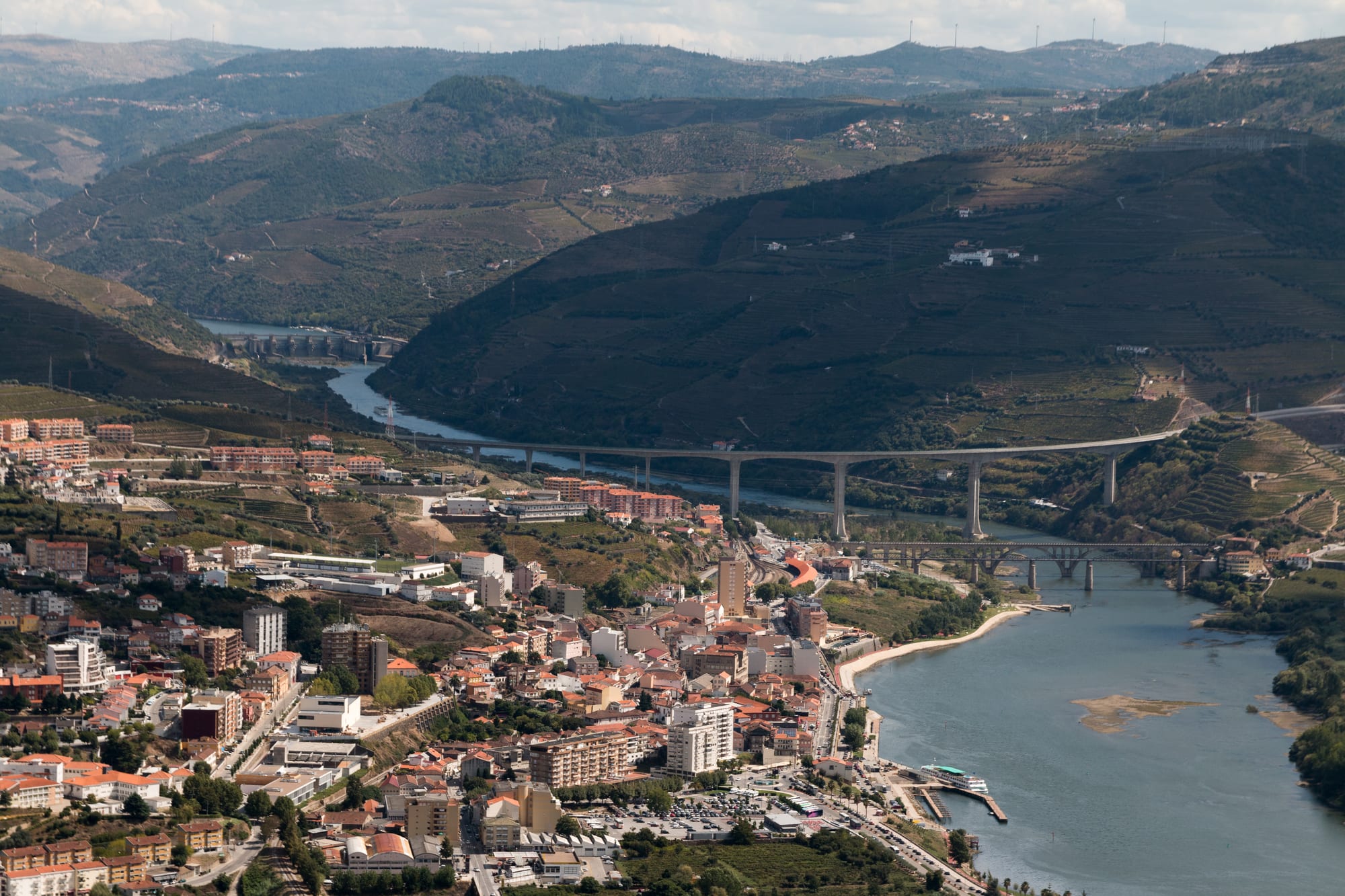
Peso da Régua spread along the Douro below terraced hills, with a high road bridge and a rail bridge crossing the river and a dam upstream

Porto & the North, Portugal

Peso da Régua

Peso da Régua on the right bank of the Douro, with the river's bridges and the Régua Dam beyond. (Daniel VILLAFRUELA. / Wikimedia Commons · CC BY-SA 4.0)

A small river city on the right bank of the Douro, about 100 km upstream from Porto, at the heart of the Douro wine region. It grew from two villages into the main trading post of the port-wine trade after 1756, when wine left its quays on rabelo boats for Gaia, and today it is a base for river cruises, the Douro railway and visits to the terraced vineyards.

Neighbourhoods

  • Régua riverside
    • First-time visitors
    • River cruises
    • Close to public transport

    The lower town stretched along the banks of the Douro, which grew with the arrival of the railway in the late 19th century. The station, the river quays where the tourist boats tie up, the Avenida do Douro and the Douro Museum are all here, a short walk apart.

    Open in Maps
  • Peso and the upper town
    • Quiet and residential
    • Views

    The older village of Peso, which merged with Régua during the 18th century, forms the part of the town away from the riverbank. It is mostly residential and quieter than the riverside.

    Open in Maps

Things to do

The town and the wine trade

  • Douro Museummuseum

    The museum of the Douro Demarcated Region and port wine, in the Casa da Companhia Velha on Rua Marquês de Pombal, the former headquarters of the wine company founded in 1756; it has a restaurant and wine bar.

    Open in Maps
  • Régua railway stationtransit hub

    The station on the Douro line, opened in 1879, whose arrival made the lower town the shipping centre for the wine trade; it was also the junction for the narrow-gauge Corgo line to Vila Real until 2009.

    Open in Maps
  • Solar Vaz Osóriolandmark

    The manor house of the Vaz Osório family, also called the Casa dos Vazes, one of the town's historic houses.

    Open in Maps
  • Alto da Fonte do Milhoattraction

    An archaeological site in the parish of Poiares e Canelas, in the hills of the municipality, classified as a National Monument since 1959.

    Open in Maps

The river

  • Douro river cruisesattraction

    Tourist boats come up the Douro to Régua through the locks of two dams, one of the classic ways to see the valley.

    Open in Maps
  • Régua Damlandmark

    A concrete gravity dam on the Douro, built between 1965 and 1973, where the river forms the border between the districts of Vila Real and Viseu.

    Open in Maps

Short trips from the town

  • The Douro line upriverattraction

    The railway that follows the Douro for much of its route, with views over the river and the terraced vineyards, continuing upriver towards Pocinho.

    Open in Maps
  • Lamegoattraction

    A historic city south of the river, seat of a diocese, with a Gothic cathedral whose Romanesque tower survives from the original building, and a legend that the first Portuguese Cortes met there in 1143.

    Open in Maps
  • Mateus Palacelandmark

    An 18th-century manor near Vila Real, with Nicolau Nasoni linked to its design, a winery and a chapel; it gave its name to Mateus rosé.

    Open in Maps

Seasonal events

  • Festas de Nossa Senhora do Socorro14–16 August

    The town's main festival, drawing thousands of people over three days; the saints' processional floats are turned towards the river while the boats sound their horns.

  • The grape harvestlate September and early October

    Harvest time in the valley, when the vineyard terraces turn gold and red.

Eat and drink

Long-standing places and food districts in Peso da Régua. Hours, ratings and directions come from your maps app, always current.

Douro wine

  • Port and Douro winesrestaurant

    The town's bars and restaurants pour the valley's port and its red and white table wines, made from local grapes such as Touriga Nacional and Tinta Roriz.

    Open in Maps
  • Douro Museum restaurant and wine barrestaurant

    The restaurant and wine bar inside the Douro Museum, in the old wine company headquarters.

    Open in Maps

The riverside

  • Avenida do Douroneighborhood

    The riverside avenue of the lower town, with cafés and restaurants facing the water.

    Open in Maps

Experience Peso da Régua

History

People have lived around Régua since at least Roman, Suebic and Visigothic times, and the origins of its name are argued over: a Roman estate called Vila Reggula, a word for livestock crossing the Douro here, or crown lands. Peso, which may refer to a place where goods were weighed and taxed, and Régua, on the right bank of the river, were two separate villages that merged during the 18th century.

What made the town was wine. In 1756 the Marquis of Pombal created the Companhia Geral da Agricultura das Vinhas do Alto Douro and marked out the Douro vineyards with granite boundary stones, creating what is considered the oldest demarcated wine region in the modern sense. From then on Régua grew into one of the main trading posts of the port trade, with wine shipped downriver to Vila Nova de Gaia on rabelo boats. The municipality was created in 1836, and the railway, which reached the lower town in 1879, reinforced its role as a commercial centre and shipping point for wine.

The Corgo line made Régua a junction for Vila Real from 1906 until it closed in 2009. The Régua Dam, built between 1965 and 1973, tamed the river. Peso da Régua became a city in 1985, and in 1988 the International Office of Vine and Wine named it an International City of Vine and Wine. The Alto Douro wine landscape around it was listed by UNESCO in 2001.

Culture & Customs

Régua's identity is bound up with port. The Douro Museum, in the old wine company headquarters on Rua Marquês de Pombal, tells the story of the demarcated region and its wine, and the Casa da Companhia Velha that houses it is itself one of the town's protected buildings.

The great event of the year is the festival of Nossa Senhora do Socorro on 14, 15 and 16 August, which draws thousands of people. During the processions the floats of the saints are turned to face the firefighters, who sound a siren in salute, and on the riverfront they are turned towards the Douro while the boats answer with their horns. The town also has a Volunteer Firefighters Museum.

The calendar of the surrounding valley follows the vines. Late September and early October are harvest time, when the terraces turn gold and red and the quintas are at their busiest. The work on the steep terraces, with port vineyards usually planted on schist and table-wine vineyards on granite soils, has shaped both the landscape and local life for centuries.

Daily Life

The municipality had about 14,500 people in 2021, down from about 17,100 in 2011, when around 10,000 lived in the town itself; it is divided into eight parishes threaded along the Douro. Like much of the interior north, it has been losing population.

Port wine is the foundation of the local economy, from the vineyards and wine estates on the slopes to the trade and transport that grew up around the station and quays. Tourism has become the other mainstay: boats bring visitors up the river through the locks, the Douro line carries them along the banks, and the quintas offer tastings and stays.

Daily life is that of a small Portuguese town — morning coffee, a long lunch and evenings along the river — but its rhythm swings with the seasons. The town is busiest in summer, with cruise passengers and the August festival, and the valley comes most alive at harvest time in autumn; winters are quiet.

Food

Wine comes first in Régua. Port is a fortified wine: its fermentation is stopped early by adding a neutral grape spirit called aguardente, which leaves natural sugar in the wine and raises its strength. The main red styles are ruby, younger, and tawny, aged much longer in barrel and often labelled with an age in steps of ten years from 10 to 50; colheitas are tawnies from a single harvest, and there are white ports too. The Douro also makes as much table wine as port, red and white, from local grapes such as Touriga Nacional, Touriga Franca, Tinta Roriz and Tinta Barroca.

Tastings are part of eating out here. The Douro Museum has its own restaurant and wine bar, and cafés and restaurants line the riverside of the lower town, where the cooking is the hearty food of the Portuguese north.

The quintas around the town, many of them working wine estates, offer tastings of their own wines.

Planning tools

Budget

The town itself is inexpensive, with simple guesthouses and cafés. The real costs of a Douro stay are the quinta visits and tastings, river cruises and, for many, a hire car, and rooms in the valley fill up and rise in price around the harvest.

Daily Budget Midrange
USD 130–250 (hotel or quinta guesthouse, restaurant dinners, wine tastings, a river cruise or hire car)
Daily Budget Shoestring
USD 55–90 (guesthouse room, prato do dia lunches, regional trains)

Book rooms early for the September harvest, and use the train for the riverside stretch rather than driving the winding valley roads.

Best Time to Visit

May, June and September suit the valley best. The harvest in late September and early October is the most atmospheric time, when the vineyards change colour. July and August are hot and dry here, and the town's festival fills it in mid-August. Winter is cool and wet, and quiet.

Suggested Number of Days

One or two days cover the town, the museum and a short river trip. Three or four allow time for the wine estates, the railway and the towns nearby. Without a car, trips into the hills take longer to arrange.

First Visit
1–2 days
With Surroundings
3–4 days

Transportation

The lower town is walkable along the river. The Douro railway runs along the riverbank through the station, and tourist boats work the river. The vineyards and hill villages are best reached by car or on organised tours; the Corgo railway to Vila Real closed in 2009.

Valley roads are narrow and winding, so allow extra time, and agree on a driver who will not be tasting.

Airport & Station Connections

Régua lies about 100 km from Porto. Trains on the Douro line from Porto run along the river to the town's station, and tourist boats come up the river through the locks of two dams. Drivers use the A24 motorway, which serves the town directly; Vila Real is about 25 km away. Porto Airport is the nearest international airport.

Walkability

The riverside lower town is compact and level, and the station, quays, museum and restaurants are all within an easy walk. The upper town and the surrounding vineyards involve steep climbs, and the estates in the hills are too far to reach on foot.

Safety

Portugal is one of the safest countries in Europe, with low violent crime. Régua is a quiet small town. The real risks in the valley are summer heat, wildfires in dry weather and the narrow, winding roads above the river.

Carry water in summer, drive carefully on the valley roads, and avoid walks in the hills on high-fire-risk days. Check current official travel advice before travelling.

Climate

A Mediterranean climate with hot, dry summers and cool to mild, wet winters. The valley is sheltered from the Atlantic by mountains, so it is much hotter in summer than the coast. Through the year, days average about 22°C and nights about 10°C.

Summer
hot and dry; across the Douro Valley temperatures often reach 35°C or more
Winter
cool to mild and wet; averaged over the whole year, nights are about 10°C, so winter nights are chilly

Local Customs

Tipping is not generally expected; a euro or two after a full meal is appreciated. Wine is the town's livelihood, and many of the quintas around it are working farms, busiest at harvest time.

Ask before walking into vineyards, which are private land, and dress modestly in churches.

Common Payment Methods

Portugal uses the euro. Cards are widely accepted in hotels and restaurants, and Multibanco cash machines are available in the town. Carry some cash for small cafés and village shops in the hills.