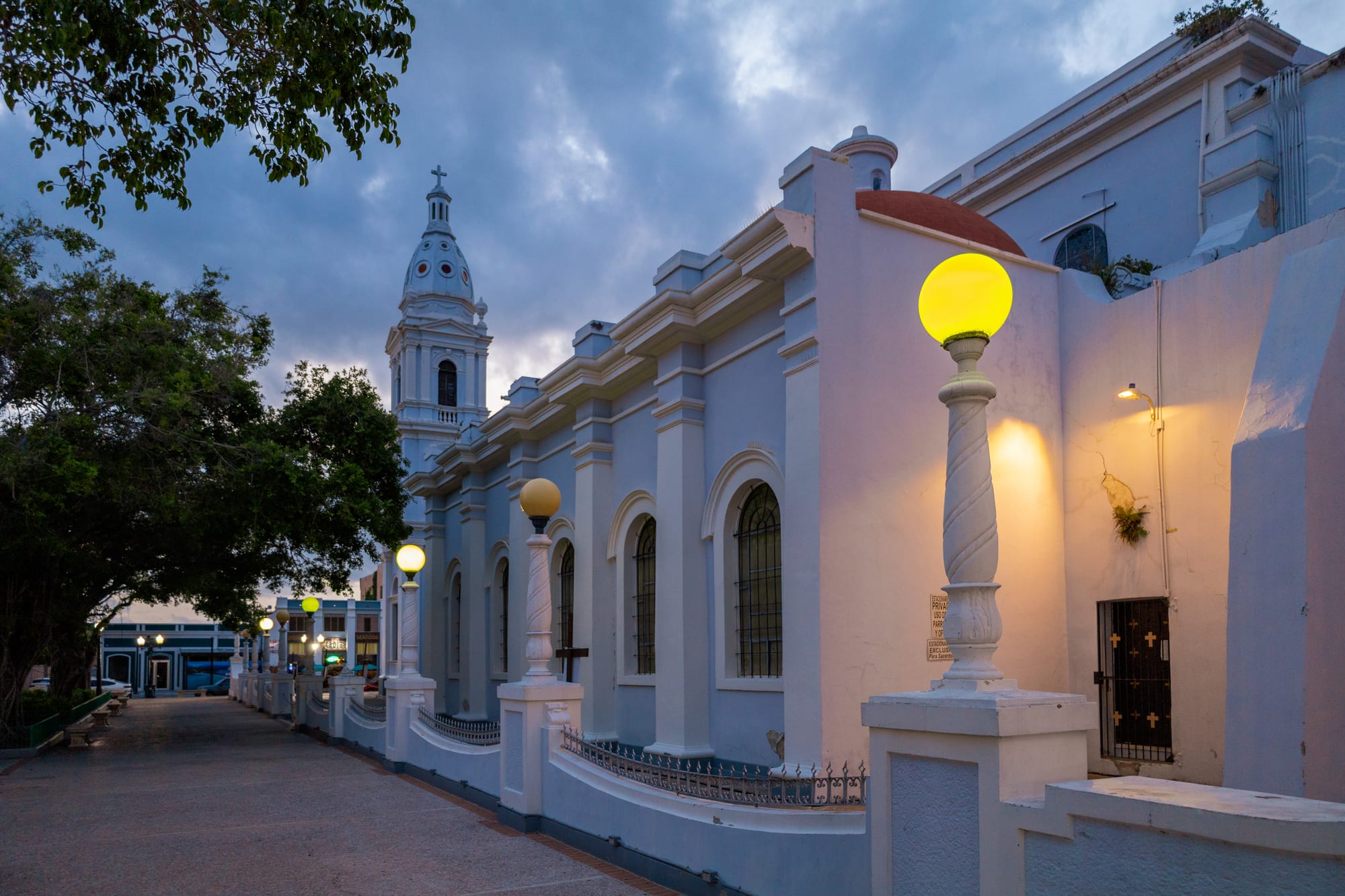
The pale blue neoclassical side of Ponce Cathedral and its domed bell tower at dusk, with glowing globe lamps along a plaza path

Puerto Rico

Ponce

Ponce Cathedral on Plaza Las Delicias at dusk. (Ligocsicnarf89 / Wikimedia Commons · CC BY 4.0)

Puerto Rico's largest city outside the San Juan area, on the southern coastal plain facing the Caribbean. Founded in 1692 and enriched by 19th-century sugar, coffee and immigrants, the 'Pearl of the South' keeps a historic centre of Ponce Creole and neoclassical buildings around Plaza Las Delicias, the island's leading art museum and the oldest carnival in Puerto Rico.

Neighbourhoods

  • Historic centre
    • First-time visitors
    • Historic district
    • Museums

    Downtown Ponce, about three miles inland, built around the twin squares of Plaza Las Delicias with the cathedral and the striped firehouse at its heart. Streets of Neoclásico Isabelino and Ponce Creole houses hold museums, the historic theatre and the market, and most of the city's hotels cluster around Plaza Degetau.

    Open in Maps
  • El Vigía hill
    • Viewpoints
    • Museums

    The hill just north of downtown, topped by the giant cross of the Cruceta del Vigía and the 1930s Castillo Serrallés mansion, with views over the city to the Caribbean.

    Open in Maps
  • La Guancha and Playa
    • Waterfront
    • Local life

    The seafront district about three miles south of downtown, near the harbour, where the La Guancha boardwalk and its food kiosks stood and from where boats have run to Caja de Muertos island.

    Open in Maps

Things to do

Plaza Las Delicias and the historic centre

  • Parque de Bombasmuseum

    The red-and-black former fire station, built as an exhibition pavilion in 1882 and Puerto Rico's first fire station, now a museum and one of the island's most recognised landmarks.

    Open in Maps
  • Plaza Las Deliciaslandmark

    The main square, really two plazas, known for its fountains and monuments and flanked by the city hall and historic buildings.

    Open in Maps
  • Ponce Cathedrallandmark

    The neoclassical Cathedral of Our Lady of Guadalupe in the middle of the plaza, whose history goes back to a chapel of 1670 and whose organ was played by the danza composer Juan Morel Campos.

    Open in Maps
  • Residencia Armstrong-Poventudlandmark

    An ornate house with a caryatid-framed entrance facing the cathedral, built in the style known as Ponce Creole.

    Open in Maps
  • Teatro La Perlalandmark

    A theatre inaugurated in 1864, described as the largest and most historic in the Spanish-speaking Caribbean.

    Open in Maps

Museums

  • Museo de Arte de Poncemuseum

    The largest art museum in the Caribbean, founded in 1959 by Luis A. Ferré, with European and Puerto Rican art and one of the most important Pre-Raphaelite collections in the Western Hemisphere.

    Open in Maps
  • Museo Castillo Serrallésmuseum

    The hilltop mansion built in the 1930s for the family behind the Serrallés rum distillery, now a museum of the sugar and rum industries.

    Open in Maps
  • Museo de la Música Puertorriqueñamuseum

    The story of Puerto Rican music from Taíno instruments to danza, bomba and plena, in the Serrallés family's town house.

    Open in Maps
  • Museo de la Historia de Poncemuseum

    Opened in 1992 as the first museum in Puerto Rico devoted to the history of a single town, two blocks from the plaza.

    Open in Maps
  • Museo de la Masacre de Poncemuseum

    A human rights museum in the building where the Ponce massacre took place on Palm Sunday 1937, with a section on the Nationalist leader Pedro Albizu Campos.

    Open in Maps

Viewpoints, markets and the waterfront

  • Cruceta del Vigíaviewpoint

    A 100-foot concrete cross on Cerro del Vigía with a tower and sky bridge giving views over the city and the Caribbean.

    Open in Maps
  • Plaza del Mercado de Poncemarket

    The historic market hall of 1863, filling a block of the historic zone with room for 65 stalls.

    Open in Maps
  • La Guancha Boardwalktrail

    A seafront boardwalk opened in 1998, damaged by Hurricane Maria and closed after the 2020 earthquakes, after which its kiosk merchants moved to a temporary site; in 2026 the municipality began demolishing the damaged structures to rebuild the waterfront.

    Open in Maps

Short trips from the city

  • Tibes Indigenous Ceremonial Centermuseum

    The oldest ceremonial and ball-game complex yet found in Puerto Rico, built by the pre-Taíno Igneri and later used by the Taíno, with a large Indigenous burial ground and a museum.

    Open in Maps
  • Hacienda Buena Vistamuseum

    A 19th-century coffee plantation begun in 1833 in the hills north of the city, run as a museum by the Puerto Rico Conservation Trust.

    Open in Maps
  • Caja de Muertos Islandpark

    An uninhabited island off the coast, protected as a nature reserve for its turtles, dry forest and reefs, with beaches and trails reached by boat from La Guancha.

    Open in Maps

Seasonal events

  • Carnaval de Poncethe week before Ash Wednesday, February or March

    A week-long carnival dating back to 1858, the oldest in Puerto Rico and one of the oldest in the Western Hemisphere.

Eat and drink

Long-standing places and food districts in Ponce. Hours, ratings and directions come from your maps app, always current.

Ponce classics

  • King's Creamcafe

    A long-running ice-cream shop opposite the Parque de Bombas, a Ponce institution for its handmade ice cream.

    Open in Maps

Food districts and markets

  • Plaza del Mercado de Poncemarket

    The 19th-century market hall downtown, with stalls of produce and local food.

    Open in Maps
  • Restaurants around Plaza Las Deliciasneighborhood

    Cafés and restaurants in the historic buildings within a short walk of the plaza.

    Open in Maps

Experience Ponce

History

People lived in the area long before Europeans: the ceremonial centre at Tibes, on the city's northern edge, was built by the Igneri, who settled there around 25 AD, and later used by the Taíno. A Spanish settlement grew around a chapel to Our Lady of Guadalupe raised in 1670, and on 12 August 1692 it was founded, named after Juan Ponce de León y Loayza, great-grandson of the conquistador. It was chartered as a village in 1712.

The 19th century made Ponce. Immigrants arrived in large numbers, sugar and coffee estates spread across the plain and the hills, and the town was declared a villa in 1848 and a city in 1877. The city's electric grid was switched on for the Ponce Fair of 1882, whose exhibition pavilion became Puerto Rico's first fire station. When the United States invaded in 1898, Ponce was the largest city on the island, with 22,000 people.

The 20th century brought hard times. Hurricane San Ciriaco devastated the region in 1899, and on Palm Sunday, 21 March 1937, police opened fire on unarmed members of a peaceful Nationalist Party march and on bystanders, in what became known as the Ponce massacre, the largest in Puerto Rican history. Sugar cultivation ended in 1976 and unemployment soared. Ponce became Puerto Rico's first autonomous municipality in 1992. Hurricane Maria struck in 2017, and the magnitude 6.4 earthquake of 7 January 2020 damaged the city; that year the historic zone was named one of America's most endangered historic places.

Culture & Customs

Ponce has been called the birthplace of Puerto Rican national identity. Its historic zone is a showcase of Neoclásico Isabelino and the Ponce Creole style that developed here between the 19th and early 20th centuries, and the city has an unusually rich set of museums, from the Museo de Arte de Ponce, founded by the industrialist Luis A. Ferré, to museums of music, local history and the 1937 massacre.

Music runs deep. The danza, the favourite music of 19th-century high society, had its master in Juan Morel Campos of Ponce, who played the cathedral organ, and the African-rooted bomba and plena rose mainly in Ponce. The Teatro La Perla, opened in 1864, has long been the stage of the city's cultural life.

The year's high point is the Carnaval de Ponce, dating back to 1858 and the oldest in Puerto Rico, a week of parades and celebrations ending on Shrove Tuesday. The city's nicknames — La Perla del Sur, La Ciudad Señorial and La Ciudad de las Quenepas, after the genip fruit — are used with pride.

Daily Life

The municipality of Ponce had 137,491 people at the 2020 census, making it the most populous municipality outside the San Juan metropolitan area, and the wider Ponce metropolitan area had 278,477. It is the second-largest municipality in Puerto Rico by land area, with 31 barrios, 12 of them in the city's urban area and 19 outside it.

The economy once depended almost entirely on sugar cane. Since the 1950s it has diversified into manufacturing, retail and tourism, alongside agriculture and services, and the city is a regional seat for both Puerto Rican and US federal government offices. Industries founded here in the early 20th century included Ponce Cement, Puerto Rico Iron Works and the Serrallés distillery.

Plaza Las Delicias, flanked by the cathedral and the city hall, is the centre of civic life. The 2020 earthquakes closed the La Guancha waterfront, and like the rest of the island the city lives with an unreliable power grid. The population has fallen, from 166,327 at the 2010 census.

Food

Ponce eats the cocina criolla of Puerto Rico: rice with pigeon peas, roast pork, stewed beans, mofongo of mashed fried plantain with garlic and pork crackling, and fried tostones. Arroz con gandules served with pernil, slow-roast pork shoulder, is the classic holiday plate, and pasteles wrapped in banana leaf appear at Christmas. The historic market hall downtown, the Plaza del Mercado, opened in 1863.

The city's sweet tooth is famous. King's Cream, opposite the Parque de Bombas, has made handmade ice cream for two generations. Quenepas, the small green genip fruit, are so associated with the city that it is nicknamed La Ciudad de las Quenepas.

The surrounding region shaped the drinks. The Serrallés family, makers of Don Q rum, built their distillery fortune here, and the sugar and rum story is told at their hilltop castle. Coffee grew in the hills to the north, as the restored plantation at Hacienda Buena Vista shows, and Puerto Rican highland coffee is the everyday drink.

Planning tools

Budget

Ponce is priced like the rest of Puerto Rico, with sales tax added at the register. Hotels downtown are the main cost; museums charge modest admission, and the plaza, the historic streets and the views are free. A rental car is the simplest way to reach Tibes and the coffee hacienda.

Daily Budget Midrange
USD 180–380 (downtown hotel, restaurants with tax and tips, rental car, museum tickets)
Daily Budget Shoestring
USD 70–120 (budget hotel or guesthouse, market and local meals, públicos and taxis)

Stay near the plaza to walk to most of the museums; plan a car for the sights outside the city.

Best Time to Visit

December to April is the drier and most comfortable season, and the carnival falls in February or March. Summer is hotter, and August to October is the peak of the hurricane season.

Suggested Number of Days

One or two days cover the historic centre and its museums. Three or four allow for the archaeological site, the coffee hacienda in the hills and a boat trip to the offshore island.

First Visit
1–2 days
With Surroundings
3–4 days

Transportation

Downtown is walkable, and many museums and restaurants are close to the plaza; taxis are easy to find for anything further. Públicos, shared vans, leave from a large terminal a few blocks north of the plaza for San Juan and other towns. A rental car is the practical way to reach the hills and the coast.

Use taxis between downtown, the Vigía hill and La Guancha; drive to Tibes and the hacienda.

Airport & Station Connections

Mercedita International Airport, Puerto Rico's third-busiest for scheduled passengers, is three nautical miles east of the city centre. Most visitors arrive from San Juan by car along the modern Highway 52, a drive of about an hour and a quarter, or by público, about two hours.

Walkability

The historic centre has good pavements and is easy to explore on foot, with the plaza, the main museums, the market and the theatre within a few blocks of each other. The art museum, the Vigía hill and the waterfront are a short ride away.

Safety

Puerto Rico has a higher violent-crime rate than most US states, but it is concentrated in specific areas and largely tied to the drug trade; tourists are rarely the target. Ponce lies in the part of the island hit by the 2019–2020 earthquakes, including a magnitude 6.4 shock on 7 January 2020.

Keep to busy downtown streets after dark, leave nothing visible in parked cars, and keep a torch and charged power bank for power cuts. Check current official travel advice before travelling.

Climate

Hot and sunny on the southern coastal plain, with a mean annual temperature of about 79°F. The drier season runs roughly December to April; May to November is wetter and is the hurricane season.

Summer
hot — highs average about 92°F, with lows around 74°F
Winter
warm — highs average about 87°F, with lows around 67°F

Local Customs

Ponceños are proud of their city's history and of its nicknames, the Pearl of the South and the Manorial City. Spanish is the everyday language. Tipping of around 18–20 per cent is expected in restaurants.

Dress modestly in the cathedral, greet people in Spanish where possible, and expect loud, crowded streets in carnival week.

Common Payment Methods

The currency is the US dollar. Cards and mobile payment are accepted almost everywhere; small bills are useful at market stalls, públicos and for tips.