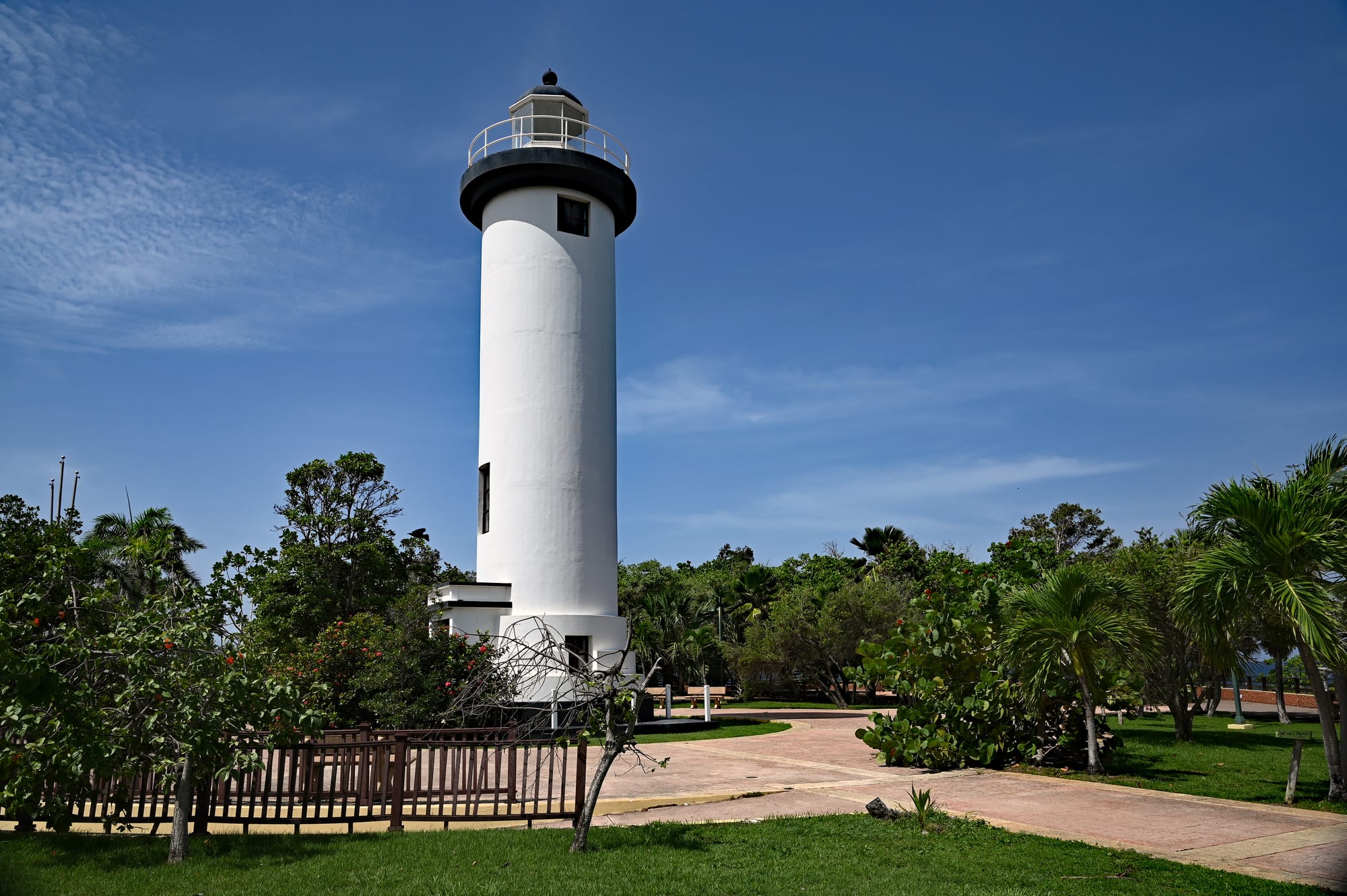
A white cylindrical lighthouse with a black lantern gallery among palms and shrubs in a park under a blue sky

Puerto Rico

Rincón

The Punta Higüero lighthouse in El Faro Park, Rincón. (P. Hughes / Wikimedia Commons · CC BY 4.0)

A beach town and municipality on the westernmost tip of Puerto Rico's main island, founded in 1771. The 1968 World Surfing Championship put its winter waves on the map, and surfers, sunset-watchers and, in winter, whale-watchers at the lighthouse park have made tourism its main industry, alongside a small town centre and a decommissioned nuclear reactor.

Neighbourhoods

  • Rincón Pueblo
    • Local life
    • Shopping

    The town centre and seat of the municipality, laid out around a Spanish-style plaza with a Catholic church and municipal buildings, surrounded by streets of shops and small local restaurants.

    Open in Maps
  • Puntas and the north-west point
    • Surfing
    • Sunsets
    • Whale watching

    The coast around Punta Higüero, the westernmost point of the main island, with the lighthouse park, Domes and Maria's beaches and the old reactor dome. Route 413 winds through it past surf shops, guesthouses and restaurants.

    Open in Maps
  • Ensenada and Tres Palmas
    • Snorkelling
    • Surfing
    • Quiet

    A coastal barrio south of the point, with Steps Beach, popular with surfers, inside the Tres Palmas Marine Reserve, which stretches along the coast between Ensenada and Puntas.

    Open in Maps

Things to do

Surf and beaches

  • Domes Beachbeach

    The north-west beach, also called Lighthouse Beach and Maria's Beach, known for surfing and considered a dangerous beach; it hosted the 1968 World Surfing Championship.

    Open in Maps

Landmarks and viewpoints

  • Punta Higüero Light and El Faro Parkviewpoint

    A lighthouse first built by Spain in 1892 and rebuilt in 1922 after the 1918 earthquake, inside a town park that is a popular spot for watching surfers, sunsets and whales.

    Open in Maps
  • BONUS Reactor Facilitylandmark

    Puerto Rico's only nuclear reactor, operated in the mid-1960s and shut down in 1968, known locally as 'the Domes', the name the beach below also carries; it is listed on the National Register of Historic Places.

    Open in Maps

Short trips from the town

  • Mayagüezattraction

    The main city of the west coast, south along Route 115, known as the 'Sultaness of the West' and for its mangoes.

    Open in Maps

Seasonal events

  • Whale watchingJanuary and February

    Humpback whales pass close to the coast, and the lighthouse park is the best-known place to watch them.

  • Humpback Whale FestivalMarch

    A town festival around the whale season.

  • Rincón International Film FestivalApril

    An annual film festival in the town.

  • Coconut FestivalMay

    A local festival celebrating the coconut.

  • Fiestas Patronales de Santa Rosa de Limayearly

    The patron-saint festival, with parades, games, artisans, rides, regional food and live music.

Eat and drink

Long-standing places and food districts in Rincón. Hours, ratings and directions come from your maps app, always current.

Rincón classics

  • El Fogón de la Curvarestaurant

    A roadside restaurant on the curve of Route 115 into town, with sea views, serving traditional Puerto Rican dishes including lechón and fresh fish.

    Open in Maps
  • El Pequeño Guavaterestaurant

    A restaurant of traditional Puerto Rican food — mofongo, lechón, arroz con gandules and yuca.

    Open in Maps
  • Antojo'srestaurant

    A place for local food on Route 115 in the town centre.

    Open in Maps

Food districts

  • Rincón Puebloneighborhood

    The small restaurants and bakeries around the plaza in the town centre.

    Open in Maps

Experience Rincón

History

Rincón — Spanish for "corner" or "nook", fitting a town on the westernmost tip of Puerto Rico's main island — was founded in 1771 by Don Luis de Añasco, who had founded the neighbouring town of Añasco in 1733. The first US census of the island, in 1899, counted 6,641 people. The Punta Higüero lighthouse was built by the Spanish government in 1892, badly damaged in the earthquake of 1918, and rebuilt by the United States in 1922.

In the 1960s Rincón became the site of Puerto Rico's only nuclear reactor. Construction of the Boiling Nuclear Superheater (BONUS) facility began in 1960; it reached its first chain reaction in 1964 and full power in 1965, but was shut down in June 1968 because of technical difficulties and the cost of the modifications it needed. The building was decontaminated, and locals know it as "the Domes", the name the beach below also carries.

The same year transformed the town. The 1968 World Surfing Championship was held at Domes and Maria's beaches, and surfers from around the world have come ever since. Tourism became the main industry, and Rincón hosted the ISA World Masters in 2007. Hurricane Maria struck in September 2017, and the coast's high levels of erosion leave the town vulnerable to major hurricanes.

Culture & Customs

Surfing defines Rincón's identity. The town is known as the capital of surfing and nicknamed the "Caribbean's Hawaii", with winter waves that can approach 25–30 feet. Famous breaks include Little Malibu, Tres Palmas, Maria's, Indicators, Domes, Pools, Sandy Beach and Antonio's, and surf schools and shops line the roads. Rincón is also known as the town of beautiful sunsets, watched from the lighthouse park and the beaches.

The town has the highest share of non-Hispanic residents of any municipality on the main island, 5.1 per cent in 2020, up from 3.6 per cent in 2010. The plaza, the church and the town's festivals keep the rhythm of a Puerto Rican pueblo.

The calendar mixes the two. Whale-watching season in January and February is followed by a Humpback Whale Festival in March, the Rincón International Film Festival in April and a Coconut Festival in May, and the Fiestas Patronales de Santa Rosa de Lima bring parades, games, artisans, rides, regional food and live music.

Daily Life

Rincón had about 15,200 people at the 2010 census, and between 2010 and 2020 it recorded the smallest population decline of any municipality in Puerto Rico — a fall of just 13 people at a time when no municipality recorded an increase. It belongs to the Aguadilla–Isabela–San Sebastián metropolitan area and is divided into nine barrios plus the town centre.

Tourism is the main industry: surfing above all, but also scuba diving, snorkelling, boat trips and sunset-watching, which support guesthouses, surf schools, restaurants and shops. Life follows the swell and the seasons, busiest in the winter surf season and quieter in summer. Shops line the street of the town centre and Route 413, and for larger shopping residents drive to the malls of Aguadilla.

The coast suffers high levels of erosion, which leaves the town vulnerable in a major hurricane. Like the rest of the island, Rincón is affected by the fragile power grid.

Food

Rincón eats the cocina criolla of Puerto Rico. Mofongo, fried green plantain mashed with garlic and pork crackling, is the signature plate, often served with seafood; arroz con gandules, rice with pigeon peas, comes with lechón, roast pork, and yuca, cassava, is a common side. Roadside restaurants on the way into town serve traditional dishes and the day's fresh fish.

Snacks are part of beach life: empanadillas, fried turnovers, and the fritters of the Puerto Rican coast — alcapurrias and bacalaítos, salt-cod fritters — eaten with a cold Medalla beer. Fish and lobster from local waters appear on menus across the town, alongside restaurants that serve its surfers and newcomers.

To drink, rum is the island spirit, and the piña colada, claimed as a San Juan invention, is a standard beach order. Puerto Rico's highland coffee, grown especially around Yauco, is the usual morning cup, and the town holds a Coconut Festival each May.

Planning tools

Budget

Rincón is priced like the rest of Puerto Rico, with sales tax added at the register. Guesthouses and holiday rentals are the main cost and fill up in the winter surf season. Surf lessons, board hire and boat trips add to the bill; the beaches, the lighthouse park and the sunsets are free.

Daily Budget Midrange
USD 180–380 (guesthouse or small hotel, restaurants with tax and tips, rental car, a surf lesson or boat trip)
Daily Budget Shoestring
USD 70–120 (guesthouse room or shared rental, local food, a rental car shared)

A rental car is close to essential — the beaches are spread along narrow roads with little public transport.

Best Time to Visit

Winter brings the big surf and the island's drier season, and humpback whales are seen in January and February. Summer is quieter, and August to October is the peak of the hurricane season.

Suggested Number of Days

Two to four days suit a first visit. Surfers often stay a week or more for the winter swells, and the rest of the west coast adds time.

First Visit
2–4 days
With Surroundings
5–7 days

Transportation

Rincón is spread along Route 115 and the winding Route 413, and the narrow roads connect beaches, guesthouses and the town centre that are too far apart to walk between. There is little public transport, so most visitors drive; local taxi and transport services can be booked.

Drive carefully on Route 413 and the town's other narrow roads, and park off the road at the beaches.

Airport & Station Connections

Most visitors fly into Luis Muñoz Marín International Airport in San Juan, about two and a half hours' drive away. Rafael Hernández Airport in Aguadilla is about 30 minutes north along Route 115, and the small Eugenio María de Hostos Airport near Mayagüez about 20 minutes south.

Walkability

The town centre around the plaza is easy on foot, and short stretches of coast can be walked between neighbouring beaches. Otherwise the town is spread out along narrow roads, and a car is needed.

Safety

Puerto Rico has a higher violent-crime rate than most US states, but it is concentrated in specific areas and largely tied to the drug trade; tourists are rarely the target. In Rincón the main dangers are in the water: the winter surf is powerful, and Domes Beach is considered dangerous.

Swim only where the water is calm, ask locally about currents, leave the big winter breaks to experienced surfers, and keep valuables out of parked cars. Check current official travel advice before travelling.

Climate

Tropical, warm and humid year-round; across the island's coasts daytime temperatures are around 82–88°F. December to April is the drier season, and May to November is wetter and overlaps the Atlantic hurricane season.

Summer
hot and humid, with daytime temperatures of around 82–88°F on the island's coasts, with more rain and the risk of tropical storms
Winter
warm and drier, still around 82–88°F by day on the island's coasts, with the big surf season

Local Customs

Rincón has the highest share of non-Hispanic residents of any municipality on the main island, though Spanish is the town's everyday language. Tipping of around 18–20 per cent is expected in restaurants.

Surf etiquette matters: surfers take turns and do not drop in on a wave someone else is riding. Cover up from the beach in town and in church.

Common Payment Methods

The currency is the US dollar. Cards and mobile payment are widely accepted; carry small bills for roadside food stalls and tips.