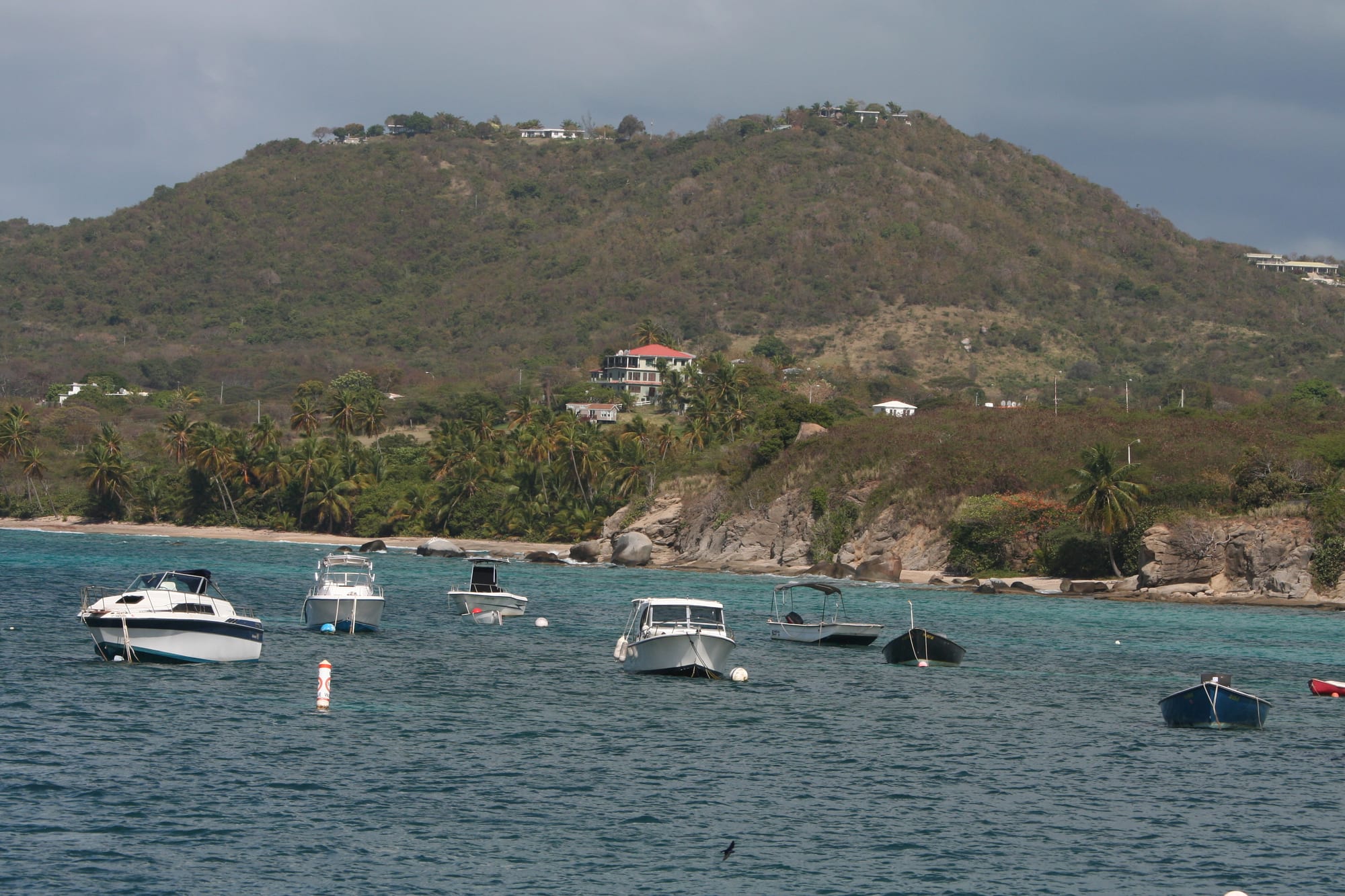
Small motor boats moored in a turquoise bay below a green hill dotted with houses and palm trees under a grey sky

Puerto Rico

Vieques

Boats moored off Esperanza on the south coast of Vieques. (Steven Isaacson / Wikimedia Commons · CC BY-SA 2.0)

An island municipality about 8 miles east of Puerto Rico's main island, once a sugar island and for six decades largely a US Navy bombing range. Since the Navy left in 2003 most of its land has been a national wildlife refuge, and two small towns, free-roaming horses, quiet beaches and the glowing water of Puerto Mosquito draw visitors.

Neighbourhoods

  • Isabel Segunda
    • Local life
    • Historic district
    • Ferry and flights

    The main town and administrative centre on the north coast, where most of the island's people live. Its plaza, Catholic church and municipal buildings are surrounded by streets of shops, and the 19th-century Spanish fort stands on the hill above the port.

    Open in Maps
  • Esperanza
    • Beaches
    • Best for food
    • First-time visitors

    A smaller community on the south coast that caters more to visitors, strung along a seafront promenade with restaurants, food kiosks and shops beside Esperanza Beach and its pier. Boat trips to the bioluminescent bay leave from nearby.

    Open in Maps
  • The former Navy lands
    • Beaches
    • Nature
    • Quiet

    The eastern and western ends of the island, used by the US Navy until 2003 and now a national wildlife refuge of dry forest, mangroves, lagoons and beaches. Parts are open to the public, while much remains closed while unexploded munitions and contamination are cleared.

    Open in Maps

Things to do

Nature and beaches

  • Puerto Mosquitopark

    The bioluminescent bay whose water glows blue when disturbed, drawing visitors on nights of very little moonlight; it is protected as a nature reserve, and swimming is not allowed.

    Open in Maps
  • Vieques National Wildlife Refugepark

    The refuge on the former Navy lands, with beaches, coastal lagoons, mangroves and some of the best sub-tropical dry forest in the Caribbean, plus coral reefs and sea-grass beds offshore.

    Open in Maps
  • Esperanza Beachbeach

    A popular beach beside Esperanza, unlike most on the island close to town, with a pier that is a local landmark and restaurants and kiosks behind it.

    Open in Maps

History

  • Fortín Conde de Mirasolmuseum

    A small Spanish fort of 1845 on the hill above Isabel Segunda, restored in 1991 and home to the Vieques Museum of Art and History and the island's historic archives.

    Open in Maps
  • Punta Mulas Lightlandmark

    A lighthouse on the north shore first lit in 1896 to guide ships past a chain of reefs, restored in 1992 and now a museum of the island's maritime history.

    Open in Maps

Seasonal events

  • Fiestas patronalesJuly

    The island's patron-saint festival, celebrated each July.

Eat and drink

Long-standing places and food districts in Vieques. Hours, ratings and directions come from your maps app, always current.

Food districts

  • Esperanza seafrontneighborhood

    The restaurants, bars and food kiosks along the promenade behind Esperanza Beach, where most visitors eat.

    Open in Maps
  • Isabel Segunda town centreneighborhood

    Local eateries and bakeries around the plaza and the streets near the ferry pier in the island's main town.

    Open in Maps

Experience Vieques

History

The island's name is a Spanish spelling of a Taíno word said to mean "small island", and its nickname, Isla Nena, casts it as Puerto Rico's little sister; under the British it was known as Crab Island. In the early 16th century Vieques became a centre of Taíno rebellion against the Spanish, who sent armed forces and killed, imprisoned or enslaved the native people. In the 19th century the town of Isabel Segunda was founded under Governor Francisco Saínz, and in the second half of the century thousands of enslaved Africans were brought to work the sugar plantations.

Sugar declined in the 1920s and 1930s, and in 1941 the US Navy bought or seized almost 80 per cent of the island as an extension of the Roosevelt Roads Naval Station. Farm workers without title to their land were evicted, the sugar industry collapsed, and for some sixty years the Navy used much of Vieques for live-fire training and weapons testing.

Protests grew over the decades and came to a head in 1999, when David Sanes, a Vieques-born civilian employee of the Navy, was killed by a misfired bomb. A campaign of civil disobedience followed, with hundreds of protesters detained and support from well beyond Puerto Rico. The Navy withdrew in May 2003; much of its land became a national wildlife refuge and was listed for federal Superfund cleanup, which is expected to continue into the 2030s. Hurricane Maria in 2017 caused major damage and a near-total shutdown of the island's tourism.

Culture & Customs

Viequenses have a strong island identity shaped by the Navy years. The long campaign against the bombing range became a cause célèbre, and it has been taken up in songs by artists including the rock band Puya and the reggaeton musician Tego Calderón. The struggle remains part of how the island sees itself, and the clean-up of the old ranges and its health effects are still debated.

Life runs at an unhurried rural pace. The island is known for its paso fino horses, owned by local families but left to roam free over parts of the island, so horses and chickens are an everyday sight in the streets and along the roads. Isabel Segunda's plaza and church are the centre of community life, and the patron-saint festival in July is the main local celebration. Esperanza, on the south coast, has a more visitor-oriented feel, with its promenade and pier.

The island is promoted for ecotourism, built on its undeveloped beaches, the wildlife refuge and the bioluminescent bay. Spanish is the everyday language, and visitors are expected to respect the slow rhythm, the protected bay and the closed areas of the old ranges.

Daily Life

Vieques had 8,249 people at the 2020 census, making it one of the least populous municipalities in Puerto Rico; most live in and around Isabel Segunda, with a smaller community at Esperanza. The former civilian area occupies roughly the central third of the island, between the refuge lands to the east and west.

The economy has been fragile since the sugar plantations closed and the Navy left. Fishing and small farming were long the main livelihoods; today the Navy clean-up is the island's largest employer, and tourism is the other mainstay, so the island depends heavily on visitors and on the ferry and small planes that connect it to the main island. Almost everything is shipped in, which raises the cost of living.

Health care is a pressing issue. The island's only hospital was damaged by Hurricane Maria; federal funds to rebuild it were approved in 2020, construction began in 2023, and as of November 2024 it was not yet complete. Residents have also long raised concerns about the health effects of decades of military training.

Food

Food on Vieques is the cocina criolla of Puerto Rico: rice with pigeon peas, stewed beans, fried plantains as tostones or sweet amarillos, and mofongo, mashed fried green plantain with garlic and pork crackling. Fritters such as alcapurrias and bacalaítos, salt-cod fritters, and a cold Medalla beer are island-wide favourites.

Most visitors eat in Esperanza, where restaurants, bars and food kiosks line the promenade behind the beach and the pier, while Isabel Segunda has more local eateries and bakeries around the plaza and the ferry dock. Almost all food is brought over from the main island, which raises the cost of living.

Rum is the island's spirit, and the piña colada, claimed as a San Juan invention, is a familiar order at the beach bars. Fishing and small farming were long the island's livelihoods. As on the main island, rice, beans and plantains are the everyday base of a meal, and fritters and other fried snacks are the usual quick bite at the beach kiosks.

Planning tools

Budget

Vieques costs at least as much as the main island. Almost everything, food included, is shipped in from the main island, which pushes up the cost of living, and rental cars, guesthouses and bio-bay tours are the main expenses. Beaches and the refuge cost little or nothing.

Daily Budget Midrange
USD 180–380 (guesthouse or small hotel, restaurant meals with tax and tips, a rental car, a bio-bay tour)
Daily Budget Shoestring
USD 70–120 (guesthouse room, kiosk meals, públicos or a shared rental car)

Book the ferry or flight and any rental car before arriving, especially in high season; the refuge beaches are free.

Best Time to Visit

December to April is the drier, busiest season, when the ferry sells out most often. May to November is quieter and wetter and overlaps the hurricane season, with the highest risk from August to October. The bioluminescent bay shows best on nights with little or no moonlight.

Suggested Number of Days

Two or three days give time for the beaches, both towns and a night on the bioluminescent bay. Four or five suit a slower beach stay. Ferry timings and the moon phase are what most often change the plan.

First Visit
2–3 days
With Surroundings
4–5 days

Transportation

Renting a car or jeep on the island is the usual way to reach the beaches, and agencies can meet the ferry. Públicos, shared vans, wait at the ferry terminal, and taxis run between the airport, Isabel Segunda and Esperanza. Bicycles can also be hired.

Many refuge beaches are reached by rough roads; drive slowly and give way to the horses that wander the roads.

Airport & Station Connections

Passenger ferries cross several times a day from Ceiba on the main island to Isabel Segunda; they sell out in high season and the service can be intermittent. Antonio Rivera Rodríguez Airport has small planes, typically six to eight seats, to Ceiba and to San Juan's two airports, with views over the islands on the way.

Walkability

Isabel Segunda and Esperanza are small enough to cover on foot, and Esperanza's seafront is pleasant to stroll. The beaches, the refuge and the lighthouse are spread across an island about 20 miles long, so a car is needed to reach them.

Safety

Puerto Rico has a higher violent-crime rate than most US states, but it is concentrated in specific areas and largely tied to the drug trade; tourists are rarely the target. On Vieques the particular concerns are the closed parts of the former Navy lands, where unexploded munitions are still being cleared, and limited medical care: the island's only hospital, damaged by Hurricane Maria, was still being rebuilt as of late 2024.

Keep to the open, signed areas of the refuge and never pick up metal objects on beaches or in the bush; leave nothing visible in parked cars, and bring any medicines needed for the stay. Check current official travel advice before travelling.

Climate

Warm, relatively dry and tropical, with little change through the year. The wetter months, May to November, overlap the Atlantic hurricane season.

Summer
hot — average daily highs reach about 90°F in September
Winter
warm and drier — average daily highs of about 85°F in January, with nights around 18°F cooler

Local Customs

Island life is slow and informal, and Spanish is the everyday language. Horses and chickens roam the streets. Tipping of around 18–20 per cent is expected in restaurants, and sales tax is added to bills.

Cover up from the beach in town, greet people in Spanish where possible, and do not feed or approach the free-roaming horses.

Common Payment Methods

The currency is the US dollar. Cards are accepted in most restaurants and shops, but carry cash and small bills for kiosks, públicos and tips.