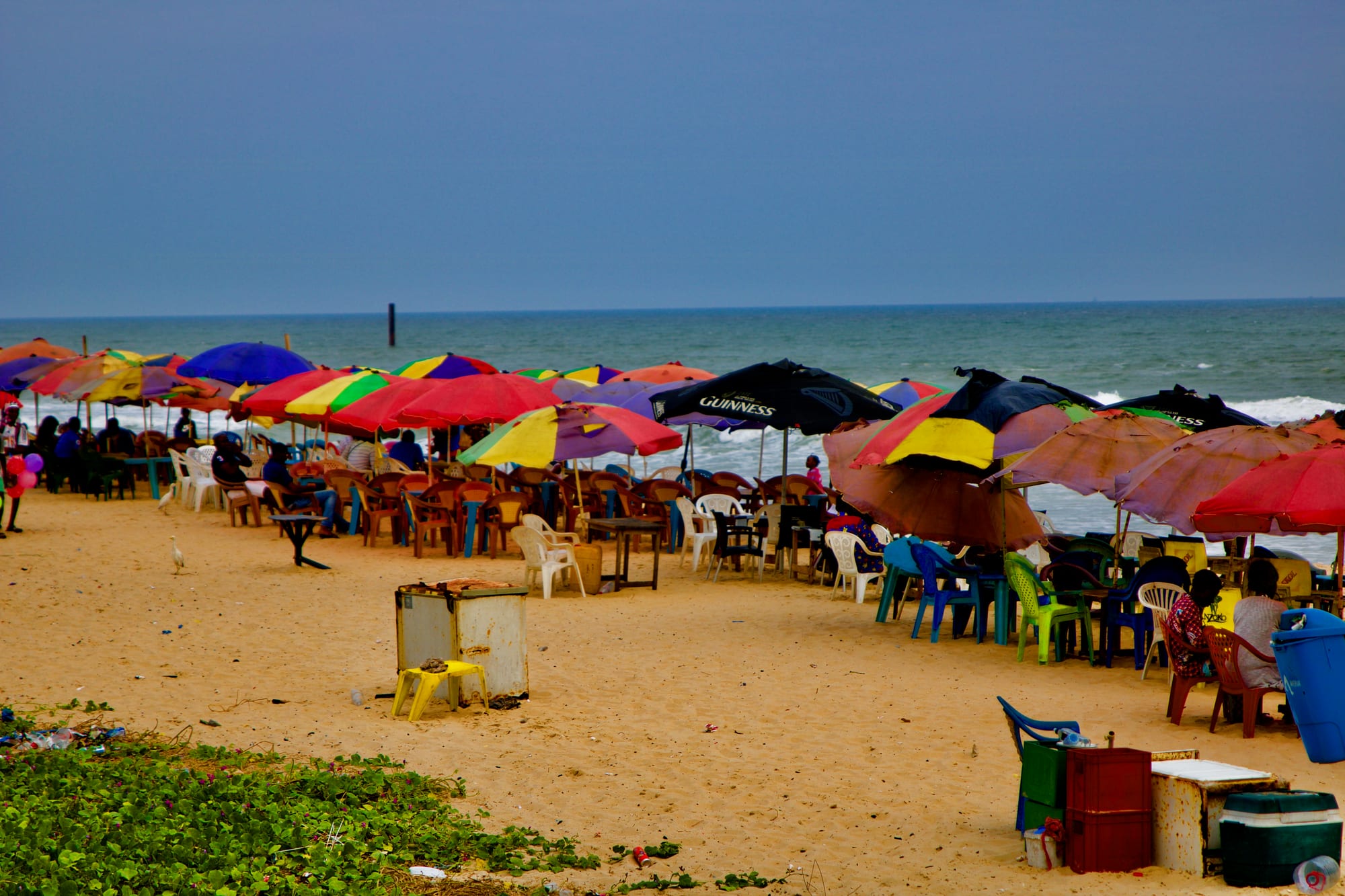
Rows of bright red, yellow and blue parasols and plastic chairs on a sandy beach beside grey-green Atlantic surf

Brazzaville, Pointe-Noire & the South, Republic of the Congo

Pointe-Noire

Parasols and beach bars on the Atlantic shore at Pointe-Noire. (Krissima POBA NGOUMA / Wikimedia Commons · CC BY-SA 4.0)

The Republic of the Congo's Atlantic port and second city, built from the 1920s as the ocean terminus of the railway from Brazzaville and now the base of the country's offshore oil industry. Beyond the container quays and oil offices are long beaches, the old Loango coast to the north and the red cliffs of the Diosso gorge.

Neighbourhoods

  • Centre-ville (Lumumba)
    • First-time visitors
    • Business
    • Close to transport

    The grid of avenues laid out beside the port, holding the banks, oil company offices, the cathedral, the railway station and most hotels. It is the most walkable part of the city and the closest to the working harbour.

    Open in Maps
  • The Côte Sauvage
    • Beaches
    • Seafood
    • Sunsets

    The open Atlantic shore running north-west from the centre, backed by beach bars, grills and weekend crowds. The sand is wide and the surf heavy, and the currents make swimming a matter of care.

    Open in Maps
  • Tié-Tié
    • Markets
    • Local life

    A large, densely built inland district east of the centre, with one of the city's busiest market areas and streets of small workshops, bars and churches. It is a good place to see everyday Pointe-Noire away from the oil economy.

    Open in Maps
  • Mvou-Mvou
    • Local life
    • Close to the railway

    The old quarter laid out for Congolese workers as the port and railway were built, just inland of the centre. It remains dense and busy, with market streets, small restaurants and music bars.

    Open in Maps
  • Loandjili and Ngoyo
    • Quiet and residential
    • Airport access

    The spreading outer districts, Loandjili to the north and Ngoyo to the south-east beside Agostinho-Neto airport, home to much of the city's growing population. They are largely residential, with local markets rather than sights.

    Open in Maps

Things to do

Beaches and the shore

  • Côte Sauvage beachesbeach

    The long Atlantic beach north of the centre, lined with bars and grills and busiest at weekends, with strong currents and cool water in the dry season.

    Open in Maps
  • The Pointe-Noire seafrontviewpoint

    The shoreline road and promenade where the city meets the ocean, looking out over the shipping anchored off the oil terminal.

    Open in Maps

Landmarks

  • Pointe-Noire railway stationlandmark

    The ocean terminus of the Congo-Ocean Railway, designed in the early 1930s and inaugurated in 1934, and the city's best-known piece of colonial architecture.

    Open in Maps
  • St Peter the Apostle Cathedrallandmark

    The Catholic cathedral in the centre, seat of the diocese created in 1955 and raised to an archdiocese in 2020.

    Open in Maps
  • Agostinho-Neto International Airporttransit hub

    The city's airport, about 4 km from the centre, inaugurated in 1934 and given a new passenger terminal in 2006, with domestic and international flights.

    Open in Maps

Markets and the working city

  • Tié-Tié marketmarket

    A large market in the Tié-Tié district, spread over streets of stalls selling cassava, plantain, fish, cloth and household goods.

    Open in Maps
  • The port and oil terminallandmark

    The deepwater harbour that gave the city its purpose, handling containers for the region and the crude pumped from the fields offshore.

    Open in Maps

Short trips from the city

  • Diossoattraction

    A town about 20 km north of the city, the old royal seat of the Kingdom of Loango and the site of its rulers' mausoleum, beside the eroded red cliffs of the Diosso gorge, called the Grand Canyon of the Congo and reaching some 50 m in height.

    Open in Maps
  • Loango Slavery Harbourlandmark

    The bay north of Pointe-Noire, one of the most important points of embarkation in the Atlantic slave trade on this coast, through which captives passed for centuries; the site is on the country's World Heritage tentative list.

    Open in Maps
  • Tchimpounga Sanctuaryattraction

    A chimpanzee rehabilitation centre run by the Jane Goodall Institute, opened in 1992 in a reserve north of the city, caring for animals rescued from the bushmeat and pet trades.

    Open in Maps
  • Conkouati-Douli National Parkpark

    Lagoons, mangroves, savannah and forest on the coast towards Gabon, established as a park in 1999, with forest elephants, chimpanzees, gorillas and beaches of international importance for nesting leatherback turtles.

    Open in Maps

Seasonal events

  • Sea-turtle nesting seasonOctober to April

    Leatherback turtles come ashore to nest on the beaches north of the city and in Conkouati-Douli, whose shore is among the world's most important for the species.

  • The cool dry season on the coastJune to September

    The months when the sea is at its coolest and the sky stays grey for weeks, and the beach bars are quieter than in the rains.

  • Independence Day15 August

    The national holiday marking independence from France in 1960, marked with parades, football and public celebrations.

Eat and drink

Long-standing places and food districts in Pointe-Noire. Hours, ratings and directions come from your maps app, always current.

Pointe-Noire classics

  • Grilled Atlantic fish on the Côte Sauvageneighborhood

    Beach grills serve whole fish, above all the capitaine, with fried plantain and chilli sauce, alongside prawns landed by the city's fishing boats.

    Open in Maps
  • Saka-saka and chikwangue kitchensrestaurant

    Local eating houses across the city serve pounded cassava leaves cooked with palm oil and smoked fish, with the leaf-wrapped cassava loaf called chikwangue.

    Open in Maps

Markets and food districts

  • Tié-Tié market areamarket

    A busy market district selling cassava, plantain, safou, smoked and salted fish, and cooked food through the day.

    Open in Maps
  • The fish landingsmarket

    Pirogues and small boats land sardines, mackerel and larger fish on the beach and by the port, sold fresh or smoked on the spot.

    Open in Maps
  • Centre-ville restaurantsneighborhood

    The blocks around the port and the main avenues hold the city's French, Lebanese and West African restaurants, serving the oil-sector population.

    Open in Maps

Experience Pointe-Noire

History

Pointe-Noire takes its name from the dark rocky point that Portuguese navigators marked on their charts in the fifteenth century. For centuries the coast belonged to the Kingdom of Loango, ruled by the Vili from a capital near present-day Diosso, and the bay at Loango just to the north was one of the great slave-trading harbours of the Atlantic, trading with French, Dutch and English merchants.

The modern city dates from 1923, when the French chose a fishing village on the bay as the ocean terminus of the Congo-Ocean Railway. The line to Brazzaville, built between 1921 and 1934 across the Mayombe hills, cost the lives of many thousands of forced labourers, and a deepwater port was built with it. From 1950 to 1958 Pointe-Noire served as the capital of the colony of Middle Congo, and the town grew quickly around the quays, the station and the workers' quarters inland.

Offshore oil changed everything again. The fields found off this coast and exploited from about 1980 drew international companies, service firms and a steady migration from the interior. The city largely escaped the worst of the fighting that struck Brazzaville in the 1990s and absorbed people fleeing it. It has kept growing since, with the port expanded to handle container traffic for the wider region, while the wealth from the fields offshore has been slow to reach most of its residents.

Culture & Customs

This is Vili country, and the coastal identity is distinct from that of the capital. Kituba and Vili are heard alongside French, and the Loango past is a living reference: the Ma Loango, the traditional ruler, remains a figure of respect, and the old royal seat at Diosso, with the mausoleum of the Loango kings, keeps that history in view; Vili masks and nkisi power figures are held in museums far beyond the Congo.

The city is also the most cosmopolitan in the country. Decades of oil work have brought French, Lebanese, West African and more recently Chinese communities, and their restaurants, shops and places of worship sit among Congolese ones. Migrants from the Niari valley, the Pool and the north have made it a Congolese melting pot, and Lingala rumba is as common in the bars as coastal styles.

Religion is prominent, with Catholic and Protestant churches alongside revivalist congregations that fill Sunday mornings with singing. Football is followed closely and played on every patch of sand. Weekends belong to the beach: families and groups of friends take over the grills and bars along the shore from midday, and the sunset over the Atlantic is the city's shared ritual. Greetings are unhurried, and elders are addressed with care.

Daily Life

About 1.42 million people lived in Pointe-Noire in 2023, making it the country's second city and, by most measures, its economic capital. Oil dominates: the offshore fields, the service companies and the terminal provide the salaries that set prices in the city, while the container port handles much of the country's trade and a share of its neighbours'. Fishing, from industrial boats and from pirogues on the beach, employs many more, and the great majority of people work in informal trade and transport.

The centre of banks and oil offices sits close to dense districts such as Mvou-Mvou and Tié-Tié and to the spreading outer quarters of Loandjili to the north and Ngoyo to the south-east, where most of the growth is happening. Power cuts, water shortages and flooding on unpaved streets in the rainy season are routine, and rents in the centre are high because of the expatriate market.

Days start early, with markets full by seven and shared taxis crowding the avenues before the heat sets in. Coastal erosion has become a serious local issue, eating into parts of the shore and the road along it. Evenings are for the grills, the bars and football on television.

Food

The Atlantic is on the plate here in a way it is not in Brazzaville. Capitaine, sardines, mackerel and prawns are grilled over charcoal or fried, sold at beach grills and market stalls, and much of the catch is smoked or salted for sale inland. Fish cooked as maboké, seasoned and steamed in a parcel of banana or cassava leaves, is a coastal favourite as much as a river one.

The staples are the country's: cassava as fufu or as chikwangue, the dense loaf steamed in leaves, and saka-saka, cassava leaves pounded and simmered for hours with palm oil, onion and smoked fish. Plantain is fried or grilled beside them, and poulet moambé, chicken in a sauce of palm-fruit pulp, is the dish most often called national. Grilled goat, ntaba, is the standard with a beer in the evening.

Safou, the purple fruit roasted or boiled with salt, comes into the markets in season, and mikaté, small fried dough balls, are a roadside breakfast. Palm wine arrives from the villages of the Kouilou, bottled lager is drunk everywhere, and ginger juice and bissap made from hibiscus flowers are the everyday soft drinks. The city's Lebanese and French restaurants add a layer that reflects the oil industry's long presence.

Planning tools

Budget

Pointe-Noire is the country's most expensive city. Hotels and restaurants are priced for the oil industry, and imported food and drink cost European prices or more. Beaches, markets and shared taxis cost little, so the gap between a local and an expatriate day is very wide.

Daily Budget Midrange
USD 160–310 (business-standard hotel, restaurant meals, hired car with driver)
Daily Budget Shoestring
USD 60–110 (simple hotel, market and street food, shared taxis)

Bring euros in cash to change; cards work only in a few hotels and supermarkets, and cash machines are unreliable.

Best Time to Visit

June to September is the dry season and the easiest time for road travel, though the coast turns grey and the sea is cool. The rainy months from October to May are hotter and brighter between storms, with warmer water and the turtle nesting season on the beaches north of the city.

Suggested Number of Days

Two days is enough for the city and its beaches. Four suit anyone adding the coast and the country to the north, where distances are long and roads slow. Sea conditions and the weather change the appeal of the shore from season to season.

First Visit
2 days
With Surroundings
4 days

Transportation

Shared taxis and minibuses run the main avenues and are how most people move; a taxi can also be hired privately by agreeing the fare first. Many visitors use a car and driver arranged through a hotel. The centre and the port area are congested in the morning and late afternoon, and unpaved streets in the outer districts flood in the rains.

Agree the fare before getting into a taxi, and allow extra time for traffic and checkpoints near the port.

Airport & Station Connections

Agostinho-Neto International Airport is a few kilometres from the centre and handles domestic flights from Brazzaville and international services to other African cities; the hop from the capital takes about an hour. The Congo-Ocean Railway reaches the city from Brazzaville slowly and irregularly, and buses and shared vehicles use the paved highway through Dolisie, the better part of a day on the road.

Walkability

The central grid between the port, the station and the cathedral is walkable, and the beachfront is a pleasant stretch on foot in the cooler hours. Beyond that the city is spread out, pavements are broken or missing, and heat and traffic make longer walks tiring; shared taxis cover the distances.

Safety

Street crime is the main risk, above all after dark and around markets, the beaches at night and transport hubs, where bag-snatching and pickpocketing occur. Police checkpoints are frequent and identity documents are asked for, and photography of the port, oil installations and official buildings is prohibited. The Atlantic surf has strong currents and rip tides.

Use arranged transport at night, carry ID and the yellow fever certificate, do not photograph the port, oil installations or official buildings, and swim only where locals do. Check current official travel advice before travelling.

Climate

Hot and humid, tempered by the ocean. The long rainy season runs from about October to May with heavy downpours and bright spells; June to September is dry, cooler and often overcast for days at a time, with temperatures averaging about 24°C against about 28°C in the wet months.

Summer
rainy season, hot and humid, around 24–32°C, with heavy showers and warm sea
Winter
dry season from June to September, grey and milder, around 20–28°C, with cool sea water

Local Customs

French is the language of business, with Vili and Kituba widely spoken on the coast and Lingala common among northern migrants. Greetings come before business and handshakes are expected. Dress is neat, and beachwear belongs on the beach rather than in town. Churches are well attended and modest dress suits a service.

Ask before photographing people, never photograph the port, refineries, soldiers or police, and keep identity documents to hand for checkpoints.

Common Payment Methods

The currency is the Central African CFA franc (XAF), pegged to the euro. Cash is used for almost everything; cards are accepted at some hotels and supermarkets serving the oil sector, and cash machines exist in the centre but cannot be relied on. Euros are the easiest currency to change.