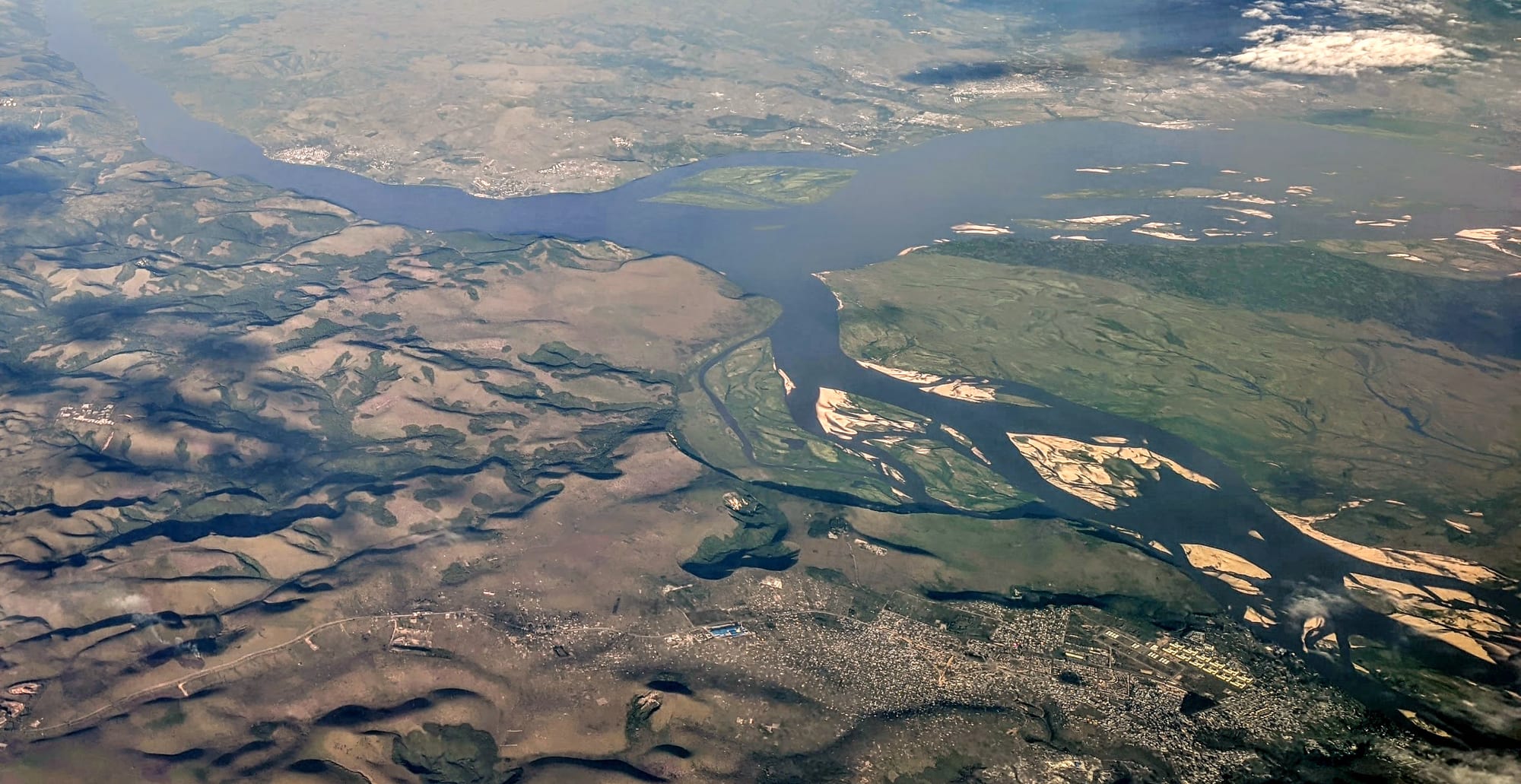
Aerial view of the wide Congo River opening into a lake-like pool with sandbanks, green islands and rolling hills around it

Republic of the Congo

Brazzaville, Pointe-Noire & the South

The Congo River widening into Pool Malebo, with the northern outskirts of Brazzaville in the foreground. (Dicklyon / Wikimedia Commons · CC BY-SA 4.0)

The southern third of the Republic of the Congo, running from the capital Brazzaville on the Congo River through the Pool, Bouenza, Niari and Lékoumou departments to Pointe-Noire on the Atlantic. The railway and highway join its two big cities, and most of the country's people, oil and trade are found here.

Explore Brazzaville, Pointe-Noire & the South

History

Before Europeans arrived the south was divided between three states. The Kingdom of Loango, ruled by the Vili from its capital near today's Diosso, held the coast; the Kingdom of Kongo's influence reached the lands south of the Niari valley; and the Teke kingdom controlled the plateaus and the river trade around Pool Malebo. From the 17th century Loango Bay was a major slave-trading harbour, dealing with French, Dutch and English merchants.

France arrived in 1880, when Pierre Savorgnan de Brazza signed a treaty with the Teke ruler, the Makoko, and set up a post on the north bank of the river that grew into Brazzaville. The town became the capital of French Equatorial Africa and, in 1940, the capital of Free France in Africa; Charles de Gaulle's Brazzaville Conference of 1944 opened the way to reform of the French empire. The Congo-Ocean Railway, built between 1921 and 1934 to link the capital to the new port of Pointe-Noire, cost the lives of many thousands of forced labourers.

After independence in 1960 the south remained the political heartland, and its rivalries shaped the 1990s. The civil wars of 1993–94 and 1997–99 were fought largely in Brazzaville's districts and in the Pool between militias loyal to rival politicians, and fighting between government forces and the Ninja militia continued in the Pool until a 2003 peace agreement, then flared again in 2016–2017 before a ceasefire in December 2017.

Culture & Customs

The south is Kongo country in the broad sense: the Lari and Sundi of the Pool and Brazzaville, the Vili of the coast, and the Bembe, Kunyi, Yombe and others of the Niari valley and the Mayombe. Kituba (Munukutuba) is the common language of the region and French the language of offices and schools, while Lingala dominates in Brazzaville's northern districts such as Poto-Poto and Talangaï.

Religion mixes Catholicism, revivalist churches and movements born here. The Lari leader André Matswa, who campaigned against colonial rule in the 1920s and died in custody in 1942, became the focus of a religious movement, Matsouanism, that lasted for decades after his death. Vili and Yombe sculptors produced the nkisi power figures now found in museums worldwide.

Brazzaville is the south's cultural engine. The Poto-Poto school of painting, founded in 1951, gave its name to a distinctive style of painting; bars in Bacongo and Poto-Poto keep Congolese rumba alive; and the sapeurs — men devoted to designer suits and elegant display — are a familiar sight in Bacongo. The city hosts the Pan-African Music Festival, known as FESPAM, every two years.

Daily Life

Brazzaville, with about two million people, and Pointe-Noire, with over a million, together hold more than half of the country's population. Dolisie, the former Loubomo, is the third city and the market town of the Niari; Nkayi, Madingou, Sibiti and Kinkala are small administrative centres.

Pointe-Noire lives on oil: the offshore fields, the service companies and the deepwater port make it the country's economic capital, though much of its population works in informal trade. Brazzaville is the city of ministries, embassies and the river trade with Kinshasa. Inland, the Niari valley and the Bouenza grow cassava, groundnuts and sugar cane, with a large sugar works at Nkayi; logging continues in the Mayombe and the Chaillu hills.

Days begin early, with markets at full volume by seven, and shared taxis and minibuses carry most people. Power cuts and water shortages are part of life in both cities, and the cost of food is a constant complaint. Weekends belong to church, family gatherings, football and the music bars.

Food

Southern cooking rests on cassava, eaten as chikwangue, the fermented dough loaf wrapped in leaves, or as fufu, and on saka-saka, pounded cassava leaves stewed with palm oil, onion and dried or smoked fish. Ngaï-ngaï, tart sorrel leaves, are cooked in a similar way, and maboké — fish cooked in a parcel of cassava or banana leaves — is eaten along the rivers.

Along the coast at Pointe-Noire the fish is from the Atlantic: grilled capitaine and sardines, prawns and smoked fish sold in the markets. In Brazzaville the street favourites are grilled goat, known as ntaba in Lingala, and fried fish at the riverside stalls, with mikaté, small fried dough balls, for breakfast. The safou, a purple fruit eaten boiled or roasted with salt, is a seasonal treat across the south.

Palm wine is sold fresh in villages and on roadsides, and bottled local lagers are sold everywhere. Ginger juice and bissap, made from hibiscus flowers, are the common soft drinks.

Attractions & Natural Wonders

Brazzaville sits on the Congo River where it widens into Pool Malebo, and its riverside Corniche looks straight across the water to Kinshasa, capital of the DR Congo. The Basilica of Sainte-Anne, with its green-tiled roof, the Sacred Heart cathedral and the white Brazza memorial, where the explorer's remains were reburied in 2006, are the main landmarks, and the Poto-Poto painting school and the Bacongo markets show the city's everyday side. On the south-western edge the river breaks into rapids that locals visit at weekends. North of the city, in Djoué-Léfini (the northern Pool until 2024), the Lésio-Louna reserve protects gorillas in a landscape of grassland and gallery forest.

On the coast, Pointe-Noire's attractions are its Atlantic beaches, the Côte Sauvage and the colonial railway station, the terminus of the Congo-Ocean line. North of the city lie Loango, with a memorial to the slave trade on the bay, and Diosso, the old Loango royal capital, where the Diosso gorge opens as a wide bowl of red and ochre cliffs above a forested floor. Diosso's former royal residence houses a regional museum.

Inland, Dolisie is the base for the Mayombe, the forested hills the railway crosses on its way to the sea. Conkouati-Douli National Park, on the coast near the Gabon border, combines lagoons, mangroves, savannah and Mayombe forest, and is home to forest elephants, chimpanzees and nesting leatherback turtles.

Cities in Brazzaville, Pointe-Noire & the South

Planning basics

Budget

The south holds both of the country's expensive cities. Brazzaville and Pointe-Noire hotels are priced for oil and government business, and restaurants aimed at expatriates charge European prices. Dolisie, Nkayi and the smaller towns are much cheaper but have only basic lodging, and cash in XAF is essential once away from the two big cities.

Daily Budget Midrange
USD 160–310 (business-standard hotel, restaurant meals, hired car with driver or a domestic flight)
Daily Budget Shoestring
USD 60–110 (simple hotel, street food and local restaurants, shared taxis and buses)

Change euros in Brazzaville or Pointe-Noire before heading inland; cash machines are scarce outside the two cities.

Safety

Street crime is the main risk in Brazzaville and Pointe-Noire, above all after dark, around markets and at bus and train stations. The Pool department saw armed conflict between government forces and a Ninja militia in the early 2000s and again in 2016–2017; a ceasefire has held since December 2017, but the area remains sensitive and checkpoints are frequent. Coastal currents off the Atlantic beaches are strong.

Use arranged transport at night, carry ID and the yellow fever certificate, do not photograph official buildings or the riverbank border area, and swim only where locals do. Check current official travel advice before travelling.

Climate

Hot and humid, with a long rainy season from about October to May and a cooler, drier, often overcast season from June to September. The coast around Pointe-Noire is cooled in the dry months by the cold Atlantic current offshore and sees grey skies for weeks at a time; the Mayombe hills and the Chaillu massif inland are wetter and a little cooler than the plateaus around Brazzaville.

Summer
rainy season, hot and humid, 25–32°C, with heavy afternoon storms
Winter
dry season, June to September, cloudy and milder, around 20–28°C, cooler still on the coast

Transportation

Brazzaville's Maya-Maya and Pointe-Noire's Agostinho-Neto airports are linked by domestic flights of about an hour. The paved national highway between the two cities takes the better part of a day by car or bus through the Pool, Bouenza and Niari. The Congo-Ocean Railway follows a similar corridor via Dolisie and the Mayombe, slowly and irregularly. Boats cross the river between Brazzaville and Kinshasa, which is in the DR Congo and needs its own visa.

Fly between the two cities if time is short; travel the highway by day and check conditions in the Pool before setting out.

Best Time to Visit

June to September, the dry season, is the most comfortable time for both cities and the easiest for road travel, though the coast is often grey and the sea cool. The rainy months make unpaved roads in the Niari, Lékoumou and Pool departments difficult, but the landscapes are at their greenest. Brazzaville's Pan-African Music Festival, held every two years, draws musicians from across the continent.