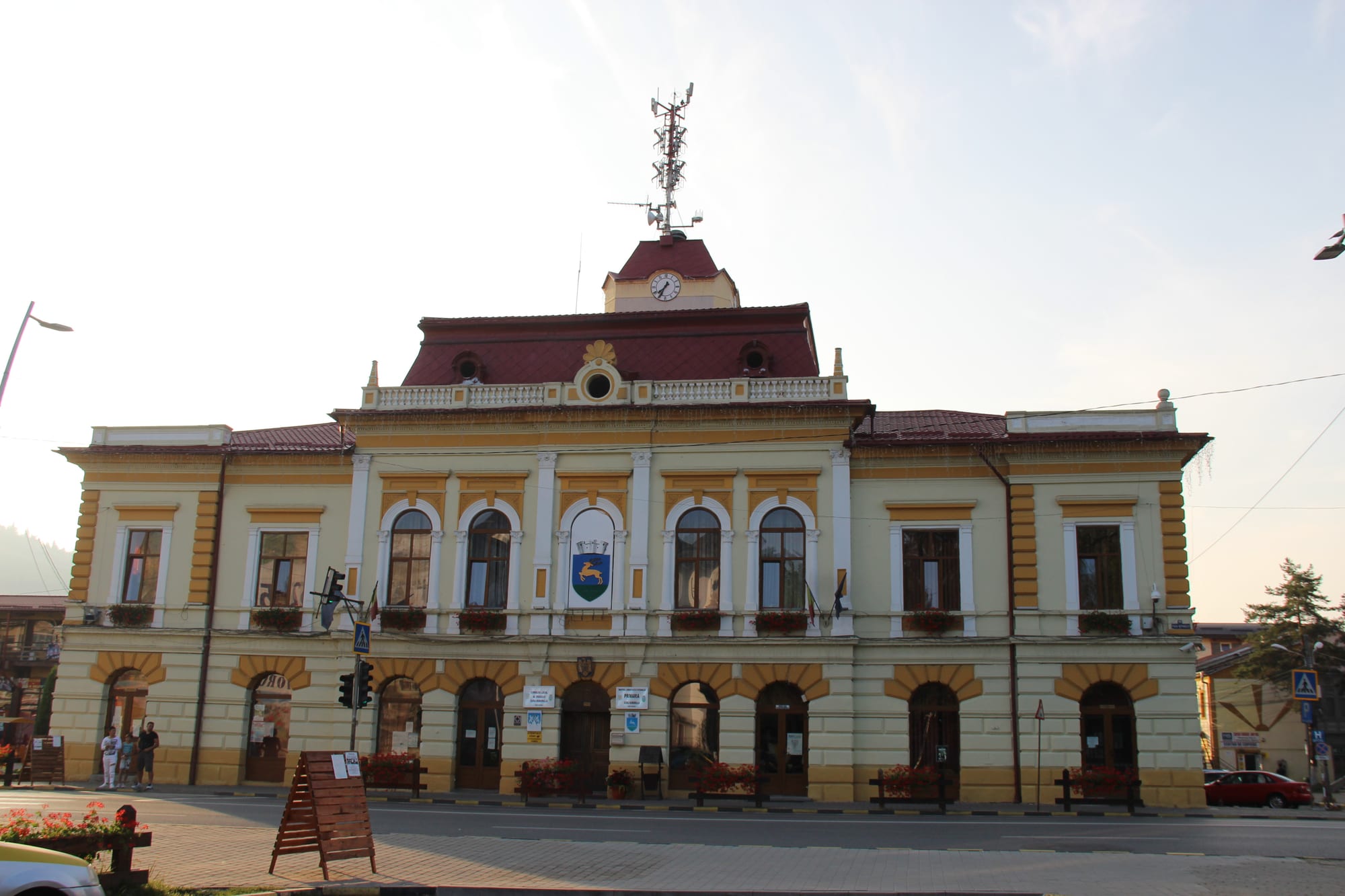
The cream and ochre town hall of Gura Humorului with a red roof, a small clock tower and flower boxes under its windows

Moldavia & Bucovina, Romania

Gura Humorului

The town hall of Gura Humorului. (Gary Todd from Xinzheng, China / Wikimedia Commons · CC0)

A small town in southern Bukovina where the Humor river meets the Moldova, at the eastern edge of the forested Obcinele Bucovinei hills. A Habsburg-era market town with a once-large Jewish community, it became a national tourist resort in 2005 and is the nearest base for the painted monasteries of Voroneț, inside the town's limits, and Humor.

Neighbourhoods

  • Town centre
    • First-time visitors
    • Close to public transport

    The compact centre around the main square and the town hall, with the bus and train stations close by, a handful of restaurants and pubs, and the 19th-century churches and synagogue of the old multi-ethnic town.

    Open in Maps
  • Voroneț
    • Painted monasteries
    • Quiet and rural

    A former village south of the centre, now a neighbourhood of the town, spread along a valley to Voroneț Monastery. The walk out takes about an hour and a half through open countryside.

    Open in Maps
  • Mănăstirea Humorului
    • Painted monasteries
    • Quiet and rural

    The neighbouring village about 5 km north on the Humor river, home to Humor Monastery, with guesthouses set against the wooded foothills.

    Open in Maps

Things to do

The painted monasteries

  • Voroneț Monasterylandmark

    Stephen the Great's church of 1488, whose outer walls were painted from 1547, famous for the intense 'Voroneț blue' and its depiction of Heaven and Hell; one of the UNESCO-listed churches of Moldavia.

    Open in Maps
  • Humor Monasterylandmark

    Petru Rareș's church of 1530 in the village of Mănăstirea Humorului, frescoed in 1535 by Toma of Suceava and, with Voroneț, probably the best preserved of the painted churches, with a guard tower that can be climbed for the view.

    Open in Maps

In town

  • Ariniș Dendrological Parkpark

    A park and leisure area by the Moldova river, laid out on a former pasture, with a sports complex, an indoor pool and an artificial ice rink.

    Open in Maps
  • Șoimul ski slopeattraction

    A 1,350-metre ski run with a chairlift, snow cannons and floodlights for night skiing, opened in January 2010.

    Open in Maps
  • Holy Trinity Roman Catholic Churchlandmark

    Built in 1811 and considered the oldest Roman Catholic church still in use in Bukovina.

    Open in Maps
  • Great Synagoguelandmark

    The synagogue of 1871, rebuilt in the early 20th century, a reminder of the Jewish community that made up a third of the town in the 19th century.

    Open in Maps

Short trips from the town

  • Moldovița Monasterylandmark

    Petru Rareș's monastery of 1532, whose outer walls were painted by Toma of Suceava in 1537.

    Open in Maps
  • Sucevița Monasterylandmark

    A monastery built in 1585 by the Movilă brothers, its painted church enclosed by defensive walls with a tower at each corner.

    Open in Maps
  • Seat Fortress of Suceavalandmark

    The princely fortress of the old Moldavian capital, strengthened by Stephen the Great, on the edge of Suceava, about 30 km to the east.

    Open in Maps

Eat and drink

Long-standing places and food districts in Gura Humorului. Hours, ratings and directions come from your maps app, always current.

Gura Humorului classics

  • Restaurantul Moldovarestaurant

    A restaurant serving traditional Romanian dishes between the main square and the bridge, with a small tourist information stand that arranges monastery trips.

    Open in Maps
  • Restaurants and guesthouses on the main squareneighborhood

    Most of the town's places to eat are on and around the central square; many guesthouses also serve home-cooked meals to their guests.

    Open in Maps

Experience Gura Humorului

History

Gura Humorului — "mouth of the Humor" — grew where the Humor river runs into the Moldova, below the monasteries founded by Moldavian princes in the valleys around it: Voroneț in 1488 and Humor in 1530. From 1774 the area belonged to the Habsburg monarchy as part of Bukovina, a sparsely settled province whose rulers paid colonists to move in. Germans, many of them from the Bohemian Forest, Poles, Ukrainians, Hungarians and Romanians settled here, and Jews were allowed to live in the town from 1835. By 1869 they formed about a third of its population.

A fire on 11 May 1899 destroyed most of the town, more than 400 houses, and it was rebuilt with donations from Jewish communities in America. Gura Humorului was declared a town in 1904. During the First World War Bukovina was a battlefield between Austria and Russian and Romanian troops, and in 1919 the province passed to Romania.

On 10 October 1941 almost the entire Jewish community, about 2,900 people, was deported to Transnistria, where many died; around 1,500 were allowed to return in 1944, and most of the survivors left for Israel between 1947 and 1951. The town was sought after as a climatic resort from the late 19th century, and in 2005 it was declared a tourist resort of national interest, followed by a European Union-funded programme that built a ski slope, a sports complex and leisure facilities in the park.

Culture & Customs

The town's culture is bound up with the painted monasteries at its edge. Voroneț, now within the town's own limits, draws visitors for its blue frescoes and its depiction of Heaven and Hell, and Humor, in the neighbouring village, is another of the UNESCO-listed churches of Moldavia. Both are working Orthodox communities rather than museums.

The Habsburg past shows in the town's other places of worship. The Roman Catholic Holy Trinity church of 1811 is considered the oldest Catholic church still in use in Bukovina; the church of Saints Constantine and Helen, built in 1862, has been Armenian, Lutheran and, since the Second World War, Orthodox; and the Great Synagogue of 1871 and the Jewish cemetery north of the centre recall a community whose languages were Yiddish, German and Romanian.

Folk crafts survive in the villages around the town, among them Easter eggs painted with traditional patterns in hot wax, and the monasteries keep the rhythm of the Orthodox year, with Easter its greatest feast.

Daily Life

Gura Humorului had about 13,300 people at the 2021 census, down from around 17,000 in the early 1990s. It is the seventh-largest urban settlement in Suceava County, and its population is overwhelmingly Romanian, with small Roma, German, Polish and Ukrainian minorities.

Tourism is the main business. Hotels, guesthouses and restaurants in the town, in Voroneț and in neighbouring Mănăstirea Humorului serve visitors to the monasteries, and some guesthouses also provide meals and arrange trips. Since the town became a resort in 2005, investment has added the Șoimul ski slope, an indoor pool and an artificial ice rink at the Ariniș leisure area, and a sports complex beside the dendrological park.

The town sits on the DN17 road and the railway between Suceava and Vatra Dornei, with the bus and train stations beside the centre, and the town of Frasin is only 7 km away. A campsite for caravans lies on the right bank of the Moldova near the ski slope. Life follows the seasons, with the monasteries busiest from spring to autumn and the ski slope in use in winter.

Food

Gura Humorului eats the food of Bukovina and Moldavia: hearty, home-cooked and built around pork, mămăligă and sour soups. Ciorbă, soured with borș from fermented bran, vinegar or sauerkraut juice, comes in many forms, including a wild mushroom ciorbă. Sarmale, cabbage or vine leaves rolled around minced meat and rice, and tochitură, pork cut into small cubes and cooked slowly in its own fat and juices, often with smoked sausage, and served with mămăligă, are standard at family meals and in guesthouse kitchens.

Mămăligă, the maize porridge, is also served as bulz, baked in the oven with cheese and butter, or with cheese and smântână, sour cream. The forests supply mushrooms for tocană, a stew with tomato, garlic and sweet paprika that can be made with mushrooms. Moldavian sweets include poale-n brâu, soft cakes filled with sweetened cheese, and the Easter bread is pască, which in Romania is usually made with cottage cheese or cream, eggs, sugar and raisins.

Țuică, plum brandy, is the everyday spirit. Many guesthouses serve meals to those staying with them, and in the centre the restaurants around the main square, among them Restaurantul Moldova, serve traditional Romanian dishes.

Planning tools

Budget

Guesthouses in the town and the villages around the monasteries are inexpensive and often serve home cooking, and monastery entry fees are small. A hire car or driver for the outlying monasteries is the largest cost.

Daily Budget Midrange
USD 75–150 (comfortable hotel or pension, restaurant meals, a hire car for the monasteries)
Daily Budget Shoestring
USD 30–50 (guesthouse with meals, local buses and trains, walking to Voroneț and Humor)

Walk to Voroneț, walk or take a minibus to Humor, and keep the hire car or driver for Moldovița, Sucevița and Putna.

Best Time to Visit

May to October for the monasteries and walks in the hills, with late spring and early autumn the most comfortable. Orthodox Easter is a major occasion in Bucovina. In winter the town has its own ski slope, but the cold is long and hard.

Suggested Number of Days

A day or two covers the town and the two nearest monasteries. Three days allow time for the outlying painted churches too, which lie in separate valleys and are best reached by car.

First Visit
1–2 days
With Surroundings
3 days

Transportation

The town is small and easy to cover on foot. Taxis are inexpensive, and maxi-taxi minibuses run to Mănăstirea Humorului from the centre without a fixed timetable. Buses and trains link the town with Suceava; for the more distant monasteries a hire car, a driver or an organised trip is the practical option.

Minibuses to Humor have no sign or timetable — they leave from the main square when enough passengers gather.

Airport & Station Connections

Gura Humorului is on the DN17 road and the Suceava–Vatra Dornei railway, 34 km from Suceava, where the nearest airport is. Buses and trains link the two, and the bus and train stations are next to each other near the centre.

Walkability

The centre is a few streets wide and entirely walkable. Voroneț and Humor monasteries are about 4.5 km and 5 km from the centre, roughly an hour and a half on foot through countryside.

Safety

Romania is a safe country with low violent crime. Gura Humorului is a quiet resort town, and the main risks are on the roads: busy two-lane national roads with lorries, horse carts and pedestrians, and winter conditions in Bucovina. Brown bears live in Romania's mountain forests.

Take care walking along roads to the monasteries, avoid driving mountain roads at night or in heavy snow, and do not approach bears near forest roads or monasteries. Check current official travel advice before travelling.

Climate

The town lies at about 470 metres in a valley at the foot of the Bucovina hills, and was sought out as a climatic health resort as early as the 19th century. Winters are long and cold, with snow.

Summer
warm — in Chernivtsi, in northern Bukovina, July averages about 20°C
Winter
long and cold, with snow — in Chernivtsi, January averages about −3°C

Local Customs

The painted monasteries are working Orthodox communities, and visitors are expected to dress modestly, with shoulders and knees covered, and to keep quiet in the churches. Photography inside may be restricted or charged for. Orthodox Easter is a major occasion across Bucovina, and the region is known for Easter eggs painted with fine patterns in wax.

Cover shoulders and knees before entering a monastery, and pay the photography fee where one is charged.

Common Payment Methods

Romania uses the leu (RON), not the euro. Cards are accepted in larger hotels, shops and restaurants, but carry cash for guesthouses, small restaurants, minibuses, taxis and monastery fees and donations. There are ATMs in the town centre.