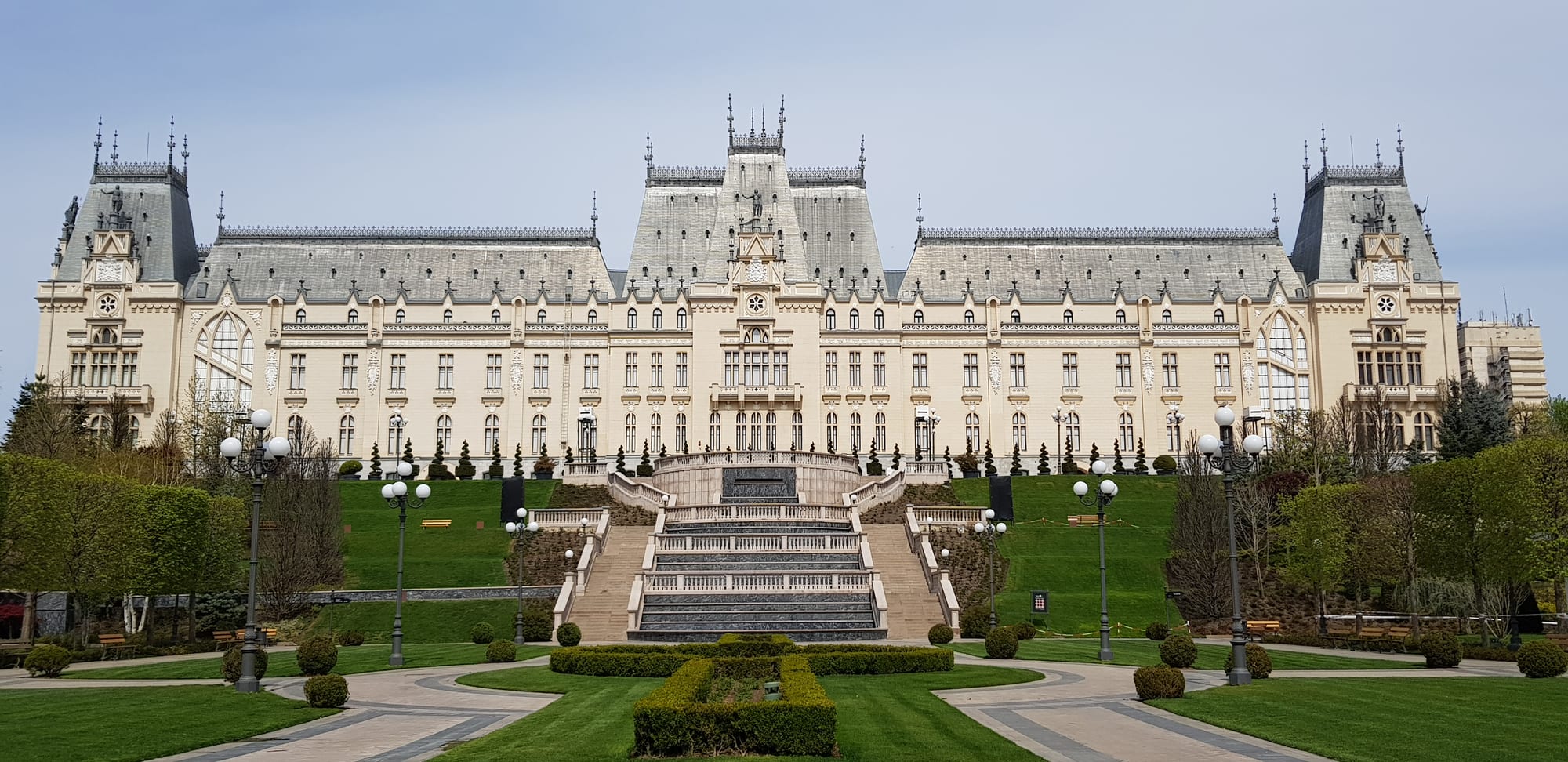
The long cream neo-Gothic façade of the Palace of Culture with grey turreted roofs above terraced lawns and a staircase

Moldavia & Bucovina, Romania

Iași

The Palace of Culture in Iași, seen from the gardens below it. (KittyKaliNeo / Wikimedia Commons · CC BY-SA 4.0)

Romania's third-largest city, on the hills above the Bahlui valley in the north-east near the Moldovan border — capital of the principality of Moldavia from 1564 to 1859 and of Romania in 1916–1918. Its neo-Gothic Palace of Culture, carved churches, old universities and theatres make it the country's self-styled cultural capital, and today a busy student and IT city.

Neighbourhoods

  • City centre and Ștefan cel Mare Boulevard
    • First-time visitors
    • Historic district
    • Close to public transport

    The old core on the terrace above the Bahlui, where the boulevard runs from Piața Unirii past the National Theatre, the Metropolitan Cathedral and Trei Ierarhi to the Palace of Culture. Part of the boulevard is closed to traffic.

    Open in Maps
  • Copou
    • Quiet and residential
    • Parks
    • Students and nightlife

    The hill north of the centre, reached along Copou Boulevard, with the main university building, Copou Park, the botanical garden and many old villas on rose-lined streets. Locals think of it as the city's well-off quarter, and student bars gather opposite the park.

    Open in Maps
  • Tudor Vladimirescu
    • Students
    • Shopping

    The city's main student campus district, east of the centre, with 22 halls of residence and places to eat aimed at students.

    Open in Maps
  • Podu Roș and Nicolina
    • Local life
    • Markets

    Working districts joined by a road bridge with a bazaar beneath it. Nicolina has one of the city's daily open markets and the Frumoasa Monastery standing among apartment blocks.

    Open in Maps

Things to do

Famous landmarks

  • Palace of Culturemuseum

    A neo-Gothic palace begun in 1906 and finished in 1925 on the site of the medieval princely court, now home to four museums of art, Moldavian history, ethnography and science and technology.

    Open in Maps
  • Vasile Alecsandri National Theatrelandmark

    Romania's first national theatre, founded in 1840; its ornate building by the Viennese architects Fellner and Helmer dates from 1894–1896 and also houses the national opera.

    Open in Maps
  • Alexandru Ioan Cuza Universitylandmark

    The oldest university in Romania, founded in 1860; its main building on Copou houses the Hall of the Lost Footsteps, painted by Sabin Bălașa.

    Open in Maps
  • Roznovanu Palacelandmark

    An 18th-century boyar palace, rebuilt in 1830–1833, which housed the Romanian government during the First World War and is now the city hall.

    Open in Maps
  • Iași railway stationtransit hub

    The Grand Railway Station of 1870, whose original building was inspired by the Doge's Palace in Venice.

    Open in Maps

Churches, monasteries and the synagogue

  • Trei Ierarhi Monasterylandmark

    Vasile Lupu's church of 1635–1639, its outer walls and twin towers covered in carved decoration; it is on Romania's tentative list for UNESCO World Heritage status.

    Open in Maps
  • Metropolitan Cathedrallandmark

    The largest Orthodox church in Romania, with paintings by Gheorghe Tattarescu and the relics of St Parascheva, focus of the great October pilgrimage.

    Open in Maps
  • Golia Monasterylandmark

    A walled monastery in the middle of the city, rebuilt by Vasile Lupu from 1650, with corner turrets, carved doorways and a 30-metre tower of 120 steps.

    Open in Maps
  • Princely Church of St Nicholaslandmark

    The church beside the Palace of Culture founded by Stephen the Great in 1491–1492 and rebuilt in 1884–1904 by the French architect André Lecomte du Noüy.

    Open in Maps
  • Armenian Churchlandmark

    A church believed to date originally from 1395, older than the first written mention of the city, and a reminder of its old Armenian community.

    Open in Maps
  • Great Synagoguelandmark

    Completed in 1671, the oldest surviving synagogue in Romania, reopened in December 2018 after a major restoration.

    Open in Maps

Parks and hilltop monasteries

  • Copou Parkpark

    One of the first planned public parks in Romania, begun in 1833, with the Obelisk of Lions and the old silver linden under which Mihai Eminescu is said to have written.

    Open in Maps
  • Iași Botanical Gardenpark

    Romania's first botanical garden, founded in 1856, covering more than 80 hectares in the Copou neighbourhood.

    Open in Maps
  • Cetățuia Monasterylandmark

    A monastery of 1668 on Cetățuia, one of the seven hills Iași is said to be built on, listed as a historic monument.

    Open in Maps
  • Galata Monasteryviewpoint

    A convent founded in the 1580s on top of Galata hill, ringed by a fortified wall with a gate tower, with panoramic views over Iași nearby.

    Open in Maps
  • Frumoasa Monasterylandmark

    An 18th-century monastery whose walls now stand among the apartment blocks of Nicolina.

    Open in Maps

Short trips from the city

  • Bârnova Monasterylandmark

    A monastery built in 1628 in the village of Bârnova, just outside the city, whose courtyard holds the county's oldest tree, a linden about 675 years old.

    Open in Maps
  • Cotnariattraction

    A village north-west of Iași at the centre of one of Romania's major wine regions, famous for the sweet white Grasă de Cotnari.

    Open in Maps

Seasonal events

  • Feast of St Paraschevamid-October, around 14 October

    Hundreds of thousands of pilgrims from Romania and abroad come to venerate the saint's relics at the Metropolitan Cathedral, while the city holds its Celebration Days.

  • International Theatre Festival for Young AudiencesOctober

    A festival of theatre for young audiences, held since 2008 at the Luceafărul Theatre.

  • HangariadaMay

    An aeronautics and art festival held each year.

  • Iași Science FestivalApril

    A week of experiments and laboratory tours at the city's universities, held since 2013 for school pupils.

Eat and drink

Long-standing places and food districts in Iași. Hours, ratings and directions come from your maps app, always current.

Food districts and markets

  • Hala Centrală marketmarket

    A market hall near the Palace of Culture, with an open, circular sunken market in front where producers sell local food.

    Open in Maps
  • Piața Nicolinamarket

    One of the city's traditional open markets, held daily, where traders from the neighbouring Republic of Moldova also sell their produce.

    Open in Maps
  • Piața Alexandru and Piața Păcurarimarket

    Two more daily neighbourhood markets for fresh fruit, vegetables, cheese and meat.

    Open in Maps

Cafés and bars

  • Bars around the Cub on Ștefan cel Mareneighborhood

    A cluster of student bars beside the green cube sculpture in the centre, mostly playing rock, indie and metal.

    Open in Maps
  • Bars opposite Copou Parkneighborhood

    Cafés and bars serving the student halls on Copou hill, busy during the university terms.

    Open in Maps

Experience Iași

History

People lived on the hills around Iași long before the town: Cucuteni–Trypillia farmers in the Neolithic, and settlements of the 6th to 10th centuries on the site of the later princely court. The city's name may come from the Iazyges or the Alanic Jassi; the Hungarian Jászvásár means "Jassic market". It is first named in a document of 1408, a grant of trading privileges by Prince Alexander the Good to merchants from Lviv, though the Armenian Church is believed to be older. Around 1564 Prince Alexandru Lăpușneanu moved the Moldavian capital here from Suceava, and Iași remained the capital until 1859. Vasile Lupu built Trei Ierarhi in 1635–1639 and set up a school and printing press there; the first book printed in Moldavia appeared in the city in 1643.

The town was repeatedly burned and looted by Tatars, Ottomans, Cossacks and Poles, and swept by plague, famine and fire. In the 18th century Greek became the language of teaching at its school, and in 1821 Alexander Ypsilantis proclaimed the Greek revolution at Trei Ierarhi. When Moldavia and Wallachia united in 1859, Iași shared the role of capital until 1862, then lost it to Bucharest. During the First World War, with Bucharest occupied, it was again the capital of a much-reduced Romania from 1916 to 1918.

By the mid-19th century at least a third of the city was Jewish. In the pogrom of late June and early July 1941, launched by the Antonescu regime, more than 13,000 Jews were killed, many of them dying on death trains. Soviet bombing in August 1944 destroyed two-thirds of the city. Communist industrialisation from 1955 brought factories and huge new districts; after 1989 most heavy industry collapsed, and the city rebuilt itself on universities, hospitals and software.

Culture & Customs

Iași calls itself Romania's cultural capital, and the claim rests on a long list of firsts: the first newspaper in Romanian in 1829, the first national theatre in 1840, the first university in 1860, the first memorial museum in 1918. The Junimea literary society met at Pogor House, and its review Convorbiri Literare first published Ion Creangă's Childhood Memories and Mihai Eminescu's best poems. Eminescu's linden tree in Copou Park and the Lonely Poplars of Bucium, which inspired one of his poems, are treated as literary monuments. The city also holds a large place in Jewish history: Naftali Herz Imber wrote the words of HaTikvah here, and Avraham Goldfaden staged what is often called the first professional Yiddish theatre performance in 1876.

Orthodoxy is central to public life. Iași is the seat of the Metropolitan of Moldavia and Bukovina, the city and its surroundings hold more than ten monasteries and about a hundred historic churches, and around 14 October hundreds of thousands of pilgrims come to venerate the relics of St Parascheva, brought here in 1641. There is also a Roman Catholic bishopric and a community of almost 10,000 Catholics.

With more than 60,000 students in five public universities, the city is young in term time. The Moldova Philharmonic, the opera and Luceafărul Theatre keep a full programme, the FILIT festival of literature and translation has run each year since 2013, and live music, readings and poetry nights fill the bars and cafés.

Daily Life

Iași had about 272,000 people in the city proper at the 2021 census, making it Romania's third-largest city, and about 423,000 in its metropolitan area, which official figures put at more than 613,000 by 2025. Tens of thousands of students and daily commuters add to the numbers. The city spreads from the old centre over hills and the Bahlui floodplain, and much of the population lives in districts built under communism, when migrants arrived from the villages.

Information technology is the growth industry, with offices of large multinationals and Romanian firms, alongside car parts, pharmaceuticals and metalworking. Education and health are major employers: Iași has fourteen public hospitals, including St Spiridon, one of the oldest in the country, and a large regional emergency hospital is being built. Shopping has moved partly to malls such as Iulius, but the open-air markets still sell produce from nearby villages and from across the border in Moldova.

In 2015 Iași was rated as having the second-worst air quality in Romania, after Bucharest. The city's long-standing complaint is its isolation: the A8 motorway, planned to link it to the rest of the country, is still in various stages of construction.

Food

Iași eats the food of Moldavia, which is hearty and pork-based. Tochitură moldovenească, the Moldavian version of tochitură, is pork cut into small cubes and cooked slowly in its own fat and juices, often with smoked sausage and sometimes in tomato sauce, and is served with mămăligă, the maize porridge that accompanies many meals. Ciorbă, the sour soup soured with borș from fermented bran, vinegar or sauerkraut juice, comes in many versions, including ciorbă moldovenească de găină, a sour soup of boiling hen. Sarmale, cabbage or vine leaves rolled around minced meat and rice, are made for Christmas and Easter.

Sweet pastries are a Moldavian speciality. Poale-n brâu, also called brânzoaice, are soft cakes filled with sweetened cheese; mucenici, figure-of-eight pastries glazed with honey and sprinkled with walnuts, are eaten on 9 March; and pelincile Domnului is a Moldavian pie of thin honeyed wheat cakes layered with hemp-seed cream. Cozonac, a sweet bread with nuts, poppy seeds or Turkish delight, is a fixture of Easter and Christmas tables.

The city sits in wine country, with vineyards at Copou, Bucium and other villages on its edges. Cotnari, north-west of the city, is known for Grasă de Cotnari, a sweet white, and Bohotin is another county vineyard. Țuică, plum brandy, is the everyday spirit. The daily markets at Nicolina, Alexandru and Păcurari, and the sunken market in front of Hala Centrală, are the places to see what Moldavian kitchens are made from.

Planning tools

Budget

The city is at its busiest during the October pilgrimage. Many churches can be visited without charge, and museum fees are low.

Daily Budget Midrange
USD 75–150 (comfortable hotel, restaurant meals with Moldavian wine, museum tickets and taxis)
Daily Budget Shoestring
USD 35–60 (hostel or budget room, market food and canteen meals, trams and buses)

Use taxi apps or metered taxis and check that the meter is running; much of the centre is easily covered on foot.

Best Time to Visit

May to October. Summers are warm to hot and the parks and Copou hill are at their best; September and October are milder, with the grape harvest in the surrounding vineyards. The St Parascheva pilgrimage in mid-October fills the centre with crowds. Winters are cold and windy, with snow.

Suggested Number of Days

Two days cover the centre, Copou and the main museums. Three or four allow for the hilltop monasteries and a trip into the wine country, and Iași also works as a stop on the way to Bucovina's painted monasteries.

First Visit
2 days
With Surroundings
3–4 days

Transportation

The city company CTP runs an extensive tram and bus network — trams have run here since 1900 — from about five in the morning to eleven at night, with machines at stops selling tickets. A restored vintage tram climbs Copou hill. Taxis are plentiful and most are metered; maxi-taxi minibuses serve the outskirts and nearby villages.

Tickets for trams and buses are bought before boarding, and services are less frequent at weekends and on public holidays.

Airport & Station Connections

Iași International Airport, the third busiest in Romania, is 8 km east of the centre, with domestic and European flights; bus 50 runs into town. The Grand Railway Station, about 1 km from the centre, has direct trains to the major Romanian cities and to Chișinău in Moldova, and long-distance coaches use the city coach station.

Walkability

The historic centre is compact and best seen on foot: the boulevard from Piața Unirii to the Palace of Culture is a short walk, and Copou is a gentle climb north. The city is hilly, so the monasteries on the southern hills and the outer districts are easier by tram, bus or taxi.

Safety

Romania is a safe country with low violent crime. In Iași the main nuisance is pickpocketing around the railway station and on crowded trams and buses, especially of people carrying luggage. Beggars can be persistent near churches, and packs of stray dogs roam abandoned industrial areas on the edge of the city.

Keep money and phones out of reach on full trams, leave stray dogs alone and do not run from them, and stay out of the derelict factories on the outskirts. Check current official travel advice before travelling.

Climate

A continental climate with four distinct seasons and fairly little rain. Summers are warm to hot and often dry; winters are cold and windy, with moderate snow. Frost and snow usually arrive in the second half of November.

Summer
warm to hot and often dry, with temperatures sometimes passing 35°C
Winter
cold and windy, with moderate snow; nights sometimes drop below −15°C

Local Customs

Iași is a devout Orthodox city, and passengers on trams and buses may be seen making the sign of the cross when passing a church. Inside churches, hats come off and short skirts are frowned on. Putting feet on the benches in Copou Park can bring a fine.

Dress modestly for churches and monasteries, keep voices low during services, and ask before photographing inside churches or during the October pilgrimage.

Common Payment Methods

Romania uses the leu (RON), not the euro. Cards and contactless payment are widely accepted in shops, malls and most restaurants; carry some cash for markets, small cafés, tram ticket kiosks and church donations. ATMs are common in the centre.