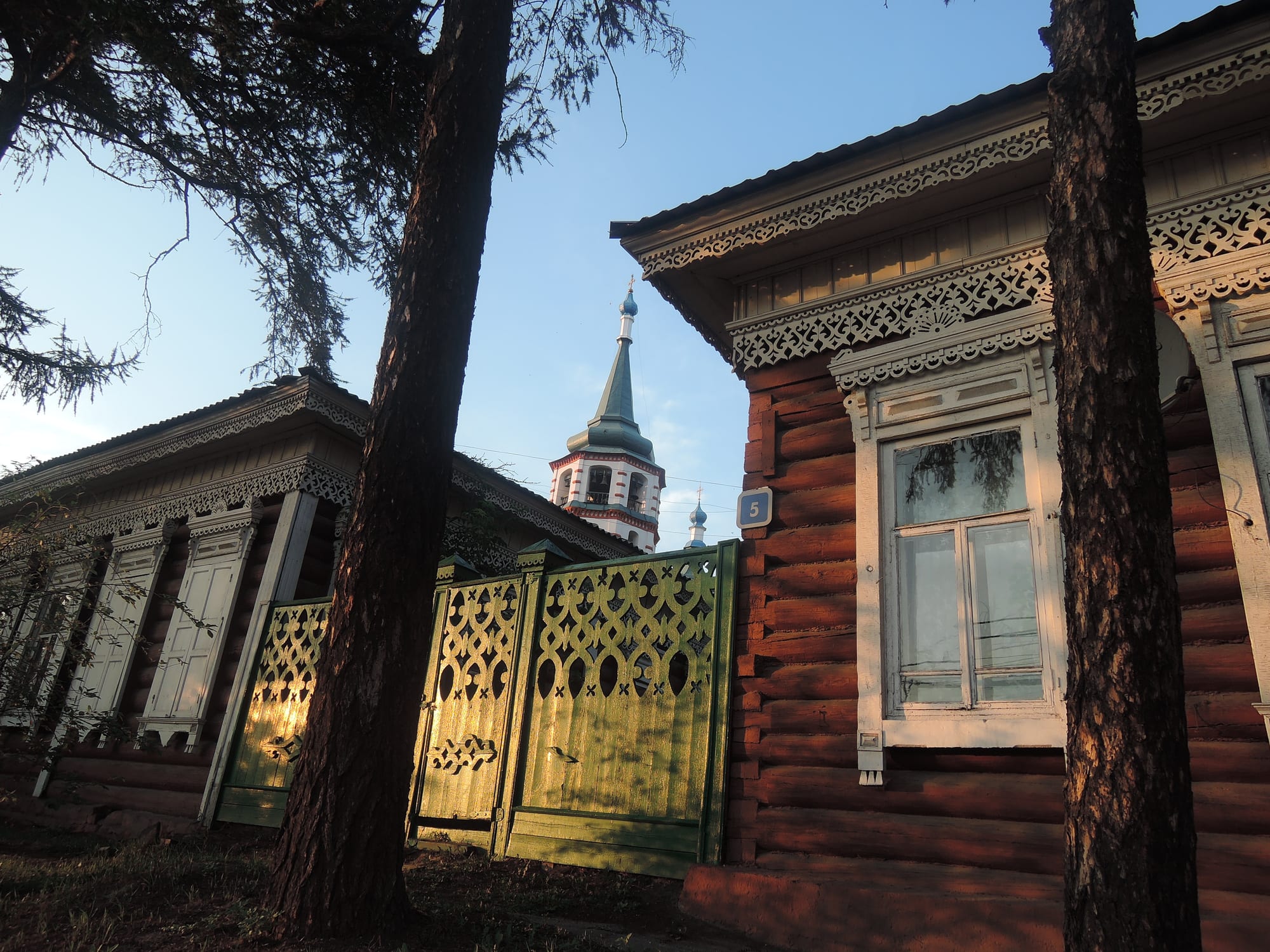
Log houses with white carved window frames and lace-like wooden eaves beside a green fretwork gate, with a church bell tower behind

Siberia, Russia

Irkutsk

Carved wooden houses in the 130th Quarter of Irkutsk. (Trasprd / Wikimedia Commons · CC BY-SA 4.0)

The capital of Irkutsk Oblast, on the Angara River about 70 km below its outflow from Lake Baikal. Founded as a fur-tribute fort in 1661, it prospered on trade with China and was shaped by the Decembrist exiles, whose carved wooden houses still stand among Soviet blocks. It is the usual gateway to Baikal. This page is written to explain the city, not to encourage travel.

Neighbourhoods

  • The historic centre and Kirov Square
    • First-time visitors
    • Historic district
    • Close to public transport

    The old core on the right bank of the Angara, centred on Kirov Square, where Yakov Pokhabov's fort stood in 1661. The Church of the Saviour, the Epiphany Cathedral and the Lower Embankment are a few minutes away, and Karl Marx Street, the only straight street in Irkutsk, follows the line of the vanished palisade.

    Open in Maps
  • The 130th Quarter
    • Best for food
    • Wooden architecture
    • Evenings out

    A block in the south of the historic centre, opened in 2011 as a specially created zone of historic buildings, where wooden houses were restored, rebuilt or moved in from other parts of the city around pedestrian lanes of cafés, restaurants and shops.

    Open in Maps
  • Wooden Irkutsk
    • Wooden architecture
    • Quiet streets

    The streets beyond the line where stone building was required after the fire of 1879, where the timber town grew. Log houses with carved window frames and eaves survive here among Soviet apartment blocks, along with the Decembrist house-museums.

    Open in Maps
  • The Angara embankment
    • Walks
    • Views
    • Summer evenings

    The promenade along the Angara below the centre, from the Alexander III monument past the Epiphany Cathedral, where young people meet in the evenings and the wide, fast river runs past towards the mouth of the Irkut.

    Open in Maps
  • The left bank
    • Railway station
    • Local life

    The districts across the Angara, where the Trans-Siberian railway and the main road to Moscow and Vladivostok pass; the railway station is here, linked to the centre by bridges and trams.

    Open in Maps

Things to do

Churches and landmarks

  • Church of the Saviourlandmark

    One of the first stone buildings in Irkutsk, begun in 1706 in the corner of the vanished kremlin, with frescoes painted on its facades in the 19th century.

    Open in Maps
  • Epiphany Cathedrallandmark

    The second-oldest stone building in the city, rebuilt in brick after a fire of 1716 destroyed the first wooden cathedral, and the cathedral of the Irkutsk diocese in the 18th and 19th centuries.

    Open in Maps
  • Znamensky Monasterylandmark

    A convent founded in 1689 where the Ushakovka meets the Angara, one of the oldest monasteries in Siberia, with a stone cathedral church of 1762.

    Open in Maps
  • Immaculate Heart of Mary Cathedrallandmark

    The cathedral of the Catholic Diocese of St Joseph, consecrated in 2000 and known for its organ concerts; the city's Catholic parish dates from 1820.

    Open in Maps
  • The 130th Quarterneighborhood

    A pedestrian district of restored, rebuilt and relocated wooden houses, opened in 2011 at the foot of Krestovaya Hill.

    Open in Maps
  • Kirov Squarelandmark

    The central square of the historic city, on the site where the first fort was built in 1661.

    Open in Maps

Museums

  • Irkutsk Museum of the Decembristsmuseum

    Two memorial houses and their estates, those of the exiled princes Sergei Trubetskoy and Sergei Volkonsky, where literary and musical salons are held each December.

    Open in Maps
  • Sukachev Regional Art Museummuseum

    One of the richest art collections in Siberia, with more than 23,000 paintings, drawings, sculptures and works of decorative art.

    Open in Maps
  • Icebreaker Angaramuseum

    An icebreaker built to order in Newcastle, England, that went into service on Lake Baikal in 1900 and has been a museum ship since 1991; it is 60 metres long.

    Open in Maps

Parks and the river

  • The Angara embankmenttrail

    The riverside promenade below the centre, the city's favourite place for an evening walk, looking across the broad Angara.

    Open in Maps
  • Irkutsk Botanic Gardenpark

    The university's protected 27-hectare garden, the only botanic garden in the Baikal region, holding the largest collection of living plants in Eastern Siberia, more than 5,000 taxa.

    Open in Maps
  • Irkutsk Damlandmark

    The rock-fill dam built across the Angara in the 1950s, the first in the Angara cascade, which created the Irkutsk Reservoir.

    Open in Maps

Markets and nights out

  • Central Marketmarket

    The city's main food market, where the roe of sig and kharius, two Baikal fish, is sold.

    Open in Maps
  • Okhlopkov Drama Theatreattraction

    One of the oldest drama theatres in Russia, named after the director Nikolay Okhlopkov.

    Open in Maps

Short trips from the city

  • Taltsy Museummuseum

    An open-air museum of 67 hectares on the right bank of the Angara, with wooden buildings rescued from villages flooded by the Angara dams, including the Spasskaya tower and a church from the 17th-century fort of Ilimsk.

    Open in Maps
  • Listvyankaattraction

    The closest village to the city on the shore of Lake Baikal, at the source of the Angara, with a smoked-fish market and boats on the lake.

    Open in Maps

Seasonal events

  • Maslenitsalate winter, the week before Orthodox Lent

    The Butter Week folk holiday of blini, sleigh rides and the burning of a straw effigy, held in the last week before Great Lent.

  • Bandy seasonwinter

    Irkutsk is a stronghold of bandy, ice hockey's older cousin played with a ball on a football-sized rink; the men's club Baykal-Energiya can draw crowds of 30,000.

Eat and drink

Long-standing places and food districts in Irkutsk. Hours, ratings and directions come from your maps app, always current.

Irkutsk classics

  • Smoked omulrestaurant

    Omul, a whitefish found only in Lake Baikal and regarded as a delicacy, is the region's signature fish, served alongside sig and kharius (grayling) in many of the city's restaurants.

    Open in Maps
  • Pozycafe

    The large steamed Buryat dumplings filled with meat, a dish of Mongolian and Buryat cooking traditionally made at the Lunar New Year and eaten with the hands.

    Open in Maps

Food districts and markets

  • Central Marketmarket

    The city's main food market, the place to buy the caviar of sig and kharius.

    Open in Maps
  • The 130th Quarterneighborhood

    The restored wooden quarter has the city's busiest cluster of cafés and restaurants, set in and around reconstructed timber houses.

    Open in Maps

Experience Irkutsk

History

Russian traders reached the Angara in 1652, when Ivan Pokhabov built winter quarters near the site to collect fur tribute from the Buryats. In 1661 Yakov Pokhabov built a fort, an ostrog, on the spot where Kirov Square now lies, and Irkutsk received town rights in 1686. Settlers from northern Russia built the trading quarter beyond its walls. The Siberian road from Moscow arrived in 1760, and goods from China came through Kyakhta — tea, silk, furs and gold — benefiting the town's economy. From 1764 it governed the whole of Eastern Siberia, to the Pacific, and in 1821 it became the seat of the Governor-General of East Siberia.

Irkutsk was also a place of exile. The officers of the Decembrist revolt of 1825 were sent to Siberia, and those who settled here, with the wives who followed them, made the town a centre of intellectual and social life; by the end of the 19th century there was one exile for every two locals. Leaders of the Polish Baikal insurrection were executed here in 1866. A fire in July 1879 destroyed three-quarters of the city, about 4,000 houses, but it recovered quickly: electricity came in 1896 and the railway in 1898, and by 1900 it was called the Paris of Siberia.

The Civil War brought bitter fighting, and in 1920 the White leader Admiral Kolchak was executed here. In the Great Terror between 15,000 and 17,000 victims were buried on the outskirts. The Soviet era brought the aircraft works, founded in 1932, and the Irkutsk dam and reservoir in the 1950s. In December 2016, 74 people died in a mass methanol poisoning. The historic centre is on UNESCO's tentative list of World Heritage Sites.

Culture & Customs

The Decembrists are the heart of the city's self-image. The exiles made Irkutsk the centre of intellectual and social life in Eastern Siberia and developed much of its cultural heritage, and two of their houses are now museums. Before the revolution the city was called the East Paris, Siberian Petersburg and the Siberian Athens; today it has the Okhlopkov Drama Theatre, one of the oldest in Russia, a Catholic cathedral known for organ concerts, and a state university founded in 1918.

Wooden architecture is the city's signature: log houses with carved window frames, shutters and eaves survive in the old streets, and the 130th Quarter recreates a whole block of them. The coat of arms shows a babr — originally a Siberian tiger — holding a sable, a word so misread by a 19th-century heraldist as 'beaver' that the local authorities came to depict it as half-tiger, half-beaver. Irkutsk was home to the writer Valentin Rasputin, whose books are set in the Angara valley, and the city appears in Jules Verne's novel Michael Strogoff.

The city has always been mostly Russian; at the 1897 census Jews made up 6.5 per cent of the population, Poles 2 per cent, and Tatars and Buryats smaller shares. Bandy is the great spectator sport: Baykal-Energiya plays in the national Super League, and the city is the centre of women's bandy in Russia. Summer weekends are spent at the dacha or on the shores of Baikal.

Daily Life

About 606,000 people lived in Irkutsk in 2025 by official estimates, against about 588,000 at the 2010 census. Regional plans group the city with the neighbouring industrial towns of Shelekhov and Angarsk in a metropolitan area of more than a million. The largest industry is the Irkut aircraft plant, best known for the Su-30 family of fighters; universities, research institutes of the Russian Academy of Sciences in the Academgorodok suburb, and the regional administration provide much of the rest.

The city is split by the Angara into the left bank, with the railway and the main roads, and the right bank, with the historic centre; the Ushakovka divides off the monastery and the old port. Stone buildings fill the streets nearest the river, wooden houses the old outskirts, and Soviet blocks surround them. Trams, trolleybuses and marshrutkas carry most people around.

Public health is a long-standing concern: in 2018 men in Irkutsk had an average life expectancy of only 63. Winters are long and very cold, and the rhythm of the year turns on summer — the dacha, berry picking and weekends on Baikal.

Food

Baikal fish defines Irkutsk's table. Omul, a whitefish of the salmon family found only in Lake Baikal, is a delicacy and the object of one of the lake's largest fisheries; it is eaten smoked and salted, alongside sig (whitefish) and kharius (Arctic grayling), and hot-smoked kharius is sold in the lakeside villages. Around Baikal the frozen raw fish dish known elsewhere as stroganina is called raskolotka: whitefish such as omul eaten in thin shavings, frozen.

The Buryat neighbours brought pozy (buuz), large steamed dumplings filled with meat, a dish of Mongolian and Buryat cooking traditionally made at the Lunar New Year and eaten with the hands. Siberian pelmeni, small dumplings of thin dough around minced meat, are boiled in salted water or broth and carefully drained, since serving them in soup is thought poor taste in Siberia.

The Central Market is the place for smoked fish and for the roe of sig and kharius. To drink there is kvass, a cloudy, sweet-and-sour, low-alcohol drink fermented from rye bread, and mors, made from lingonberries or cranberries, and the cafés of the 130th Quarter and the old centre are where most of the city eats out.

Planning tools

Budget

Irkutsk is cheaper than Moscow. Trips to Baikal, guided excursions and summer lakeside lodging add most to the bill. Foreign bank cards do not work, so the whole stay has to be paid from cash brought into the country and exchanged for roubles.

Daily Budget Midrange
USD 85–170 (mid-range hotel, restaurants, museums, a guided Baikal excursion)
Daily Budget Shoestring
USD 30–60 (hostel bed, canteens and pozy, trams and marshrutkas)

Carry more cash than planned for trips to Baikal, where exchange offices are scarce; the embankment, the 130th Quarter and the churches cost nothing.

Best Time to Visit

June to early September, the warmest part of the year, with the foliage at its finest in early September; July is also the wettest month. Late winter suits the frozen lake for the well equipped. Timing matters less than the national picture: most governments advise against all travel to Russia.

Suggested Number of Days

Two days cover the city itself. Most visitors come for Lake Baikal, and adding the lake shore and the open-air museum on the way to it takes the stay to four to six days; Olkhon Island needs more.

First Visit
2 days
With Surroundings
4–6 days

Transportation

Trams are the backbone of public transport, with trolleybuses, buses and marshrutka minibuses filling in. Tram tickets are bought from the driver and stamped on board. Buses run to Listvyanka and the open-air museum, and boats run from the Irkutsk port to Listvyanka and other points on Baikal.

Carry passport, visa and migration card at all times; be careful with private drivers offering rides at the airport, where there is some risk of fraud.

Airport & Station Connections

Irkutsk International Airport lies on the city's eastern edge, about 5 km from the centre, with buses, trams and minibuses to Kirov Square. The city is on the Trans-Siberian Railway, about halfway between Moscow and Vladivostok or Beijing, and trains run on to Ulaanbaatar; the station is on the left bank of the Angara.

Walkability

The historic centre is compact and good on foot: Kirov Square, the churches, the embankment and the 130th Quarter are within walking distance of one another. The wooden streets reward wandering. The station and the dam are a tram ride away, and pavements are icy in winter.

Safety

Far from the front line, but the national risks apply in full: arbitrary detention of foreigners on political charges, wartime censorship laws and near-total loss of consular support. In Irkutsk, the aircraft plant and the dam are sensitive sites. The natural hazards are serious: ticks carrying encephalitis in the taiga, weak or cracking ice on Baikal and extreme winter cold. In 2016 dozens of people died after drinking a toxic alcohol substitute.

Most governments advise against all travel to Russia and against any travel near the Ukrainian border. Buy alcohol only from reputable shops, take tick precautions in the forest, never go onto Baikal ice without local advice, and do not photograph the dam, bridges or military sites. Check current official travel advice before travelling.

Climate

Continental, with extreme differences between seasons, though Lake Baikal makes the city slightly milder than other places at its latitude. July is the wettest month, February the driest, and nearly all winter precipitation falls as dry snow.

Summer
warm — July averages about 19°C, and the record high is 37.2°C
Winter
very cold — January averages about −17.6°C, and the record low is −49.7°C

Local Customs

Irkutsk is mostly Russian and Orthodox, and it has had Catholic (largely Polish) and Jewish communities since the 19th century. Tipping is not necessary but expected in restaurants; more than 10 per cent would be unusual, and it is not customary in self-service canteens.

Cover shoulders and knees in churches, where women usually cover their hair; ask before photographing people.

Common Payment Methods

The currency is the rouble (RUB). Western and Japanese credit and debit cards — Visa, Mastercard, American Express and JCB — do not work in Russia, and most foreign cards cannot be used at Russian ATMs; some shops serving many foreigners accept UnionPay. Bring enough cash for the whole stay, including the Baikal shore.