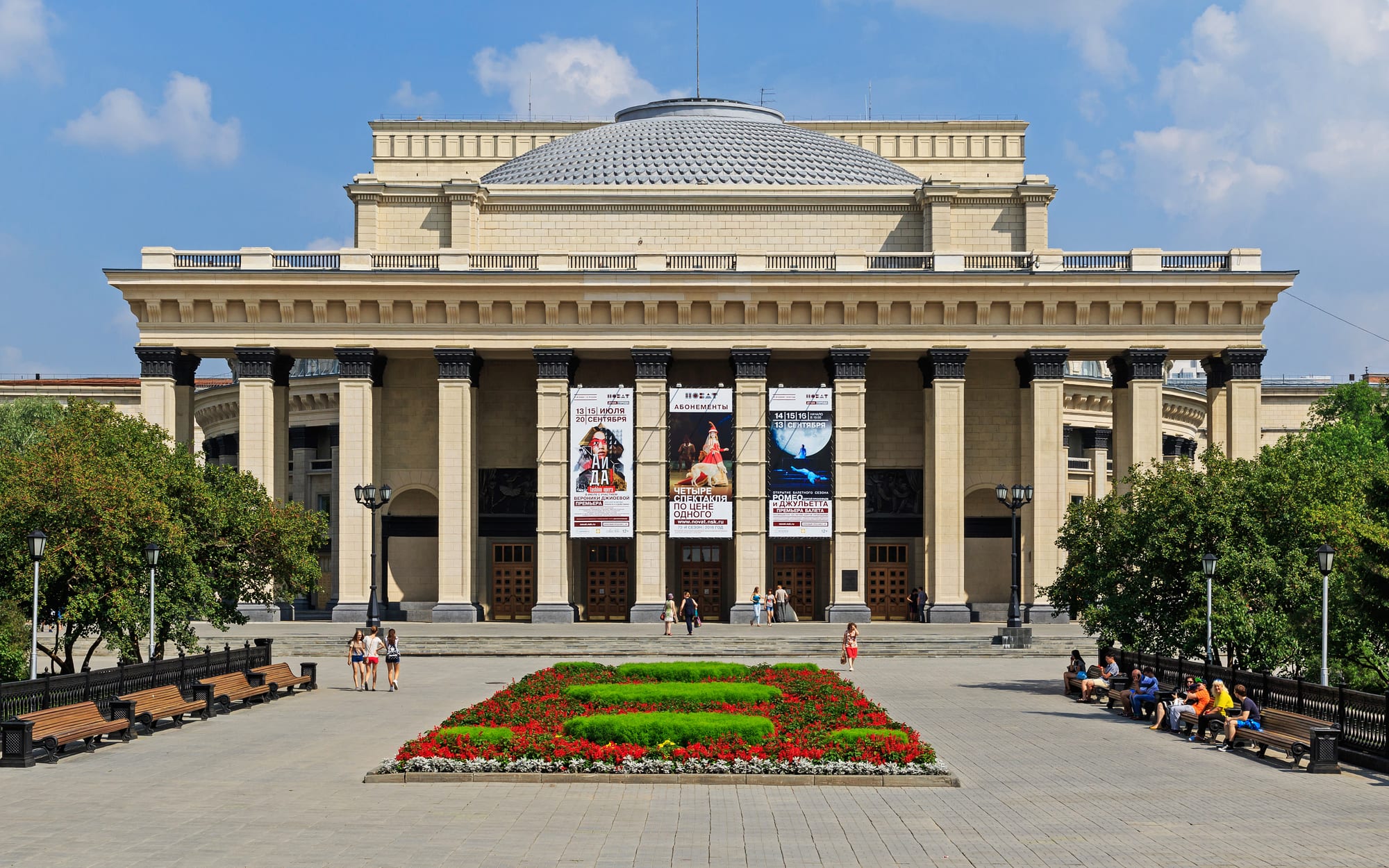
A large domed theatre with a row of tall columns behind a square of flower beds and benches under a blue summer sky

Siberia, Russia

Novosibirsk

The Novosibirsk Opera and Ballet Theatre on Lenin Square in summer. (A.Savin / Wikimedia Commons · FAL)

Siberia's largest city and Russia's third-largest, on the Ob River where the Trans-Siberian Railway crossed it in the 1890s. Founded as a railway settlement in 1893, it grew into an industrial and scientific centre, with a vast opera house on Lenin Square and the research town of Akademgorodok to the south. This page is written to explain the city, not to encourage travel.

Neighbourhoods

  • Tsentralny District
    • First-time visitors
    • Historic district
    • Close to public transport

    The city centre, built around Lenin Square and the long Krasny Prospekt. The opera house, the art museum, the Alexander Nevsky Cathedral and the small Saint Nicholas Chapel stand within walking distance of each other, among Stalin-era blocks and early 20th-century buildings, with metro stations under the main avenue.

    Open in Maps
  • Zheleznodorozhny District
    • Close to public transport
    • Trans-Siberian stopovers

    The railway district around the main Novosibirsk-Glavny station. It is the arrival point for Trans-Siberian travellers, and Lenin Square is about a twenty-minute walk away.

    Open in Maps
  • Zayeltsovsky District
    • Parks
    • Families

    The district home to Zayeltsovsky Park in a pine forest, with its children's railway, and to the city zoo — the greener side of the city.

    Open in Maps
  • Leninsky District and the left bank
    • Local life
    • Quiet and residential

    The residential left bank of the Ob, reached by road, rail and metro bridges from the centre. It is largely residential, a view of everyday Novosibirsk away from the sights.

    Open in Maps
  • Akademgorodok
    • Science and universities
    • Nature
    • Beaches

    The academic town built from 1957 about 30 km south of the centre, home to the Siberian branch of the Academy of Sciences, more than 35 research institutes and Novosibirsk State University. Tree-lined streets lead through the forest to the shore of the Ob Sea.

    Open in Maps

Things to do

Famous landmarks

  • Novosibirsk Opera and Ballet Theatrelandmark

    The great domed theatre on Lenin Square, completed in 1944 and opened with its first performance in May 1945 — the largest theatre building in Russia, larger than Moscow's Bolshoi.

    Open in Maps
  • Lenin Squarelandmark

    The main square of the city, part of Krasny Prospekt, made up of a transport square and a theatre square in front of the opera house.

    Open in Maps
  • Krasny Prospektlandmark

    The central avenue, about 7 km long, running from the Ob through the centre past Lenin Square; until 1920 it was Nicholas' Avenue.

    Open in Maps
  • Alexander Nevsky Cathedrallandmark

    A neo-Byzantine church of 1896–99, one of the first stone buildings of the young town, built as a monument to Tsar Alexander III, who began the Trans-Siberian Railway.

    Open in Maps
  • Saint Nicholas Chapellandmark

    A tiny Orthodox chapel on a traffic island on Krasny Prospekt, said to mark the geographical centre of the former Soviet Union, where services are still held.

    Open in Maps
  • House of Leninlandmark

    A building on Krasny Prospekt now used as the chamber hall of the city's philharmonic.

    Open in Maps
  • City Trade Houselandmark

    A building of 1910–1911 on Krasny Prospekt designed by Andrey Kryachkov, home since 1985 to the city's museum of local lore.

    Open in Maps

Museums

  • Novosibirsk State Art Museummuseum

    The city's art museum, a short walk south of Lenin Square on Krasny Prospekt, in a building by Andrey Kryachkov.

    Open in Maps
  • Novosibirsk Museum of Local Historymuseum

    The regional museum of local lore, on Krasny Prospekt near Lenin Square, housed since 1985 in the City Trade House.

    Open in Maps
  • Museum for Railway Technologymuseum

    An open-air railway museum beside Seyatel station south of the city, opened in 2000 and the second-largest transport museum in Russia after St Petersburg's.

    Open in Maps

Parks and the river

  • Novosibirsk Zoopark

    A large zoo with around 11,000 animals of more than 700 species and a part in dozens of breeding programmes for endangered species.

    Open in Maps
  • Zayeltsovsky Parkpark

    A park created in 1932 in the Zayeltsovsky pine forest, home to the Small West Siberian children's railway.

    Open in Maps
  • Bugrinsky Bridgelandmark

    The third road bridge over the Ob within the city, joining the two banks.

    Open in Maps

Akademgorodok and the Ob Sea

  • Akademgorodokneighborhood

    The Soviet science town in the forest south of the city, laid out in the late 1950s around research institutes and the university.

    Open in Maps
  • Monument to the Laboratory Mouseattraction

    A sculpture of a laboratory mouse wearing a pince-nez, unveiled in 2013 outside the Institute of Cytology and Genetics to honour the mice used in genetic research.

    Open in Maps
  • Central Siberian Botanic Gardenpark

    A botanic garden in the south-east of the city, bordering Akademgorodok.

    Open in Maps
  • The Ob Seabeach

    The reservoir created in the 1950s by a dam on the Ob, 200 km long and up to 17 km wide, whose beaches fill with people in summer.

    Open in Maps

Seasonal events

  • City DayLast Sunday of June

    Novosibirsk's annual city holiday, held on the last Sunday of June since 1995; the first, on 4 October 1987, saw the first snow of the year.

  • Siberian Snow Sculpture FestivalWinter

    An annual international snow sculpture competition, held every winter since December 2000, drawing sculptors and artists from across Russia and abroad.

Eat and drink

Long-standing places and food districts in Novosibirsk. Hours, ratings and directions come from your maps app, always current.

Novosibirsk classics

  • Siberian pelmenirestaurant

    Dumplings of minced meat in a thin, unleavened dough, a staple of Russian cooking since the expansion into the Urals and Siberia; in Siberia they are boiled in salted water or broth.

    Open in Maps
  • Stolovaya canteensrestaurant

    Cafés, a relic of the Soviet era, serving cheap, fast traditional food.

    Open in Maps

Food districts and markets

  • Central Marketmarket

    One of the city's two best-known markets.

    Open in Maps
  • Around Lenin Squareneighborhood

    The main square is a popular place to eat in the centre.

    Open in Maps

Experience Novosibirsk

History

On 30 April 1893 a settlement was founded on the right bank where the Trans-Siberian Railway was to cross the great river, near land traditionally inhabited by the Chat Tatars, and the older village of Bolshoye Krivoshchyokovo on the opposite bank was resettled to make way for the bridge. In 1895 the new town was named Novonikolayevsk, after Saint Nicholas and the new Tsar, Nicholas II. When the rail bridge opened in 1897, about 7,800 people lived there; by 1907, with more than 47,000, it had been granted town status, and before the revolution its population reached 80,000.

The Russian Civil War ravaged the town and destroyed the Ob bridge, and for the first time its population fell. Rebuilding began in 1921 under the New Economic Policy, and in 1926 the town was renamed Novosibirsk, roughly "New Siberian". Under Stalin it became one of the largest industrial centres of Siberia: tram lines were laid in 1934, when the population of 287,000 already made it the largest city in Siberia, and work on the opera house began in 1931 on the old market square. During the Second World War, factories evacuated from western Russia were moved here.

In 1957 the scientific complex of Akademgorodok was founded 30 km south of the centre, and on 2 September 1962 the population passed one million, making Novosibirsk at the time the youngest city in the world of that size. Its metro, begun in 1979, opened in 1985. Today it is the administrative centre of the Siberian Federal District and its region.

Culture & Customs

The opera house is the symbol of the city. Begun in the 1930s and completed in 1944, it opened in 1945 and is the largest theatre building in Russia. The theatre scene runs deep for a city so young, with the Red Torch drama theatre, founded in 1932 and directed since 2015 by Timofey Kulyabin, the Globe youth theatre, a puppet theatre, a musical theatre and a philharmonic society founded in 1937 that plays in the House of Lenin.

Akademgorodok gives the city a strong academic identity. Novosibirsk State University is among the leading Russian schools in the natural sciences and mathematics, and the science town's institutes, forest and laboratory mouse monument give it an atmosphere quite unlike the industrial centre.

The architecture tells the city's story in layers: early 20th-century buildings by Andrey Kryachkov, Stalinist Neoclassicism along Krasny Prospekt, and Soviet Modernist and Brutalist blocks. A long list of annual festivals includes the Siberian Snow Sculpture Festival, the Transsiberian Art Festival, a documentary film festival and the "Pokrovskaya Autumn" festival of Russian music, and City Day fills the centre on the last Sunday of June.

Daily Life

About 1.6 million people lived in Novosibirsk at the 2021 census, up from about 1.47 million in 2010, making it the third-most populous city in Russia after Moscow and St Petersburg and the largest in Siberia. It is the administrative centre of both Novosibirsk Oblast and the Siberian Federal District, and a commercial, transport and industrial hub: Tolmachevo is the busiest airport in Siberia and the base of S7 Airlines, and the city grew up as a Trans-Siberian railway town.

The city is split by the Ob into the right bank, with the centre and the old railway districts, and the residential left bank, joined by three road bridges, two railway bridges and a metro bridge. The city is divided into ten districts, served by metro, buses, trams, trolleybuses and marshrutka minibuses. Akademgorodok, though administered by the city, has its own self-contained life of research institutes, students and forest.

The rhythm of the year is set by the climate. Snow usually settles in mid-November and lies all winter, and in summer the Ob Sea is one of the most popular destinations for residents. Local government has seen recent change: in April 2024 the city council chose Maxim Kudryavtsev, a deputy governor of the region, as mayor.

Food

Novosibirsk eats as Siberia and Russia do, and pelmeni — dumplings of minced meat in a thin, unleavened dough — became a staple of Russian cuisine during the expansion into the Urals and Siberia. Mixing different meats in the filling is popular; in Siberia they are boiled in salted water or sometimes broth, and some recipes fry them golden brown after boiling. The name comes from the Finno-Ugric Komi and Udmurt languages, where it means "ear bread".

Soups open a traditional meal: shchi, the cabbage soup, borscht, ukha, and the salty-sour solyanka and rassolnik made on a meat broth. In summer, okroshka is a cold soup based on kvass, the mildly fermented bread drink, or on kefir. Kasha porridge, such as buckwheat, is one of the most important dishes of traditional Russian cuisine.

For eating cheaply, the stolovaya — a café surviving from the Soviet era — offers cheap, fast traditional food. Lenin Square is a popular place to eat in the centre, and the Central Market is one of the city's two best-known markets.

Planning tools

Budget

Novosibirsk is cheaper than Moscow and mid-priced for Siberia, with inexpensive public transport and canteen meals. The practical difficulty is payment rather than cost: most foreign cards do not work, so every rouble has to come from cash brought into the country.

Daily Budget Midrange
USD 85–170 (mid-range hotel, restaurants, an opera or ballet ticket, taxis)
Daily Budget Shoestring
USD 30–60 (hostel bed, canteens and markets, metro and buses)

Bring enough cash for the whole stay; Lenin Square, Krasny Prospekt, the cathedral and the riverside cost nothing.

Best Time to Visit

Late spring to early autumn, when days are warm and Akademgorodok and the Ob Sea are at their best; City Day falls in late June. Winters are long and bitterly cold, though the opera and ballet season runs indoors. Timing matters less than the national picture: most governments advise against all travel to Russia.

Suggested Number of Days

Two days cover the centre for most visitors breaking a Trans-Siberian journey. Allow three or four to include the science town and the reservoir to the south, which take most of a day to reach and see.

First Visit
2 days
With Surroundings
3–4 days

Transportation

Novosibirsk has a metro, opened in 1985, with two lines and 13 stations under the centre and across the Ob, alongside buses, trams, trolleybuses and marshrutka minibuses. Suburban trains on the line to Berdsk stop at Seyatel, beside the railway museum.

A trolleybus stop called 'Airport' on the main street serves the disused old airport, not Tolmachevo.

Airport & Station Connections

Tolmachevo Airport, the busiest in Siberia and the hub of S7 Airlines, lies in the town of Ob, 16 km west of the centre — about half an hour by bus to Novosibirsk-Glavny, the main station, which is on the Trans-Siberian Railway.

Walkability

The centre is fairly compact: the station to Lenin Square is about a twenty-minute walk, and the main sights line Krasny Prospekt. The districts beyond are spread out, and Akademgorodok, 30 km south, needs transport. Pavements are snowy and icy through the long winter.

Safety

Beyond the ordinary crime of a large European city, the decisive risks are political and legal: near-total loss of consular support, a real risk of arbitrary arrest and lengthy detention of foreigners on politically motivated charges (and their use in prisoner swaps), sweeping wartime censorship laws, and the possibility that men of certain ages, including dual nationals, face conscription or exit bans. Within the city, the centre around Lenin Square is the safest area. The long, bitterly cold winter is the main natural hazard.

Most governments advise against all travel to Russia and against any travel near the Ukrainian border. Do not photograph bridges, military or infrastructure sites. Check current official travel advice before travelling.

Climate

Humid continental, with warm summers and bitterly cold, dry winters. Winter is harsh for visitors from mild climates, though less severe than further east in Siberia.

Summer
warm — temperatures usually range from about 15°C to 26°C, and can reach 30–35°C
Winter
bitterly cold — usually between about −20°C and −12°C, falling at times to −30°C or −35°C

Local Customs

Tipping was traditionally frowned upon in Russia but has become more common: it is not obligatory in restaurants, is not given in self-service canteens, and is not customary in taxis, where the fare is agreed before setting off.

LGBT people face severe legal repression in Russia, and photographing military or infrastructure sites can bring espionage charges.

Common Payment Methods

The currency is the Russian rouble. Western credit and debit cards — Visa, Mastercard, American Express — do not work in Russia, and most foreign cards cannot be used at Russian ATMs, so all money needs to be brought in as cash and exchanged. Museums and sights take cash.