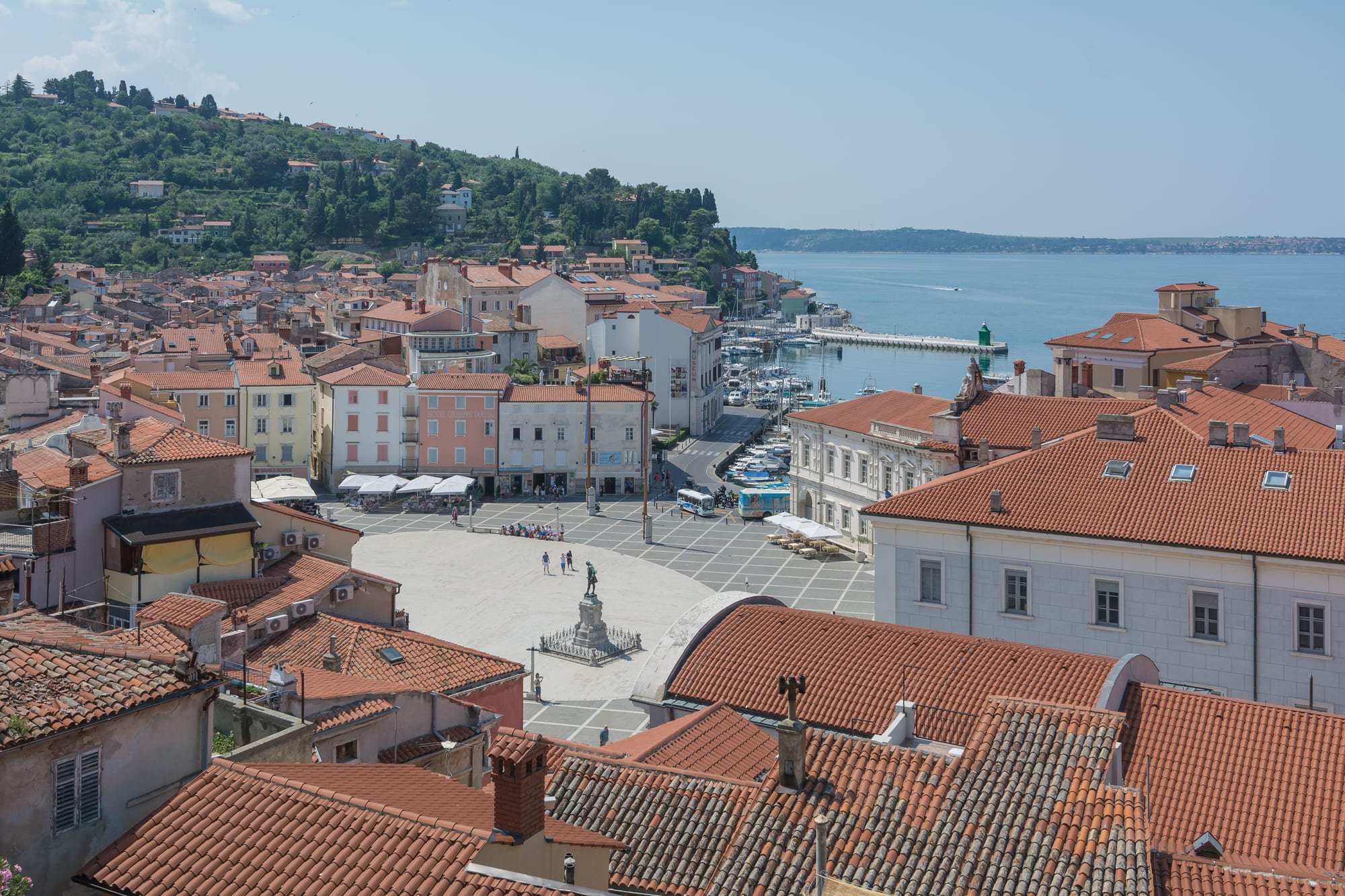
An oval paved square with a statue, ringed by red-roofed houses, with a harbour and a green hill beyond

The Coast, Karst & Soča Valley, Slovenia

Piran

Tartini Square and its statue of Giuseppe Tartini, seen from St George's Parish Church, with the inner harbour beyond. (Isiwal / Wikimedia Commons · CC BY-SA 4.0)

A small bilingual port town at the tip of a narrow peninsula on Slovenia's short Adriatic coast, where Slovene and Italian are both spoken. Venetian for five centuries, it grew rich on salt, and its tight lanes, oval main square and hilltop church still look towards Venice; today it is one of the country's leading resorts.

Neighbourhoods

  • Tartini Square and the harbour
    • First-time visitors
    • Close to public transport
    • Best for food

    The oval main square, built over the old fishermen's harbour in 1894, with Tartini's statue, the town hall and the red Venetian Gothic house, opening onto the inner port, the aquarium and the maritime museum. Buses stop here, and waterfront restaurants line the quays.

    Open in Maps
  • Punta
    • Historic district
    • Sea views
    • Swimming

    The quarter at the tip of the peninsula, a maze of narrow streets and compact houses ending at the lighthouse. Residents and visitors swim from the piers and rocks along its seafront, since the town has no beach.

    Open in Maps
  • St George's hill and the walls
    • Viewpoints
    • Quiet

    The ridge above the old town, crowned by St George's Parish Church and its bell tower, with the Franciscan monastery nearby and, further inland, the surviving stretches of the town walls overlooking the roofs and the bay.

    Open in Maps
  • Fiesa
    • Beaches
    • Quiet

    A small tourist settlement east of the town on the northern coast towards Strunjan, linked to Piran by a promenade along the shore.

    Open in Maps
  • Portorož
    • Beaches
    • Nightlife
    • Resort hotels

    The neighbouring seaside and spa resort along the bay to the south-east, developed from the late 19th century, with hotels, a casino and spa facilities facing the bay, linked to Piran by bus.

    Open in Maps

Things to do

Old town landmarks

  • Tartini Squarelandmark

    The largest square in Piran, named after the violinist and composer Giuseppe Tartini, whose bronze statue by Antonio Dal Zotto has stood here since 1896.

    Open in Maps
  • Tartini Housemuseum

    The house on the square where Giuseppe Tartini was born, first mentioned in 1384 and one of the oldest in the town.

    Open in Maps
  • St George's Parish Churchlandmark

    The town's largest and most important church, in Venetian Renaissance style on the hill above the old town, with its tall bell tower.

    Open in Maps
  • Walls of Piranviewpoint

    Well-preserved stretches of the town's defensive walls on the ridge, with views over the roofs, the peninsula and the Gulf of Piran.

    Open in Maps
  • Piran Minorite Monasterylandmark

    The Franciscan monastery of St Francis, whose cloister, one of the finest in the Slovenian Littoral, hosts summer concerts.

    Open in Maps

Museums and the sea

  • Piran Aquariummuseum

    A small aquarium on the inner quay of the port, open since 1964 and run by the University of Primorska.

    Open in Maps
  • Sergej Mašera Maritime Museummuseum

    The town's maritime museum, on the waterfront just south of Tartini Square.

    Open in Maps
  • Swimming from the piersbeach

    With no beach in the old town, swimmers use the piers and rocks along the seafront towards Punta and the cliff path to Fiesa.

    Open in Maps

Short trips along the coast

  • Sečovlje Saltworkspark

    The largest salt pans in Slovenia, worked since the 13th century and still producing salt by traditional methods, now a landscape park and a wetland of international importance with a museum of salt-making.

    Open in Maps
  • Strunjanpark

    A settlement in the Municipality of Piran with its own salt pans, which with those of Sečovlje are the northernmost Mediterranean saltworks.

    Open in Maps
  • Izolaattraction

    The seat of its own municipality and, like Piran, one of the three major towns of Slovenian Istria.

    Open in Maps
  • Koperattraction

    Slovenia's fifth-largest city and its only commercial port, with the Venetian Gothic Praetorian Palace and Loggia among its sights.

    Open in Maps
  • Škocjan Cavesattraction

    A UNESCO-listed cave system on the Karst, where the Reka river runs through a vast underground canyon.

    Open in Maps
  • Lipicaattraction

    The Karst village of the Lipica Stud Farm, the origin of the Lipizzan horse.

    Open in Maps

Seasonal events

  • Piran Musical EveningsJuly and August

    Friday evening concerts in the cloister of the Minorite monastery, moved into the church of St Francis when it rains, with organ concerts in St George's.

  • Municipal DayOctober

    The municipality's festival, marking the founding in 1944 of the first Slovene Partisan naval detachment.

Eat and drink

Long-standing places and food districts in Piran. Hours, ratings and directions come from your maps app, always current.

Piran classics

  • Piran saltmarket

    Piranska sol, protected sea salt gathered by hand in the salt fields near the town, sold in a shop on the main square.

    Open in Maps
  • Fuži with Istrian olive oilrestaurant

    Fuži, the hand-folded diamond pasta of Istria, and the region's protected extra virgin olive oil, slightly bitter and spicy, appear on local menus.

    Open in Maps

Food districts

  • Prešernovo nabrežjeneighborhood

    The waterfront promenade where many of the town's restaurants have open-air tables facing the sea, most serving fish, meat and mixed grills.

    Open in Maps
  • Back streets of the old townneighborhood

    Smaller seafood restaurants a street or two back from the harbour, often a little cheaper than the waterfront.

    Open in Maps

Experience Piran

History

In pre-Roman times the hills around Piran were home to the Histri, farmers, hunters and fishermen who also raided Roman shipping. Rome took the peninsula in 178–177 BC and covered it with country villas. When the empire declined and Avars and Slavs raided Istria in the late 6th century, people withdrew to easily defended islands and headlands, and by the 7th century Piran, under Byzantine rule, was heavily fortified. The Franks took Istria in 788, and by 952 the town was part of the Holy Roman Empire. Its name probably comes from the Greek pyrrhos, "red", after the reddish flysch stone of the area.

From 1283 to 1797 Piran belonged to the Republic of Venice, governed semi-autonomously by a council of local noblemen with a Venetian official. It fought off attacks by Genoa and pirates, and its salt pans, worked since the 13th century, made it prosperous. Plague killed about two-thirds of the people in 1558, and in the last decades of Venetian rule the town declined in competition with Austrian Trieste. It passed to Austria in 1797, to Napoleon's empire from 1806 to 1814, and back to Austria.

By 1900 Piran was a flourishing market and spa town; the first trolleybus line in what is now Slovenia began running here in 1909, replaced by a tram that ran until 1953. After the First World War it was ceded to Italy. After the Second World War it fell into Zone B of the Free Territory of Trieste under Yugoslav administration and was annexed to Yugoslavia in 1954. Much of its Italian-speaking population left in the Istrian exodus and was replaced by Slovene settlers, and since 1991 the town has been part of independent Slovenia.

Culture & Customs

Piran's best-known son is Giuseppe Tartini, the violinist and composer born here, whose statue by Antonio Dal Zotto has dominated the main square since 1896, with St George's on the hill above. The painter Cesare Dell'Acqua was also born in the town. For decades summer concerts have been held in the cloister of the Minorite monastery, prized for its acoustics, and the Piran Coastal Galleries, a group of six public contemporary art galleries, are based here.

The town's culture is shaped by its Venetian past and by the two languages. Piran is officially bilingual, and an Italian community keeps its own primary school and grammar school, while much of the population arrived from other parts of Slovenia after the Second World War. Until the mid-20th century Italian was the dominant language; Slovene replaced it after the exodus, and Tartini's birthplace on the main square is now the seat of the Italian community in Slovenia.

The municipality's festival on 15 October commemorates the founding of the first Slovene Partisan naval detachment in 1944. In 2010 the town elected Peter Bossman, a physician from Ghana, as mayor, the first black mayor in the formerly communist countries of Europe. The local football club, NK Portorož Piran, plays at the small Pod Obzidjem stadium below the walls.

Daily Life

Piran is the seat of the Municipality of Piran, which also includes the resort of Portorož and the village of Strunjan. A little over a century ago Piran was an Austro-Hungarian town of more than 15,000 people, roughly the size of Koper. Today it is one of Slovenia's major tourist attractions, with the spas, hotels and casino of Portorož close by, and the University of Primorska runs the aquarium as part of its science centre.

Daily life is lived outdoors for much of the year: people swim from the piers and rocks, walk the promenade towards Fiesa and Portorož, and meet on Tartini Square. Cars are kept out of the old town, and residents use the parking on the waterfront at Fornače and the coastal buses. The bora is less frequent than it once was, but its gusts, mostly from the direction of Trieste, can still exceed 100 km/h and cause trouble for residents.

The territorial claims of Slovenia and Croatia in the Gulf of Piran remain a matter of debate in the border disputes that began after the break-up of Yugoslavia.

Food

Piran eats like the rest of Slovenian Istria, which is known above all for its wines and olive oil. The extra virgin olive oil of Slovenian Istria, slightly bitter and spicy with a strong fruit aroma, has protected status, as does piranska sol, Piran salt, gathered by hand in the salt fields of Sečovlje and Strunjan near the town; a shop on the main square sells it. Istrian prosciutto, istrski pršut, an uncooked, unsmoked dry-cured ham, and meat from boškarin, the local Istrian cattle, are other protected products of the region.

Fuži, the Istrian pasta made by cutting thin sheets of dough into diamonds and folding two corners together, is a regional staple, and brodet, a fish stew made along the Istrian and Dalmatian coasts, belongs to the same tradition. Many restaurants line the waterfront on Prešernovo nabrežje with open-air tables facing the sea, serving fish, meat and mixed grills; smaller seafood restaurants one street back from the harbour tend to be cheaper.

The local wines are the white Malvazija, made from Istrian Malvasia, and the red Refošk, from the Refosco grape grown in Slovenian and Croatian Istria and around Trieste.

Planning tools

Budget

Piran is among the most expensive places in Slovenia in July and August, when rooms in the old town are scarce and parking is costly. Restaurants on the waterfront charge more than those in the back streets, and staying in Koper or a Karst village is cheaper. Swimming from the piers, the walls and the square cost nothing.

Daily Budget Midrange
USD 140–280 (old-town guesthouse or seafront hotel, restaurant dinners, museum tickets, parking)
Daily Budget Shoestring
USD 65–100 (hostel or private room, bakery and supermarket food, buses)

Park at the Fornače garage outside the old town and take the free shuttle bus to Tartini Square.

Best Time to Visit

May, June and September offer warm weather and swimming with fewer visitors. July and August are hot and busy, with the musical evenings in the monastery cloister. Winters are mild but can be windy, and the town is quiet out of season.

Suggested Number of Days

The old town itself is small and can be seen in a day or two. Three to five days allow time for the salt pans, the other coastal towns and the caves and stud farm of the Karst, or simply for more time by the sea.

First Visit
1–2 days
With Surroundings
3–5 days

Transportation

Cars are generally not allowed in the old town, whose streets are very narrow; visitors park outside at Fornače and other garages and take the free shuttle bus to Tartini Square. Buses run frequently along the coast to Portorož, Lucija, Izola and Koper, and a free bus links Piran with Portorož. A cliffside walking and cycling path leads east to Fiesa.

Walk or take the shuttle and coastal buses rather than driving into the old town.

Airport & Station Connections

Frequent buses link Piran with Koper, about 20 minutes away, and with Trieste in about an hour; buses from Ljubljana run roughly hourly and take two to two and a half hours. Koper is linked to Ljubljana by rail. Portorož Airport, the smallest of Slovenia's three international airports, is near Sečovlje, south of Portorož.

Walkability

Excellent. The old town is compact and car-free, and everything from the square to the lighthouse and the church is a few minutes' walk, though the lanes up to St George's and the walls are steep and stepped. The seafront promenade continues to Portorož and the coastal path to Fiesa.

Safety

Slovenia is one of the safest countries in Europe, with low crime. In Piran the main concerns are pickpocketing in the summer crowds and the natural ones: slippery rocks and piers when swimming, and occasional gusts of the bora wind of more than 100 km/h.

Take care on wet piers and rocks, and secure loose items when the bora blows. Check current official travel advice before travelling.

Climate

A humid subtropical climate with warm summers and cool, rainy winters, milder than most of Slovenia. Snow is rare, usually on about three days a year and almost always only a trace, and fog appears on about four days a year, mostly in winter.

Summer
warm — July averages above 22°C, and about 22 days a year reach 30°C or more
Winter
mild — January averages above 4°C, with only about one day a year staying below 0°C

Local Customs

Piran is officially bilingual, and both Slovene and Italian are spoken; the town has Italian-language schools as well as Slovene ones. St George's and the monastery are working churches, so visitors are expected to dress and behave respectfully inside.

Expect to hear both Slovene and Italian greetings, and dress respectfully in the churches.

Common Payment Methods

The currency is the euro. Cards are widely accepted in shops, restaurants and garages, and cash machines are found around the main square. A little cash is useful for small purchases.