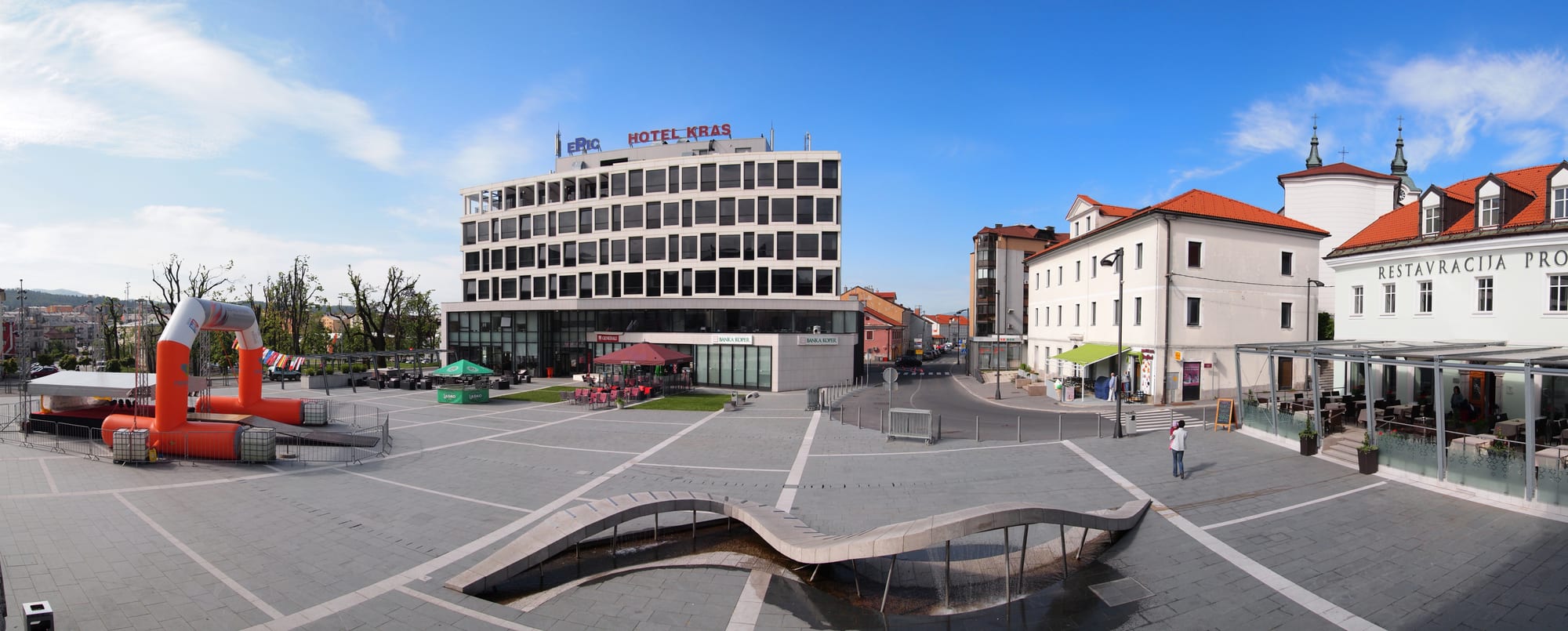
Wide view of a paved town square with a modern office block, white houses with red roofs and two church towers under a blue sky

The Coast, Karst & Soča Valley, Slovenia

Postojna

Titov trg, the main square in the centre of Postojna. (Tiia Monto / Wikimedia Commons · CC BY-SA 3.0)

A small town in Inner Carniola on the Pivka river, at the low pass between central Slovenia and the sea. A market borough since 1432 and an Italian garrison town between the world wars, it is known worldwide for Postojna Cave, a show cave toured by underground train, with Predjama Castle in its cliff a short drive away.

Neighbourhoods

  • The old centre and Titov trg
    • First-time visitors
    • Historic district
    • Close to public transport

    The old core of the town grew up below Sovič hill and along the roads to Ljubljana and Trieste. Its main square, Titov trg, holds the old manor that now houses the Karst Research Institute, with the parish church of St Stephen close by and the bus station a short walk away.

    Open in Maps
  • Postojna Cave and Veliki Otok
    • Caves
    • Families

    The cave entrance lies at the north-western edge of town; the cave itself was carved by the Pivka river. Restaurants, cafés, an adventure park and the cave's karst exhibition gather around it, and the village of Veliki Otok, with a campsite in a pine forest near Pivka Cave, lies just beyond.

    Open in Maps
  • Kremenca and the eastern estates
    • Quiet and residential
    • Local life

    After the Second World War the town spread east in large blocks of flats at Kidričevo naselje and Kremenca, stopping only at the motorway. It is everyday Postojna — homes, schools and shops rather than sights.

    Open in Maps

Things to do

The caves

  • Postojna Caveattraction

    A cave system more than 24 km long carved by the Pivka river; visitors ride an electric cave train for about 3.5 km and walk a further 1.5 km past stalactites, stalagmites and draperies, at about 10°C all year.

    Open in Maps
  • The olm and the karst exhibitionmuseum

    The cave tour passes an aquarium of olms, the blind cave salamander, and the EXPO Postojna Cave Karst exhibition, opened in 2014, explains karst landscapes and the cave's history as a tourist site.

    Open in Maps
  • Planina Caveattraction

    A huge river cave near the village of Planina, where the Pivka and the Rak meet underground in one of the largest subterranean river confluences in Europe.

    Open in Maps

In and around town

  • Notranjska Museummuseum

    The town museum, whose permanent exhibition is devoted to the karst of Inner Carniola.

    Open in Maps
  • Church of St Stephenlandmark

    The parish church of Postojna, in the town centre, belonging to the Diocese of Koper.

    Open in Maps
  • Betal Rock Shelterattraction

    A cave above the road from Postojna to Bukovje where excavations found Palaeolithic stone tools and the bones of cave bears, wolves and other Ice Age animals, the oldest layers about 300,000 years old.

    Open in Maps

Short trips from the town

  • Predjama Castlelandmark

    A Renaissance castle of 1570 built into a cave mouth halfway up a cliff, the seat of the 15th-century robber knight Erasmus of Lueg, who was killed here after a long siege.

    Open in Maps
  • Hošperk Castlelandmark

    The ruined Baroque manor of the Cobenzl and Windisch-Grätz families near the mouth of Planina Cave, largely destroyed in the Second World War.

    Open in Maps
  • Rakov Škocjanpark

    A karst valley and regional nature reserve where the Rak river runs between natural stone bridges and disappears into caves, crossed by footpaths.

    Open in Maps
  • Lake Cerknicapark

    An intermittent lake on a karst field in Inner Carniola that fills and drains with the seasons through the limestone beneath it.

    Open in Maps
  • Škocjan Cavesattraction

    A cave system on the Karst Plateau, a UNESCO World Heritage Site since 1986, where the Reka river runs through an underground canyon.

    Open in Maps

Eat and drink

Long-standing places and food districts in Postojna. Hours, ratings and directions come from your maps app, always current.

Postojna classics

  • Carniolan sausagerestaurant

    Kranjska klobasa, the parboiled, hot-smoked pork sausage named after Carniola, the old duchy Postojna belonged to, served in pairs joined by a wooden skewer.

    Open in Maps
  • Jotarestaurant

    A soup of beans with sauerkraut or sour turnip, potatoes, bacon and spare ribs, eaten across the Slovenian Littoral and Trieste to the west.

    Open in Maps

Food districts

  • Restaurants by the cave and the castleneighborhood

    Several restaurants and cafés stand beside the entrance to Postojna Cave and below Predjama Castle, serving the day visitors to both.

    Open in Maps

Experience Postojna

History

The Postojna area has been inhabited since the Palaeolithic: excavations at the Betal Rock Shelter, just outside the town, found stone tools and the bones of Ice Age animals, and a Roman fort stood on Sovič, the hill above the town. The settlement is first mentioned in 1226 and became a market borough in 1432. Its Slovene name is said to come from the white-tailed eagle, which once nested on Sovič and still appears on the town's coat of arms, while German speakers knew the place as Adelsberg. Ottoman raiders reached it several times in the 16th century, and after the castle on Sovič burned in 1689 a new manor rose on today's Titov trg.

Postojna sat on the main road from Ljubljana to Trieste, and carters' traffic, then the railway in 1857, made it grow. The cave had been visited since the Middle Ages — names scratched inside date to 1213 — but in 1818, during preparations for a visit by Emperor Francis I, the lamplighter Luka Čeč found new passages, and the cave opened to the public as a tourist sight, with rails from 1872 and electric light from 1884, before Ljubljana had it. Postojna was declared a town in 1909.

After the First World War the Treaty of Rapallo gave the town to Italy, which built barracks on its upper edge, and its position near the Yugoslav border helped make it an important regional centre. In 1944 Slovene Partisans destroyed a German fuel store inside the cave, and the fire burned for seven days. After 1945 the town expanded east in blocks of flats, and it is today the main centre of Inner Carniola, home to the Karst Research Institute and, since 2002, the International Union of Speleology.

Culture & Customs

Postojna's identity is bound up with the karst. The Karst Research Institute of the Slovenian Academy of Sciences and Arts has its seat in the old manor on Titov trg, karst studies are taught in the town, and since 2014 it has hosted a UNESCO karst study centre, the first of its kind in Slovenia. The olm, the pale blind salamander of the underground rivers, lives in the cave, and the hatching of olm young there in 2016 made news around the world.

The cave itself has long been a stage. Its concert hall, in use since the 19th century, can hold thousands of people, and a post office inside, first opened in 1899, is described as the world's first underground post office. Predjama Castle carries the region's best-known legend: that of Erasmus of Lueg, the robber knight who defied the Habsburg emperor and held out in the cliff castle until he was killed after a long siege; a popular but unfounded story says he died by a cannon shot while in his lavatory.

The town also has a cultural centre with an events hall, a public library and a music school, and the town holds a summer cultural festival, Zmaj 'ma mlade. Several well-known Slovenes were born here, among them Luka Čeč, the cave's first guide, Alojz Kraigher and Borut Pahor.

Daily Life

A little over 10,000 people live in the town, the largest in Inner Carniola and the seat of the Municipality of Postojna. It sits on a gentle slope above the Pivka valley, beneath the Postojna Gate, the easiest pass from the interior of Slovenia towards the sea, so the old road, the motorway and the railway from Ljubljana all run through it.

Forests surround the town, and timber, then engineering and food industries, grew up alongside tourism; the cave company, the forestry company and a bakery are among the larger employers. Postojna is also a local centre for schools, with a grammar school and forestry and wood-working colleges, as well as courts, the police and the regional administration.

Life divides between the old centre around Titov trg and the post-war estates at Kremenca and Kidričevo naselje to the east. Each day the visitors arrive by coach and car for the cave and leave again by evening, while the town keeps its own pace. A ski area on the slopes of the Javorniki east of town has not operated for several years.

Food

Postojna belonged for centuries to the Duchy of Carniola, which gave its name to Slovenia's best-known sausage, kranjska klobasa. It is a parboiled sausage of chopped pork and bacon seasoned with salt, a little garlic and black pepper, stuffed into pork casing, hot-smoked and sold in pairs linked by a wooden skewer.

From the west comes jota, a thick soup of beans with sauerkraut or sour turnip, potatoes, bacon and spare ribs, made through the Slovenian Littoral, around Trieste and in Istria, usually with olive oil and garlic. Žganci, a dish of buckwheat, maize or wheat flour regarded as a national dish, especially in its buckwheat form, and potica, the rolled festive pastry, are shared with the rest of Slovenia. Inner Carniola once had more unusual food as well: roasted dormouse and quail were eaten here, and until the crayfish plague of the 1880s the noble crayfish of its rivers was a source of income and often on the menu.

Eating out is simple. Several restaurants and cafés stand by the cave entrance and below Predjama Castle for the day visitors.

Planning tools

Budget

Postojna lives from day visitors, and the cave and castle tickets are the main expense. Rooms and meals in town are cheaper than on the coast or at Bled, and the campsite near Pivka Cave is the budget option.

Daily Budget Midrange
USD 120–250 (town hotel or guesthouse, restaurant dinners, cave and castle tickets, a hire car)
Daily Budget Shoestring
USD 60–95 (hostel or campsite, bakery and lunch-menu food, trains and buses)

Cave and castle tickets are the main daily cost, so it is worth choosing which sights to see before arriving.

Best Time to Visit

The cave is open every day and stays at about 10°C all year, so it can be visited in any season; summer brings the longest opening hours and the biggest crowds. Spring and autumn suit walks in the karst valleys, and in winter the town is quiet and the cave tours run less often.

Suggested Number of Days

Many visitors come for a single day from Ljubljana or the coast. Staying a night or two allows the surrounding caves, castles and karst valleys to be seen at an easier pace, and a car makes those outings much simpler.

First Visit
1 day
With Surroundings
2–3 days

Transportation

The town is small enough to cross on foot. A seasonal shuttle bus links the railway station, the cave and Predjama Castle; outside its season the castle, about 9 km away along a winding road with no footpath, is reached by car or taxi. A car is the practical way to see the karst valleys and the other caves.

The cave entrance is a short walk from the bus station, but about 20 minutes on foot from the railway station.

Airport & Station Connections

Ljubljana is 48 km away by road and rail, less than an hour by car on the A1 motorway, and there are trains and buses from the capital. Postojna station, on the main line between Ljubljana and Trieste, is the highest working railway station in Slovenia. International flights use Ljubljana Airport at Brnik, north-west of the capital.

Walkability

The centre is compact and easy on foot, and the cave lies at the edge of town, about 2 km from the railway station. Predjama Castle and the other caves are beyond walking distance for most visitors.

Safety

Slovenia is one of the safest countries in Europe, with low crime. Postojna is a quiet town, and the main hazards are underfoot: cave paths are damp and can be slippery, and the cave train passes under low, jagged ceilings.

Wear sturdy shoes and a warm layer in the caves, and keep heads and arms inside the cave train. Check current official travel advice before travelling.

Climate

The town stands on the high karst between the Alps and the sea and is cooler than the coast. Inside the cave the temperature stays at about 10°C all year. In Ljubljana, 48 km away by road, July and August are the warmest months and snow is common from December to February.

Summer
in Ljubljana, July and August highs are generally between 25 and 30°C
Winter
in Ljubljana, January temperatures are mostly around 0°C, with frequent fog and snow

Local Customs

A greeting on entering a shop or inn is normal, and Slovene is the language of the town, though English is widely spoken at the caves. The cave is damp and chilly, and visitors dress for it.

Bring warm clothing and sturdy shoes for the cave even in midsummer.

Common Payment Methods

Slovenia uses the euro. Cards are accepted almost everywhere; keep a little cash for parking and small purchases.