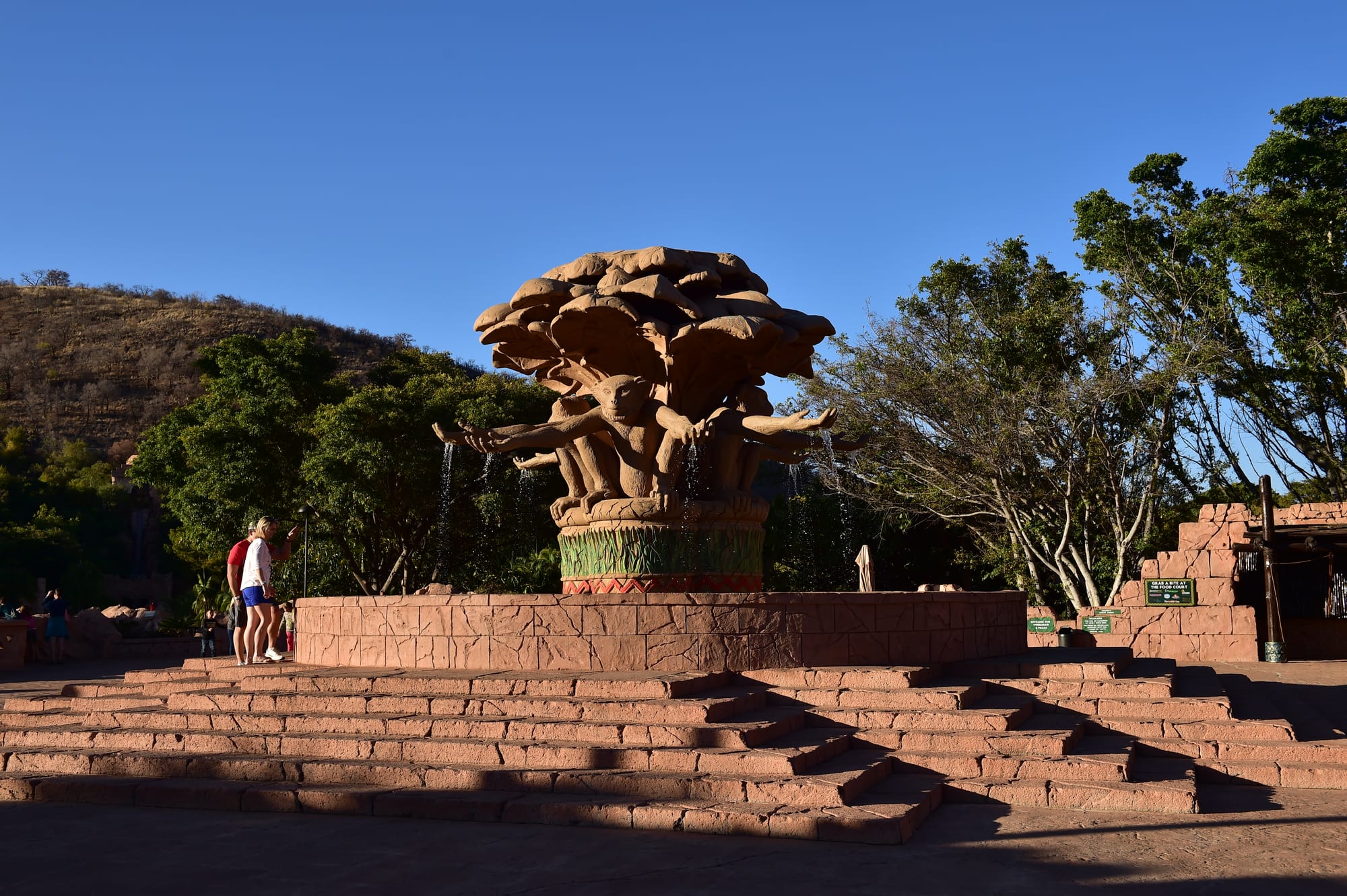
A large carved stone fountain shaped like a tree on a stepped plaza, with wooded hills rising behind under a clear blue sky

The Free State & North West, South Africa

Sun City

A stone fountain on the plaza at the Valley of Waves, Sun City, in the North West province. (South African Tourism from South Africa / Wikimedia Commons · CC BY 2.0)

A purpose-built resort complex in the North West province, set in bushveld between the Elands River and the Pilanesberg hills about 140 kilometres from Johannesburg. Opened in 1979 in the then nominally independent Bophuthatswana, it grew from a casino into a complex of hotels, two golf courses, an artificial wave pool and an arena, beside a national park.

Neighbourhoods

  • The entertainment centre
    • First-time visitors
    • Nights out
    • Shops and restaurants

    The heart of the original 1979 resort, with the casino floors, cinemas, shops, bars and a concourse of restaurants under one roof. It is the busiest part of the complex and the point most visitors pass through several times a day.

    Open in Maps
  • The Lost City
    • Architecture
    • Gardens
    • Photography

    The 1990s extension built as an invented ruined African palace, with carved animal columns, domes, bridges and a large area of planted forest and water gardens. It is the most theatrical part of Sun City and can be walked through by visitors.

    Open in Maps
  • The Valley of Waves
    • Families
    • Swimming

    A walled water park opened in the 1990s with a wave machine, sand beach, slides and pools, laid out below palm-covered slopes. It is the resort's summer centre of gravity and is busy through South African school holidays.

    Open in Maps
  • The golf courses and the bush edge
    • Golf
    • Quiet
    • Wildlife

    Two courses and their fairway walks fill the ground between the resort buildings and the hills, with game seen on the edges. Beyond them the ground rises into the Pilanesberg, and the park gates are a short drive away.

    Open in Maps
  • Ledig and the Bakubung villages
    • Local life

    Outside the resort gates lie the villages of the Bakubung community, on whose land Sun City was built and from which much of its workforce comes — ordinary North West settlements of houses, shops and taxi ranks.

    Open in Maps

Things to do

Inside the resort

  • Valley of Wavesattraction

    A water park opened in the 1990s with a wave pool, a sand beach, slides and a lazy river, built into a landscaped valley of palms and rock.

    Open in Maps
  • Gary Player Country Clubattraction

    A championship golf course designed by Gary Player and named after him, one of the longest in the world, which hosts the Nedbank Golf Challenge towards the end of each year.

    Open in Maps

Wildlife next door

  • Pilanesberg National Parkpark

    A large reserve filling the eroded bowl of a volcano roughly 1.25 billion years old, stocked from 1979 under the scheme known as Operation Genesis and now holding elephant, rhino, lion and much else.

    Open in Maps

Short trips from the resort

  • Rustenburgattraction

    The main city of the platinum belt, at the foot of the Magaliesberg, with shopping, a nature reserve on the mountain slopes and the Royal Bafokeng Stadium nearby.

    Open in Maps
  • Magaliesbergtrail

    A long quartzite range of cliffs, kloofs and streams running east towards Pretoria, popular for hiking, birdwatching and weekend drives.

    Open in Maps
  • Royal Bafokeng Stadiumattraction

    The stadium of the Royal Bafokeng Nation at Phokeng, used for football and rugby and one of the venues of the 2010 World Cup.

    Open in Maps

Seasonal events

  • Nedbank Golf ChallengeNovember or December

    A professional golf tournament played on the Gary Player Country Club course, first played in 1981 and one of the world's richest golf tournaments.

Eat and drink

Long-standing places and food districts in Sun City. Hours, ratings and directions come from your maps app, always current.

Around the resort

  • The entertainment centre's restaurantsneighborhood

    The concourse holds a run of restaurants and bars covering grills, seafood, pizza, buffets and fast food, and is where most meals in the resort are eaten.

    Open in Maps
  • Braai and South African grillsrestaurant

    Grilled meat is the local staple, with boerewors sausage, steaks and sosaties, and pap, the stiff maize porridge, with a tomato and onion relish.

    Open in Maps

Outside the gates

  • Ledig and the road to Rustenburgneighborhood

    Outside the resort, the villages and the Rustenburg road have small takeaways, butcheries that grill meat to order and street vendors selling grilled maize and vetkoek, fried dough.

    Open in Maps
  • Rustenburg's shopping-centre restaurantsneighborhood

    The nearest city has the wider choice, with chain steakhouses, Indian and Portuguese-style chicken restaurants and coffee shops in its malls.

    Open in Maps

Experience Sun City

History

The land around the Pilanesberg belongs to the Bakubung, a Tswana community whose villages lie beside what is now the resort, and the hills themselves are the eroded root of a volcano that erupted more than a billion years ago. In the apartheid era this area was assigned to Bophuthatswana, a homeland made up of scattered blocks of territory which was declared nominally independent in 1977 and recognised by no state other than South Africa and Transkei, another homeland.

That status was the reason Sun City exists. Gambling and other entertainment then restricted in South Africa were permitted in the homelands, and the hotel operator Sol Kerzner opened a casino resort on Bakubung land in December 1979, reachable in a couple of hours from Johannesburg. It became a byword for weekends away, boxing matches, beauty pageants and concerts at its arena, and international performers who appeared there were criticised during the cultural boycott of apartheid South Africa, with a protest record in 1985 making the resort's name a slogan of the anti-apartheid campaign.

The complex expanded through the 1980s and again in the early 1990s, when the Lost City was built: a themed extension with an invented legend, a palace hotel, a rainforest of imported and planted trees, an artificial wave pool and a second golf course. Bophuthatswana collapsed in March 1994 and the area became part of the new North West province, ending the gambling monopoly that had underpinned the business as casinos opened across the country. Sun City has since repositioned itself as a family and conference resort trading on its water park, its golf and the neighbouring national park, and has been repeatedly refurbished.

Culture & Customs

Sun City is a manufactured place, and its style is deliberate: carved elephants and leopards, mock ruins, domes and bridges, piped birdsong, and an imagined African civilisation invented for the Lost City extension. Visitors treat it as spectacle rather than heritage, and the contrast with the real Tswana villages and Iron Age sites nearby is part of what makes it a much-discussed place in South Africa.

Its cultural weight in the country comes from entertainment and sport. The arena has staged world title boxing, beauty pageants and long-running concert seasons, and the year-end golf tournament on the championship course is a fixture of the sporting calendar that fills the resort. For a generation of South Africans a trip here — the wave pool, the slides, the arcade — is a shared childhood memory, which keeps it busy in school holidays.

The politics are unavoidable. The resort was created because the homeland system allowed activities banned elsewhere, it drew international protest during the boycott years, and it was built on land belonging to a community whose members provide much of the workforce. Those facts sit alongside its present role as an employer and a large contributor to the North West's tourism economy. Manners inside are relaxed and international: casual dress, English as the working language, tipping expected, and a steady rhythm of buffet breakfasts, pool afternoons and evening entertainment.

Daily Life

Sun City has no permanent population of its own in the way a town does; its residents are guests, and the people who make it work live in the Bakubung villages at Ledig outside the gates, in Mogwase and in Rustenburg, arriving by staff bus and minibus taxi for shifts that run around the clock. Thousands of jobs depend on the complex — kitchens, housekeeping, gardens, gaming, security, maintenance, guiding — making it one of the largest employers in the district.

The working day follows the guests: breakfast services from early morning, the water park and pools through the middle of the day, golf at both ends of it, and the casino and restaurants late. Occupancy swings hard with school holidays, long weekends, conferences and the year-end tournament, so staffing is seasonal and overtime common.

Outside the fence, life is that of the rural North West: subsistence and small plots, platinum mining a short drive away around Rustenburg, high unemployment, and households in which resort wages support extended families. Water supply, electricity interruptions and road conditions are the recurring local concerns, and the relationship between the resort, the Bakubung authorities and the provincial parks board — over land, jobs and the boundary with the national park — is a continuing local issue.

Food

Eating at Sun City is resort eating: buffets, grills, pizzas, sushi, burgers and coffee shops spread through the entertainment centre and the hotels, aimed at families and conference groups rather than at local tradition. The braai, the open-fire grill that is the national way of cooking meat, appears in a formal version at the steakhouses and in outdoor settings, with boerewors, the coiled spiced sausage, sosaties, marinated kebabs, and beef and lamb over coals.

The North West's own cooking shows more clearly outside the gates. Pap, the stiff maize porridge, is eaten with a meat stew or with chakalaka, a spiced vegetable relish; seswaa, beef or goat boiled until it falls apart and then pounded, is the Tswana dish for celebrations; and ting, a sour fermented sorghum or maize porridge, is a household staple. Butcheries sell meat to be grilled on the spot, which is the local equivalent of a restaurant meal.

Snacks and drinks are straightforward. Vetkoek, fried dough eaten with mince or jam, and grilled maize cobs are sold at the roadside; biltong and droëwors, the air-dried spiced meats, are the standard travelling food; and the fruit spirit known as mampoer, distilled from peaches or marulas, is made on farms to the west. Wine comes from the Cape, beer is the default drink, and rooibos, the red bush tea, is served everywhere.

Planning tools

Budget

Sun City is one of the more expensive places to stay in the interior, and almost all spending happens inside the complex, where rooms, meals and activity tickets are priced for a captive audience. Day visitors pay an entry fee that is partly redeemable inside. Staying in a guesthouse outside the gates or a park camp at Pilanesberg cuts the cost sharply.

Daily Budget Midrange
USD 180–350 (resort hotel room, resort restaurants, water park and activity tickets, a game drive)
Daily Budget Shoestring
USD 55–95 (guesthouse outside the resort, self-catering, day entry, self-drive in the park)

Compare a day visit from a guesthouse outside the gates with a resort stay; the water park, the walks and the gardens can all be done in a day.

Best Time to Visit

Winter, from May to September, is the best time for game viewing in the neighbouring park and gives warm, dry, cloudless days, though nights are cold and the water park is less appealing. Summer, from November to March, is hot with afternoon thunderstorms and suits the pools, and is also when South African school holidays fill the resort.

Suggested Number of Days

A day or two covers the resort's public attractions. Three or four allow time for the neighbouring national park as well, at a slower pace. School holidays, weekends and big events make the complex much busier, which stretches the time everything takes.

First Visit
1–2 days
With Surroundings
3–4 days

Transportation

Almost everyone arrives by car, hire car or coach transfer from Johannesburg or Pretoria, roughly two to three hours away. Inside the complex a shuttle links the hotels, the entertainment centre and the water park, and much of it can be walked. A vehicle is needed for the national park or anywhere beyond the gates.

Leave a car in the resort's car parks rather than driving between its hotels, and use a vehicle with reasonable clearance for the park's gravel roads.

Airport & Station Connections

The resort lies about 140 kilometres north-west of Johannesburg, two to three hours by road through Rustenburg or via Brits, and around 40 kilometres from Rustenburg. OR Tambo International at Johannesburg is the nearest major airport, and scheduled coach and shuttle transfers run from Johannesburg and Pretoria for guests without a car.

Walkability

The complex is designed to be crossed on foot, with covered walkways, bridges, gardens and paths connecting the hotels, the entertainment centre and the water park, and a shuttle for the longer stretches. Distances are greater than they look and the middle of a summer day is hot. Beyond the gates there are no pavements and walking is not practical.

Safety

The resort is fenced, staffed and patrolled, and sees few of the problems found in the cities; the main issues inside are sunburn, heat and pool safety for children. Outside, the risks are those of the wider region — long drives on roads busy with mining traffic, wildlife on reserve roads, and the requirement to stay in a vehicle in the national park, where elephants and lions are present.

Stay in the vehicle in the game reserves, drive in daylight, and avoid demonstrations in mining towns. Check current official travel advice before travelling.

Climate

Bushveld climate on the edge of the highveld, warm year-round and much milder in winter than the plateau to the south. Summer runs from December to February and is the rainy season, with hot days and afternoon thunderstorms; winter is dry and sunny with cold nights and very little cloud.

Summer
hot, around 28–34°C by day, with afternoon thunderstorms from November to March
Winter
dry and sunny, around 22–25°C by day, with nights near 5°C

Local Customs

Setswana is the language of the surrounding district, with English used throughout the resort and Afrikaans widely heard. Tipping is expected: around ten per cent in restaurants, small amounts for porters, housekeeping and game-drive guides. Dress is casual by day, a little smarter in the evening, and swimwear stays at the pools. Gambling is legal and restricted to over-18s, with identification sometimes requested.

Ask before photographing people, avoid photographing inside the casino areas, and keep to marked paths and viewing points where wildlife has access to the resort's edges.

Common Payment Methods

The currency is the South African rand. Cards are accepted everywhere in the resort, including for room accounts that most spending can be charged to, and there are ATMs in the entertainment centre. Cash is useful for tips, for small traders outside the gates and for the days when power interruptions affect card machines.