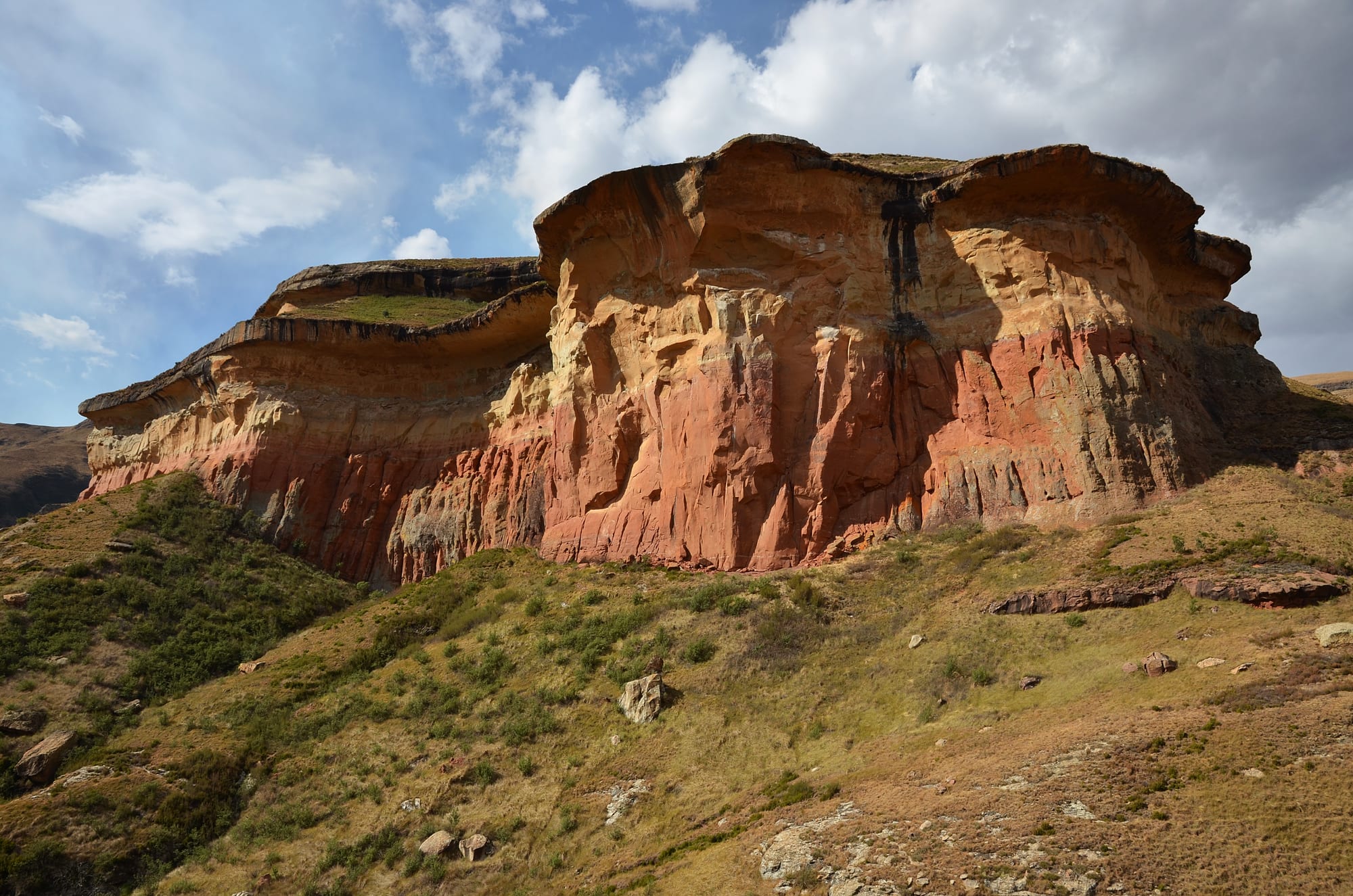
Layered red, cream and ochre sandstone cliffs with overhanging tops above a grassy, rock-strewn slope

South Africa

The Free State & North West

Sandstone cliffs in the Golden Gate Highlands National Park, near Clarens in the eastern Free State. (Pavel Špindler / Wikimedia Commons · CC BY 3.0)

The farming and mining heartland of South Africa's interior plateau, between the Vaal and Orange rivers and the Botswana border — the old Boer republic around Bloemfontein and the sandstone highlands of Clarens and Golden Gate, joined with the platinum belt of Rustenburg, the resort of Sun City and the game reserves of Pilanesberg and Madikwe.

Explore The Free State & North West

History

The Vredefort Dome, near the Vaal River, marks a meteorite impact about two billion years ago, and the Taung skull, found in the North West in 1924, became the type specimen of Australopithecus africanus. In later centuries the plateau was home to Sotho and Tswana chiefdoms, and in the west to San and Khoekhoe peoples and the Griqua, a people of mixed descent.

Voortrekkers crossed the Orange River from the 1830s. Potchefstroom, founded in 1838, was the first capital of the northern Boer settlements, and the Orange Free State became an independent Boer republic in 1854, with Bloemfontein as its capital. Its wars with the Basotho of Moshoeshoe between 1858 and 1868 took most of the fertile land west of the Caledon River, which became the eastern Free State. In the South African War, British troops took Bloemfontein in 1900, Boer forces besieged Mafikeng, and thousands of Boer women and children and Black civilians died in British concentration camps.

Bloemfontein was the birthplace of the African National Congress in 1912 and of the National Party two years later. Under apartheid, Bophuthatswana, a homeland made of scattered pieces of territory, was declared nominally independent in 1977, with its capital at Mmabatho, and the small Basotho homeland of Qwaqwa lay in the eastern Free State. Bophuthatswana collapsed in March 1994, weeks before the first democratic election. In 2012 police shot dead 34 striking miners at Marikana, near Rustenburg, the most lethal use of force by the security forces against civilians since the Soweto uprising of 1976.

Culture & Customs

Sesotho is the main language of the Free State and Setswana of the North West, each spoken at home by more than half the population, with Afrikaans strong in both provinces, especially in the farming towns and in Bloemfontein and Potchefstroom. The Basotho blanket, worn as a cloak in the cold highveld winter, and the conical straw hat are common sights in the eastern Free State.

The Free State has long been a centre of Afrikaner culture: the Voortrekker and Boer War monuments and Dutch Reformed churches in the centre of every town. Bloemfontein's university, now the University of the Free State, was historically an Afrikaans institution, and Potchefstroom hosts the Aardklop Afrikaans arts festival each September.

The Royal Bafokeng Nation near Rustenburg, a Tswana community that won rights to platinum royalties on its land, is one of the most unusual traditional authorities in the country. Church life is strong across both provinces, and choirs and gospel music are popular. Rugby is followed with passion in Bloemfontein, home of the Free State Cheetahs, and Clarens has become an artists' village with many galleries.

Daily Life

The Free State has about 3 million people. Bloemfontein, in the Mangaung metro of roughly 800,000, is the judicial capital and seat of the Supreme Court of Appeal. Welkom and Virginia grew on the goldfields discovered in the 1940s, Sasolburg on Sasol's chemical plants, and Bethlehem and Harrismith serve the east. In the North West, Rustenburg, Mahikeng, the provincial capital, Klerksdorp and Potchefstroom are the main towns.

The economy rests on farming and mining. The Free State grows a large share of the country's maize, wheat and sunflowers and raises sheep and cattle, while its gold mines have been declining for decades. The North West's Bushveld Complex around Rustenburg holds the world's largest known platinum reserves, and mining shapes its towns, from migrant hostels to informal settlements.

Life in the small towns follows the farming calendar, the church and the rugby season. Unemployment, collapsing municipal services and water supply, poor roads and the decline of the old gold towns dominate local news.

Food

The plateau is maize country, and pap, the stiff maize porridge, appears at almost every meal, eaten with boerewors or a meat stew. Sesotho and Setswana tables add motoho, a fermented sorghum porridge, and ting, a sour porridge, while seswaa, beef or goat boiled until tender and pounded, is a Tswana dish.

The Free State's grain farms produce much of the country's bread flour, and potbrood, bread baked in a cast-iron pot over coals, goes with a braai. Ficksburg is the centre of South Africa's cherry growing, and the eastern Free State grows asparagus. Biltong, dried spiced meat, is made from beef and game across the region.

The Marico district in the North West is known for mampoer, a strong fruit brandy distilled on farms from peaches and other fruit. Clarens has craft breweries nearby, and Parys has become a weekend destination for its restaurants.

Attractions & Natural Wonders

Bloemfontein's sights centre on its history: the National Women's Monument and the Anglo-Boer War Museum, the old Raadsaal, the Oliewenhuis Art Museum and the view over the city from Naval Hill, with its game reserve. J. R. R. Tolkien was born in the city in 1892.

In the eastern Free State, Clarens is the base for the Golden Gate Highlands National Park, whose sandstone cliffs such as the Brandwag Buttress glow gold in the late afternoon, with zebra and eland on the grasslands. The Vredefort Dome lies around Parys on the Vaal River.

In the North West, Sun City, opened in 1979, has casinos, golf courses, the Lost City hotel and its Valley of Waves. Next door, the Pilanesberg National Park fills the eroded volcanic bowl of the Pilanesberg with rhinos, elephants, lions and more. Madikwe Game Reserve, on the Botswana border, was restocked from 1992 with elephants, buffalo, rhinos, lions and wild dogs.

Around Rustenburg, the Magaliesberg range and Hartbeespoort Dam are weekend escapes from Gauteng, while Potchefstroom has its old Voortrekker churches and Mahikeng its siege history. The Taung skull site lies in the far west.

Cities in The Free State & North West

Planning basics

Budget

This is one of the cheapest parts of South Africa to travel. Guesthouses and farm stays in the Free State towns cost well below Cape Town prices, and Golden Gate's park chalets are good value. The exceptions are the hotels of Sun City and the lodges of Madikwe, where all-inclusive rates are high.

Daily Budget Midrange
USD 110–220 (country guesthouse or park chalet, restaurant meals, car hire, game drives)
Daily Budget Shoestring
USD 45–75 (guesthouse or park campsite, self-catering, self-drive)

Visit Pilanesberg on a self-drive day permit and save the private lodges for Madikwe; Clarens fills up at weekends with visitors from Gauteng.

Safety

Crime affects the cities — Bloemfontein, Welkom, Rustenburg and Klerksdorp — as elsewhere in South Africa, but the main tourist areas of Clarens, Golden Gate, Sun City, Pilanesberg and Madikwe see few problems. The platinum belt has seen violent labour disputes, and the main hazards for visitors are long drives, stray livestock and wildlife on reserve roads.

Stay in the vehicle in the game reserves, drive in daylight, and avoid demonstrations in mining towns. Check current official travel advice before travelling.

Climate

Both provinces lie on the highveld plateau, with summer rain falling in afternoon thunderstorms and dry, sunny winters. Winters are cold at night, with frost widespread and occasional snow in the eastern Free State highlands around Clarens and Harrismith. The North West is warmer and drier towards the Kalahari fringe in the west.

Summer
warm to hot, 26–32°C, with afternoon thunderstorms from November to March
Winter
sunny and dry, 15–20°C by day; frost at night, occasional snow in the eastern highlands

Transportation

Bloemfontein is about four to five hours' drive from Johannesburg on the N1, and has an airport with domestic flights. Sun City and the Pilanesberg are about two to three hours from Johannesburg, Clarens around three and a half hours, and Madikwe four to five. Roads are generally good, though potholes and heavy trucks are common on some provincial routes.

A car is essential; drive in daylight, and take care on mining and freight routes busy with heavy vehicles.

Best Time to Visit

April and May bring autumn colours in the eastern Free State and clear skies; winter from June to August is the best game-viewing season at Pilanesberg and Madikwe, with cold mornings. Spring and summer are green, and Ficksburg's Cherry Festival takes place in November.