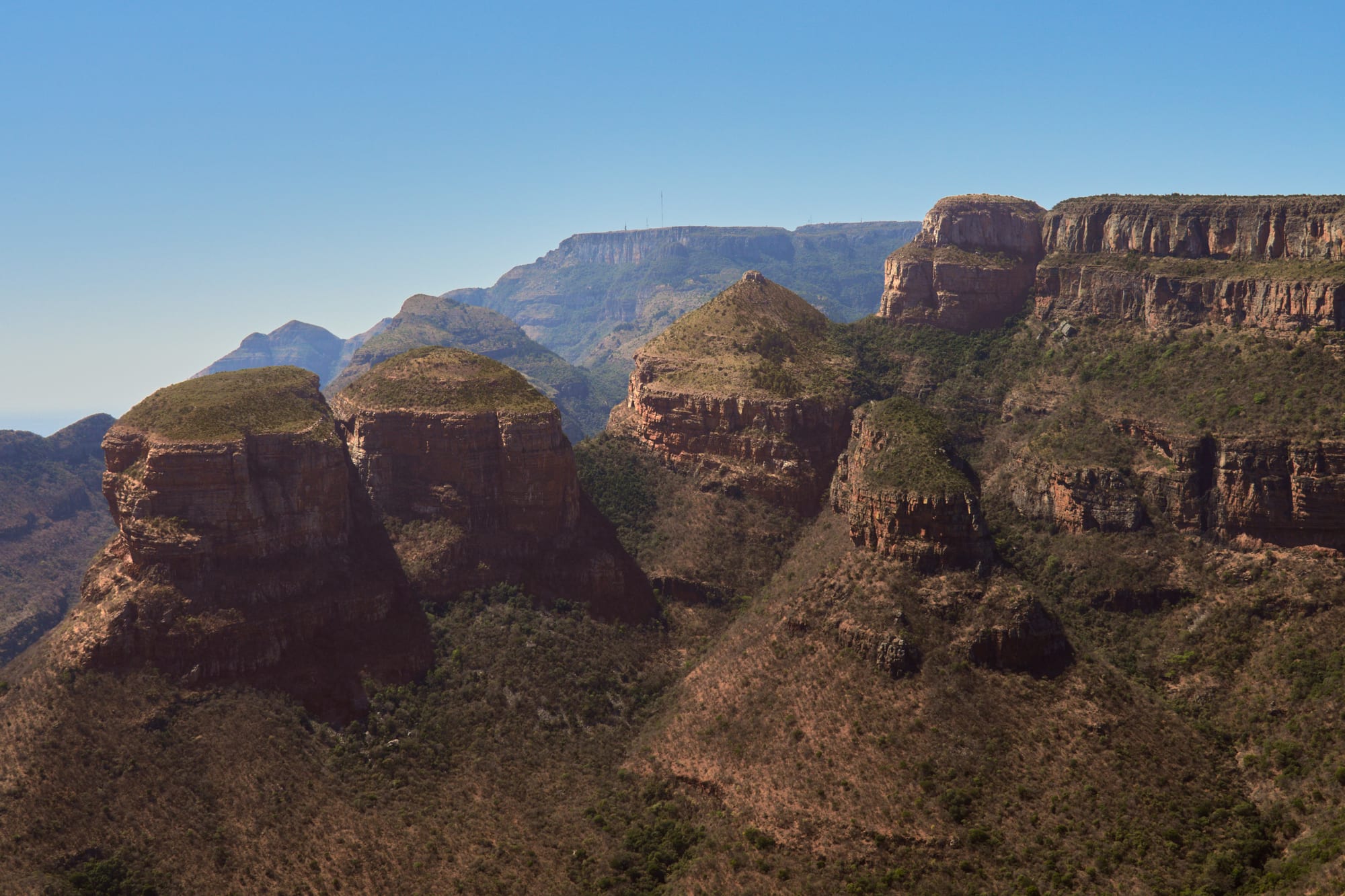
Three rounded, grass-capped rock towers with red-brown cliffs rising from a wooded canyon under a clear blue sky

South Africa

Johannesburg, Pretoria & Kruger

The Three Rondavels above the Blyde River Canyon, seen from the Panorama Route in Mpumalanga. (lumoplank / Wikimedia Commons · CC0)

The north-east of South Africa, joining Gauteng's gold-built cities of Johannesburg and Pretoria with the Mpumalanga and Limpopo provinces below the escarpment — the country's economic engine and the route most visitors take to the Kruger National Park, the Blyde River Canyon and the ancient kingdom of Mapungubwe on the Limpopo.

Explore Johannesburg, Pretoria & Kruger

History

The Cradle of Humankind holds fossils of early hominins going back millions of years. Much later, in the Limpopo valley, the kingdom of Mapungubwe flourished in the 13th century, trading gold and ivory towards the Indian Ocean before its centre shifted to Great Zimbabwe. Sotho-Tswana, Pedi, Venda, Tsonga and Ndebele peoples settled the highveld and lowveld, and the Pedi kingdom under Sekhukhune resisted both Boers and British until its defeat in 1879.

Voortrekkers founded the South African Republic, or Transvaal, north of the Vaal River, with Pretoria as its capital from 1860. The gold discovery of 1886 on the Witwatersrand created Johannesburg almost overnight, and the mining boom drew labour from across southern Africa and brought the conflicts that led to the South African War of 1899–1902. After the Union of 1910, Pretoria became the administrative capital.

Gauteng became the centre of both apartheid's machinery and the resistance to it. Sophiatown was bulldozed in the 1950s, police killed dozens of protesters at Sharpeville in 1960, the Rivonia trial of 1963–64 sentenced Mandela and his comrades to life, and on 16 June 1976 police opened fire on Soweto schoolchildren protesting against Afrikaans teaching. The homelands of Venda, Lebowa, Gazankulu, KaNgwane and KwaNdebele covered much of what is now Limpopo and Mpumalanga. Mandela was inaugurated at the Union Buildings in 1994, and the new provinces took their present names between 1995 and the early 2000s.

Kruger has its own history: President Paul Kruger's government proclaimed the Sabi Game Reserve in 1898, and it was enlarged and renamed the Kruger National Park in 1926.

Culture & Customs

Gauteng is the country's melting pot. People from every province and from across Africa live there, and many residents switch easily between isiZulu, English, Sesotho, Setswana and Afrikaans, blended in the township slang known as tsotsitaal. Johannesburg's energy runs through its music — kwaito in the 1990s and amapiano now, both born in its townships — its fashion, its galleries in Braamfontein and Maboneng, and its huge churches, including the Zion Christian Church, whose Easter gathering at Moria in Limpopo draws up to a million pilgrims. Pretoria has a stronger Afrikaans character and houses the embassies and the civil service.

Limpopo is the home of the Pedi, the Venda and the Tsonga, and speaks Sepedi, Tshivenda and Xitsonga. Venda culture holds sacred places such as Lake Fundudzi, and the Balobedu of the Modjadjiskloof area have a line of Rain Queens. Mpumalanga speaks siSwati, isiZulu and isiNdebele; the Ndebele women's geometric house painting and beadwork, made famous by artists such as Esther Mahlangu, are the best-known art of the region.

Sport is a religion in Gauteng: Soweto's two football giants, Kaizer Chiefs and Orlando Pirates, contest the Soweto derby, and Ellis Park and Loftus Versfeld host big rugby matches.

Daily Life

Gauteng is the smallest province by area and the most populous, with about 15 million people. Johannesburg has around 5 million, and Tshwane, the metro that includes Pretoria, and Ekurhuleni, east of Johannesburg, are the other two big metros. Mpumalanga has Mbombela as its capital, and Limpopo, with about 6 million people, has Polokwane as its capital.

Gauteng produces around a third of the country's economic output: finance on the Johannesburg Stock Exchange in Sandton, manufacturing, government in Pretoria and the old gold mines. Mpumalanga's highveld is coal country, lined with Eskom power stations and some of the worst air pollution in the country, while its lowveld grows citrus, bananas and macadamia nuts. Limpopo mines platinum and other minerals, grows mangoes, avocados and tomatoes, and depends heavily on tourism around Kruger.

Life in Gauteng starts early, with long commutes by minibus taxi from the townships and gridlock on the highways. Inequality is plain, with townships like Alexandra beside Sandton. Illegal mining, broken municipal services, water outages and crime are the daily concerns; in the lowveld, rhino poaching is a constant battle for Kruger's rangers.

Food

Gauteng's township food is the region's contribution to South African eating. The kota, a hollowed quarter-loaf stuffed with chips, polony, cheese, egg and fried sausage, is the Johannesburg answer to Durban's bunny chow. Shisa nyama, meaning "burn the meat", is the name for the butcheries where customers buy meat and have it braaied on the spot, eaten with pap, the stiff maize porridge, and chakalaka. Magwinya, fried dough balls, and mogodu, tripe, are other favourites.

In Limpopo, mopane worms — the caterpillars of the emperor moth, dried and eaten crisp or stewed with tomato and onion — are a delicacy and a trade. Morogo, wild spinach, is cooked with maize meal, and the marula fruit makes a traditional beer and the cream liqueur Amarula.

The lowveld is fruit country, and roadside stalls around Hazyview and Tzaneen sell mangoes, bananas, avocados, litchis and macadamias. Mpumalanga's highland trout, caught around Dullstroom, is a popular dish, and Pretoria's Afrikaans tradition keeps biltong, boerewors and koeksisters on every table.

Attractions & Natural Wonders

Johannesburg's main sights tell the city's story: the Apartheid Museum and Gold Reef City, Constitution Hill, the Maboneng and Braamfontein districts, and Soweto, with Vilakazi Street, the Mandela House and the Hector Pieterson Memorial. North-west of the city lies the Cradle of Humankind, with the Sterkfontein Caves and the Maropeng visitor centre. Pretoria has the Union Buildings, Church Square with Paul Kruger's statue, the Voortrekker Monument and Freedom Park, and its October jacarandas.

The Panorama Route along the Mpumalanga escarpment takes in the Blyde River Canyon, the Three Rondavels, Bourke's Luck Potholes, God's Window, the waterfalls around Graskop and Sabie, and Pilgrim's Rest, a preserved 19th-century gold-mining town. Further south, the Barberton Makhonjwa Mountains are a UNESCO World Heritage Site for their ancient rocks.

Kruger National Park runs about 350 kilometres from the Crocodile River to the Limpopo, with its busiest camps, Skukuza and Lower Sabie, in the south, the mopane country of Letaba and Shingwedzi in the centre and north, and Pafuri's riverine forest at the top. The Sabi Sand, a group of private reserves, adjoins the south-western boundary, and the Timbavati and Klaserie reserves, unfenced from the park, lie further north.

In far-north Limpopo, Mapungubwe National Park protects the hill of the old kingdom at the meeting of the Limpopo and Shashe rivers, where South Africa, Botswana and Zimbabwe meet. The Waterberg and the Soutpansberg are the other main mountain areas.

Cities in Johannesburg, Pretoria & Kruger

Planning basics

Budget

Gauteng is good value for hotels and restaurants outside the smartest suburbs of Sandton and Rosebank. In Kruger, SANParks rest camps with self-catering bungalows keep a safari affordable, while lodges in the Sabi Sand and the other private reserves on Kruger's western edge are among the most expensive places to stay in Africa. Limpopo's smaller towns are cheap.

Daily Budget Midrange
USD 150–310 (guesthouse or rest-camp bungalow, car hire, park fees, guided drives)
Daily Budget Shoestring
USD 50–85 (hostel or Kruger campsite, self-drive, self-catering)

Book Kruger rest camps months ahead for school holidays; one or two nights in a private reserve adds walking safaris and off-road leopard viewing to a self-drive trip.

Safety

Johannesburg has high rates of violent crime. The central business district, Hillbrow and the areas around taxi ranks are risky, and carjacking and smash-and-grab at traffic lights are real hazards across Gauteng; Sandton, Rosebank, Maboneng by day and guided Soweto tours are generally fine. In Kruger the risks are animals and malaria: the lowveld is a malaria area, especially in the wet season.

Keep car doors locked and bags out of sight, avoid walking in Johannesburg after dark, stay in vehicles in Kruger except at marked sites, and take malaria advice before visiting the lowveld. Check current official travel advice before travelling.

Climate

Johannesburg and Pretoria sit on the highveld at around 1,300 to 1,750 metres, with warm summers broken by afternoon thunderstorms and dry, sunny winters with frosty nights. Below the escarpment the lowveld, where Kruger lies, is much hotter and more humid in summer and mild in winter. The Limpopo valley in the far north is hot and dry.

Summer
25–30°C with afternoon storms on the highveld; 30–40°C in the lowveld and the Limpopo valley
Winter
dry and sunny, 17–20°C by day and near freezing at night on the highveld; 23–26°C by day in Kruger

Transportation

OR Tambo International at Johannesburg is South Africa's main hub. The Gautrain links the airport with Sandton and Pretoria. Kruger is about five to six hours' drive from Johannesburg on the N4 to Mbombela or via the Panorama Route, and there are flights to Kruger Mpumalanga International, Skukuza, Hoedspruit and Phalaborwa. Inside Kruger, speed limits are low and distances long. Mapungubwe is roughly six hours north of Johannesburg by road.

Use the Gautrain or ride-hailing in Gauteng, reach Kruger's gates before they close at dusk, and fly to the lowveld if short of time.

Best Time to Visit

May to September is the classic safari season: the bush thins, animals gather at water, the risk of malaria is lower and days are sunny. Summer, from November to March, brings green landscapes, newborn animals and migrant birds, but heat and storms; the Panorama Route can be misty. Pretoria's jacarandas flower in October and November.