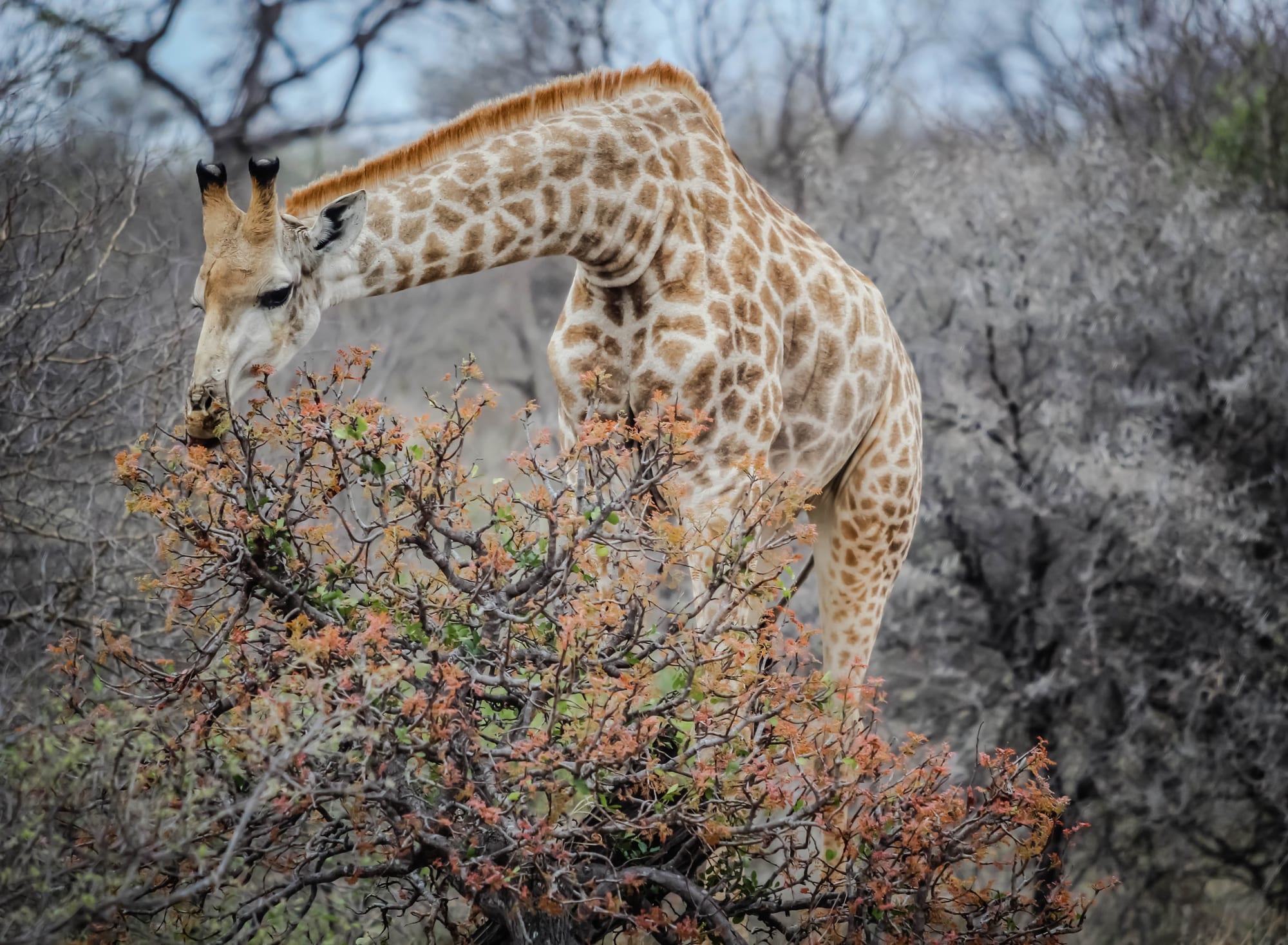
A giraffe stretching its head down to browse the red-tipped leaves of a thorny bush in dry grey bushveld

Johannesburg, Pretoria & Kruger, South Africa

Hoedspruit

A giraffe browsing in the bushveld around Hoedspruit, Limpopo. (Casey Allen westbeach013 / Wikimedia Commons · CC0)

A small lowveld town in Limpopo, at the foot of the Klein Drakensberg where the escarpment drops to the bushveld. It stands on the Selati railway line beside a South African Air Force base, part of which now handles civilian flights, and lives today on wildlife, with private reserves adjoining it on the Kruger side and citrus and mango farms filling the plain.

Neighbourhoods

  • The town centre
    • First-time visitors
    • Supplies and shops
    • Close to the airport

    A compact grid of shops, supermarkets, banks, workshops and small restaurants beside the main road, where lodges and farms buy their supplies and safari guests break their journeys. It is functional rather than pretty, and everything is a short drive apart.

    Open in Maps
  • The wildlife estates
    • Quiet and residential
    • Wildlife on the doorstep

    Around the town lie fenced residential estates where houses share the ground with impala, giraffe and birdlife, home to guides, pilots, conservation staff and retirees. Many self-catering guest houses are in these estates, several minutes out from the shops.

    Open in Maps
  • The reserve road
    • Safari lodges
    • Game drives

    East of the town, gravel roads run through citrus farms to the gates of the private reserves that share an unfenced boundary with the Kruger National Park. This is where most safari guests are collected and driven in.

    Open in Maps
  • The farm belt
    • Scenic driving
    • Farm stalls

    North and west of the town, irrigated orchards of citrus, mangoes, avocados and macadamias run towards the escarpment, worked by seasonal labour and dotted with packhouses and roadside stalls.

    Open in Maps

Things to do

Wildlife around the town

  • Timbavati Private Nature Reservepark

    A private reserve of about 530 square kilometres east of the town, formed by neighbouring landowners in 1956 and now unfenced from Kruger, known for lion, leopard and elephant.

    Open in Maps
  • Balule Nature Reservepark

    A reserve on the Olifants River north-east of the town, part of the Associated Private Nature Reserves whose fences with Kruger were removed in the 1990s.

    Open in Maps
  • The Associated Private Nature Reservespark

    The grouping of private reserves — Timbavati, Klaserie, Umbabat and Balule — that together protect some 1,800 square kilometres alongside Kruger's western boundary.

    Open in Maps
  • Eastgate Airporttransit hub

    The civilian airport created in the late 1990s in an unused part of the air force base, served by scheduled Airlink and CemAir flights, with car hire at the terminal.

    Open in Maps

Mountains and water

  • Mariepskopviewpoint

    At about 1,950 metres, the highest point above the Blyde River Canyon, named for the 19th-century Pulana chief Maripe Mashile, with forest, cliffs and a long view over the lowveld.

    Open in Maps
  • Blyde River Canyon Nature Reservepark

    The reserve protecting the Blyde River Canyon, whose Swadini section is reached only from the Limpopo side, around the Blyderivierpoort Dam, home to hippo and crocodile.

    Open in Maps

Short trips from the town

  • Kruger National Parkpark

    One of the largest national parks in the world, reached from the town through the Orpen gate.

    Open in Maps
  • Phalaborwaattraction

    A mining town on Kruger's western border, the only South African town that borders the park, with its own airport and the Hans Merensky Golf Estate.

    Open in Maps

Eat and drink

Long-standing places and food districts in Hoedspruit. Hours, ratings and directions come from your maps app, always current.

Hoedspruit classics

  • The town's grills and coffee shopsneighborhood

    The small centre and its shopping courts hold steakhouses, pizza places, bakeries and coffee shops used by farmers, guides and safari guests between flights.

    Open in Maps
  • Bushveld braai and game meatrestaurant

    Grilled meat over coals is the standard evening meal in the district, with beef, boerewors sausage and game such as kudu appearing on menus.

    Open in Maps

Farm produce

  • Citrus and mango farm stallsmarket

    Roadside stalls and packhouse shops sell oranges, naartjies, mangoes, avocados and macadamia nuts in season from the irrigated farms around the town.

    Open in Maps
  • Marula productsmarket

    The marula tree grows across this lowveld, and its fruit becomes juice, oil, a traditional beer and the Amarula cream liqueur.

    Open in Maps

Experience Hoedspruit

History

The plain below the Klein Drakensberg has a long history of settlement, with an Early Iron Age farming site nearby dated to between AD 450 and 1000; Mariepskop, the peak that dominates the western skyline, is named for the Pulana chief Maripe Mashile, whose people used it as a stronghold in the 19th century. The first European farm, Hoedspruit, was taken up in 1844, and its name — Afrikaans for "hat creek" — reportedly comes from a hat its owner lost in the flooded stream.

The railway made the place. The Selati line, built to link the lowveld with the main line at Kaapmuiden and eventually running on to Phalaborwa, passes through Hoedspruit and served as a strategic supply route in war and peace, driving the region's growth. Irrigation turned the hot, dry plain into orchard country, and citrus and mangoes became the district's main crops.

Its second transformation was military. A wartime training airstrip of the early 1940s became Air Force Base Hoedspruit, commissioned in 1977, which brought servicemen, families, housing and infrastructure to a place that had little of any. In the late 1990s an unused portion was converted into a civilian terminal, Eastgate Airport, now served by scheduled airlines. That opened the third phase: as the fences between the Kruger National Park and the private reserves along its western boundary came down in 1993, Hoedspruit became the arrivals hall for a safari industry, and lodges, guide schools and conservation projects have shaped it since.

Culture & Customs

Hoedspruit is a bush town with an unusually mixed population for its size. Xitsonga and Sepedi are the first languages of most people in the surrounding villages and on the farms, while the town and its estates hold Afrikaans- and English-speaking farmers, pilots, mechanics, lodge owners and field guides, with staff from across southern Africa working in the reserves. Conversation is informal, first names are used quickly, and almost every social connection runs back to either farming, flying or wildlife.

Wildlife is the local culture. Many residents have trained as field guides or work in conservation, and there are rehabilitation and breeding centres, raptor and reptile facilities and research projects around the town. Anti-poaching is a serious and sometimes dangerous business here, since the reserves on Kruger's boundary carry rhino and the losses since the late 2000s have been heavy; rangers, dog units and monitoring teams are part of the community.

Life is outdoor and early. People start work at first light because of the heat, sport and socialising happen in the late afternoon, and the braai is the standard form of hospitality. Church is central in the villages, and traditional Tsonga music and dance are performed at cultural events and celebrations. Air force history still shows in the town's older suburbs, and aircraft overhead are part of the everyday soundscape.

Daily Life

The town proper is small, although the wider municipality of Maruleng and the villages along the road towards the escarpment count many more, and the daytime population swells with farm workers, lodge staff and travellers moving through. Housing runs from the old air force quarters and ordinary suburban streets to the fenced wildlife estates and, at the other end, the villages where services are thinner.

Three sectors carry the economy: irrigated agriculture, especially citrus and mangoes with their packhouses and seasonal labour; tourism and conservation across the reserves; and the airport with the remaining military presence. Work is often seasonal, unemployment in the surrounding villages is high, and many households rely on a single wage or a grant. Schools and the supermarkets draw people in from a wide area.

The rhythm of the day is set by heat and light: early starts, a slow midday, and activity again towards evening, with game drives leaving before dawn and again in the late afternoon. Recurring concerns are water — the rivers are shared between farms, towns and the parks, and droughts bite — along with electricity interruptions, road maintenance, human-wildlife conflict where elephants break fences, and the long-running fight against rhino poaching.

Food

Hoedspruit eats like the lowveld: meat, maize and fruit. The braai, a wood or charcoal grill, is the social centre of the week, with boerewors, a spiced coiled sausage, steaks, lamb chops and sosaties, marinated kebabs. Potjiekos, a stew of meat and vegetables layered in a three-legged cast-iron pot over coals, is the slow-cooked version. Pap, the stiff maize porridge, comes with a tomato and onion sauce or chakalaka, a spiced vegetable relish, and in Tsonga kitchens with morogo, cooked wild greens.

Game meat is normal here rather than exotic: kudu and other game appear as steaks, stews and above all as biltong and droëwors, the air-dried spiced meat that every shop sells and every vehicle carries. Lodges serve the same repertoire in a smarter form, often with a braai in a boma, an outdoor enclosure lit by fire.

The farms supply the rest. Oranges and naartjies, mangoes, avocados and macadamia nuts are sold at the roadside and packed for export, and mango achar, a hot oily pickle, is a staple relish. Marula trees grow wild across the bushveld; their fruit is made into juice, brewed into a traditional beer, and used in the Amarula cream liqueur. Rooibos tea fills the gaps between.

Planning tools

Budget

Costs here split sharply. The town itself is inexpensive, with self-catering cottages, guesthouses and ordinary restaurants, and a self-drive day in the national park is cheap. The private reserves on the Kruger boundary are the opposite: all-inclusive lodge rates covering meals and two game drives a day run into hundreds of dollars a person.

Daily Budget Midrange
USD 140–290 (guesthouse or estate cottage, restaurant meals, hire car, a guided game drive)
Daily Budget Shoestring
USD 45–80 (self-catering cottage or campsite, supermarket food, shared car, park day fee)

Staying in or near the town and driving into the national park for the day costs a fraction of a private-reserve lodge; a night or two in a reserve buys off-road viewing and night drives.

Best Time to Visit

May to September is the classic game-viewing season: the bush thins out, animals gather at water, days are warm and dry and nights cold. From November to March the lowveld is hot and humid, with heavy afternoon storms, thick green bush, newborn animals and migrant birds, and a higher malaria risk. September and October are hot and dry.

Suggested Number of Days

Two or three days give time for game viewing from a base in or beside the town. Four to six allow the national park, the private reserves and a run up the escarpment as well. How much is needed depends on whether the trip is self-drive or built around guided drives.

First Visit
2–3 days
With Surroundings
4–6 days

Transportation

A vehicle is essential: the town, the estates, the reserve gates and the farms are spread over many kilometres of tar and gravel, and there is no visitor transport. Lodges collect guests from the airport, and most independent travellers hire a car at the airport or arrive in one from Johannesburg. Minibus taxis serve local residents on the main roads.

Keep to daylight for driving, watch for antelope, warthog and livestock on the roads, and take a vehicle with reasonable clearance for the gravel farm and reserve roads.

Airport & Station Connections

Hoedspruit lies several hours by road from Johannesburg, or a short flight to Eastgate Airport, shared with the air force base, which has scheduled Airlink and CemAir services. Most visitors fly in and are met, or drive the Panorama Route through Graskop and down the escarpment.

Walkability

Hoedspruit is not a walking town. The centre's shops can be covered on foot, but the estates, lodges and gates are kilometres apart on roads with no pavements, and wildlife moves freely on unfenced ground. Walking after dark is discouraged, and inside the reserves walking is only allowed with an armed guide.

Safety

Crime is lower here than in the cities, and the reserves and estates are controlled and patrolled, but house break-ins and theft from vehicles happen and the long, empty district roads are best driven in daylight. The real hazards are animals and disease: elephants, buffalo and hippo are dangerous on foot, and the lowveld is a malaria area, especially in the wet season, as the region's health advice sets out.

Keep car doors locked and bags out of sight, avoid walking in Johannesburg after dark, stay in vehicles in Kruger except at marked sites, and take malaria advice before visiting the lowveld. Check current official travel advice before travelling.

Climate

Hot lowveld climate, sheltered by the escarpment to the west. Summer runs from December to February and is the rainy season, with humid heat and afternoon thunderstorms; winter is dry, sunny and warm by day with cold early mornings, which is why it suits game viewing.

Summer
hot and humid, often 30–36°C by day, with heavy afternoon storms from November to March
Winter
dry and sunny, around 23–26°C by day, with cold early mornings

Local Customs

The district mixes Xitsonga and Sepedi-speaking communities with Afrikaans and English-speaking farming, aviation and safari families, and greetings come before business. Tipping matters in a tourism economy: around ten per cent in restaurants, and separate tips for guides and trackers at the end of a stay. Dress is neutral and casual for game drives, with warm layers for early mornings.

Ask before photographing people or farm workers, keep quiet and seated during game drives, and never leave food or bins where baboons and monkeys can reach them.

Common Payment Methods

The currency is the South African rand. Cards work in the town's shops, supermarkets, fuel stations and restaurants, and lodges usually bill by card or in advance. Cash is useful for tips, farm stalls and craft sellers, and for the days when a power interruption stops card machines working.