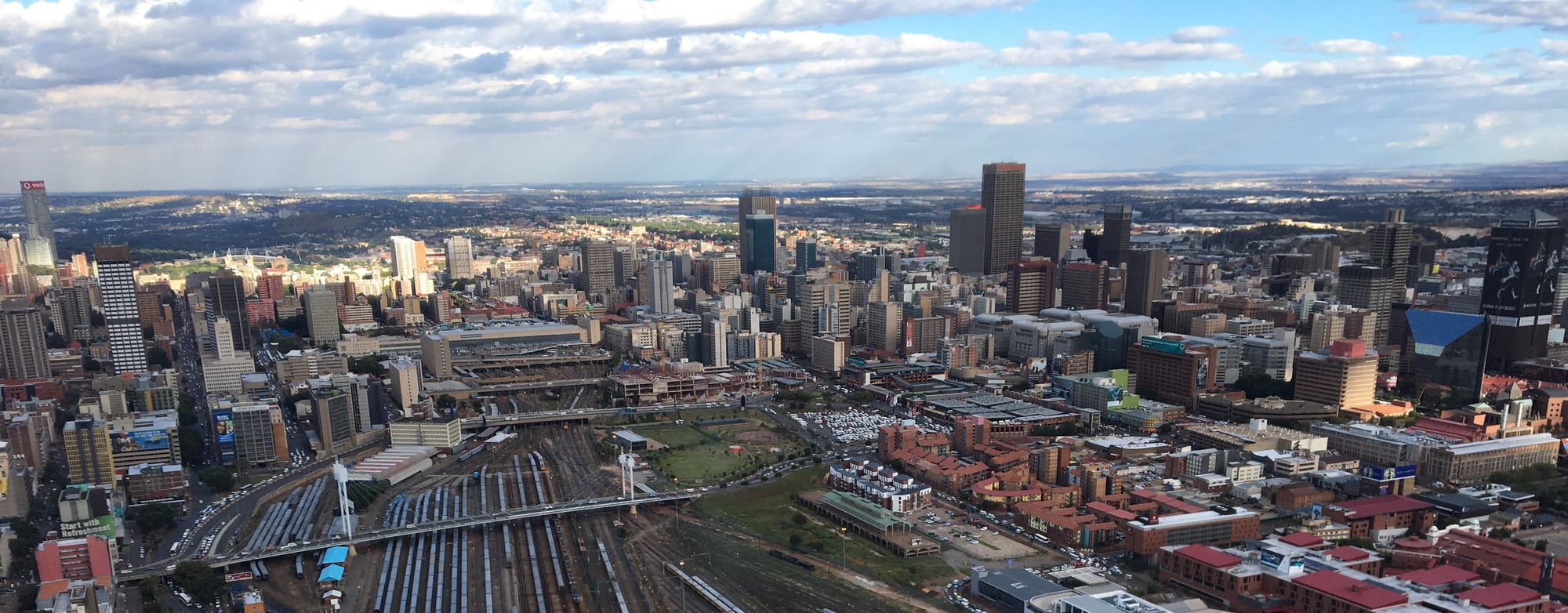
A wide aerial view over a dense city of tower blocks with railway yards and low buildings in the foreground

Johannesburg, Pretoria & Kruger, South Africa

Johannesburg

The skyline of central Johannesburg. (Mark Hillary / Wikimedia Commons · CC BY 2.0)

South Africa's largest city and its financial capital, created by the gold rush of 1886 on the Witwatersrand and grown into a sprawling metropolis on the highveld. Its museums and memorials — the Apartheid Museum, Constitution Hill and Soweto — tell the story of the twentieth century, while Sandton's towers, Maboneng's galleries and the townships that shaped kwaito and amapiano show a restless present.

Neighbourhoods

  • Sandton
    • First-time visitors
    • Business
    • Close to public transport

    The city's financial centre, north of the old centre, built around the Johannesburg Stock Exchange, office towers, a large shopping complex and Nelson Mandela Square. Most international hotels are here, and the Gautrain links it to the airport and Pretoria.

    Open in Maps
  • Rosebank
    • Shopping
    • Markets
    • Close to public transport

    A smaller, greener business and shopping district between Sandton and the centre, with malls, the Keyes Art Mile arts precinct and a Gautrain station, surrounded by residential streets.

    Open in Maps
  • Braamfontein
    • Students and nightlife
    • Arts and culture

    North of the railway lines on the edge of the old centre, built around the University of the Witwatersrand. Student life gives it a lively street scene near the city core, and the Joburg Theatre and Constitution Hill both stand in the district.

    Open in Maps
  • The inner city and Maboneng
    • Historic district
    • Street art
    • Local life

    The old gold-rush grid of the central business district, crowded and intensely busy by day with traders and commuters. The Maboneng area on its edge has been the best-known attempt to revive the old centre.

    Open in Maps
  • Melville and the western suburbs
    • Best for food
    • Bars
    • Quiet and residential

    Old western suburbs of small houses and mature gardens, where 7th Street in Melville holds a long run of restaurants and bars. The Melville Koppies ridge and the parks and dam of Emmarentia lie close by.

    Open in Maps
  • Soweto
    • History
    • Local life
    • Music

    The vast group of townships south-west of the centre, built to house Black workers under segregation and now home to well over a million people. Vilakazi Street, the Hector Pieterson Memorial, shisa nyama grills and the Orlando Towers draw visitors, most of them with a guide.

    Open in Maps

Things to do

Museums and memory

  • Apartheid Museummuseum

    The museum of the apartheid system and the struggle against it, opened in 2001 beside Gold Reef City, where visitors enter through doors marked by a randomly assigned racial classification.

    Open in Maps
  • Constitution Hillmuseum

    The site of the Old Fort prison complex, including the Number Four section where Black male prisoners were held, now shared with the Constitutional Court of South Africa.

    Open in Maps
  • Hector Pieterson Memorial and Museummuseum

    The museum and memorial in Orlando West, Soweto, opened in 2002 near the place where schoolchildren were shot during the uprising of 16 June 1976; it is named after the schoolboy whose photograph became the image of that day.

    Open in Maps
  • Mandela Housemuseum

    The small brick house on Vilakazi Street in Soweto where Nelson Mandela lived from 1946, now a museum; Desmond Tutu also lived on the same street.

    Open in Maps
  • Johannesburg Art Gallerymuseum

    A large public art collection in a Lutyens-designed building beside Joubert Park in the inner city, holding South African and European works.

    Open in Maps

Landmarks and viewpoints

  • Carlton Centrelandmark

    A 1970s tower in the inner city, for decades the tallest building in Africa, whose 50th and topmost floor is known as the Top of Africa.

    Open in Maps
  • Vilakazi Streetneighborhood

    The Orlando West street, named after the poet Benedict Wallet Vilakazi, where both Nelson Mandela and Desmond Tutu once lived.

    Open in Maps
  • Orlando Towerslandmark

    The painted cooling towers of a disused power station in Soweto, painted with a mural and advertising and now used for bungee and BASE jumping.

    Open in Maps
  • Nelson Mandela Squarelandmark

    A shopping square attached to Sandton City, renamed in 2004 when a six-metre bronze statue of Mandela was unveiled there.

    Open in Maps

Parks and outdoors

  • Johannesburg Zooattraction

    A 55-hectare zoo founded in 1904 in the northern suburbs, beside Zoo Lake.

    Open in Maps
  • Johannesburg Botanical Gardenpark

    A garden of roses and herb beds beside Emmarentia Dam, whose shores are used for walks and picnics and whose water has a sailing club.

    Open in Maps
  • Melville Koppiestrail

    A protected ridge of highveld grassland and rocky outcrops in the western suburbs, with Iron Age smelting remains and views over the city.

    Open in Maps

Nights out, markets and sport

  • Joburg Theatreattraction

    The city's main civic theatre complex in Braamfontein, a group of four theatres staging drama, opera, ballet and musicals.

    Open in Maps
  • Gold Reef Cityattraction

    A theme park and casino built on a disused gold mine south of the centre, with rides and buildings designed to recall the gold-rush era.

    Open in Maps
  • FNB Stadiumattraction

    The largest stadium in Africa, at Nasrec beside Soweto, rebuilt in the shape of an African pot for the 2010 World Cup, whose final it hosted, and used for football and concerts.

    Open in Maps

Short trips

  • Cradle of Humankindattraction

    A UNESCO World Heritage Site listed in 1999 for its hominin fossil caves, including the Sterkfontein Caves, where the skull known as Mrs Ples was found (closed to visitors in 2024 after flooding), and the Maropeng visitor centre.

    Open in Maps
  • Pretoriaattraction

    The government city of jacaranda streets, the Union Buildings, the Voortrekker Monument and a cluster of national museums.

    Open in Maps

Seasonal events

  • Youth Day commemorations16 June

    Marches, services and gatherings in Soweto and across the city mark the 1976 uprising, with the main events around the Hector Pieterson Memorial.

  • Jacaranda floweringOctober

    Jacaranda trees flower purple every October, most famously in nearby Pretoria, known as the Jacaranda City.

  • Soweto Derbyduring the football season, roughly August to May

    The meeting of Kaizer Chiefs and Orlando Pirates, the country's biggest football fixture, usually played at FNB Stadium.

  • Summer thunderstorm seasonNovember to March

    Hot afternoons end in dramatic highveld storms and short, heavy downpours, after which the evenings are clear and cool.

Eat and drink

Long-standing places and food districts in Johannesburg. Hours, ratings and directions come from your maps app, always current.

Johannesburg classics

  • Kota from the townshipsneighborhood

    A hollowed quarter-loaf filled with chips, polony, cheese and atchar, a township cousin of the bunny chow sold across Johannesburg's townships.

    Open in Maps
  • Shisa nyama grillsneighborhood

    Township butcheries where meat bought at the counter is grilled over an open fire on the spot, often eaten with pap and chakalaka.

    Open in Maps
  • Fordsburgneighborhood

    An inner-city district west of the centre that is a major centre of Indian and Pakistani culture, with many halal restaurants and the Oriental Plaza shopping centre.

    Open in Maps

Markets and food districts

  • Melville's 7th Streetneighborhood

    A single long street of restaurants, bars and pavement tables in the western suburbs, one of the city's few high streets lined with restaurants.

    Open in Maps
  • Mabonengneighborhood

    The inner-city district at the heart of efforts to revive the old centre, with cafés, restaurants and galleries.

    Open in Maps

Experience Johannesburg

History

There was no city here before 1886. Gold was found that year on the farm Langlaagte on the Witwatersrand ridge, and within a decade a mining camp in the South African Republic had become the largest town in South Africa, its grid of narrow stands laid out for a settlement nobody expected to last. The gold lay in a deep, hard reef that needed capital and machinery, so mining houses formed quickly, drawing migrant labour from across the subcontinent into compounds beside the shafts and bringing the tensions that helped cause the South African War of 1899–1902.

Segregation was written into the city from early on, and hardened after 1948. Sophiatown, a freehold suburb where Black residents owned property, was demolished in the 1950s and its people moved to the South Western Townships, Soweto. The mines pushed south and west, leaving yellow tailings dumps along the old reef. Resistance grew in the same streets: the Treason Trial, the Rivonia arrests of 1963 at a farmhouse in the northern suburbs, and, on 16 June 1976, the shooting of schoolchildren protesting in Soweto against compulsory teaching in Afrikaans, which set off a nationwide revolt.

After 1990 the inner city changed fast. Companies moved north to Sandton, older office blocks filled with residents from across Africa, and parts of the centre fell into disrepair. Since the 2000s the Constitutional Court has occupied a former prison on Constitution Hill, the Apartheid Museum has opened, the Gautrain has been built, and neighbourhoods such as Maboneng and Braamfontein have been reworked — while the city's basic problems of services, policing and inequality remain unresolved.

Culture & Customs

Johannesburg is the country's cultural engine, and its inventions travel. Kwaito, the slowed-down house music of the 1990s, came out of Soweto and its sound systems; amapiano, with its log-drum bass, spread from Gauteng's townships to the world in the early 2020s; and before both, the marabi and jazz of Sophiatown produced musicians who became famous in exile, a tradition the city's Joy of Jazz festival has carried onto its stages. Dance styles, slang and fashion still move outwards from the same places.

The city is intensely mixed. People from every South African province and from across the continent live here, and residents switch languages within a sentence, blending them in tsotsitaal. That mixture shows in its food, its huge independent churches, its street trade and its art scene, which runs from the Johannesburg Art Gallery and the university museums to commercial galleries and studios in Braamfontein, Maboneng and the northern suburbs.

Football is the city's game. Kaizer Chiefs and Orlando Pirates, both Soweto clubs, contest the country's biggest derby, while rugby fills Ellis Park, where the 1995 World Cup was won. Johannesburgers are direct, fast-moving and entrepreneurial, proud of a city made by newcomers, and quick to warn a visitor about where not to go — advice worth taking, and usually followed by an offer of a lift.

Daily Life

About 4.8 million people live in the City of Johannesburg, and around 15 million in Gauteng, the small province it anchors with Pretoria and Ekurhuleni. Soweto alone holds well over a million. The pattern of settlement still follows the apartheid map: wealthy northern suburbs behind walls and electric fences, townships to the south and east, and informal settlements on open land, with long commutes between them.

The economy is the country's largest — the stock exchange and the banks in Sandton, mining head offices, insurance, retail, media and manufacturing on the East Rand — and a vast informal economy of street traders, minibus taxis and spaza shops runs alongside it. Unemployment is high, and the gap between a professional in Sandton and a household in an informal settlement a few kilometres away is among the widest anywhere.

Days start before dawn with taxis filling at the ranks and highways clogging by six. Failing services, potholes and crime dominate local politics, and the council has changed hands repeatedly, slowing repairs to buildings and infrastructure in the inner city. The rotating blackouts known as load shedding, which disrupted life for years, last occurred in May 2025. Weekends are for shisa nyama, church, football and the parks, and for escapes to the bushveld a few hours north.

Food

Township cooking is Johannesburg's contribution to the national table. The kota — a quarter of a white loaf hollowed out and packed with chips, polony, cheese and atchar — is the city's street food, sold across the townships. Shisa nyama, literally burn the meat, means buying meat over a butchery counter and having it grilled on the spot, eaten with pap, the stiff maize porridge, and the spiced vegetable relish chakalaka. Magwinya are deep-fried dough balls, and mogodu, tripe, is eaten with hot pap and spinach.

Immigration fills the rest of the menu. Fordsburg and Mayfair are the districts for biryani, curries and grilled meats from the communities of Indian, Pakistani and Somali descent; Yeoville is home to a pan-African community; and Portuguese and Mozambican influence gives the city its taste for peri-peri chicken. The northern suburbs have a serious restaurant scene, alongside a strong coffee and craft-beer culture in Braamfontein, Maboneng and Melville.

Old Afrikaans and settler traditions continue in biltong and droëwors, dried and spiced meat sold everywhere, in boerewors on the braai, and in milk tart and koeksisters. Weekend markets gather bakers, cheesemakers and small producers, and umqombothi, the maize and sorghum beer, is still brewed.

Planning tools

Budget

Johannesburg is good value outside Sandton and Rosebank, where hotel prices match international business cities. Guesthouses in the northern suburbs, township food and the many free or low-cost museums keep costs down, and restaurant bills are modest by Western standards. Transport is the hidden expense: ride-hailing between districts adds up, and a hire car needs secure parking.

Daily Budget Midrange
USD 150–310 (guesthouse or rest-camp bungalow, car hire, park fees, guided drives)
Daily Budget Shoestring
USD 45–85 (hostel bed or guesthouse room, kota and shisa nyama, Gautrain and ride-hailing)

Stay near a Gautrain station to cut transport costs, and book guided walking or township tours rather than exploring the inner city and Soweto alone.

Best Time to Visit

The highveld is pleasant most of the year. April, May and September bring warm, clear, dry days and cool nights, the easiest conditions for walking and for trips to the Cradle of Humankind. Summer, from November to March, is green and warm with heavy afternoon storms; winter days are sunny and mild but nights are cold and the air is dry.

Suggested Number of Days

Two or three days covers the main museums, the inner city and Soweto. Four to six allow the fossil caves to the north-west and the capital next door, or a break in the bush. Distances are long and traffic heavy, so fewer places fit into a day than the map suggests.

First Visit
2–3 days
With Surroundings
4–6 days

Transportation

The city was built for cars and spreads over a very large area. The Gautrain, a fast rail line, links the airport, Sandton, Rosebank, Marlboro and Pretoria, with bus feeders from its stations, and the Rea Vaya bus rapid transit runs from Soweto through the centre. Most visitors combine these with ride-hailing apps, which are cheap and widely used. Minibus taxis carry most residents but are hard for outsiders to use.

Keep doors locked and bags out of sight in traffic, treat red lights at quiet junctions late at night with caution, and allow extra time for the morning and evening peaks on the highways.

Airport & Station Connections

O. R. Tambo International, at Kempton Park east of the city, is Africa's second-busiest airport and the main gateway to southern Africa; the Gautrain reaches Sandton from it in around fifteen minutes. Lanseria, to the north-west, handles flights to Cape Town, Durban and regional destinations. Long-distance coaches and the Johannesburg–Cape Town and Johannesburg–Durban roads converge on the city, and Park Station in the centre is the hub for buses and trains.

Walkability

Johannesburg is not a walking city. Individual districts work on foot — Braamfontein, Maboneng, Melville's 7th Street, the Rosebank and Sandton centres, Vilakazi Street — but they sit kilometres apart with motorways between them. Walking in the inner city is normal by day and unwise after dark, and most residents move between districts by car.

Safety

Johannesburg has high rates of violent crime. The central business district, Hillbrow and the areas around taxi ranks are risky, and carjacking and smash-and-grab at traffic lights are real hazards across Gauteng; Sandton, Rosebank, Maboneng by day and guided Soweto tours are generally fine. The level of caution required is higher than in most cities.

Keep car doors locked and bags out of sight, avoid walking in Johannesburg after dark, use a guide for the inner city and the townships, and draw cash inside shopping centres rather than at street ATMs. Check current official travel advice before travelling.

Climate

A high-altitude subtropical climate at about 1,750 metres, mild all year and far cooler than the map latitude suggests. Rain falls almost entirely in the southern-hemisphere summer, from October to March, in short, violent afternoon thunderstorms; winter is dry, sunny and dusty.

Summer
warm and stormy from December to February, averaging around 26°C by day, with thunder most afternoons
Winter
dry and sunny from June to August, around 16°C by day, with nights around 4°C and occasional frost

Local Customs

Many residents move easily between isiZulu, Sesotho, Setswana, English and Afrikaans, and the township slang known as tsotsitaal borrows from all of them; a greeting before a question is expected. Tipping is around ten per cent in restaurants, and car guards in parking areas are given small change. Church is important to many families, and Sunday lunches are long.

Ask before photographing people, particularly in the townships, and keep a phone put away in crowded streets; visits to Soweto and the inner city are best made with a local guide, who will also explain what is being seen.

Common Payment Methods

The currency is the South African rand. Cards and contactless payment work almost everywhere, including in ride-hailing apps and many township restaurants, and ATMs are plentiful in shopping centres. Small cash is useful for car guards, markets and street food, and street-corner ATMs are best avoided.