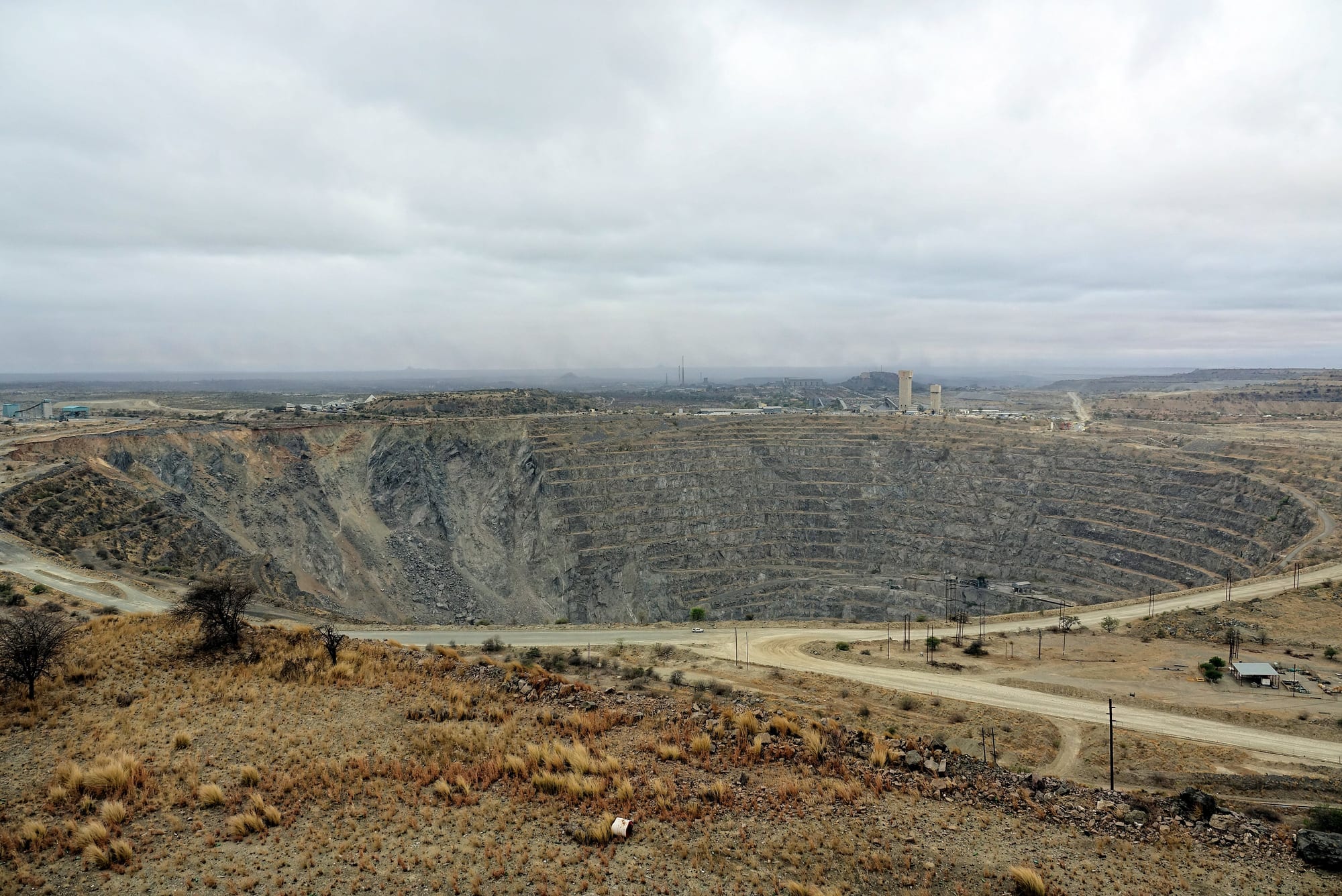
A vast terraced open pit cut into dry bushveld, with mine buildings and chimneys on the far rim under a grey sky

Johannesburg, Pretoria & Kruger, South Africa

Phalaborwa

The Palabora open-pit mine on the edge of Phalaborwa in Limpopo. (Bjørn Christian Tørrissen / Wikimedia Commons · CC BY-SA 4.0)

A hot lowveld mining town in Limpopo, built in the 1950s and 1960s beside an ancient copper deposit and now best known as the town at a Kruger National Park gate. Its open pit is one of the largest excavations in Africa, and the park boundary runs along the edge of the golf course and the airport.

Neighbourhoods

  • The town centre
    • First-time visitors
    • Supplies and shops
    • Close to the Kruger gate

    A planned grid of wide streets, shopping centres, banks and fuel stations laid out for the mine's workforce, with jacarandas and flame trees along the verges. Most guesthouses sit in the quiet residential blocks around it, minutes from the park gate.

    Open in Maps
  • The gate and airport edge
    • Safari starts
    • Wildlife on the doorstep

    The eastern side of town runs straight into the Kruger boundary, with the park gate, the airport and a golf course laid out along it. Warthog, impala and hippo are part of the scenery, and the bush begins where the last street ends.

    Open in Maps
  • Namakgale and the township areas
    • Local life
    • Markets

    About twelve kilometres from the centre, Namakgale and neighbouring settlements house much of the municipality's population, built during the mining years and grown far beyond their original plan, with busy taxi ranks, street trade and small shops.

    Open in Maps
  • The mine side
    • Industrial landscape
    • Viewpoints

    South of the town the ground is given over to the open pit, the smelter stacks and the rock dumps of the copper and phosphate operations, visible for kilometres and lit at night.

    Open in Maps

Things to do

The town and the mine

  • Palabora minelandmark

    The copper operation on the town's southern edge, whose open pit is around two kilometres across and several hundred metres deep, with vermiculite and magnetite among its by-products.

    Open in Maps
  • Phalaborwa Airporttransit hub

    The town's small airport, long called Hendrik van Eck Airport after the engineer and industrialist of the mining era, with its single runway on the boundary of the national park; it now handles charter flights rather than scheduled services.

    Open in Maps

Into the national park

  • Kruger National Parkpark

    One of the world's largest national parks, covering 19,485 square kilometres, entered here at a gate on the town's edge, giving quick access to its central mopane country.

    Open in Maps

Short trips from the town

  • Letaba Rest Campattraction

    A rest camp on the Letaba River known for its elephants and its museum of large tusks, at the junction of the park's main north road and the road from Phalaborwa.

    Open in Maps
  • Hoedspruitattraction

    A bushveld town below the Klein Drakensberg to the south, surrounded by private reserves and used as another base for the park.

    Open in Maps

Eat and drink

Long-standing places and food districts in Phalaborwa. Hours, ratings and directions come from your maps app, always current.

Phalaborwa classics

  • The town's grills and takeawaysneighborhood

    Steakhouses, pizzerias, chicken and burger outlets and coffee shops in the shopping centres, serving mineworkers, park staff and travellers stocking up before a drive.

    Open in Maps
  • Braai and boereworsrestaurant

    Grilled meat over coals is the standard meal of the district — boerewors sausage, steak, chops and chicken, usually with pap and a tomato and onion relish.

    Open in Maps
  • Shisa nyama and street foodneighborhood

    In the township areas, butcheries grill meat bought over the counter and eaten on the spot with pap and chakalaka, alongside vetkoek, fried dough, and grilled maize.

    Open in Maps

Markets and produce

  • Roadside fruit and vegetable stallsmarket

    Stalls along the approach roads sell mangoes, bananas, oranges, tomatoes and dried mopane worms in season, much of it from the irrigated farms along the Olifants River.

    Open in Maps

Experience Phalaborwa

History

Long before the modern town, the hills here were worked for metal. Communities on this stretch of the Olifants River mined and smelted copper and iron from at least the fourth century AD, and the archaeological remains of furnaces and terraced settlement on a hill just inside what is now the national park record an industry that traded metal across the lowveld. The name Phalaborwa comes from Sepedi and is usually explained as "better than the south", a claim about the district's warmth and mineral wealth.

Industrial mining came in the twentieth century. Geological survey of the Palabora igneous complex revealed a very large, low-grade copper orebody alongside phosphate and vermiculite, and from the 1950s a mining company and a state phosphate producer opened operations side by side. A town was planned and built for their workforces, with wide streets, schools and shopping centres on what had been thinly settled bushveld, and rail and road links were laid in to carry the ore out. The open pit grew into one of the largest excavations on the continent, around two kilometres across, and when the economic limits of open-pit mining were reached the company sank shafts and moved production underground in the 2000s.

The second thread is the national park. A gate on the town's eastern edge opened Kruger's central section to visitors arriving from the north-west, and Phalaborwa became a service town for the park as well as for the mine. Under apartheid much of what is now Limpopo was divided into homelands, and after 1994 the town and the townships of Namakgale and Lulekani were joined in the Ba-Phalaborwa municipality. Tourism now sits alongside mining as the town's second industry.

Culture & Customs

Phalaborwa is a company town that became a park town, and both identities show. The mine set the pattern of life for two generations: shift work, sports clubs, company housing and a strong trade-union tradition, with families who have worked underground or on the plant for decades. The park set the other rhythm, bringing guides, rangers, tour operators and a steady flow of visitors who stop for fuel, food and a bed either side of a game drive.

The district is Sepedi- and Xitsonga-speaking, and the Ba-Phalaborwa name recognises the communities whose ancestors mined and smelted here. Traditional leadership, church congregations and burial societies are strong in the townships and villages, and choral singing, gospel and, at celebrations, Tsonga dance and marimba music are part of community life. Afrikaans and English remain common in the town centre and at the mine.

Outdoor life fits around the heat. Golf is popular on the course laid out beside the park boundary, where antelope and warthog graze the fairways and the water hazards are treated with respect; fishing, cycling and bush walks fill the cooler hours; and braais and sport on television occupy the weekends. Wildlife in the streets is taken in stride, and residents are matter-of-fact about both the dust of the mine and the elephants a few kilometres away.

Daily Life

The Ba-Phalaborwa municipality takes in Namakgale, Lulekani and many villages as well as the town, and most of its people live outside the old planned centre. The daily commute brings workers in to the mine, the shops, the schools, the hospital and the park.

The economy still rests on the ground: copper, phosphate and vermiculite from the mines and processing plants, with the associated transport, engineering and contracting businesses. Tourism is the second pillar, supporting guesthouses, restaurants, guides and the airport, and government services provide much of the remaining formal employment. Mining has shed jobs over the years, unemployment in the townships is high, and there is a long-standing awareness that a town built on one orebody must eventually find another livelihood.

Days start early because of the heat: shops and offices open soon after dawn, the middle of the day is slow, and life returns to the streets in the late afternoon. Air quality and dust, water supply from the Olifants, electricity interruptions and the state of the roads are perennial local complaints. Elephants and hippos along the park boundary, and the poaching of rhino inside it, are recurring news close to home.

Food

Eating here is lowveld eating, built around the braai. Wood or charcoal fires take boerewors, the coiled spiced sausage, steak, lamb chops and chicken, with pap, the stiff maize porridge, and chakalaka, a spiced vegetable relish, and a potjie, the cast-iron pot stew, for slower occasions. Shisa nyama butcheries in Namakgale grill meat bought at the counter and serve it with pap and salads, which is the town's most sociable way to eat.

Local specialities come from the bush and the fields. Mopane worms, the dried caterpillars of the emperor moth harvested from mopane trees across Limpopo, are eaten crisp as a snack or stewed with tomato and onion, and they are traded in large quantities in season. Morogo, cooked wild greens, goes with maize meal, and ting, a sour fermented porridge, is common on Sepedi tables. Biltong and droëwors, air-dried spiced meat, are made locally and sold everywhere.

Fruit is the other pleasure of a hot district. Irrigated farms along the Olifants and around Tzaneen to the west supply mangoes, bananas, oranges, avocados, litchis and macadamia nuts, sold from roadside stalls, and mango achar, a hot oily pickle, accompanies many meals. Marula trees grow wild in the surrounding bushveld, their fruit made into a traditional beer at the end of summer and used in the cream liqueur produced in the province, while rooibos tea and strong filter coffee are the everyday drinks.

Planning tools

Budget

Phalaborwa is an inexpensive base for the national park. Guesthouses and self-catering units in the town cost far less than lodges, supermarkets supply the makings of a self-catered safari, and the park charges a daily conservation fee per person plus vehicle entry. The biggest variables are car hire and whether nights are spent inside the park.

Daily Budget Midrange
USD 110–210 (guesthouse or rest-camp bungalow, restaurant meals, hire car, park fees)
Daily Budget Shoestring
USD 40–70 (guesthouse or campsite, self-catering, shared car, park day fee)

Book rest camps inside the park months ahead for school holidays, and buy supplies in town, where prices are lower than at the camp shops.

Best Time to Visit

May to September is the main season: the bush is thin and dry, animals concentrate on the rivers and waterholes, days are warm and the malaria risk is lower. October to March is very hot, often above 35°C, with thunderstorms, thick green bush, newborn animals and migrant birds, and fewer visitors.

Suggested Number of Days

A night or two is enough for the town itself and a first look at the park through the nearby gate. Three to five suit a longer stay using the central and northern camps, or a trip combined with the escarpment. Heat and driving distances set the pace more than anything else.

First Visit
1–2 days
With Surroundings
3–5 days

Transportation

A car is needed. The town is laid out for driving, distances inside the park are long and speed limits low, and there is no visitor transport beyond taxis and lodge transfers. Minibus taxis link the town with Namakgale, Hoedspruit and Tzaneen for local travellers.

Fill the tank before entering the park, allow far longer than the distance suggests on park roads, and reach the gate well before it closes at dusk.

Airport & Station Connections

Phalaborwa is about 500 kilometres from Johannesburg, six to seven hours by road via Tzaneen or the lowveld route, and the small airport on the edge of town handles charter flights only, scheduled services having ended in 2020. Many visitors arrive from Hoedspruit, about 50 kilometres south, or drive through the park itself from camps further south.

Walkability

The central shopping area can be walked, but the town is spread out, hot and built around cars, and the park boundary means wildlife occasionally wanders into open ground on the edges. Walking between districts, and anywhere after dark, is not advisable; inside the park visitors must stay in their vehicles except at marked sites.

Safety

As a mining town Phalaborwa sees the property crime common across the country — break-ins, theft from vehicles and opportunistic mugging — concentrated away from the guesthouse areas, and the town is generally quiet. The particular risks here are wildlife, since hippo, warthog and antelope move along the park boundary and crocodiles live in the Olifants River, and malaria, since this is a lowveld malaria area, as the region's health advice sets out.

Don't display phones or jewellery, keep the car locked in traffic, use Uber or Bolt after dark, take malaria precautions for the lowveld, and drive with headlights on and caution for animals and pedestrians. Check current official travel advice before travelling.

Climate

One of the hottest towns in the country, low-lying and dry, with summer running from December to February. Rain falls in summer as short, heavy storms, and winter days are warm and cloudless with mild nights, which is why this is the season most visitors choose.

Summer
very hot and humid, commonly 32–38°C by day and higher in heatwaves, with afternoon storms
Winter
dry and sunny, averaging around 26°C by day, with nights around 9°C — the highest winter temperatures in the country

Local Customs

Sepedi and Xitsonga are the main languages of the district, with Afrikaans and English widely used in the town and at the mine, and greetings before any request are expected. Tipping is normal: around ten per cent in restaurants, small change for car guards and petrol attendants, who fill the tank and clean the windscreen. Dress is light and casual; the heat makes early starts and long lunches normal.

Ask before photographing people, mine property or the park's staff and gates, keep to the marked areas along the river where crocodiles and hippo are present, and do not feed monkeys or warthog near houses.

Common Payment Methods

The currency is the South African rand. Cards are accepted in the town's shops, supermarkets, fuel stations, restaurants and at the park gate and rest camps. Cash is worth carrying for street traders, roadside stalls, tips and car guards, and for the occasions when a power interruption takes card machines offline.