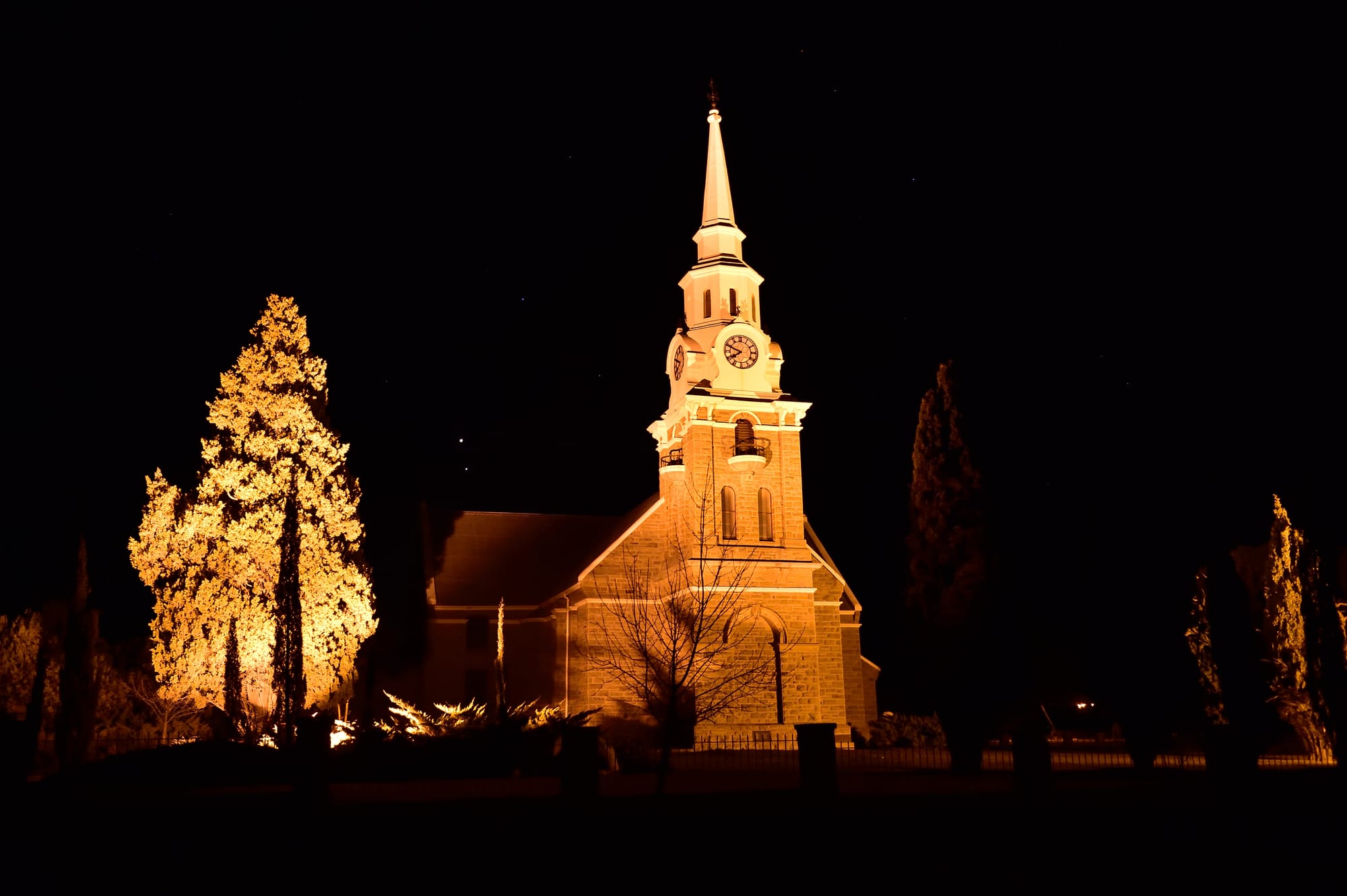
A floodlit stone church with a tall white spire and clock face standing against a black night sky, framed by lit trees

The Northern Cape & the Kalahari, South Africa

Sutherland

The Dutch Reformed church at the centre of Sutherland, floodlit after dark. (South African Tourism from South Africa / Wikimedia Commons · CC BY 2.0)

A small Karoo village on the Roggeveld escarpment, high, dry and famously cold, where snow is common in winter. Laid out around its church in the 1850s, it became known worldwide when the South African Astronomical Observatory built its telescopes on a ridge outside town, drawing visitors for tours and for some of the darkest night skies in the country.

Neighbourhoods

  • The village centre
    • First-time visitors
    • Historic buildings
    • Close to everything

    A handful of wide streets around the stone church, with a museum, guesthouses, a few shops, two fuel stations and a couple of places to eat. The whole village can be walked in twenty minutes, and after dark the sky above it is exceptionally clear and dark.

    Open in Maps
  • The edge of the village and the guest farms
    • Stargazing
    • Quiet and residential
    • Farm stays

    Cottages, self-catering units and sheep farms scattered on the plateau just beyond the last houses, where the horizon is open in every direction. Many have their own telescopes or viewing decks, and the dark is complete a short way beyond the village lights.

    Open in Maps
  • The observatory ridge
    • Astronomy
    • Viewpoints

    The hill north-east of the village carrying the domes of the national observatory, reached by a gravel road across open veld. The telescopes are the village's main visitor draw, and the ridge looks out over the Roggeveld plateau.

    Open in Maps

Things to do

Astronomy

  • Southern African Large Telescopeattraction

    The largest optical telescope in the southern hemisphere, inaugurated in 2005 on the observatory ridge about 15 km from the village, alongside the other telescopes of the South African Astronomical Observatory, which draws many visitors to the village.

    Open in Maps

In the village

  • Dutch Reformed churchlandmark

    The church of 1899 at the centre of the village, its spire the village's main landmark; British troops used it as a fort during the Anglo-Boer War.

    Open in Maps
  • Louw Housemuseum

    The birthplace of the Afrikaans poets N. P. van Wyk Louw, born in Sutherland in 1906, and his younger brother W. E. G. Louw, now a village museum.

    Open in Maps
  • Rebelskop fort ruinslandmark

    The ruins of a fort on Rebelskop, a hill outside the village named after an Anglo-Boer War engagement in which some 250 Boer commandos attacked the British garrison for ten hours.

    Open in Maps

Short trips from the village

  • Salpeterkopviewpoint

    A long-dormant volcano near the village, last active some 66 million years ago, rising above the surrounding plateau.

    Open in Maps
  • Tankwa Karoo National Parkpark

    A park of sparse Succulent Karoo shrubland below the Roggeveld escarpment, in one of the most arid parts of the country and within a recognised biodiversity hotspot.

    Open in Maps
  • Matjiesfonteinattraction

    A tiny Victorian village laid out in the 1880s around a railway refreshment station, later a health resort, preserved for its Victorian character and declared a National Monument in 1975.

    Open in Maps

Eat and drink

Long-standing places and food districts in Sutherland. Hours, ratings and directions come from your maps app, always current.

Where to eat

  • The village centreneighborhood

    A small number of restaurants, pubs and coffee stops around the main street, serving Karoo lamb, steaks, soups and hearty winter food to visitors and farmers.

    Open in Maps
  • Guesthouse and farm kitchensrestaurant

    Most guesthouses and guest farms cook dinner for their guests, usually a set menu of lamb, stew or roast, which is how many visitors eat here, since choice in the village is limited.

    Open in Maps

Local produce

  • Karoo lamb and farm producemarket

    The plateau's sheep farms produce the region's best-known meat, and shops and stalls sell biltong, droëwors, preserves, rusks and honey from the district.

    Open in Maps

Experience Sutherland

History

The high Roggeveld plateau on which Sutherland stands was grazing country for Khoekhoe herders before trekboer farmers moved up the escarpment with their sheep. The plateau is among the coldest places in South Africa, and the Roggeveld Mountains separate it from the lower-lying Tankwa Karoo to the west; sheep farming shaped settlement here long before there was a village.

Sutherland itself was established in the mid-1850s as a church and market town for the scattered sheep farms, and it was named after the Reverend Henry Sutherland, a Dutch Reformed minister who travelled to the Roggeveld each year to hold services. The village grew slowly around the church, a school and a few shops; the church that dominates the skyline dates from 1899. During the South African War British troops used the church as a fort, several clashes took place in the town, and the ruins of a fort remain on Rebelskop, a hill outside the village.

For most of its history Sutherland was known mainly for sheep farming, for its reputation as the coldest town in South Africa, and as the birthplace in 1906 of the poet N. P. van Wyk Louw, a central figure in Afrikaans literature. That changed after the South African Astronomical Observatory chose a ridge outside the village for its telescopes in the early 1970s, valuing the altitude, the dry air and the darkness. The Southern African Large Telescope, inaugurated in 2005, made the site internationally significant, and astronomy tourism has since become the village's second economy alongside sheep farming.

Culture & Customs

Life here is that of a small Karoo dorp: Afrikaans-speaking, church-centred and organised around the farming year of lambing, shearing and the wool clip. The church is the social as well as the spiritual centre, and its bazaars, funerals and services still mark the calendar. Families have farmed the surrounding plateau for generations, and conversation with a stranger usually starts with the weather, which here is a serious subject.

The cold is a point of identity. Residents compare winters, and record low temperatures are discussed with the pride other towns reserve for sport. Snow is common in winter, and it brings day visitors up the passes when it falls, and the village takes a certain pleasure in being the place other South Africans think of as unbearably cold.

The observatory has given the village a second, quite different culture. Astronomers and technicians live and work nearby, visitors arrive with telescopes and cameras, and guesthouses have learned to serve dinner early so that guests can be outside under a dark sky by nightfall. Keeping light pollution down is a shared local practice, backed since 2007 by a national law protecting the site's dark skies. Literary visitors come for the Louw connection, and Afrikaans poetry has an unusually strong presence in the village's sense of itself.

Daily Life

About 3,000 people live in Sutherland, most of them in the village itself, which serves an enormous and almost empty district of sheep farms. Wool and mutton are the economic base, with tourism — guesthouses, tours, restaurants and guides — now providing a large share of local work, and the observatory employing staff and buying services locally. The municipality, the schools and the clinic account for much of the rest.

The village is small enough that everyone knows the traffic on the main street. Farming families come in for supplies, church and school, and the population of the district is far more dispersed than the village figure suggests. Housing divides between the older village core and the areas built for coloured residents under apartheid planning, a division still visible in the street layout and in income.

Daily rhythms follow the light and the cold. Work is done in the daytime, fires and heaters go on early in winter, and the village is quiet well before the sky gets interesting. Water supply, distance from services, the state of the gravel roads and the shortage of jobs for young people are the standing concerns; power cuts have shaped routines for years, though here they also produce a darker sky. Visitors, and the money they bring for a few nights at a time, matter disproportionately to the village economy.

Food

Karoo lamb is the centre of everything. Sheep grazed on the plateau's aromatic scrub produce meat with a flavour that carries a regional reputation, and it is served as chops over the coals, as a slow-roasted leg, as lamb pie, or cooked for hours in a potjie, the three-legged iron pot set on a fire. Skilpadjies, lamb's liver wrapped in caul fat and grilled, and tongue, kidneys and other offal dishes are part of the tradition on farms.

Winter cooking suits the cold: thick soups, bredies — stews of mutton with tomato, cabbage or waterblommetjies — samp and beans, and pumpkin dishes. Bread is often made on the fire, as roosterkoek on the braai grid or potbrood in a cast-iron pot, and buttermilk rusks are dipped in coffee at almost any hour. Melktert, koeksisters and moskonfyt, a syrup made from grape must, appear on the sweet side.

Game from the plateau, especially springbok, is eaten as steaks, stews and biltong, and biltong and droëwors are the standard snack for the long drives. There is little in the way of restaurant choice, so evening meals in guesthouses and guest farms are where most visitors eat, with dinner served early enough to get outside under the stars afterwards. Rooibos tea, grown in the mountains to the west, is the regional drink.

Planning tools

Budget

Sutherland is cheap to visit, with self-catering cottages, guest farms and simple guesthouses at modest prices and little to spend money on beyond meals, fuel and visits to the observatory. The main costs are the long drive to reach it and, in winter, heating and warm clothing.

Daily Budget Midrange
USD 120–250 (guesthouse or guest farm, dinner and breakfast, car hire and fuel, an observatory visit)
Daily Budget Shoestring
USD 35–65 (self-catering cottage or campsite, self-catering meals, shared car)

Book accommodation and stargazing well ahead around new moon and school holidays, and bring far warmer clothes than the season suggests.

Best Time to Visit

Clear skies are common all year, and the dark nights around new moon are what most visitors come for. Autumn and spring give the most comfortable combination of mild days and cold, clear nights. Winter is bitterly cold, with frost, snow and superb transparency; summer days are hot but the nights still cool sharply.

Suggested Number of Days

A night or two is the usual visit, built around the observatory and a clear evening sky, with a second night as insurance against cloud. Add a day for the drives down the escarpment and the passes, which are slow and mostly gravel.

First Visit
1–2 days
With Surroundings
2–3 days

Transportation

A car is the only practical way to get here and around. The village itself is walked in minutes, but the observatory, the passes and the neighbouring towns are all a drive away, much of it on gravel. There is no public transport for visitors, and fuel and repairs are limited, so arriving with a full tank and a sound spare tyre matters.

Gravel roads around the escarpment are rough in places and slippery when wet; drive slowly, and avoid the passes after dark or in snow.

Airport & Station Connections

Cape Town is about 360 km south-west, roughly four hours, most of it on the N1 before turning off at Matjiesfontein for the climb up the escarpment. Sutherland can also be reached from the Karoo towns to the north and east on long gravel routes. The nearest airports with scheduled flights are those of Cape Town, so almost everyone drives.

Walkability

The village is tiny and flat enough to cross on foot in a few minutes, and walking after dark to look at the sky is part of the point of coming. Torches are useful after dark, and everything outside the village, including the observatory, needs a vehicle.

Safety

Sutherland is a quiet farming village with very little crime, and visitors walk in it at night without concern. The real hazards are the cold, which is severe and catches people out on winter nights, and the roads: gravel surfaces, long empty stretches, weak mobile signal and livestock or game on unfenced verges.

Tell someone the route on remote drives, carry extra water, stay in the vehicle in the Kgalagadi except at designated sites, and drive only in daylight. Carry warm layers, a torch and a spare tyre, and check road conditions before driving the passes in winter. Check current official travel advice before travelling.

Climate

High, dry and famously cold, at about 1,450 m on the Roggeveld escarpment, with a large daily temperature range, thin air and very low humidity that make the night skies exceptionally clear. In the southern hemisphere summer runs from December to February and winter from June to August.

Summer
warm to hot days of 26–30°C, with cold nights that can fall towards 10°C
Winter
cold days of 10–14°C, nights well below freezing, with frost, hard ice and frequent snow

Local Customs

Afrikaans is the everyday language, with English spoken at guesthouses and the observatory. This is a conservative farming village where church, family and the sheep calendar structure the week, greetings come before business, and people are welcoming to the visitors their economy depends on. Ask before photographing people or houses.

Keep outdoor lights and headlights to a minimum at night and use a red torch near the observatory, since white light spoils dark-sky viewing for everyone; tip about 10 per cent in restaurants.

Common Payment Methods

The currency is the South African rand. Cards are accepted at most guesthouses and fuel stations, but the village has only one bank and a patchy signal can knock out card machines, so it is sensible to arrive with cash.