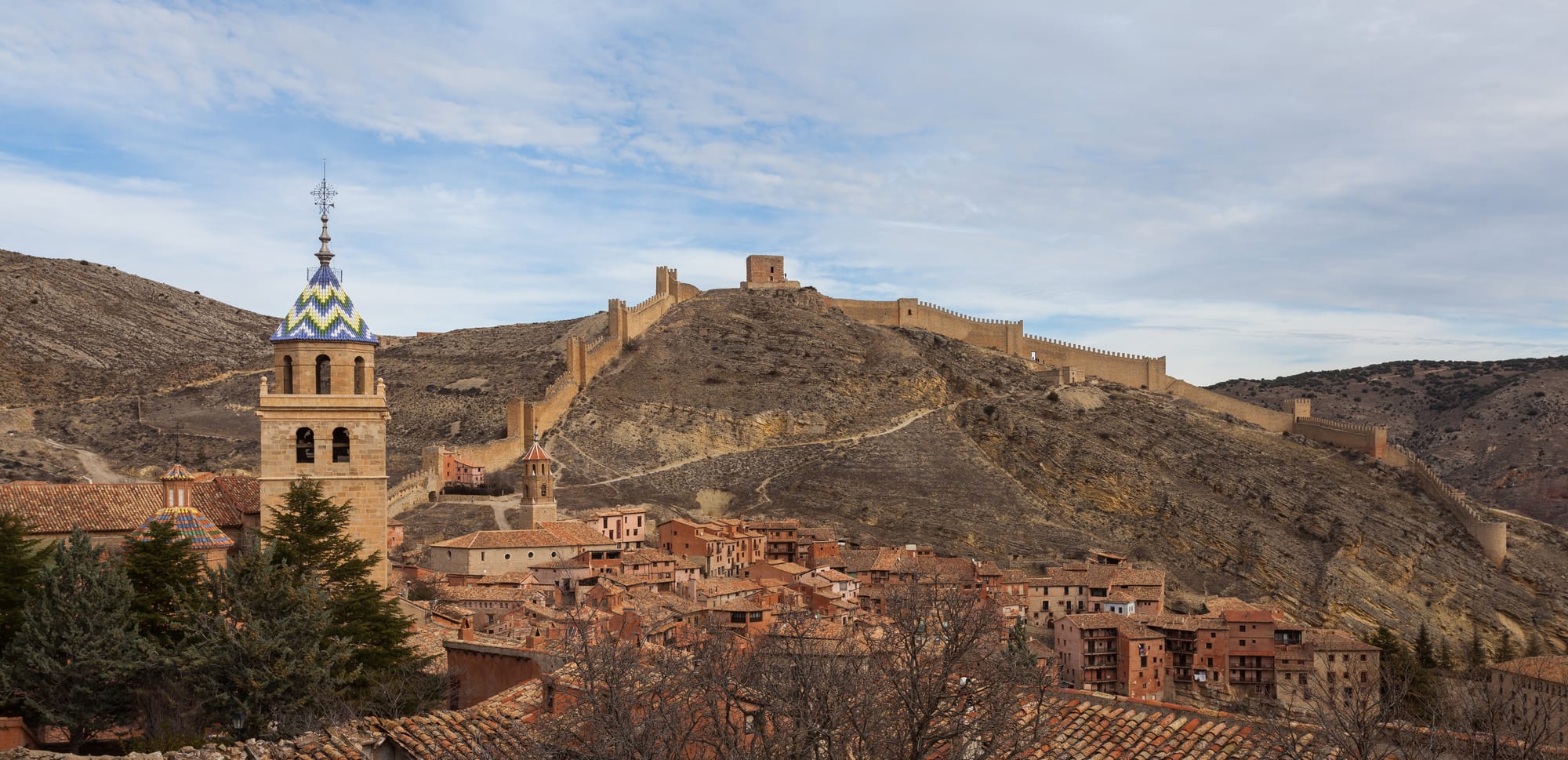
A tiled church tower and reddish houses of Albarracín below a long crenellated wall climbing a dry hillside

Aragon, Spain

Albarracín

A church tower and the old town of Albarracín beneath the walls on the ridge above. (Diego Delso / Wikimedia Commons · CC BY-SA 3.0)

A walled hill town of about a thousand people in the mountains of Teruel province, built on a rocky spur almost encircled by the Guadalaviar river. Capital of an 11th-century Berber taifa kingdom and then of an independent Christian lordship, it keeps its reddish houses, steep lanes and long ridge-top walls, and now draws visitors and rock climbers.

Neighbourhoods

  • The old town
    • First-time visitors
    • Historic district
    • Walks and viewpoints

    The walled town on its spur inside the meander of the Guadalaviar, with steep, narrow streets, houses in the reddish local stone known as rodeno, and the hanging houses built over the river gorge. The cathedral, the Alcázar and the town hall square are all here.

    Open in Maps
  • El Arrabal
    • Quiet and residential
    • Close to the river

    The lower quarter on the river plain of the Guadalaviar, which grew outside the gate on the gentler side of the spur. It is flatter and quieter than the old town, a short walk below it.

    Open in Maps

Things to do

The walled town

  • Albarracín Cathedrallandmark

    The 16th-century Cathedral of the Saviour, with a single nave and side chapels, beside the castle; its museum holds Flemish tapestries telling the story of Gideon.

    Open in Maps
  • Alcázar of Albarracínlandmark

    The fortress of the Banu Razin kings in the old town, destroyed in the 18th century and excavated and restored between 2004 and 2006 so that its walls and medieval remains can be visited.

    Open in Maps
  • Walls and Torre del Andadorlandmark

    The town walls run up the ridge to the Torre del Andador, a tower of the 10th and 11th centuries built in Muslim style, with the Torre de doña Blanca at the far end of the spur.

    Open in Maps
  • Town halllandmark

    The 16th-century town hall on the Plaza del Ayuntamiento, with wooden balconies and a gallery running along the side above the river.

    Open in Maps
  • Episcopal palacelandmark

    The former bishops' palace beside the cathedral, with a Baroque doorway, from the centuries when Albarracín was the seat of its own diocese.

    Open in Maps

Rocks and pinewoods

  • Pinares de Rodenopark

    A protected landscape of red sandstone and pine forest shared by Albarracín, Bezas and Gea de Albarracín, with gorges, wind-carved hollows and rock shelters painted with prehistoric art in the Levantine style.

    Open in Maps
  • Sierra de Albarracíntrail

    The mountain range at the south-western end of the Iberian System, rising to 1,856 metres at Sierra Alta.

    Open in Maps

Short trips from the town

  • Teruelneighborhood

    The provincial capital, known for its Mudéjar buildings, part of a UNESCO World Heritage Site, its cured ham and the Vaquilla del Ángel festival.

    Open in Maps

Eat and drink

Long-standing places and food districts in Albarracín. Hours, ratings and directions come from your maps app, always current.

Albarracín classics

  • Restaurants in the old townneighborhood

    The bars and restaurants among the old town's lanes are the place to try Teruel ham, roast ternasco lamb and Aragonese migas.

    Open in Maps

Experience Albarracín

History

People were here long before the town. Painted rock shelters in the red sandstone pinewoods around Albarracín hold Epipalaeolithic and Neolithic art in the Levantine and schematic styles, and in the Iron Age the area belonged to a Celtic tribe, the Lobetani. The Roman settlement seems to have been called Lobetum, and in Visigothic times the place was known as Santa María de Oriente.

The town's name comes from the Banu Razin, a Berber family who ruled the Taifa of Albarracín, a small independent Muslim kingdom, from 1012 until the Almoravids took it in 1104. Their fortress, the Alcázar, and the Torre del Andador survive from that time. The town then passed, by cession rather than conquest, to the Azagra family of Navarre, who from about 1170 held it as a lordship independent of both Castile and Aragon and even created their own bishopric. A siege by James I failed in 1220; Peter III of Aragon conquered Albarracín in 1284, and in 1300 it was finally joined to the Kingdom of Aragon. A Jewish community lived here from before the 12th century until the expulsion of 1492.

The Alcázar was occupied until the late 16th century and destroyed in the 18th, after the War of the Spanish Succession. In July 1937, during the Civil War, Republican troops seized most of the town while soldiers and civilians held out in the town hall and the cathedral, until Nationalist reinforcements retook it after five days. Albarracín was declared a National Monument in 1961, received the Gold Medal for Merit in the Fine Arts in 1996, and has been proposed for UNESCO World Heritage status.

Culture & Customs

Albarracín's identity is bound up with its look. The houses are built in rodeno, the reddish sandstone of the surrounding hills, with the iron balconies and popular architecture typical of the province, and on the side facing the river the hanging houses lean out over the gorge of the Guadalaviar. The town is a classic spur town of al-Andalus, a long, narrow site on a rocky promontory with a fortress at its highest point, and its whole historic centre is protected as a site of cultural interest. It has belonged to the association of the Most Beautiful Villages of Spain since the association was founded.

Church history matters here more than in most towns of its size. Albarracín was a bishop's seat for centuries, and today its Cathedral of the Saviour is, together with Teruel's cathedral, one of the two seats of the Diocese of Teruel and Albarracín. The cathedral museum keeps a series of Flemish tapestries on the life of Gideon.

The landscape has created a culture of its own. The many red sandstone boulders and cliffs around the town have made Albarracín a well-known rock-climbing area, especially for bouldering. The red sandstone pinewoods of the Rodeno are a protected landscape and part of the Albarracín cultural park, valued for the prehistoric paintings in their rock shelters.

Daily Life

About 1,000 people live in the municipality, which counted 998 inhabitants in 2025. It is one of the largest municipalities by area in Teruel province, taking in several small outlying hamlets as well as the town, which is the capital of the Sierra de Albarracín comarca. Like much of the province it has lost people over the last century, but tourism has brought new money in recent decades and has helped to slow the decline, and a share of the residents are foreign nationals.

Life divides between the two parts of the town: the old walled town on the spur, with its hanging houses over the gorge, and the Arrabal on the river plain below. Visitors fill the lanes at weekends and in summer; on winter weekdays the town is quiet.

The surrounding land is high, dry and forested. The Sierra de Albarracín rises to the north and the Montes Universales to the south, and the Guadalaviar, Tagus, Júcar, Cabriel and Jiloca rivers all have their sources in the mountains around the town. The pinewoods were long tapped for resin.

Food

Albarracín eats as the rest of the province of Teruel does. Jamón de Teruel, the province's cured ham, holds a protected designation of origin. Ternasco, roast lamb, is one of the most characteristic dishes of Aragonese cooking, and migas, a dish of bread crumbs first made by shepherds, is prepared in Teruel with chorizo and bacon and is often served with grapes.

The wider Aragonese kitchen relies on a short list of local ingredients: olive oil from Empeltre and Arbequina olives, sweet onions, and unusual vegetables such as local chard, borage and cardoon. Bread has its own traditions. Pan de cañada, a long flatbread with dimples or grooves filled with olive oil, spread across Aragon with the transhumant shepherds who carried it on the drovers' roads, and Teruel's pintadera bread carries the Aragonese government's C'Alial quality seal.

There are no markets or food streets of note in a town this small. Eating out means the bars and restaurants inside the old town and in the Arrabal, where local ham, lamb and migas are the common order.

Planning tools

Budget

Albarracín is a small town with modest prices by Spanish standards, but its few small hotels and guesthouses fill at weekends and in summer, which is when rooms cost most. Most visitors arrive by car, so fuel or a hire car is part of the budget, and many come only for the day.

Daily Budget Midrange
USD 110–220 (small hotel, restaurant dinners, a hire car and site tickets)
Daily Budget Shoestring
USD 50–85 (guesthouse room, bar meals and a menú del día, a shared car or bus to Teruel)

Book rooms early for summer weekends; walking the lanes and the walls costs nothing.

Best Time to Visit

Late spring and early autumn bring mild days and fewer people. Summer days are warm with cool nights, and the town is busiest then and at weekends. Winters are cold and frosty but quiet, with low winter light on the reddish walls.

Suggested Number of Days

The town itself is small and many visitors come for a day. An overnight stay allows the quiet evenings and mornings; allow another day or two for the surrounding countryside.

First Visit
1–2 days
With Surroundings
2–3 days

Transportation

A car is the practical way to reach Albarracín and the countryside around it. Teruel, the provincial capital, lies on the motorway between Zaragoza and Sagunto and on the railway line between the same two cities. Within the old town everything is done on foot; cars are left outside the steep lanes.

Driving into the old town's narrow, steep streets is best avoided; park below and walk up.

Airport & Station Connections

Albarracín stands in the mountains of Teruel province and is reached by road from the city of Teruel, which has the nearest railway station, on the line from Zaragoza to Sagunto. Most visitors arrive by road.

Walkability

The old town is compact and can only really be seen on foot, but its streets are steep and narrow, with steps and uneven paving, and the walk up to the walls and the Torre del Andador is a real climb. The Arrabal below is flatter. Good shoes help, and the stone can be icy on winter mornings.

Safety

Spain is a safe country with low violent crime. Albarracín is a small, quiet town and crime is not a concern for most visitors. The practical risks are steep, uneven streets, exposed paths along the walls and climbing on the sandstone boulders outside town, and cold winter nights.

Keep to the paths on the walls, use proper equipment or a guide for climbing, and carry warm layers outside summer. Check current official travel advice before travelling.

Climate

High and inland, the area has a cold, dry climate. In nearby Teruel, summers are warm to hot with a large difference between day and night, winters are cold, and the least rain falls in winter, the most in late spring and mid-autumn.

Summer
warm to hot by day in nearby Teruel, with much cooler nights; the highest reading at the Teruel observatory is 41.3°C, in August 2021
Winter
cold — in nearby Teruel minimum temperatures sometimes drop to −10°C

Local Customs

The old town is lived in as well as visited, and the hanging houses and lanes are people's homes, so quiet in the evenings is appreciated. The cathedral is a place of worship and the seat, with Teruel, of a shared diocese; visits are not made during services. Meals follow the Spanish rhythm of a late lunch and a late dinner.

Dress modestly inside the cathedral, keep noise down in the lanes at night, and take litter home from the pinewoods.

Common Payment Methods

Spain uses the euro. Cards and contactless are accepted almost everywhere, including small bars; carry a little cash for small shops and rural bars.