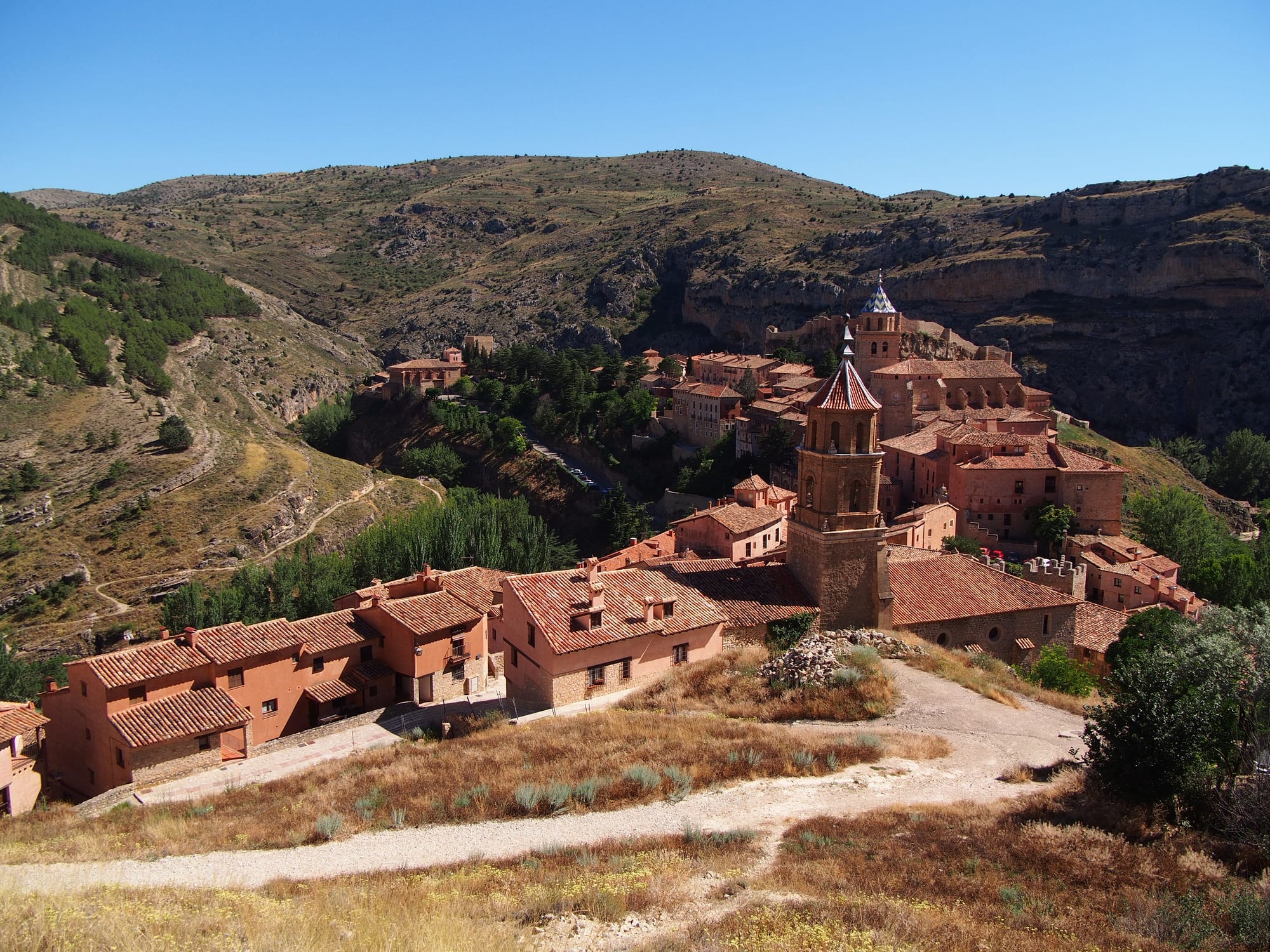
Pinkish stone houses and a church tower of Albarracín spread across a hillside above a rocky river gorge

Spain

Aragon

The village of Albarracín on its rocky spur above the Guadalaviar gorge, Teruel province. (rheins / Wikimedia Commons · CC BY 3.0)

A large inland region of north-eastern Spain stretching from the high Pyrenees on the French border across the dry Ebro valley to the uplands of Teruel — the core of a medieval crown that ruled much of the Mediterranean, with Zaragoza as its capital and a heritage of Mudéjar towers, Romanesque monasteries and mountain valleys.

Explore Aragon

History

Iberians and Celtiberians held the land before Rome; the poet Martial was born at Bilbilis near Calatayud. Augustus founded Caesaraugusta on the Ebro, the city whose name became Zaragoza. Under Muslim rule, Saraqusta was a major frontier city and in the 11th century the seat of a taifa kingdom whose rulers built the Aljafería palace.

Christian Aragon began as a small county in the Pyrenean valleys around Jaca, became a kingdom under Ramiro I in 1035, and pushed south: Alfonso I the Battler took Zaragoza in 1118. In 1137 the betrothal of the infant queen Petronilla to Ramon Berenguer IV, Count of Barcelona, joined Aragon and Catalonia in the Crown of Aragon, which went on to rule the Balearics, Valencia, Sicily, Sardinia and Naples. Its king Ferdinand II married Isabella of Castile in 1469, uniting the crowns of Spain.

Aragon kept its own laws, the fueros, and the office of the Justicia to defend them, until Philip II crushed a revolt in 1591 and Philip V's Nueva Planta decrees abolished its institutions in 1707. Zaragoza resisted two French sieges in 1808 and 1809, remembered through the heroine Agustina de Aragón, and Goya was born at Fuendetodos in 1746. In the Civil War, the battle of Teruel was fought in the bitter winter of 1937–38, and Belchite's old town was left in ruins. Aragon became an autonomous community in 1982 and Zaragoza hosted the Expo in 2008.

Culture & Customs

Aragonese identity is proud but less politically charged than in neighbouring Catalonia. Aragonese, or fabla, survives in some Pyrenean valleys, and Catalan is spoken along the eastern strip known as La Franja. The traditional stereotype of the baturro, the stubborn, blunt-spoken peasant, is embraced with humour.

The Virgin of the Pillar is the region's patron, and the Fiestas del Pilar around 12 October see thousands of people lay flowers before her image in Zaragoza's main square. The jota, a fast dance with sung verses, is Aragon's folk art. In Holy Week, the towns of the Lower Aragon drum route, including Calanda and Alcañiz, beat drums through the night, a tradition recognised by UNESCO as intangible heritage.

The Mudéjar architecture of Aragon, brick churches and towers decorated with glazed tiles by Muslim craftsmen after the Christian conquest, is a UNESCO World Heritage Site. Teruel remembers the 13th-century legend of the Lovers, Diego and Isabel, and holds the Vaquilla del Ángel festival in July. The film director Luis Buñuel was born in Calanda.

Daily Life

About 1.35 million people live in Aragon, and around half of them in Zaragoza, Spain's fourth-largest city with about 700,000 people. Huesca has about 55,000 and Teruel about 36,000, making them among the smallest provincial capitals in Spain. Much of the rest is very thinly populated, and Teruel province has become a symbol of rural depopulation, even giving its name to a political movement, Teruel Existe.

Zaragoza's economy rests on a large car plant at Figueruelas, logistics along the Madrid–Barcelona corridor, and services. Agriculture remains important: cereals, pigs, fruit in the irrigated Ebro and Cinca valleys, and black truffles around Sarrión. Wind and solar farms have multiplied, while the coal mines and power station of the Teruel basin have closed. In the Pyrenees, ski resorts such as Formigal and Cerler and summer tourism keep the valleys alive.

Life in Zaragoza runs on the Spanish rhythm of late meals and evening walks, with the tapas bars of El Tubo and the Ebro riverside as its focus.

Food

Aragonese cooking is inland and robust. Ternasco de Aragón, young lamb roasted with potatoes, is the signature dish, and chicken or lamb al chilindrón is stewed with peppers, tomato and onion. Migas are fried breadcrumbs with pork and grapes, bacalao ajoarriero is salt cod with garlic, peppers and egg, and borage and cardoon are winter vegetables rarely eaten elsewhere.

Jamón de Teruel, cured high on the cold plateau, was Spain's first ham to win a protected designation of origin. Graus in the Pyrenean foothills makes a cured pork longaniza sausage, and the Tronchón is a sheep's cheese from Teruel. Calanda's late peaches, grown inside paper bags on the tree, carry a protected designation, and the Lower Aragon produces olive oil.

Sweets include frutas de Aragón, candied fruit dipped in chocolate, Zaragoza's adoquines del Pilar, big boiled sweets, and the trenza de Almudévar, a plaited pastry with nuts and raisins. The wines are mostly red Garnacha from Cariñena, Campo de Borja and Calatayud, and Somontano around Barbastro produces reds and whites from a wider range of grapes.

Attractions & Natural Wonders

Zaragoza is centred on the vast Basilica of the Pilar beside the Ebro and its stone bridge, with La Seo cathedral, the Roman theatre and forum museums, and the Aljafería palace. Nearby are Goya's birthplace at Fuendetodos, the ruins of old Belchite, and the waterfalls of the Monasterio de Piedra park.

In the south, Teruel has the Mudéjar towers of San Salvador and San Martín, a cathedral with a painted wooden ceiling, the Lovers' mausoleum and the Dinópolis dinosaur park. Albarracín, one of Spain's most admired villages, climbs a ridge above the Guadalaviar gorge, and prehistoric rock paintings lie in the pine woods nearby. Valderrobres in the Matarraña has a castle and Gothic bridge.

In the north, Huesca has its Gothic cathedral, with the castle of Loarre and the rock towers of the Mallos de Riglos nearby, and the Sierra de Guara is known for canyoning, with the village of Alquézar. The Aragonese Pyrenees include Jaca's Romanesque cathedral and citadel, the monastery of San Juan de la Peña beneath an overhanging rock, the vast Canfranc railway station, the medieval village of Aínsa, and the Benasque valley below Aneto, the highest peak of the Pyrenees. Ordesa y Monte Perdido National Park, entered from Torla, has a glacial canyon with the Cola de Caballo waterfall at its head, and the park is part of a UNESCO World Heritage Site.

Cities in Aragon

Planning basics

Budget

Aragon is good value by Spanish standards. Zaragoza is noticeably cheaper than Madrid or Barcelona, hotels in Teruel and Huesca are modest in price, and the menú del día is widespread. The Pyrenean valleys cost more in the ski season and in August, and Albarracín's small hotels fill at weekends, while Zaragoza's prices rise during the Pilar festival.

Daily Budget Midrange
USD 110–230 (mid-range hotel or mountain inn, restaurant dinners, a hire car and site tickets)
Daily Budget Shoestring
USD 50–85 (hostel or pension, tapas and menú del día, trains and buses)

Eat tapas in Zaragoza's El Tubo lanes, and book Pyrenean and Albarracín lodgings early for summer weekends.

Safety

Aragon is safe, with low crime even in Zaragoza. The main risks are in the mountains: sudden storms, snow and ice on high routes into early summer, avalanches in winter and accidents on the popular canyoning routes of the Sierra de Guara. Summer heat in the Ebro valley and the strong cierzo wind on exposed roads are other hazards.

Check the mountain forecast before high-level walks, use a qualified guide for canyoning, and carry water in the Ebro valley in summer. Check current official travel advice before travelling.

Climate

Aragon spans three climates. The Ebro valley around Zaragoza is dry and continental, with hot summers and a cold, gusty north-west wind, the cierzo, in winter. Teruel's high plateau has cold winters with hard frost and warm summers. The Pyrenees are alpine, with heavy snow from December to April and cooler, stormy summers.

Summer
hot in the Ebro valley, 30–36°C; warm in Teruel with cool nights; 18–26°C in the Pyrenean valleys
Winter
cold and windy in Zaragoza, 2–12°C; freezing nights in Teruel; deep snow in the Pyrenees

Transportation

Zaragoza lies on the high-speed line between Madrid and Barcelona, and trains continue to Huesca. Teruel is reached by motorway and slower trains on the Zaragoza–Valencia line. Buses connect the provincial capitals and Pyrenean towns such as Jaca and Torla, but a car is best for Albarracín, the Pyrenean valleys, the Sierra de Guara and the Mudéjar villages.

Start early for the Ordesa valley in summer, entering from Torla, as trails are at their busiest at peak times.

Best Time to Visit

May, June, September and October suit the cities and Albarracín, with mild weather and fewer crowds. The Pyrenees and Ordesa are best from June to early October, when trails are clear, although the Ordesa valley is at its busiest in high season. Winter brings skiing in the Pyrenees, and Zaragoza's Fiestas del Pilar fill the city around 12 October.