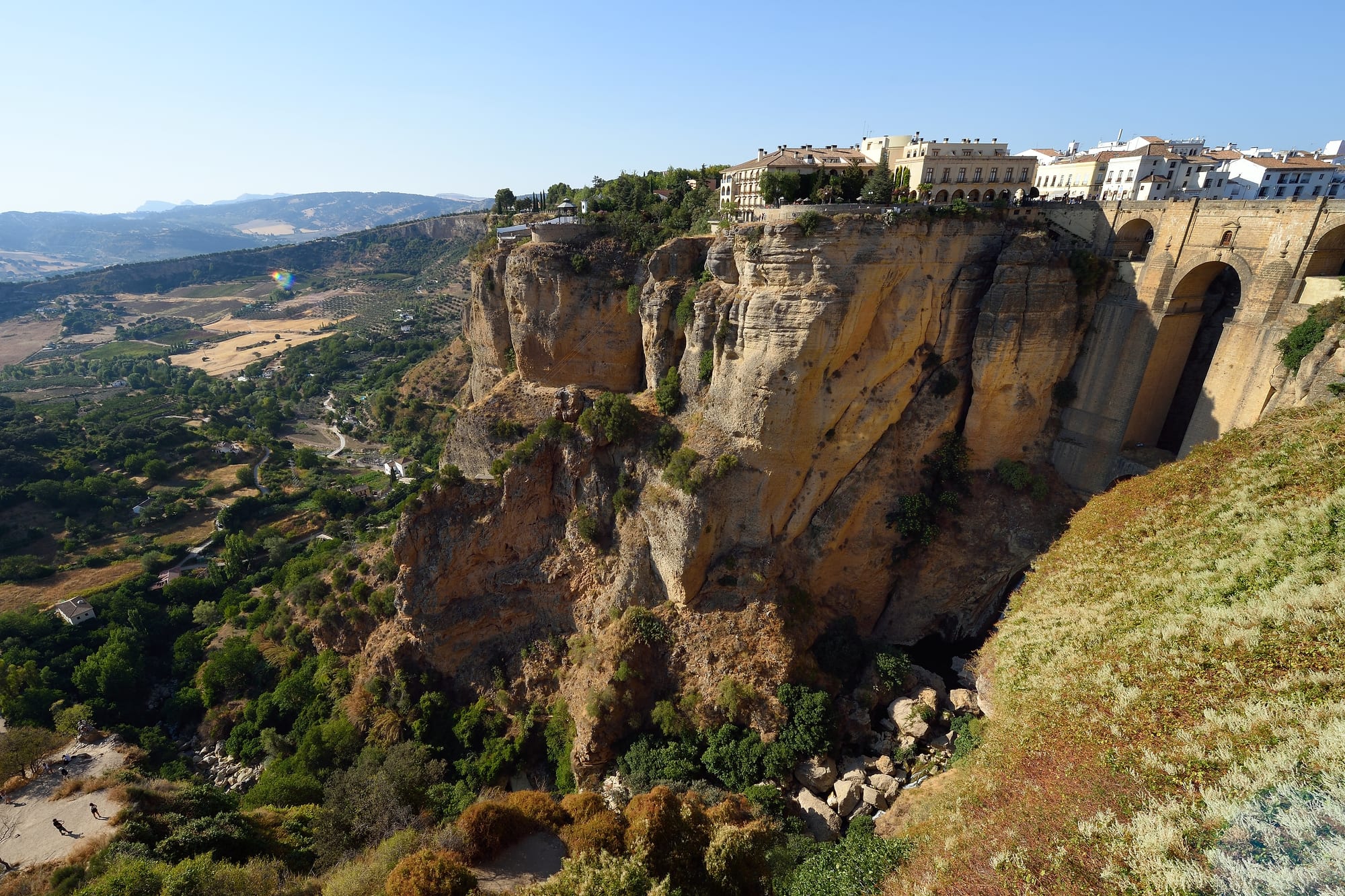
Sheer golden cliffs of a deep gorge crossed by a tall stone bridge, with white buildings on the rim and green valley below

Spain

Andalusia

The El Tajo gorge and the Puente Nuevo at Ronda, in the mountains of Málaga province. (Tim Adams / Wikimedia Commons · CC BY 3.0)

Spain's southernmost and most populous region, stretching from the Portuguese border to the deserts of Almería and from the Sierra Morena to the Strait of Gibraltar — the heartland of Moorish al-Andalus, home to Seville, Córdoba and Granada's Alhambra, and the birthplace of flamenco, sherry and the tapas bar.

Explore Andalusia

History

Southern Iberia was the land of Tartessos, a Bronze Age culture rich in metals, and of Phoenician traders who founded Gadir, now Cádiz, around 1100 BC by tradition. Rome made the area the province of Baetica, one of its wealthiest; Itálica near Seville was the birthplace of the emperors Trajan and Hadrian, and Córdoba produced the philosopher Seneca. The Vandals and then the Visigoths followed, and in 711 Muslim forces crossed the strait and began the conquest that gave the region its name, al-Andalus.

Córdoba became the capital of an Umayyad emirate and, from 929, a caliphate under Abd al-Rahman III, one of the largest and most cultured cities in Europe. After the caliphate broke up, Almoravids and Almohads from North Africa ruled from Seville. Castile's Ferdinand III took Córdoba in 1236 and Seville in 1248, and the Nasrid kingdom of Granada survived until 1492, when its last sultan, Boabdil, surrendered the Alhambra to the Catholic Monarchs.

Seville then held a monopoly on trade with the Americas, and its port grew rich on silver in the 16th century, before the trade shifted to Cádiz in the 18th. Spain's liberal constitution of 1812 was drawn up in besieged Cádiz. Much of the countryside was held in great estates worked by landless labourers, and poverty drove emigration into the 20th century. Andalusia won autonomy in 1981, and Seville's Expo of 1992, together with the Madrid–Seville high-speed line, marked its modernisation.

Culture & Customs

Andalusians speak a Spanish with its own accent — clipped endings, swallowed "s" sounds, and in places the ceceo that turns "s" into a "th" sound — and are proud of it. The region's image, often taken as Spain's image abroad, grew from its own traditions: flamenco, a UNESCO intangible heritage art of song, guitar and dance shaped in particular by Andalusia's Gitano communities, is performed in the peñas and tablaos of Seville, Jerez, Granada's Sacromonte and Cádiz.

The festival year is intense. Holy Week brings processions of hooded brotherhoods carrying images through the streets, above all in Seville and Málaga, followed by Seville's April Fair of casetas, horses and flamenco dresses. The Romería del Rocío takes roughly a million pilgrims on foot and horseback to a village in the Doñana marshes at Pentecost, Córdoba opens its flower-filled courtyards in May, and Cádiz's carnival is known for the satirical songs of its chirigotas. Horse culture is strongest in Jerez, and bullfighting keeps a stronger following here than in most of Spain, with historic rings at Ronda and Seville.

Religion is Catholic in form, expressed through brotherhoods and local devotions more than church attendance. Ceramics, guitar-making and embroidered shawls continue as crafts.

Daily Life

About 8.5 million people live in Andalusia, making it Spain's most populous region. Seville, the capital, has about 690,000 people and Málaga about 590,000; Córdoba, Granada, Almería, Jerez de la Frontera and Cádiz are the other main cities. The Costa del Sol has large communities of British, Scandinavian and other foreign residents.

The economy leans on tourism, agriculture and public services. The province of Jaén is carpeted with olive groves and produces a large share of the world's olive oil, the plastic greenhouses around Almería supply vegetables to much of Europe, and strawberries come from Huelva. Aerospace in Seville and technology in Málaga have grown, but unemployment is persistently among Spain's highest, and drought and water shortages are pressing issues.

Summer life runs to the rhythm of the heat: early mornings, a long lunch and a siesta, then streets and terraces filling after dark. Evenings are spent outdoors, often moving from bar to bar for tapas, and dinner can start after ten in July.

Food

Andalusian food is built for heat. Gazpacho, the cold blended soup of tomato, pepper, cucumber, garlic, bread and oil, and salmorejo, its thicker Córdoba cousin topped with egg and ham, are summer staples; Málaga has ajoblanco, a cold soup of almonds and garlic. Pescaíto frito, small fish and squid fried in olive oil, is eaten along the coast, as are espetos, sardines grilled on skewers over beach fires in Málaga. Cádiz makes tortillitas de camarones, crisp fritters of tiny shrimp. Inland, Córdoba has rabo de toro, oxtail stew, and flamenquín, rolled ham and pork fried in breadcrumbs. Cured ham from the acorn-fed pigs of Jabugo in the Huelva hills is highly prized.

Sweets reflect convent and Moorish traditions: pestiños, fried honey-glazed pastries, and torrijas, bread soaked in milk or wine and fried, at Easter; the yemas, egg-yolk sweets, of Seville's nuns; piononos, small cream-topped sponge cakes from Santa Fe near Granada; and the polvorones and mantecados, crumbly Christmas shortbreads, of Estepa.

Jerez, El Puerto de Santa María and Sanlúcar de Barrameda make sherry — dry fino, manzanilla, nutty oloroso and sweet Pedro Ximénez — and Montilla-Moriles and Málaga have their own fortified and sweet wines. At the ferias people drink rebujito, manzanilla mixed with lemonade.

Attractions & Natural Wonders

Seville's cathedral, the Giralda and the Real Alcázar, with the Archive of the Indies, form a UNESCO World Heritage Site; the Santa Cruz quarter, the Plaza de España, the Triana district across the river and the Metropol Parasol complete the city. Córdoba's Mezquita-Cathedral sits in a historic centre also on the UNESCO list, beside the Roman bridge and the old Jewish quarter, with the caliphal city of Medina Azahara just outside. Granada has the Alhambra and Generalife, the Albaicín, the cave houses of Sacromonte and the Royal Chapel with the tombs of Ferdinand and Isabella; the Sierra Nevada National Park and the Alpujarras villages lie beyond.

Málaga has the Alcazaba, Gibralfaro castle and the Picasso Museum, and the Costa del Sol runs from Nerja, with its caves, through Torremolinos to Marbella. Inland, the Caminito del Rey is a walkway along the gorge of El Chorro. Cádiz has its cathedral and La Caleta beach, and the Costa de la Luz leads to Vejer de la Frontera, the Roman ruins of Baelo Claudia and windy Tarifa. Jerez and Sanlúcar have sherry bodegas.

Ronda's Puente Nuevo spans the El Tajo gorge, and the white villages — Arcos de la Frontera, Grazalema, Zahara de la Sierra and Setenil de las Bodegas, built under overhanging rock — spread through the Sierra de Grazalema. Úbeda and Baeza have Renaissance centres on the UNESCO list, Doñana National Park protects marshes of the Guadalquivir, and Almería has the Cabo de Gata coast and the Tabernas desert.

Cities in Andalusia

Planning basics

Budget

Andalusia is among the better-value parts of Spain, especially in Granada, where many bars still serve a free tapa with each drink, and in inland towns such as Jaén, Úbeda and the Alpujarras. Seville in Holy Week and the April Fair, Marbella in summer and the Costa del Sol in August are expensive. Alhambra, Alcázar and Mezquita tickets are moderate but sell out.

Daily Budget Midrange
USD 140–260 (mid-range hotel, restaurant dinners, monument tickets, a hire car for the white villages)
Daily Budget Shoestring
USD 55–100 (hostel or pension, tapas and menú del día, buses and regional trains)

Book Alhambra tickets weeks ahead, and expect hotel prices in Seville to rise sharply for Holy Week and the Feria.

Safety

Andalusia is safe. Pickpockets work the crowds in Seville, Granada and Málaga, especially during Holy Week and the ferias, and car break-ins occur at beach and viewpoint car parks. Heat is the main danger in summer, and wildfires are a risk in dry months. Beach flags and currents on the Atlantic coast should be respected.

Plan sightseeing for the morning and evening in summer, carry water, and keep bags close in processions and festival crowds. Check current official travel advice before travelling.

Climate

Andalusia is the hottest part of mainland Spain. The Guadalquivir valley, home to Seville and Córdoba, regularly passes 40°C in July and August. The coasts are milder, with sea breezes on the Costa del Sol and strong winds around Tarifa, and Almería is Europe's driest corner. Winters are mild and sunny on the coast, cooler inland, and the Sierra Nevada holds snow and a ski season.

Summer
very hot inland, 36–44°C in Seville and Córdoba; 28–32°C on the coasts
Winter
mild on the coast, 12–18°C by day; cool inland with cold nights; snow in the Sierra Nevada

Transportation

Málaga and Seville have the main airports. High-speed trains link Madrid with Córdoba, Seville, Málaga and Granada, and Córdoba to Seville is a short trip. Regional trains reach Cádiz, Jerez and Ronda, and buses connect most towns reliably. A car is the practical way to see the white villages, the Alpujarras and the coast of Almería, but city centres are narrow and parking is scarce.

Use trains between the big cities, rent a car for the white villages and the mountains, and leave it outside the historic centres.

Best Time to Visit

March to May and late September to November. Spring is the season of Holy Week processions, Seville's April Fair, the patio festival in Córdoba and the pilgrimage to El Rocío at Pentecost, with orange blossom in the streets. Summer heat makes inland cities hard going in July and August, when life shifts to the beaches. Winter is mild on the coast, good for sightseeing, and brings skiing in the Sierra Nevada; Cádiz's carnival falls in February.