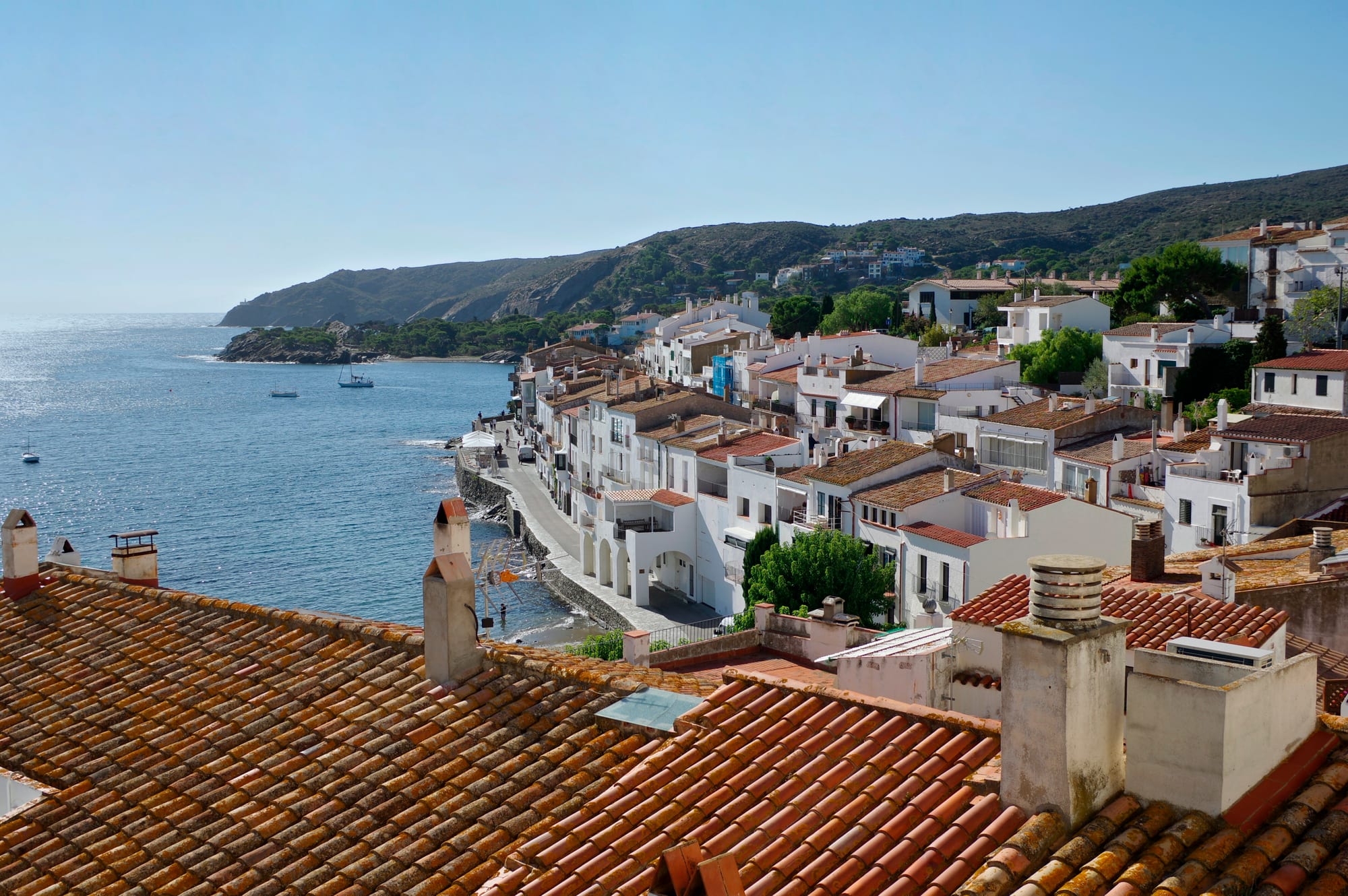
Terracotta rooftops and white houses along a seafront promenade, with a calm blue bay and green headlands beyond

Spain

Catalonia

The whitewashed seafront of Cadaqués on the Cap de Creus peninsula, near the northern end of the Costa Brava. (Berthold Werner / Wikimedia Commons · CC BY-SA 4.0)

Spain's north-eastern corner, running from the Pyrenees and the French border down the Mediterranean coast to the Ebro delta — a nation within Spain with its own language and a long history as a trading power, centred on Barcelona and taking in Girona, Tarragona, the Costa Brava and the mountain of Montserrat.

Explore Catalonia

History

Iberian tribes lived here when Greek traders founded Emporion, now Empúries, on the northern coast in the 6th century BC. Rome landed there during the Second Punic War and made Tarraco, modern Tarragona, the capital of its largest Iberian province, Hispania Tarraconensis. After Visigothic and brief Muslim rule, Charlemagne's Franks pushed south in the late 8th century and created a border march of counties. The Counts of Barcelona, from Wilfred the Hairy in the 9th century, gradually ruled independently, and the Benedictine monasteries of Ripoll and Montserrat became spiritual centres.

In 1137 the marriage that joined Barcelona with the Kingdom of Aragon created the Crown of Aragon, a Mediterranean power that spread to Valencia, the Balearics, Sicily, Sardinia and Naples. Catalonia kept its own parliament, the Corts, and the Generalitat, founded in the 14th century. Its fortunes waned as Castile's rose after the union of the crowns in 1479, and Catalonia revolted in the Reapers' War of 1640. In the War of the Spanish Succession it backed the Habsburgs; Barcelona fell to the Bourbon army on 11 September 1714, and its institutions were abolished.

The 19th century made Catalonia Spain's industrial workshop, built on textiles, and brought the Renaixença, a revival of Catalan literature, followed by Modernisme architecture. Autonomy returned under the Second Republic, Barcelona was a Republican stronghold in the Civil War, and Franco suppressed Catalan in public life. Self-government was restored in 1979, Barcelona hosted the 1992 Olympics, and a disputed independence referendum on 1 October 2017 led Madrid to suspend the region's autonomy temporarily.

Culture & Customs

Catalan is the heart of regional identity. It is a Romance language with its own literature, co-official with Spanish, used as the main language of schooling and heard everywhere, though Spanish dominates in parts of Barcelona's suburbs, many of them settled by migrants from southern Spain. In the Val d'Aran, Aranese, a form of Occitan, is also official. Identity varies: some Catalans want independence, others feel both Catalan and Spanish, and the question divides families and politics.

The festival calendar is distinctive. Castells, human towers built up to nine or ten storeys by rival colles, are UNESCO intangible heritage and a highlight of town festivals, especially in the Tarragona area. The sardana, a circle dance to a cobla band, is danced in squares on Sundays; correfocs send costumed devils with fireworks through the streets; giants and big-heads lead processions; and the Patum of Berga at Corpus Christi is also on UNESCO's intangible list. On Sant Jordi, 23 April, people give books and roses. At Christmas children beat the Tió, a smiling log, to make it give presents, and nativity scenes include the caganer, a squatting figure.

Catalans are often described, by themselves as well as others, as reserved and thrifty, with a value called seny — common sense — balanced by rauxa, outbursts of passion. Football is political too: FC Barcelona calls itself "more than a club".

Daily Life

About 8 million people live in Catalonia, and roughly two thirds of them in the Barcelona metropolitan area. Barcelona itself has about 1.7 million, and L'Hospitalet de Llobregat, Badalona, Terrassa and Sabadell are large cities in their own right. Lleida, Tarragona and Girona, each with roughly 100,000 to 140,000 people, are the other provincial capitals. Immigration from the rest of Spain in the 1950s–70s and from abroad since the 2000s has reshaped the population.

The economy is among Spain's largest, spread across tourism, cars and chemicals, pharmaceuticals, food processing, the port of Barcelona, the Tarragona petrochemical complex, and a growing technology and start-up scene. Inland, farming dominates the Lleida plain — fruit orchards and pigs — and wine the Penedès and Priorat. Barcelona's struggles with overtourism, cruise ships and rising rents have led to limits on holiday lets.

Barcelonans eat slightly earlier than Madrid, but lunch is still around two and dinner after nine. Weekends mean the beach, the mountains or a family meal, and summer means a second home on the coast or in the Pyrenees for many families.

Food

Catalan cooking balances sea and mountain, often in one dish — mar i muntanya, such as chicken with lobster. Its base sauces are the sofregit of onion and tomato cooked slowly in oil, picada, a paste of nuts, garlic and bread that thickens stews, and allioli, garlic pounded with oil. Pa amb tomàquet, bread rubbed with tomato, oil and salt, accompanies almost every meal. Escalivada is roasted aubergine and peppers; esqueixada a salad of shredded salt cod; suquet a fisherman's fish stew; and arròs negre rice coloured with squid ink. Botifarra sausage, often with white beans, and fuet, a thin cured sausage, are everyday pork products.

In late winter, families gather for the calçotada, grilling calçots — long, mild spring onions from the Valls area — over flames and dipping them in romesco, a sauce of dried peppers, almonds and hazelnuts. Crema catalana, a custard with a caramelised sugar crust, is the classic dessert, panellets, small almond balls, are eaten on All Saints' Day, and the coca de Sant Joan, a sweet flatbread with candied fruit, marks midsummer.

Catalonia produces most of Spain's Cava, the sparkling wine centred on Sant Sadurní d'Anoia in the Penedès, and the powerful reds of Priorat and Montsant come from the hills behind Tarragona. The region also has a strong tradition of creative cooking, associated with chefs such as Ferran Adrià and the Roca brothers.

Attractions & Natural Wonders

Barcelona is the main attraction: Gaudí's Sagrada Família, Park Güell, Casa Batlló and La Pedrera, Domènech i Montaner's Palau de la Música Catalana and Sant Pau hospital, the Gothic Quarter and cathedral, La Rambla and the Boqueria market, the Picasso Museum, and the Miró Foundation and National Art Museum on Montjuïc. An hour west, Montserrat's jagged peaks hold the monastery with its Black Madonna and boys' choir, and paths lead up to hermitages and viewpoints.

To the north, Girona has its cathedral, the lanes of the Call, the old Jewish quarter, the walls and the houses above the Onyar. The Costa Brava begins at Blanes and runs past the walled Vila Vella of Tossa de Mar, Calella de Palafrugell and Begur to the Greek and Roman ruins of Empúries and the whitewashed town of Cadaqués, next to Dalí's house at Portlligat and the Cap de Creus natural park. Inland, Figueres has the Dalí Theatre-Museum.

South of Barcelona lie the beaches of Sitges and the Costa Daurada. Tarragona's Roman remains — the amphitheatre, circus and walls, with the Pont del Diable aqueduct nearby — form a UNESCO World Heritage Site, as does the Cistercian monastery of Poblet inland. The Ebro delta's rice fields and lagoons are a major bird habitat. In the Catalan Pyrenees, the Vall de Boí's Romanesque churches, the Aigüestortes i Estany de Sant Maurici National Park, the Núria valley and the Val d'Aran's Baqueira-Beret ski area offer mountain walking and winter sports.

Cities in Catalonia

Planning basics

Budget

Barcelona is one of Spain's most expensive destinations, with high hotel prices, a city tourist tax on top of Catalonia's regional one, and ticketed entry to the Gaudí sights. The Costa Brava is costly in July and August. Girona, Tarragona, Lleida and the inland and mountain towns are noticeably cheaper, and the menú del día remains good value across the region.

Daily Budget Midrange
USD 170–320 (mid-range hotel in Barcelona, cheaper elsewhere, restaurant dinners, Gaudí tickets, a hire car for the Pyrenees)
Daily Budget Shoestring
USD 70–110 (hostel, menú del día and bakery breakfasts, metro and regional trains)

Book the Sagrada Família and Park Güell online well ahead, and consider basing a coastal stay in a smaller town rather than Barcelona.

Safety

Catalonia is safe, but Barcelona has some of Europe's most persistent pickpocketing, especially on La Rambla, in the Gothic Quarter, on the metro and on beaches. Car break-ins are common at coastal car parks. Mountain weather in the Pyrenees turns quickly, and forest fires are a summer risk in dry years. Political demonstrations are usually peaceful.

Wear bags across the body in Barcelona, never leave items unattended on the beach, and check mountain forecasts before hiking. Check current official travel advice before travelling.

Climate

Mediterranean along the coast, with warm humid summers and mild winters, and rain concentrated in autumn storms. The inland plain around Lleida is more continental, hotter in summer and colder and foggier in winter. The Pyrenees are alpine: snow from December to April, cool summer nights and afternoon thunderstorms.

Summer
warm and humid on the coast, 27–32°C; hotter inland around Lleida; pleasant in the Pyrenees, 20–26°C
Winter
mild on the coast, 8–15°C; cold and foggy on the Lleida plain; snow and ski season in the Pyrenees

Transportation

Barcelona–El Prat is the main airport, with Girona and Reus serving budget flights. High-speed trains link Barcelona to Madrid in under three hours and to Girona, Figueres and the French border, and to Camp de Tarragona in well under an hour. Regional Rodalies trains run along the coast and inland, and a mountain railway or cable car climbs Montserrat. Buses reach the Costa Brava towns, but a car is the practical way to explore the coves and the Pyrenean valleys.

Use the train for Girona, Tarragona, Sitges and Montserrat; hire a car only for the Costa Brava's smaller coves and the Pyrenees.

Best Time to Visit

May, June and September are ideal: warm sea, open beach restaurants and fewer crowds than midsummer. Sant Jordi on 23 April fills Barcelona with book and rose stalls, Sant Joan on the night of 23 June is celebrated with fireworks and bonfires, the Diada on 11 September is Catalonia's national day, and La Mercè in late September brings human towers to Barcelona. July and August are hot and very busy. Winter suits city visits and skiing, and late winter is calçot season.