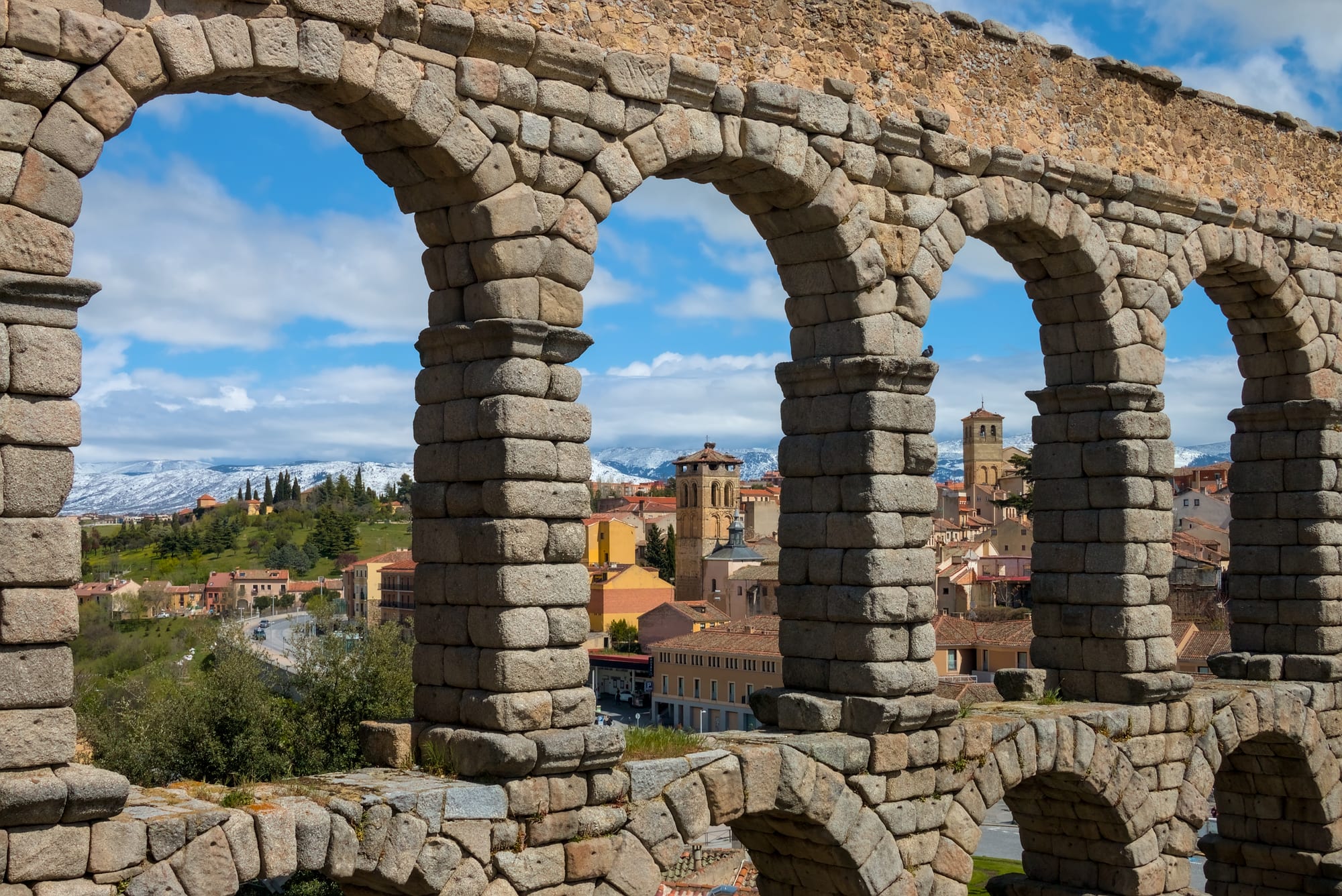
Granite arches of a Roman aqueduct framing the rooftops and church towers of Segovia, with snowy mountains beyond

Spain

Castile and León

Segovia seen through the arches of its Roman aqueduct, with the Sierra de Guadarrama behind. (Benjamin Smith / Wikimedia Commons · CC BY-SA 4.0)

Spain's largest autonomous community, a high plateau north and west of Madrid drained by the Duero — the heartland of the old kingdoms of Castile and León, dense with cathedrals, castles and walled cities such as Salamanca, Segovia, Ávila, Burgos and León, and home to the Ribera del Duero wine country.

Explore Castile and León

History

The Sierra de Atapuerca near Burgos holds some of Europe's oldest human remains, the basis of a species named Homo antecessor, and is a UNESCO World Heritage Site. Celtiberian peoples later held the plateau, and the siege of Numantia near Soria, which fell to Scipio Aemilianus in 133 BC, became a symbol of resistance. Rome left Segovia's aqueduct, the gold mines of Las Médulas in El Bierzo, and León itself, founded as the camp of the Seventh Legion.

In the Middle Ages the plateau was a frontier. The Kingdom of León grew out of Asturias in the 10th century, while Castile, a county of castles around Burgos, rose to become a kingdom and permanently absorbed León in 1230. Rodrigo Díaz, El Cid, born near Burgos, became its hero. León's Cortes of 1188 is often cited as one of the earliest European parliaments, and the University of Salamanca, founded in 1218, is among Europe's oldest. Isabella was proclaimed queen in Segovia in 1474, the Treaty of Tordesillas divided the new world with Portugal in 1494, and Columbus died in Valladolid in 1506.

The wool trade made the region rich, but the Comuneros revolt against Charles V ended in defeat at Villalar in 1521, and Valladolid's spell as royal capital under Philip III was brief. From the 17th century the plateau declined into a land of farming and emigration. In the Civil War Burgos served as the seat of Franco's government, and since 1983 the nine provinces have formed one autonomous community, facing steady rural depopulation.

Culture & Customs

Castile and León is often described as the cradle of the Spanish language: the Castilian that spread across Spain and the Americas grew here, and the region takes pride in the clarity of its speech. Identity is split, however, between Castilian and Leonese, and in León a movement calls for a separate region; the Leonese language survives in a few western valleys.

Catholicism shaped the region's image as a land of convents, mystics and cathedrals. Saint Teresa of Ávila and Saint John of the Cross were reformers of the Carmelite order here in the 16th century. Holy Week is the high point of the year, with slow processions of carved and painted wooden figures, including works by Gregorio Fernández, in Valladolid, Zamora and León.

Other festivals include the Carnaval del Toro at Ciudad Rodrigo, the Santa Águeda festival in Zamarramala near Segovia, where women take over the running of the village for a day, Soria's San Juan fiestas, and Valladolid's Seminci film festival. Castilians are often described as sober and reserved, but the evening round of bars is as lively as anywhere in Spain.

Daily Life

About 2.4 million people live across an area larger than Portugal, making it one of the most thinly populated regions in Europe. Valladolid, the seat of the regional government, is the largest city with about 300,000 people; Burgos has about 175,000, Salamanca about 145,000 and León about 120,000. The other provincial capitals — Palencia, Zamora, Ávila, Segovia and Soria — are small cities of 40,000 to 80,000.

The plateau is Spain's great cereal belt, with wheat, barley and sunflowers, and sheep and pig farming. Valladolid builds cars for Renault, Burgos has a food and industrial base, and universities in Salamanca, Valladolid, León and Burgos keep their cities young. Wine and tourism have grown strongly.

The defining issue is depopulation. Hundreds of villages have fewer than a hundred people, many are ageing or empty, and the young leave for Madrid; Soria and Zamora have become symbols of the so-called "empty Spain".

Food

This is the land of the asador, the roasting house. Lechazo asado, milk-fed lamb roasted in a wood-fired clay dish, is the pride of Aranda de Duero and the Ribera, and cochinillo, suckling pig roasted until the skin is crisp enough to cut with the edge of a plate, is Segovia's signature. Burgos makes morcilla, a blood sausage with rice, and a fresh white cheese; León has cecina, cured smoked beef, and El Bierzo botillo, a pork sausage of mixed cuts.

Guijuelo in Salamanca province is one of Spain's main centres for cured Iberian ham, and Salamanca's hornazo is a bread pie filled with pork loin, chorizo and egg. Sopa castellana, a garlic soup with bread, paprika and egg, warms winter nights, and judiones de La Granja are giant white beans stewed with pork. Zamorano is a hard sheep's-milk cheese, and Ávila's yemas de Santa Teresa are sweets made of sugared egg yolk.

The Ribera del Duero is one of Spain's leading red-wine regions, made mainly from Tempranillo, known locally as Tinto Fino. Rueda makes crisp Verdejo whites, Toro powerful reds, Bierzo reds from Mencía, and Cigales rosés.

Attractions & Natural Wonders

Salamanca's golden sandstone old town, a UNESCO World Heritage Site, centres on the baroque Plaza Mayor, the Plateresque university façade with its hidden carved toad, the Old and New Cathedrals and the Casa de las Conchas. Segovia has its Roman aqueduct, the cathedral and the Alcázar above the river valleys, with the royal palace of La Granja nearby. Ávila's medieval walls, walkable in parts, enclose the city of Saint Teresa.

Burgos has one of Spain's great Gothic cathedrals and, nearby, the Atapuerca sites and the monastery of Santo Domingo de Silos, known for its cloister and Gregorian chant. León's cathedral glows with medieval stained glass, while the Royal Pantheon of San Isidoro keeps Romanesque frescoes and Gaudí's Casa Botines stands in the centre; the Camino de Santiago crosses both cities and continues to Astorga. Valladolid has its Plaza Mayor and the National Museum of Sculpture.

The Ribera del Duero stretches along the river around Peñafiel, whose long castle holds a wine museum, and Aranda de Duero, with cellars dug beneath the old town. Further afield are Zamora's Romanesque churches, the Roman gold workings of Las Médulas, the Templar castle of Ponferrada, Lake Sanabria and the granite peaks of the Sierra de Gredos.

Cities in Castile and León

Planning basics

Budget

Castile and León is one of the cheapest regions to travel in Spain. Hotels in the provincial capitals cost well below Madrid's rates, the menú del día is widespread, and in León and some other cities a free tapa still comes with each drink. Segovia and Salamanca are the most visited and slightly dearer, and roast-lamb feasts and top Ribera wineries are the main splurges.

Daily Budget Midrange
USD 110–230 (mid-range or parador hotel, a roast-lamb dinner, cathedral tickets, a winery tour)
Daily Budget Shoestring
USD 50–85 (hostel or pension, free tapas and menú del día, buses and regional trains)

Base in León or Salamanca for the best free-tapa bar rounds, and book Ribera del Duero winery visits in advance.

Safety

Castile and León is very safe, with some of Spain's lowest crime rates. Petty theft is possible around Segovia's aqueduct and in crowded Holy Week processions. The main hazards are the weather — summer heat on the plateau, winter fog and ice on roads and snow on mountain passes — and summer wildfires, which have burned large areas in recent years.

Check mountain pass conditions in winter and keep water in the car on long plateau drives in summer. Check current official travel advice before travelling.

Climate

The region sits on the high northern meseta, mostly 700 to 1,000 metres up, and has a continental climate: long, cold winters with frequent frost and fog, short springs, and hot, dry summers with cool nights. Burgos and Soria are among Spain's coldest provincial capitals. The mountain rims — the Cantabrian range, the Sierra de Gredos, the Guadarrama — get heavy snow, while El Bierzo is milder.

Summer
hot and dry by day, 28–34°C, with cool nights
Winter
cold, often below freezing at night, 0–10°C, with fog and occasional snow

Transportation

High-speed trains from Madrid reach Segovia and Valladolid quickly, continuing to León, Burgos, Palencia and Zamora; Salamanca and Ávila have slower but regular services. Buses link the provincial capitals. Distances across the plateau are long and rural bus services thin, so a car is useful for the Ribera del Duero, the Romanesque villages and the mountains.

Segovia and Ávila work as day trips from Madrid, but staying overnight shows them after the tour groups leave.

Best Time to Visit

May, June, September and October bring warm days and comfortable nights for touring the cities. Holy Week in Valladolid, Zamora and León is the region's great spectacle, though beds fill early. High summer is hot but tolerable thanks to the cool evenings, and the grape harvest in the Ribera del Duero comes in late September and October. Winter is cold but suits roast-lamb dinners and uncrowded cathedrals.