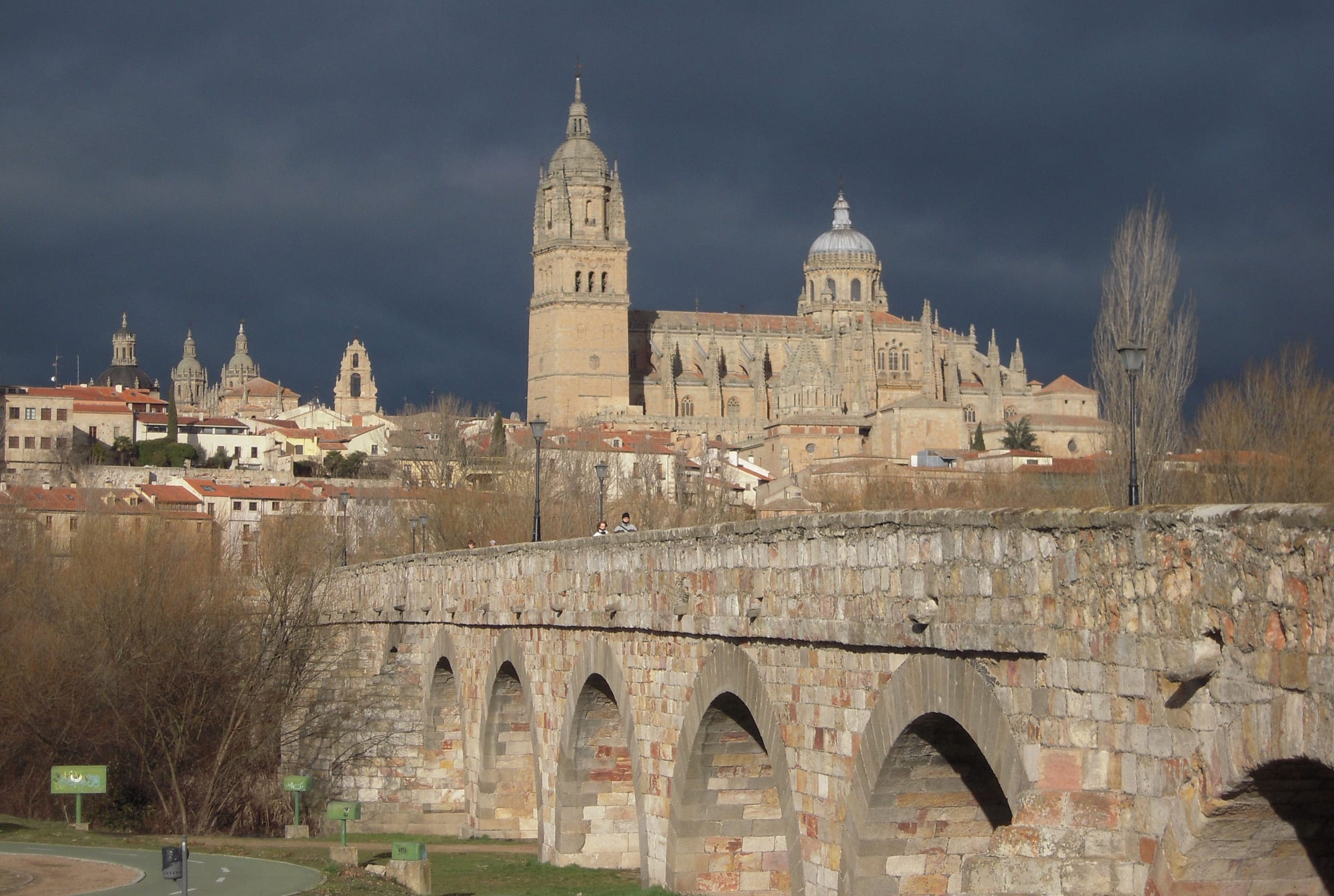
The tall sandstone tower and dome of Salamanca's cathedrals above old town roofs, with the stone arches of the Roman bridge in front

Castile and León, Spain

Salamanca

Salamanca's cathedrals seen from the Roman bridge over the Tormes. (Alurín / Wikimedia Commons · CC BY-SA 3.0)

A provincial capital on the Tormes in western Castile and León, built in golden sandstone around one of Europe's oldest universities, founded in 1218. Its old city, a UNESCO World Heritage Site, holds a baroque Plaza Mayor and two cathedrals side by side, and students — many learning Spanish — keep its streets and bars busy all year.

Neighbourhoods

  • Barrio del Centro
    • First-time visitors
    • Best for food
    • Historic district

    The heart of the old city, built around the Plaza Mayor and its city hall. The Casa de las Conchas, the Dueñas convent and the central food market are here, and the streets around the square are lined with bars and cafés.

    Open in Maps
  • Barrio de las Universidades
    • Historic district
    • Architecture
    • Students

    The part of the old city named after the university's Escuelas Mayores and Escuelas Menores, which stand around the Patio de Escuelas, a short walk from the cathedrals and La Clerecía.

    Open in Maps
  • San Vicente
    • Views
    • Quiet and residential

    The south-western corner of the historic centre, on the hill where the first settlement of Salamanca grew. Its raised position gives views over the old city and its cathedrals.

    Open in Maps
  • Tenerías and the Tormes riverside
    • Walks
    • Museums

    The old suburb, first known as the arrabal de Santiago, that grew south of the walls by the river, much changed today. It holds the Romanesque-Mudéjar church of Santiago del Arrabal and a museum of motoring history.

    Open in Maps
  • Salesas and Labradores
    • Nightlife
    • Best for food
    • Local life

    Residential districts north of the old city. A string of tapas bars lines Calle Van Dyck, about 1 km north of the Plaza Mayor, and Labradores, once the centre of the city's nightlife, is now mostly bars and restaurants.

    Open in Maps

Things to do

Famous landmarks

  • Plaza Mayorlandmark

    The baroque main square built between 1729 and 1755 to designs by the Churriguera family, with the city hall on one side and the others lined with restaurants and ice-cream parlours.

    Open in Maps
  • University of Salamancalandmark

    The oldest university in the Hispanic world, founded in 1218; the carved Plateresque façade of its Escuelas Mayores hides a small frog, or toad, that visitors try to find.

    Open in Maps
  • Old Cathedrallandmark

    The Romanesque cathedral of Santa María, begun in the 12th century under its founding bishop, Jerome of Périgord.

    Open in Maps
  • New Cathedrallandmark

    The much larger Gothic cathedral begun in the 16th century and completed in the 18th, joined to the old one at the Patio Chico; a 1992 restoration added a small astronaut to the Puerta de Ramos.

    Open in Maps
  • Casa de las Conchaslandmark

    A mansion built between 1493 and 1517 whose façade, mixing late Gothic and Plateresque, is covered with carved scallop shells; it now houses a public library.

    Open in Maps
  • La Clerecíalandmark

    The former Jesuit college, begun in 1617, with a baroque church, twin towers and a large dome 50 metres high; it is now the seat of the Pontifical University.

    Open in Maps
  • Roman bridgelandmark

    The bridge over the Tormes whose first fifteen arches date from Roman times; the rest has been rebuilt several times after floods, and the bridge appears on the city's coat of arms.

    Open in Maps

Convents and churches

  • Convento de San Estebanlandmark

    A Dominican monastery with a Plateresque façade shaped like a triumphal arch and a baroque altarpiece by José Benito de Churriguera; by tradition Columbus stayed with its Dominicans while seeking support for his voyage.

    Open in Maps
  • Convento de las Dueñaslandmark

    A Dominican convent of the 15th and 16th centuries whose two-storey cloister has fancifully carved capitals, with monsters and grotesques in the spandrels.

    Open in Maps

Museums

  • Casa Lismuseum

    A small Art Nouveau palace of 1905 with an iron and glass façade on the old city wall, now a museum of Art Nouveau and Art Deco decorative arts.

    Open in Maps
  • General Archive of the Spanish Civil Warmuseum

    The archive of documents seized by Franco's forces, now part of the Historical Memory Documentary Centre, with a permanent exhibition open to the public.

    Open in Maps

Parks and the river

  • Huerto de Calixto y Melibeapark

    A small garden near the cathedrals, where some place the story of the novel La Celestina.

    Open in Maps
  • Campo de San Franciscopark

    The city's first public garden, laid out on the land of the former convent of San Francisco el Real.

    Open in Maps

Short trips from the city

  • Ciudad Rodrigoattraction

    A small walled cathedral city on a rocky rise above the River Águeda, a border fortress besieged by Wellington during the Peninsular War.

    Open in Maps
  • La Albercaattraction

    A village in the Sierra de Francia at over 1,000 metres, capital of its comarca.

    Open in Maps

Seasonal events

  • Holy WeekMarch or April

    The city's best-known festival, with processions through the old city, some walked in complete silence, declared of International Tourist Interest in 2003.

  • Lunes de Aguasthe Monday after Easter Monday

    A local holiday when people head out into the countryside to eat hornazo, the meat pie of Salamanca.

  • Fiestas of the Virgen de la VegaSeptember

    The fiestas of the city's patron, whose feast falls on 8 September.

Eat and drink

Long-standing places and food districts in Salamanca. Hours, ratings and directions come from your maps app, always current.

Salamanca classics

  • Tapas on Calle Van Dyckneighborhood

    A street about 1 km north of the Plaza Mayor with a string of tapas bars, many of the tapas pork-based.

    Open in Maps
  • Bars around the Plaza Mayorneighborhood

    The arcades and side streets of the main square hold traditional restaurants and tapas bars serving grills and meaty tapas.

    Open in Maps

Food districts and markets

  • Mercado Central de Abastosmarket

    The central food market in the Barrio del Centro, a short walk from the Plaza Mayor.

    Open in Maps

Experience Salamanca

History

The first settlement at Salamanca was an Iron Age village on the hill of San Vicente above the Tormes; by the 3rd century BC a larger town had grown on the neighbouring hill where the cathedrals now stand. Hannibal besieged and took it, as Helmantica, in 220 BC. Under Rome it became Salmantica, a town on the road later called the Vía de la Plata, and the first fifteen arches of its bridge over the Tormes survive from that time. After the Muslim conquest in 712 the area became a thinly peopled frontier, and lasting resettlement came only after the capture of Toledo in 1085, when Raymond of Burgundy brought settlers in 1102 and the Old Cathedral was begun.

In 1218 Alfonso IX of León granted the cathedral schools the rank of a studium generale, and Salamanca grew into one of Europe's great centres of learning. Antonio de Nebrija published the first grammar of the Castilian language in 1492; Columbus sought support for his voyage among the Dominicans of San Esteban; and in the 16th century the School of Salamanca, led by Francisco de Vitoria, laid foundations of international law. The city joined the Comuneros revolt of 1520, and in the 16th century, its golden age, some 6,500 students enrolled each year.

Decline followed in the 17th century, but in the 18th the Plaza Mayor was built and the New Cathedral completed. During the Peninsular War the French destroyed a large part of the city's buildings for their defences, and in 1812 Wellington defeated them nearby at the Battle of Salamanca. In the Civil War the city was an early Nationalist headquarters, where Franco was proclaimed Generalissimo in 1936. UNESCO listed the old city in 1988, and Salamanca was a European Capital of Culture in 2002.

Culture & Customs

The university shapes the city's character. Its carved Plateresque façade, with the small toad hidden among the decoration, is a rite of passage for visitors, and students from across Spain and abroad — many of them on summer courses in Spanish — fill its squares and bars. The Pontifical University, founded in 1940 to continue the old theological studies, occupies La Clerecía. Writers are part of the story too: Fray Luis de León studied here, and the old rectors' house is kept as it was when Miguel de Unamuno was rector.

The city's stone gives it its look: the golden sandstone of the old city is the setting of many Plateresque buildings, and restorers keep up a tradition of adding a contemporary detail — an astronaut was carved on the New Cathedral's Puerta de Ramos in 1992. The Plaza Mayor is a popular gathering place.

Holy Week is the great festival, known for processions, some walked in silence, and has been of International Tourist Interest since 2003. On Lunes de Aguas, the Monday after Easter Monday, people head out to the countryside to eat hornazo, and the fiestas of the patron, the Virgen de la Vega, fall in September. Football divides loyalties between Salamanca CF and Unionistas de Salamanca, founded in 2013.

Daily Life

About 144,000 people lived in the city in 2024, and more in the surrounding towns that have grown into its suburbs. The population is older than the Spanish average — almost 29 per cent are over 65 — and has fallen slightly over recent decades as families moved to the metropolitan area. About 13 per cent were born abroad, with Peruvians, Colombians, Venezuelans, Hondurans and Moroccans the largest groups.

The university and tourism dominate the economy, and services employ the great majority of workers; industry is small, though a veterinary vaccine maker and a fertiliser company rank among the region's larger businesses. Spanish-language teaching has grown into a sector of its own, bringing students from many countries, above all in summer.

Most residents live in districts outside the old city, such as Garrido, Salesas and Labradores to the north. The rhythm is set by the academic year: term time fills the bars of Van Dyck and the old city, while the summer brings language students and tourists instead.

Food

Salamanca's cooking is the meat-rich food of the western plateau. The best known dish is hornazo, a pie of bread dough baked with pork loin, spicy chorizo and hard-boiled eggs, eaten in the countryside on Lunes de Aguas; the festival's name supposedly comes from a twisting of the word enagua, petticoat. Hornazo is also eaten in the neighbouring province of Ávila. Chanfaina, rice steamed with pork, is very popular, and cocido is a slow-cooked casserole based on chickpeas.

Tapas are the everyday way to eat out. Many are pork-based — ribs, chorizo, ham, bacon or jeta, pig's cheek — and bars across the city serve them, with a string of them along Calle Van Dyck, about 1 km north of the Plaza Mayor. The arcades and side streets of the Plaza Mayor hold traditional restaurants, the square itself is ringed with restaurants and ice-cream parlours, and the central market stands a short walk from the square.

Planning tools

Budget

Salamanca is one of the more visited cities of Castile and León and a little dearer than its neighbours, but still cheaper than Madrid. The menú del día is widespread, tapas bars make eating out inexpensive, and the large student population keeps prices down in the bars.

Daily Budget Midrange
USD 110–220 (mid-range hotel in the old city, restaurant dinners, cathedral and museum tickets)
Daily Budget Shoestring
USD 50–85 (hostel or pension, tapas and menú del día, walking and city buses)

Plan a night in the city rather than a day trip, to see the Plaza Mayor in the evening.

Best Time to Visit

Spring and autumn are the most comfortable seasons for walking the old city. Holy Week brings the processions and fills hotels; summer is hot by day, with cool nights, and brings many foreign students to Spanish-language courses. September has the fiestas of the patron, and winters are cold and frosty but quiet.

Suggested Number of Days

Two days cover the old city without rushing and leave time for its evenings. Add a day or two for the walled towns and mountain villages of the province. Many people come on a day trip from Madrid, which leaves little time inside the monuments.

First Visit
2 days
With Surroundings
3–4 days

Transportation

The old city is compact and best seen on foot. City buses, with 13 day lines and two night lines, link the railway station and the outer districts with the centre. Motorways run to Ávila, to Valladolid and Burgos, and along the Ruta de la Plata to the north and south.

Leave a car outside the old city; its narrow streets are best walked.

Airport & Station Connections

The main railway station, Vialia-Estación de Salamanca, has frequent trains to Madrid and Valladolid; Alvia trains from Madrid Chamartín take about 1 hour 40 minutes. Buses also connect the city with Madrid and Valladolid. Salamanca's small airport, at the Matacán air base east of the city, has few flights; Madrid–Barajas is the nearest international airport.

Walkability

Very walkable: the Plaza Mayor, the university, the cathedrals and the Roman bridge lie within a compact, largely pedestrian old city of sandstone streets. The walk from the Plaza Mayor down to the river is short and gently downhill.

Safety

Spain is a safe country with low violent crime. Salamanca is a calm university city; the main concern is petty theft in crowds, above all during the Holy Week processions, and the summer heat on the plateau.

Keep bags closed in crowded processions, and carry water in summer. Check current official travel advice before travelling.

Climate

A cold semi-arid climate close to the Mediterranean type, at about 800 metres above sea level. Winters are cool with frequent frosts, summers are warm to hot with cool nights, and rain is spread through the year, with summer the driest season.

Summer
warm to hot by day with cool nights; in Valladolid, on the same plateau, summer highs are generally 30–35°C
Winter
cool, with frequent frosts when nights drop below 0°C; Valladolid averages 56 days of frost a year

Local Customs

Salamanca is a student city: bars and tapas rounds fill the evenings, and lunch is the main meal. The cathedrals and convents are places of worship as well as monuments. Tipping is neither mandatory nor considered customary in Spain.

Dress modestly in churches and convents, and keep quiet during services.

Common Payment Methods

The currency is the euro. Cards and contactless are accepted almost everywhere, including small bars; a little cash is useful at markets.