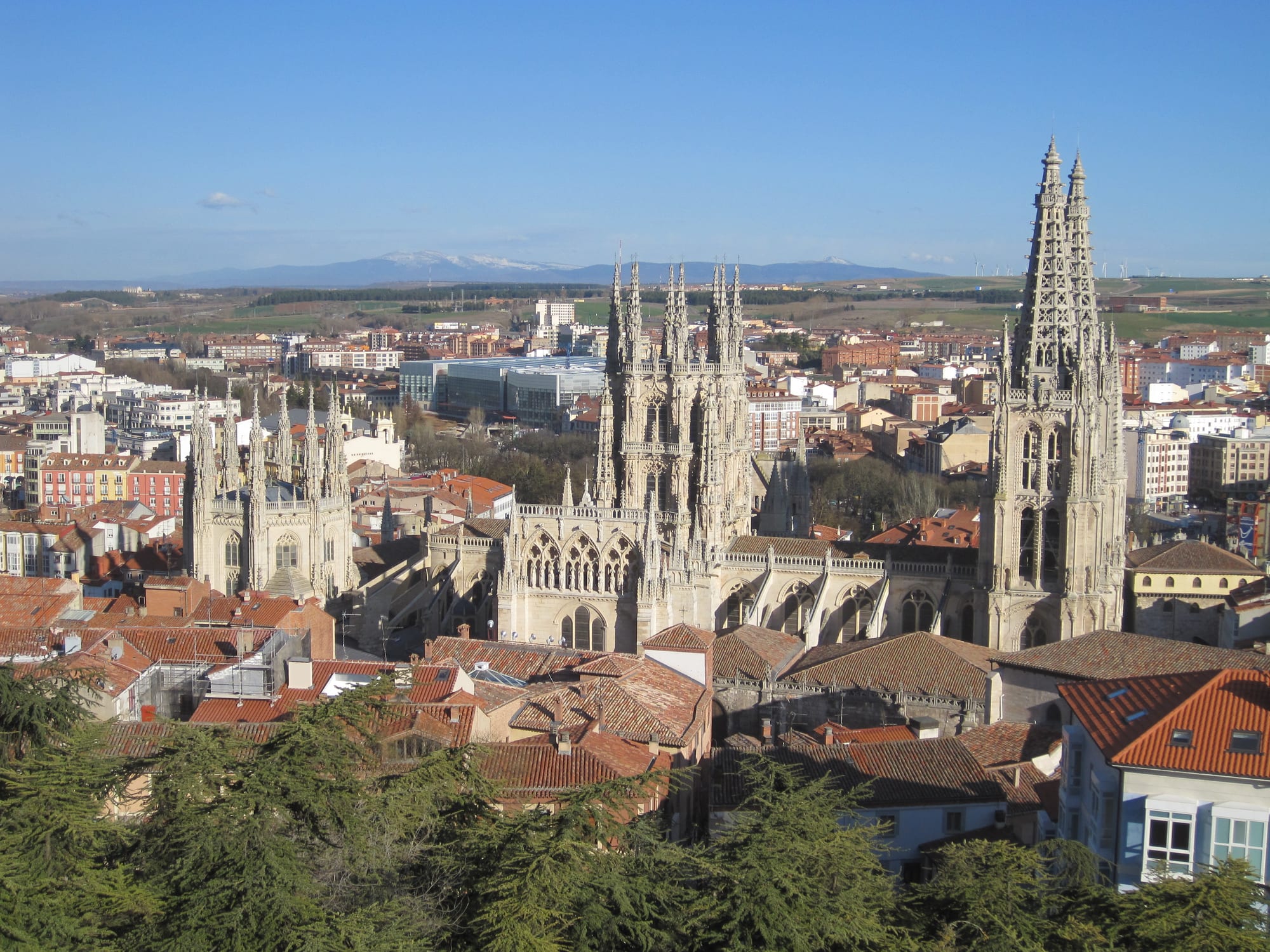
The pale Gothic spires of Burgos Cathedral among red-tiled roofs, with the city and distant snowy mountains behind

Castile and León, Spain

Burgos

Burgos Cathedral and the city seen from the viewpoint on the castle hill. (Eltitomac / Wikimedia Commons · Public domain)

A provincial capital on the Arlanzón at the northern edge of the Castilian plateau, founded in 884 and long called the Head of Castile. A trading hub on the Way of St James, it is crowned by a Gothic cathedral, a UNESCO World Heritage Site where El Cid is buried. Today it is an industrial and university city, with the Atapuerca fossil sites close by.

Neighbourhoods

  • The old town and the cathedral
    • First-time visitors
    • Historic district
    • Close to public transport

    The historic centre between the castle hill and the river, around the cathedral, the Plaza Mayor and the church of San Nicolás. Much of it, including the Plaza Mayor and the Santa María bridge, has been pedestrianised, and the international bus station is about a hundred metres from the cathedral.

    Open in Maps
  • Paseo del Espolón and the riverside
    • Walks
    • Cafés

    The tree-lined promenade along the Arlanzón, running from the theatre square to the Arco de Santa María past shops and cafés. The riverbanks form a green corridor through the city, continuing west along the Paseo de la Isla.

    Open in Maps
  • Huerto del Rey and San Lorenzo
    • Nightlife
    • Best for food

    The streets just north-east of the cathedral, with a dense strip of bars around Plaza Huerto del Rey and tapas bars along Calle San Lorenzo.

    Open in Maps
  • The castle hill
    • Views
    • Parks

    The hill above the old town. Its park holds the castle ruins, a bird conservation centre and a viewpoint over the city and the cathedral, reached by steps from the church of San Esteban.

    Open in Maps
  • Las Huelgas and the university
    • Quiet and residential
    • Students

    The districts west of the centre, around the Cistercian abbey of Las Huelgas and the former pilgrims' Hospital del Rey, now part of the University of Burgos campus, where the Parral park lies.

    Open in Maps

Things to do

Famous landmarks

  • Burgos Cathedrallandmark

    A Gothic cathedral begun in 1221, a UNESCO World Heritage Site, with openwork spires, the richly carved Constable's Chapel and the tomb of El Cid and his wife Jimena.

    Open in Maps
  • Arco de Santa Maríalandmark

    The ceremonial gateway in the city walls, erected for the first entry of the Emperor Charles V, facing the Santa María bridge over the Arlanzón.

    Open in Maps
  • San Nicolás de Barilandmark

    A church on the Camino de Santiago behind the cathedral, known for one of the largest altarpieces in Spain and the only one carved in limestone.

    Open in Maps
  • Statue of El Cidlandmark

    The equestrian statue of the city's hero at the foot of Calle Santander, beside the Teatro Principal.

    Open in Maps
  • Castle of Burgoslandmark

    The ruined medieval fortress on a hill 75 metres above the city, a residence of the kings of Castile, largely destroyed by the French in 1813.

    Open in Maps

Monasteries

  • Abbey of Las Huelgaslandmark

    A monastery of Cistercian nuns founded by Alfonso VIII in 1180, about 1.5 km west of the centre, known for its cloisters and for the privileges once held by its abbess.

    Open in Maps
  • Miraflores Charterhouselandmark

    A Carthusian monastery about four kilometres from the centre, holding the alabaster tombs of King Juan II and Queen Isabella of Portugal, a wooden statue of Saint Bruno and carved choir stalls.

    Open in Maps

Museums

  • Museum of Human Evolutionmuseum

    Opened in 2010 beside the river, built around the finds of Atapuerca, where some of the earliest known hominids in western Europe lived.

    Open in Maps
  • Museum of Burgosmuseum

    The provincial museum in two adjoining 16th-century palaces, with finds from Atapuerca to the present day, including the traditional sword of El Cid.

    Open in Maps

Parks and the river

  • Paseo del Espolónpark

    The emblematic tree-lined promenade on the Arlanzón between the theatre square and the Arco de Santa María.

    Open in Maps
  • Fuentes Blancaspark

    The most visited large park, stretching east of the city along the Arlanzón, near the pine forests of La Cartuja.

    Open in Maps

Short trips from the city

  • Archaeological site of Atapuercaattraction

    Caves in the Sierra de Atapuerca, about 15 km east of Burgos, a UNESCO World Heritage Site with fossils and stone tools of the earliest known hominids in western Europe; visits can be arranged through the museum.

    Open in Maps
  • Abbey of Santo Domingo de Siloslandmark

    The Benedictine abbey where the Silos Glosses, among the earliest writings in Spanish, were recorded.

    Open in Maps
  • Covarrubiasattraction

    A village in the wooded valley of the Arlanza, said to have been founded by the Visigothic king Chindasuinth.

    Open in Maps

Seasonal events

  • Holy WeekMarch or April

    The processions of the days before Easter.

  • El CurpillosJune, the Friday before or after Corpus Christi

    The Día del Parral, the city's oldest festival, held in El Parral park, with stalls of pinchos and drinks run by the city's peñas.

  • Sampedroslate June

    The city's main fiestas of San Pedro and San Pablo, around 29 June, with bullfights every afternoon among the events.

Eat and drink

Long-standing places and food districts in Burgos. Hours, ratings and directions come from your maps app, always current.

Burgos classics

  • Tapas on Calle San Lorenzoneighborhood

    A street near the Plaza Mayor that is one of the city's main tapas areas, for pinchos such as the cojonuda.

    Open in Maps
  • Bars of Huerto del Reyneighborhood

    The square and streets north-east of the cathedral, lined with bars, grills and tapas places.

    Open in Maps

Cafés and promenades

  • Paseo del Espolón cafésneighborhood

    Cafés along the riverside promenade between the theatre and the Arco de Santa María.

    Open in Maps

Experience Burgos

History

Early humans lived around Burgos as long as 800,000 years ago, in the caves of the Sierra de Atapuerca to the east. The city itself was founded in 884 by Diego Rodríguez Porcelos, Count of Castile, as an outpost on the expanding Christian frontier, in a land named Castile after its many castles. It came to be called Caput Castellae, the Head of Castile. In the 11th century it became a bishop's seat and the capital of the new Kingdom of Castile, and El Cid, the Castilian warrior of that age, was born nearby.

As a major stop on the French Way to Santiago and a hub of trade between the Bay of Biscay and the south, Burgos became by the 13th century the most important trading centre of northern Castile, with a large foreign merchant community. The cathedral was begun in 1221, kings favoured the city as a seat and burial place. Alfonso XI imposed direct royal rule in 1345.

A long decline began in the 17th century. Wellington besieged the castle unsuccessfully in 1812, and the French destroyed it the next year. During the Civil War Burgos was the base of Franco's Nationalist government. Named a pole of industrial development in the 1960s, it has since grown into a manufacturing city. The Museum of Human Evolution opened in 2010, UNESCO named Burgos a City of Gastronomy in 2015, and high-speed trains arrived in 2022.

Culture & Customs

Burgos is proud to be called the cradle of Castilian Spanish. It is argued that the language first developed in this area in the 10th century, and the Valpuesta cartularies, to the north-east, and the Silos Glosses, from the province's monastery of Santo Domingo de Silos, hold some of the earliest written Spanish; some argue that the purest Spanish is spoken in the region. El Cid, the city's hero, has an equestrian statue in the centre and lies with his wife in the cathedral.

The Camino de Santiago runs through the old town, and pilgrims are part of daily life, as they have been since the Middle Ages. The city's big festival is the Sampedros, around 29 June, with bullfights every afternoon; in June comes El Curpillos too, the city's oldest festival, held in the Parral park where the peñas run stalls of pinchos and drinks.

The Auditorium and Congress Centre opened in 2012, and the city's cultural life includes the Fadrique de Basilea Book Museum. Football means Burgos CF, refounded in 1994, which plays at the El Plantío stadium, and two basketball clubs, CB San Pablo and CB Tizona. The countryside near Burgos doubled for the American West in The Good, the Bad and the Ugly, whose final scene was shot at Santo Domingo de Silos.

Daily Life

About 177,000 people live in the city (INE, 2025), and about 200,000 in its metropolitan area, making it the second city of Castile and León after Valladolid. A quarter of the population is over 65, and about 15 per cent were born abroad, most often in Colombia, Romania, Venezuela, Ecuador and Morocco.

Burgos is one of Spain's richer cities. It is strongly industrial, with the largest industrial park in northern Spain at Villalonquéjar and the headquarters of the car-parts maker Grupo Antolin, alongside a large public sector serving the provincial capital. Wheat fields surround the city. The University of Burgos, founded in 1994, has about 10,000 students, and a private university opened in 2008.

Life is lived outdoors when the weather allows: along the Espolón and the river parks, which give the city one tree for every three residents, and on a little over 60 km of bike lanes. Winters are long and cold, and evenings in the bars of San Lorenzo and Huerto del Rey are the city's social centre.

Food

Burgos is famous above all for two products. Morcilla de Burgos is a blood sausage made with rice, onion, pork lard, paprika and other spices; towns across the province make their own versions. Queso de Burgos is a soft, fresh white cheese, once made from sheep's milk and now usually from cow's milk or a mixture. The cheese appears in the dessert called postre del abuelo, Burgos cheese with honey.

The city's most famous dish is olla podrida, a stew of beans with morcilla, chorizo, ribs, bacon and other pork. Roast lamb, sopa castellana and sopa burgalesa, and beans are other specialities, and yemas de Burgos are a traditional sweet. Wine comes from the nearby Ribera del Duero, Rioja and Arlanza denominations.

The main tapas areas are near the Plaza Mayor, such as Calle San Lorenzo and Calle Sombrerería; among the best-known pinchos are the cojonuda, patatas bravas and tortilla de patatas. Burgos was named Spain's Capital of Gastronomy for 2013 and a UNESCO City of Gastronomy in 2015.

Planning tools

Budget

Burgos is good value, with hotels well below Madrid's prices, a widespread menú del día and a strong tapas culture. Cathedral entry is the main sightseeing cost, and pilgrims on the Camino receive a reduced rate.

Daily Budget Midrange
USD 110–220 (central hotel, restaurant dinners, cathedral and museum tickets)
Daily Budget Shoestring
USD 50–85 (pilgrim hostel or pension, pinchos and menú del día, walking and city buses)

Eat at lunchtime on the menú del día and make dinner a round of pinchos.

Best Time to Visit

Late spring to early autumn, when the days are warm and the nights cool. The Sampedros fiestas at the end of June are the busiest and liveliest time. Winters are long, windy and cold, with frost on most days and regular snow, but the cathedral and museums are quiet.

Suggested Number of Days

One or two days are enough for the city itself. Allow three or four to add the prehistoric sites, the monasteries and the villages of the province.

First Visit
1–2 days
With Surroundings
3–4 days

Transportation

The historic centre is compact and largely pedestrianised. City buses cover the wider town, and the public bike scheme, Bicibur, uses a network of a little over 60 km of bike lanes. A car helps for Atapuerca and the villages of the province.

Use the underground car park beneath the Plaza Mayor or leave the car outside the centre.

Airport & Station Connections

High-speed AVE trains have served Burgos since 2022, reaching Madrid in about an hour and a half with a stop in Valladolid. The station is in Villímar, north-east of the city, linked to the centre by bus 25. The international bus station, close to the cathedral, has services from across Spain and Europe. Burgos Airport has only seasonal flights; the main international airports are Bilbao and Madrid–Barajas.

Walkability

Very walkable: the cathedral, the Plaza Mayor, the Espolón and the tapas streets lie within a few minutes of each other. The castle park is reached by steps from San Esteban, and Las Huelgas is about 1.5 km west; Miraflores, about four kilometres out, is a long walk along the river.

Safety

Spain is a safe country with low violent crime. Burgos is a calm city; the main hazards are the weather — icy pavements and roads in winter, when temperatures often fall well below freezing — and pickpockets in the crowds of the Sampedros.

Wear warm, grippy footwear in winter and keep valuables close in festival crowds. Check current official travel advice before travelling.

Climate

A warm-summer Mediterranean climate with a continental influence, at 865 metres above sea level. Burgos is considered the coldest city in Spain of over 100,000 people, with chilly, windy winters, while summers are pleasant. Annual precipitation averages 546 mm.

Summer
warm — summer months average highs of about 27.5°C
Winter
cold and windy — temperatures drop below freezing almost every day, often to −10°C, and snowfalls are common

Local Customs

Burgos is a cathedral city and a stage on the Camino de Santiago, and pilgrims are a familiar sight. Tipping is neither mandatory nor considered customary in Spain.

Dress modestly in the cathedral and churches and keep quiet during services.

Common Payment Methods

The currency is the euro. Cards and contactless are accepted almost everywhere, including small bars; a little cash is useful at festival stalls and markets.