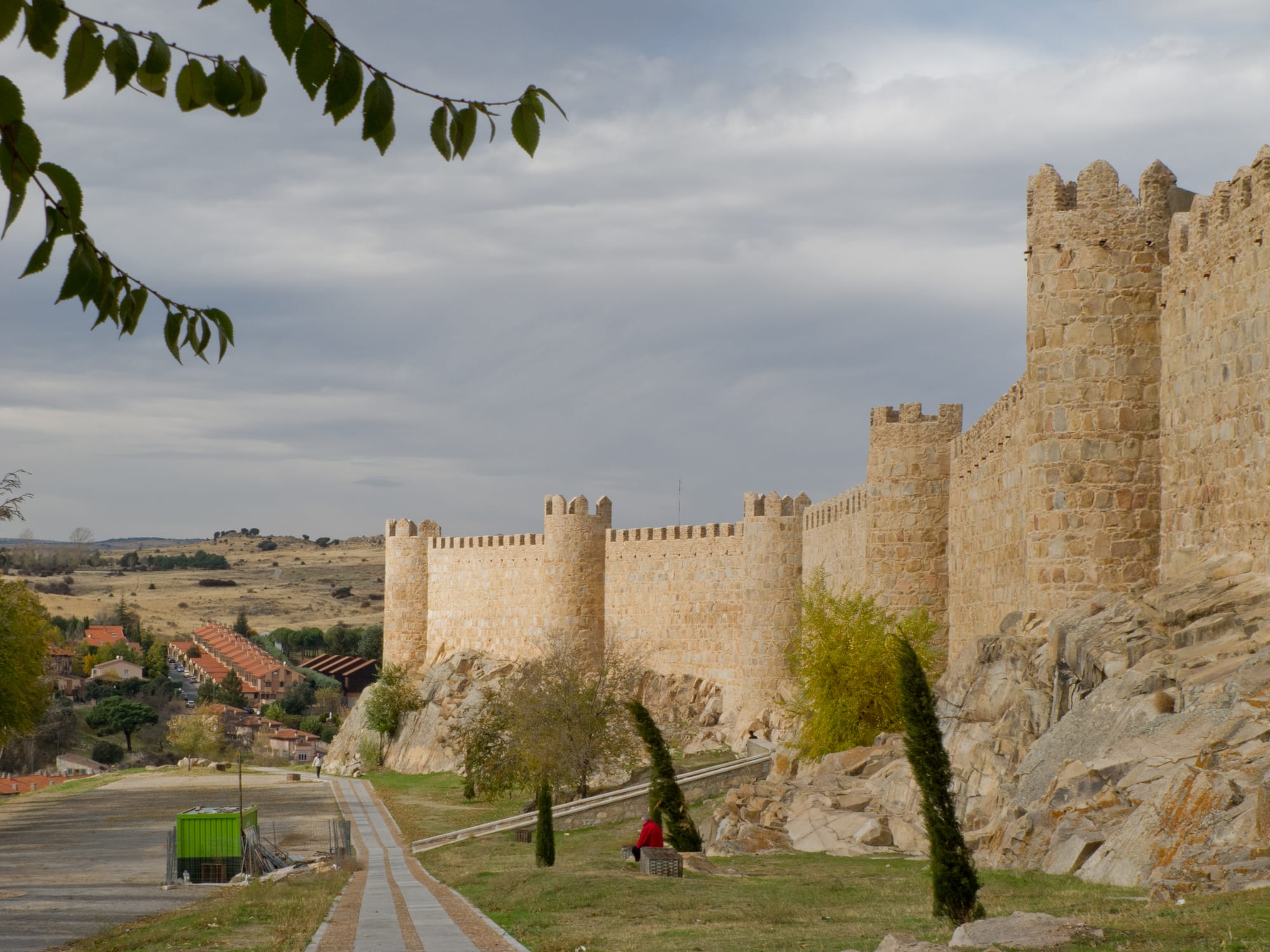
Golden granite walls with round crenellated towers rising from a rocky outcrop, with open countryside beyond

Castile and León, Spain

Ávila

The medieval walls of Ávila rising from the granite rock of the city's hill. (Carlos Delgado / Wikimedia Commons · CC BY-SA 3.0)

The highest provincial capital in Spain, on a rocky hill above the Adaja west of Madrid, still enclosed by medieval walls begun in 1090. Known as the city of stones and saints, it is bound up with Saint Teresa and the Carmelite reform, and its old town and churches outside the walls form a UNESCO World Heritage Site. Today it is a quiet administrative and university town.

Neighbourhoods

  • Inside the walls
    • First-time visitors
    • Historic district
    • Best for food

    The old town keeps its Roman plan of two main streets crossing at the centre. The cathedral, palaces and convents fill its lanes, restaurants cluster towards the Plaza del Mercado Chico, and the old town is closed to private cars.

    Open in Maps
  • Mercado Grande and Calle San Segundo
    • Best for food
    • Close to public transport

    Outside the east flank of the walls, the Plaza del Mercado Grande faces the Romanesque church of San Pedro at the Alcázar gate. Calle San Segundo, running along the walls, holds many of the city's restaurants.

    Open in Maps
  • San Vicente and Avenida de Madrid
    • Romanesque churches
    • Arts and culture

    The area outside the walls along the Avenida de Madrid, with the Basilica of San Vicente and the Lienzo Norte congress and performance centre; the San Segundo hermitage stands just west of the walls by the Adaja.

    Open in Maps
  • Newer districts
    • Quiet and residential
    • Local life

    The neighbourhoods that grew up around the old town, such as Las Hervencias, with the hospital, stadium, sports grounds and schools, and a shopping centre on the north-eastern outskirts. The Royal Monastery of Santo Tomás stands outside the walled city, in the Santo Tomás-Universidad district.

    Open in Maps

Things to do

Walls and landmarks

  • Walls of Ávilalandmark

    Walls begun in 1090 with a perimeter of about 2.5 kilometres, 88 semicircular towers and curtain walls averaging 12 metres high; visitors can walk along roughly half of their length.

    Open in Maps
  • Ávila Cathedrallandmark

    A Gothic cathedral whose apse forms one of the towers of the walls, planned as a cathedral-fortress, with Romanesque parts in red-and-white stone and a main altarpiece begun by Pedro Berruguete.

    Open in Maps
  • Plaza del Mercado Chicolandmark

    The main square of the old town, reached through lanes lined with restaurants and tapas bars.

    Open in Maps

Churches and convents

  • Basilica of San Vicentelandmark

    One of the best examples of Romanesque architecture in Spain, outside the walls, with decorated western and southern gates and the cenotaph of the martyrs Vincent, Sabina and Christeta.

    Open in Maps
  • Convento de San Josélandmark

    The first convent of Discalced Carmelite nuns, founded by Saint Teresa in 1562; its church, designed by Francisco de Mora, was added in 1607.

    Open in Maps
  • Iglesia-convento de Santa Teresalandmark

    The church and convent dedicated to Saint Teresa, starting point of processions to the cathedral during her October festival.

    Open in Maps
  • Real Monasterio de Santo Tomáslandmark

    A Dominican monastery built between 1482 and 1493 for the Catholic Monarchs outside the walled city, now also home to a museum of East Asian art.

    Open in Maps
  • Church of San Pedrolandmark

    A Romanesque church begun about 1100, standing outside the walls on the Plaza del Mercado Grande at the Alcázar gate.

    Open in Maps
  • Hermitage of San Segundolandmark

    A small 12th-century hermitage on the right bank of the Adaja, west of the walls, with an alabaster statue by Juan de Juni and the tomb of the city's patron saint.

    Open in Maps

Short trips from the city

  • Sanctuary of Our Lady of Sonsoleslandmark

    A sanctuary about 5 kilometres south-east of the city housing the Virgin of Sonsoles, co-patroness of Ávila, a traditional place of pilgrimage.

    Open in Maps
  • Sierra de Gredospark

    A range of the Sistema Central spanning five provinces, rising to 2,592 metres at Pico Almanzor.

    Open in Maps
  • Arévaloattraction

    The largest town of La Moraña, where the Adaja meets the Arevalillo, known with Segovia for its roast suckling pig.

    Open in Maps

Seasonal events

  • Holy WeekMarch or April

    Processions of the city's fraternities along the town walls, of International Tourist Interest.

  • San Segundo2 May

    The pilgrimage to the hermitage of the patron saint, where by popular belief a handkerchief placed in his tomb with three wishes wins one of them.

  • Summer festivalmid-July

    The city's summer fiestas.

  • Fiestas de Santa Teresaaround 15 October

    The main festival, opened by the mayor in the Plaza Mayor, with concerts, a fairground, bullfights, chocolate with churros and processions between the cathedral and the Santa Teresa church.

Eat and drink

Long-standing places and food districts in Ávila. Hours, ratings and directions come from your maps app, always current.

Ávila classics

  • La Flor de Castillacafe

    The traditional pastry shop where the yemas de Santa Teresa are always found.

    Open in Maps

Food streets

  • Calle de San Segundoneighborhood

    The street along the east flank of the walls, where most of the city's eating places are found, serving meaty Castilian food and chuletón.

    Open in Maps
  • Plaza del Mercado Chiconeighborhood

    The old town's main square and the lanes leading to it, with restaurants and tapas bars.

    Open in Maps

Experience Ávila

History

In the 5th century BC the Vettones held the hill, calling it Obila, "high mountain", and built one of their strongest forts there; Bronze Age stone statues of boars have been found nearby. Under Rome the town took a regular plan, with two main streets crossing at a forum, and tradition holds that Secundus, its first bishop, brought Christianity in the 1st century. After Visigothic rule and the Muslim conquest it became an almost empty no man's land, until Raymond of Burgundy resettled it around 1088 and the walls were begun in 1090.

Medieval Ávila was a frontier town with one of the largest Jewish communities in Castile by the late 13th century, which ended with the expulsion of 1492. The city prospered under the Catholic Monarchs, and in 1520 it was the first meeting place of the Holy Junta of the Comuneros, which drafted a proto-constitution in the cathedral. In the 16th century Teresa of Ávila founded the first convent of her reformed Discalced Carmelites here, in 1562.

From the 17th century the city declined until it had only about 4,000 people. The railway from Madrid to the French border brought modest growth in the 19th century, and in 1936 the town fell quickly to the rebel side in the Civil War. Adolfo Suárez, the first democratically elected prime minister after Franco, came from here. UNESCO listed the old town and its churches outside the walls in 1985.

Culture & Customs

Ávila calls itself the city of stones and saints, and religion runs through its identity. Teresa of Ávila, mystic, writer and the first woman named a Doctor of the Church, is the town's most famous historical resident, and her convents, her festival and even the city's sweets bear her name. The city keeps many active convents.

The writer Azorín called Ávila "perhaps the most 16th-century town in Spain", and Orson Welles named it the place he would most like to live, calling it a "strange, tragic place"; he filmed scenes of Chimes at Midnight here. The walls, lit at night, are the largest fully illuminated monument in the world.

Holy Week, of International Tourist Interest, is the first public festival after the winter, with processions along the walls. San Segundo, the patron, is honoured on 2 May with a pilgrimage to his hermitage, and the summer fiestas fall in mid-July. The Santa Teresa festival around 15 October is the biggest, with a proclamation in the Plaza Mayor, concerts, bullfights, chocolate with churros and processions. Sport centres on Óbila CB, the basketball team, and Real Ávila football club.

Daily Life

About 59,000 people live in the municipality (INE, 2025). The city has grown strongly in modern times, as new districts such as Las Hervencias went up around the old town with a hospital, a stadium, sports grounds and schools, and the population roughly doubled.

As the provincial capital the city is the centre of administration and services for the province, and tourism draws visitors to the walls and convents. The Catholic University of Ávila and three colleges of the University of Salamanca — a polytechnic school, a college of education and tourism and a school of nursing — bring students. The city has two industrial estates, Las Hervencias and Vicolozano.

Life inside the walls is quiet, with the old town closed to private cars, while most residents live in the newer neighbourhoods outside. The climate shapes the year: long, cold winters at over 1,100 metres, and a summer of festivals and evening walks below the illuminated walls.

Food

Ávila's signature dish is the chuletón de Ávila, a grilled ribeye steak best eaten rare, cut from the Avileña-Negra ibérica, an indigenous black cattle breed known well beyond the province for its meat. Judías del barco and patatas revolconas are other typical dishes of the town and region, along with mollejas de ternera.

The best-known sweet is the yemas de Santa Teresa, small orange balls of egg yolk served in white paper and made in honour of the saint. The traditional pastry shop La Flor de Castilla always sells them; other bakeries make them as yemas de Ávila or simply yemas. Hornazo, a bread filled with sausage, bacon, meat and eggs, is eaten here as in Salamanca, and cochinillo, roast suckling pig, is found in the city and in Arévalo.

Most restaurants line Calle de San Segundo along the walls and the lanes leading to the Plaza del Mercado Chico. Castilian food here is meaty, and dinner is served late.

Planning tools

Budget

Ávila is good value, with hotel prices well below Madrid's and a menú del día in many restaurants. A chuletón dinner is the local splurge, and many visitors come only for the day from Madrid.

Daily Budget Midrange
USD 110–220 (hotel inside or by the walls, a chuletón dinner, entry to the walls, cathedral and convents)
Daily Budget Shoestring
USD 50–85 (hostel or pension, tapas and menú del día, walking)

Stay overnight to see the walls lit up after dark.

Best Time to Visit

Late spring to early autumn, when the high plateau is warm by day. Holy Week brings the processions, July the summer fiestas, and the Santa Teresa festival in mid-October is the year's high point. Winter lows are the coldest of any Spanish provincial capital, with snow at times.

Suggested Number of Days

The walled town and its churches fit into one or two days, and many people come only on a day trip from Madrid. Allow three or four days to add the mountains and the towns of the province.

First Visit
1–2 days
With Surroundings
3–4 days

Transportation

The city is easily explored on foot, and city buses serve the wider town. The old town is closed to private cars. A car is useful for the Sierra de Gredos and the villages of the province.

Park outside the walls and walk in through one of the gates.

Airport & Station Connections

Trains run every hour or two from Madrid Príncipe Pío, taking about 90 minutes via El Escorial, and a few more come from Chamartín and Atocha. Buses from Madrid Estación Sur take about 80 minutes. By road the A-6 comes from Madrid. The nearest airport is Adolfo Suárez Madrid–Barajas.

Walkability

The walled town is small and easy to cross on foot, though it sits on a hill and some streets slope. The churches outside the walls are a short walk from the gates; the Santo Tomás monastery, outside the walled city, is a longer walk. Pavements can be icy on winter mornings.

Safety

Spain is a safe country with low violent crime. Ávila is a quiet city; the main hazards are the weather — cold winters with ice and snow at this height and strong sun in summer — and crowds during Holy Week.

Dress for cold nights even outside winter, and check road conditions over the mountain passes in snow. Check current official travel advice before travelling.

Climate

A warm-summer Mediterranean climate bordering on cold semi-arid, shaped by an altitude of about 1,130 metres. Summers are warm and winters chilly with snowfalls, and Ávila has the coldest winter lows of any Spanish provincial capital.

Summer
warm — July, the hottest month, averages about 21°C over day and night
Winter
chilly — January averages about 3°C, with snowfalls and the coldest nights of Spain's provincial capitals

Local Customs

Ávila is a deeply religious city, shaped by its convents and by the memory of Saint Teresa, and many convents still have communities of nuns. Dinner is served late, and before about 8.30 pm often only tapas are available. Tipping is neither mandatory nor considered customary in Spain.

Dress modestly and keep quiet in convents and churches, especially during services.

Common Payment Methods

The currency is the euro. Cards and contactless are accepted almost everywhere, including small bars; a little cash is useful in pastry shops and villages.