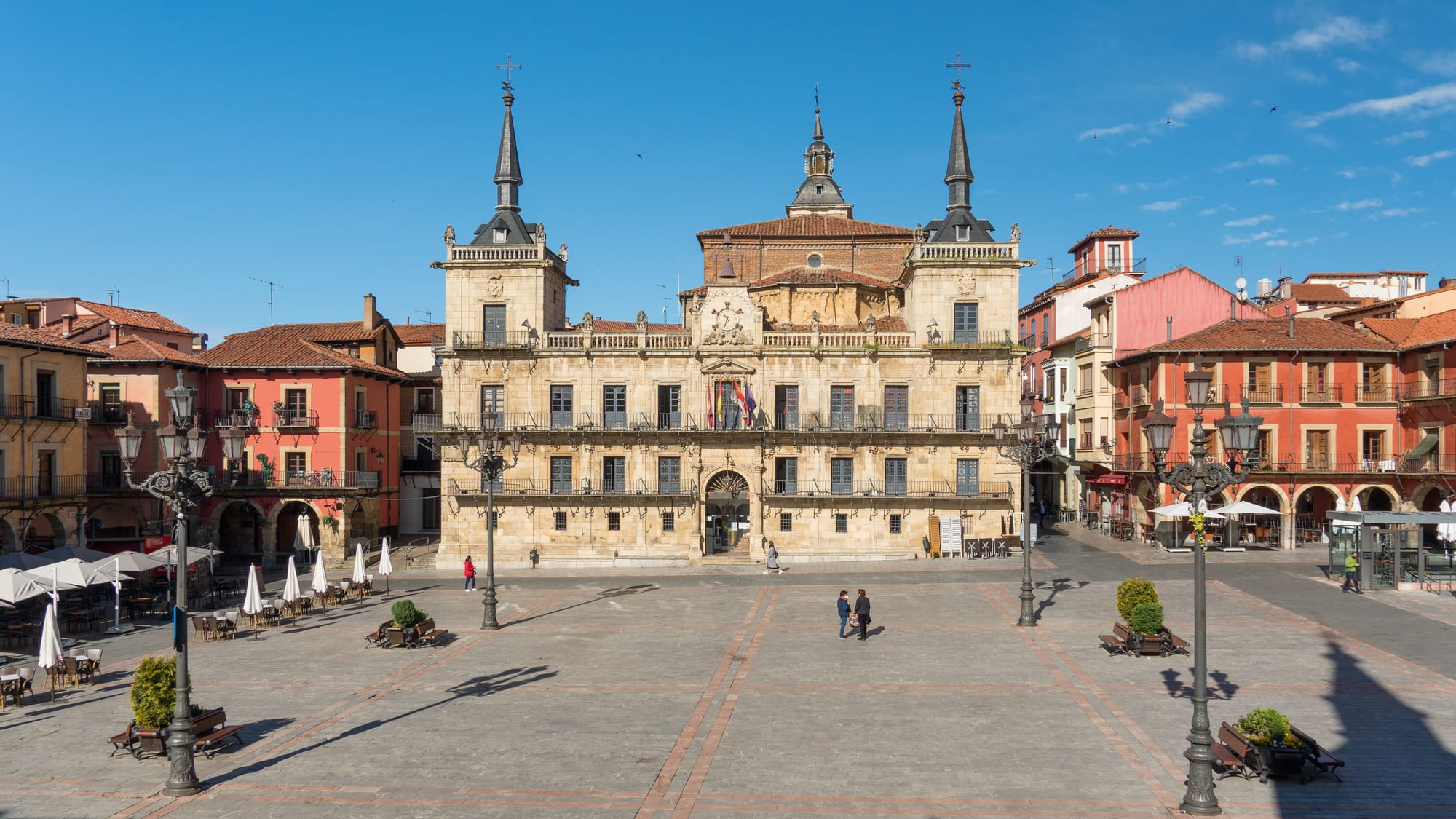
The arcaded Plaza Mayor of León with the twin-towered stone old town hall, red and pink houses and café umbrellas

Castile and León, Spain

León

The Plaza Mayor of León, with the old town hall at its head. (Fernando / Wikimedia Commons · CC BY-SA 4.0)

A provincial capital on the northern plateau between the Bernesga and Torío rivers, founded as the camp of a Roman legion and later the seat of the medieval Kingdom of León. Its Gothic cathedral, the royal pantheon of San Isidoro and a building by Gaudí stand within and around the old walls, and it remains a major stop on the Camino de Santiago, known for its free tapas.

Neighbourhoods

  • Barrio Húmedo
    • Best for food
    • Nightlife
    • First-time visitors

    The old quarter inside the Roman walls, nicknamed the 'wet district' for its density of bars. It is centred on the Plaza de San Martín, takes in the Plaza Mayor with its long-running market, and is the place for the evening round of drinks with free tapas.

    Open in Maps
  • The cathedral quarter and Calle Ancha
    • Historic district
    • First-time visitors

    The northern half of the walled town, where Calle Ancha runs up to the cathedral on the Plaza de Regla. San Isidoro, the best-preserved stretches of Roman wall and the palaces around the Plaza de San Marcelo, including Casa Botines, are a few minutes' walk apart.

    Open in Maps
  • The Ensanche
    • Shopping
    • Close to public transport

    The planned extension built from the late 19th century between the old town and the railway, along Avenida de Ordoño II and around the Plaza de Santo Domingo. It holds the main shopping streets, offices and many of the city's bars and cafés, and leads down to the river and the stations.

    Open in Maps
  • San Marcos and the Bernesga
    • Architecture
    • Walks
    • Museums

    The riverside quarter around the long plateresque front of San Marcos, beside the Bernesga, whose banks are laid out with gardens and walking paths. The concert hall and the MUSAC contemporary art museum stand in the newer streets just to the north.

    Open in Maps

Things to do

Famous landmarks

  • León Cathedrallandmark

    A Gothic cathedral begun around 1205 whose main structure was finished in 1302, with one of the largest collections of medieval stained glass in the world, nearly 1,800 square metres of it.

    Open in Maps
  • Basilica of San Isidorolandmark

    A Romanesque basilica rededicated to Saint Isidore of Seville in 1063, where the Cortes of 1188 met; its Royal Pantheon, the burial place of León's medieval kings, keeps 12th-century wall paintings in exceptional condition.

    Open in Maps
  • Casa Botineslandmark

    A neo-Gothic building of 1891–1892 by Antoni Gaudí, built for a fabrics company and later a savings bank, now a museum of Gaudí, the building's history and Spanish art of the 19th and 20th centuries.

    Open in Maps
  • San Marcoslandmark

    A former convent and pilgrims' hospital of the Order of Santiago, rebuilt from the 16th century with a richly carved plateresque façade; its church remains in use, and it served as a prison camp from 1936 to 1940.

    Open in Maps
  • Palacio de los Guzmaneslandmark

    A 16th-century palace beside Casa Botines, now the seat of the provincial government, designed by Rodrigo Gil de Hontañón around a central patio.

    Open in Maps
  • Roman wallslandmark

    Long stretches of the walls of the legionary camp, built between the 1st century BC and the 4th century AD, still stand around the old town.

    Open in Maps

Squares and museums

  • Plaza Mayorlandmark

    The arcaded main square of the old town, closed by the twin-towered old town hall and home to a market held since 1660.

    Open in Maps
  • Plaza del Granolandmark

    A square on the south side of the old town that once held the city's grain market.

    Open in Maps
  • MUSACmuseum

    The contemporary art museum of Castile and León, opened in 2005 in a building by Mansilla+Tuñón whose façade of coloured glass panels won the 2007 European Union Prize for Contemporary Architecture.

    Open in Maps
  • Museo de Leónmuseum

    The provincial museum on the Plaza de Santo Domingo, with displays on León's prehistory and history.

    Open in Maps
  • Museo Sierra-Pambleymuseum

    A house facing the cathedral, the mansion of a prosperous 19th-century statesman, visited by guided tour.

    Open in Maps

Nights out and sport

  • Plaza de San Martínneighborhood

    The small square at the heart of the Barrio Húmedo, ringed by bars where each drink still comes with a tapa.

    Open in Maps
  • Auditorio Ciudad de Leónattraction

    The city's concert hall, opened in 2002 and designed by Mansilla+Tuñón, the architects of the MUSAC, a block east of San Marcos.

    Open in Maps
  • Estadio Reino de Leónattraction

    The football ground of Cultural Leonesa, south of the railway station.

    Open in Maps

Short trips from the city

  • Monastery of San Miguel de Escaladalandmark

    A monastery church east of León with 10th-century work, an example of the Mozarabic or repopulation architecture of the Christian north.

    Open in Maps
  • Astorgaattraction

    A Camino de Santiago town with a cathedral and an episcopal palace designed by Gaudí.

    Open in Maps

Seasonal events

  • Holy WeekMarch or April

    Processions run from the Friday before Holy Week to Easter Sunday, with more than 15,000 hooded penitents, the papones; in the nine-hour Procession of the Meeting about 4,000 of them carry thirteen floats through the city.

  • Burial of GenarínHoly Week

    An irreverent procession in memory of Genarín, a beggar killed in 1929 by the city's first rubbish lorry, celebrated with plenty of drink.

  • San Juan and San Pedrolast week of June

    The city's summer fiestas between 23 and 29 June, with concerts, street markets, terraces in every square, and bonfires and fireworks on San Juan's night.

Eat and drink

Long-standing places and food districts in León. Hours, ratings and directions come from your maps app, always current.

León classics

  • Cecina and morcillarestaurant

    Cured, smoked beef and blood sausage, two of the most representative Leonese foods, served in the old-town bars.

    Open in Maps
  • Cocido leonésrestaurant

    The local stew of meat, vegetables and chickpeas, served after a vegetable-and-vermicelli soup, a long lunch dish rather than an evening one.

    Open in Maps

Food districts and markets

  • Barrio Húmedoneighborhood

    The old town's tight streets of tapas bars, busiest from about nine to midnight, where the custom is one drink and then on to the next bar.

    Open in Maps
  • Plaza Mayor marketmarket

    The market held in the arcaded main square since 1660.

    Open in Maps
  • Valdevimbreneighborhood

    A village south of the city in the Tierra de León wine area, where old tunnels dug to keep wine cool now hold cellars and restaurants.

    Open in Maps

Experience León

History

León began as a Roman army camp. The Legio VI Victrix camped between the Bernesga and Torío rivers during the Cantabrian Wars around 29 BC, and in 74 AD the Legio VII Gemina settled there permanently; the city's name comes from the Latin Castra Legionis. The legion guarded the newly conquered north-west and the gold carried out of the mines of Las Médulas, and long stretches of its walls still stand. The settlement yielded without a fight to the Arab commander Musa around 714, lay largely empty for more than a century, and was repopulated under Ordoño I of Asturias in 856.

After 910 the Asturian kings moved their court from Oviedo to León, which became the capital of the Kingdom of León. Almanzor sacked it around 987; Alfonso V rebuilt it and in 1017 issued a decree regulating its markets and life. Pilgrims on the road to Santiago passed through, and in 1188 Alfonso IX called the Cortes of León, with representatives of the towns alongside nobles and clergy — recognised by UNESCO in 2013 as a cradle of parliamentary government. The city also had an important Jewish community, whose Great Synagogue was granted to San Isidoro by the Catholic Monarchs in 1495.

Union with Castile ended León's political weight, and from the 16th century the city declined. It was among the first to rise against the French in 1808, became a provincial capital in 1833, and grew again as a railway junction and coal-mining centre from the late 19th century. The military coup of July 1936 succeeded here with little resistance, and San Marcos became a prison camp. Rural migration in the 1960s took the population past 100,000; it peaked in the mid-1990s.

Culture & Customs

Religion and ceremony shape León's calendar. Holy Week, declared of International Tourist Interest in 2002, fills the old town with processions from the Friday before Palm Sunday to Easter Sunday, carried by more than 15,000 papones, the Leonese word for the hooded penitents. Its climax is the Procession of the Meeting, when the floats of Saint John and the sorrowing Virgin are made to dance as they face each other. Alongside it runs the Burial of Genarín, a boozy mock procession for a beggar killed in 1929. In late June the fiestas of San Juan and San Pedro bring concerts, bonfires and a week of terraces.

The city's identity is strongly Leonese rather than Castilian. The council and local associations promote the Leonese language, the University of León has trained its teachers since 2001, and lessons have been offered in city schools since 2008. Pride in the Cortes of 1188 and in the medieval kingdom runs deep.

Social life centres on bars. The Barrio Húmedo is known across Spain for its density of bars and for the free tapa served with each drink, and the custom is to have one drink and move on. Modern architecture has a place too: the MUSAC and the concert hall are the work of the same architects, Mansilla+Tuñón. Football means Cultural Leonesa, which now plays in the third tier, the Primera Federación.

Daily Life

About 123,000 people lived in the municipality in 2025, and around 200,000 in the metropolitan area including San Andrés del Rabanedo. The city's own population peaked at about 148,000 in 1995 and has slowly fallen since as growth shifted to suburbs such as San Andrés, Villaquilambre and Trobajo del Camino. It is an older city than most: more than a quarter of residents are over 65, and in 2024 about 12 per cent were born abroad, the largest groups from Colombia, Morocco, the Dominican Republic and Venezuela.

The economy rests on services, public administration and the university, with industry concentrated in pharmaceuticals, biotechnology and logistics, following a tradition set by the antibiotics manufacturer that long operated here. The railway remains important: high-speed trains link León with Madrid and the north-west.

Most people live in flats in the Ensanche and the districts built since the 1960s to the north and west, such as San Mamés, Eras de Renueva and La Palomera, while the walled old town fills with visitors and drinkers at night. Shopping runs along Calle Ancha and Ordoño II. The day follows the Spanish rhythm: a drink and a tapa before a late lunch, a walk in the evening, and a round of bars that often replaces dinner.

Food

Leonese cooking is built on cured meat. Cecina, beef salted and dried by smoke and air, is the best known; morcilla is blood sausage; and botillo, a speciality of El Bierzo in the west of the province, is a pig's caecum stuffed with chopped ribs, tail and other cuts seasoned with salt, paprika, garlic and marjoram, then smoked and dried. Garlic soup warms winter evenings, and cocido leonés, a long lunch of meat, vegetables and chickpeas, is served after a soup of vegetables and vermicelli.

The tapa is León's great institution. In many bars a small plate comes free with each drink — a corto, a very small beer, a caña, roughly half a pint, a glass of wine, or a butano, a small glass of orange soda — and in the Barrio Húmedo the rounds run from about nine until midnight. Many visitors make a meal of it; others move on to the restaurants inside the same bars that serve traditional Leonese dishes.

The province has its own wine, Tierra de León, a protected designation since 2007 covering the south of the province at around 900 metres above sea level. Its usual grape is Prieto Picudo, a variety peculiar to León, and around the village of Valdevimbre old tunnels dug to keep wine cool are still used as cellars, bars and restaurants.

Planning tools

Budget

León is one of the cheaper cities in northern Spain. Hotels cost well below Madrid's rates, the menú del día is widespread, and because a tapa comes free with each drink in many bars, an evening out can stand in for dinner. Prices rise during Holy Week, when rooms fill early.

Daily Budget Midrange
USD 110–230 (mid-range hotel, restaurant meals, cathedral and museum tickets)
Daily Budget Shoestring
USD 50–85 (hostel or pension, free tapas and menú del día, walking everywhere)

Leave a car outside the centre: parking in the old town is expensive and everything worth seeing is within walking distance.

Best Time to Visit

May, June, September and October bring warm days and cool evenings. Holy Week is the city's great spectacle but the busiest and dearest time, and late June has the San Juan fiestas. At more than 800 metres up, summer evenings are cool even after hot days, while winter is cold, with morning frost and the odd snowfall.

Suggested Number of Days

The old town is compact and most visitors see it in one or two days, with an evening in the tapas bars. Allow three or four to add the Camino towns and monasteries of the province. Pilgrims walking the Camino often take a rest day here.

First Visit
1–2 days
With Surroundings
3–4 days

Transportation

The centre is best covered on foot. The city has 13 bus lines run by a subsidiary of ALSA, a bike-share scheme with stations around the city, and a commuter railway from the north-east of the province that runs as a tram once it enters the city.

The long-distance railway station and the bus station sit close together on the west bank of the Bernesga, a short walk from the old town.

Airport & Station Connections

High-speed trains reach León from Madrid in about two hours; ALSA buses from Madrid take about three and a half hours. León Airport, about 6 km from the city, is small and mainly domestic, with flights to Barcelona; Madrid-Barajas is the usual international gateway.

Walkability

Very good. The walled old town, the cathedral, San Isidoro and Casa Botines are within a few minutes of one another, San Marcos is a short walk down the Ensanche, and the riverbanks have gardens and paths. Many old-town streets are pedestrianised.

Safety

Spain is a safe country with low violent crime. León is calm, and the Barrio Húmedo, though rowdy late at night, is kept relatively safe by the crowds in its streets. Petty theft is possible in the packed Holy Week processions, and winter mornings bring frost and slippery roads.

Watch bags in Holy Week crowds and take care on icy pavements on winter mornings. Check current official travel advice before travelling.

Climate

León sits at about 840 metres on the northern plateau. Winters are cold, with frequent morning frost and about nine days of snow a year, though heavy falls are uncommon; summers are warm and fairly dry, with cool nights. The city gets plenty of sunshine, around 2,670 hours a year.

Summer
warm and fairly dry, usually between about 16°C at night and 35°C on the hottest days
Winter
cold, usually between about −1°C and 7°C, with frost before dawn

Local Customs

León is one of the few places in Spain where a tapa usually comes free with each drink, and going de tapas, a small beer or glass of wine at a time, is the usual evening out, often taking the place of dinner. Dinner itself is late, from about half past ten. Many Leonese see their city as the heart of a historic kingdom distinct from Castile, and the Leonese language is taught in some schools.

Tipping is neither mandatory nor considered customary. During Holy Week, give the processions room and keep quiet as the floats pass.

Common Payment Methods

The currency is the euro. Cards and contactless payment are accepted almost everywhere, including small bars, and cash machines are easy to find in the centre; a little cash is useful for market stalls.