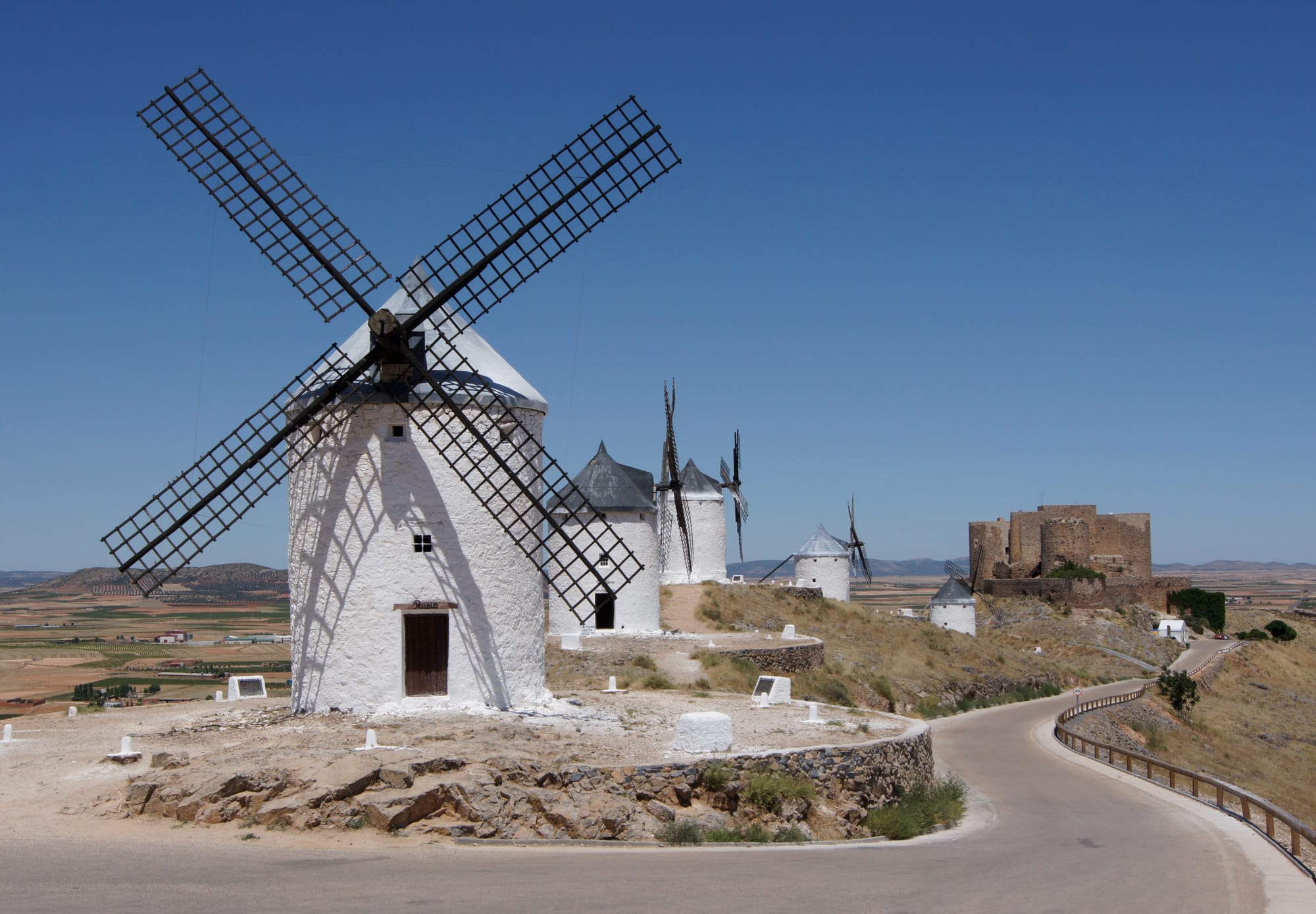
White windmills with black sails on a dry ridge above farmland, with a stone castle at the end of the ridge

Spain

Madrid & Castile-La Mancha

The windmills and castle on the ridge above Consuegra, in the province of Toledo. (Jebulon / Wikimedia Commons · Public domain)

The heart of the Spanish meseta — the capital, Madrid, and the high, open plains of Castile-La Mancha around it, a land of royal palaces, the old imperial city of Toledo, Cuenca on its gorges, and the windmills and vineyards of Don Quixote's La Mancha.

Explore Madrid & Castile-La Mancha

History

The central plateau was home to Celtiberian peoples such as the Carpetani before Rome took it; Toledo, as Toletum, was a Roman town, and Complutum, the Roman predecessor of Alcalá de Henares, lies just outside the modern city. After Rome fell, the Visigoths made Toledo their capital, and its church councils shaped Spanish Christianity. Muslim rule from the early 8th century left Toledo a rich frontier city of Muslims, Christians and Jews, and Madrid began as a small Muslim fortress, Mayrit, above the Manzanares river.

Alfonso VI of Castile took Toledo in 1085. The city became a seat of the Castilian court and a centre of learning, where scholars translated Arabic and Greek works into Latin and Castilian. The plains to the south, La Mancha, were a frontier held by military orders such as Calatrava and Santiago, whose castles still dot the landscape. In 1520–21 Toledo led the Comuneros revolt of Castilian cities against Charles V, which was crushed.

In 1561 Philip II fixed the court at Madrid, then a modest town, and built El Escorial nearby; Toledo slowly declined while Madrid grew into the capital of an empire. On 2 May 1808 Madrid rose against Napoleon's troops, an uprising Goya painted. In the Civil War Madrid held out against Franco's forces until 1939, and the siege of Toledo's Alcázar in 1936 became a Nationalist legend. Since the 1980s Madrid has been an autonomous community of its own and Castile-La Mancha another, governed from Toledo.

Culture & Customs

Madrid is a city of newcomers — from the provinces and, since the 1990s, from Latin America and beyond — and its identity is open rather than ethnic. The castizo tradition of old Madrid survives in the chulapo costumes, the chotis dance and the verbenas, or street fairs, of San Isidro in May and of the August festivals in La Latina and Lavapiés. Late nights are a point of pride, and the movida, the cultural burst of the years after Franco, still defines the city's image of itself.

Castile-La Mancha is more rural and more traditional. Its identity is bound up with Don Quixote: Cervantes set his novel of 1605 on these plains, and towns from El Toboso to Campo de Criptana claim episodes from it. Toledo's Corpus Christi procession, with the cathedral's great monstrance carried through streets hung with awnings, is its biggest feast, and Cuenca's Holy Week is known for the Turbas procession, when crowds accompany the Nazarene through the streets before dawn on Good Friday. Almagro, with its 17th-century open-air theatre, hosts a classical theatre festival each July.

Crafts include Toledo's damascene work — gold and silver thread inlaid in steel — and its swords, Talavera de la Reina's glazed ceramics, and lace and embroidery in the villages. Spanish here is standard Castilian, and the region is largely Catholic by tradition.

Daily Life

The Community of Madrid has about 7 million people, around 3.4 million of them in the city itself, with large suburbs such as Móstoles, Alcalá de Henares and Getafe. It is Spain's financial and administrative capital and its richest region by output, home to government ministries, bank and company headquarters, and a large university population. Housing costs are the dominant political issue.

Castile-La Mancha, far larger, has only about 2.1 million people. Albacete, with about 175,000, is the biggest town; Guadalajara, Toledo, Talavera de la Reina, Ciudad Real and Cuenca are smaller. Much of the region is part of "empty Spain", with ageing villages, and the northern provinces now serve partly as commuter territory for Madrid. The economy rests on farming — cereals, vines, olives, sheep and saffron — food processing, logistics along the motorways from Madrid, and tourism in Toledo and Cuenca.

Days run late, especially in Madrid: a coffee and toast mid-morning, lunch from about two, a walk or a drink in the evening and dinner rarely before nine. In La Mancha towns the rhythm is slower, the plaza is the centre of life, and summer evenings are spent outdoors once the heat breaks.

Food

Madrid's signature dish is cocido madrileño, a chickpea stew with meats, sausages and vegetables served in stages — broth with noodles first, then the rest. Callos a la madrileña, tripe stewed with chorizo, and the bocadillo de calamares, a bread roll filled with fried squid rings, are both Madrid classics, and churros or porras with thick hot chocolate are the traditional end to a late night. Rosquillas, small ring-shaped pastries, are eaten for San Isidro.

La Mancha cooking is shepherds' and farm food. Queso manchego, a hard sheep's-milk cheese with a protected designation, is its best-known product. Pisto manchego is a stew of tomatoes, peppers and courgette, often topped with an egg; migas are fried breadcrumbs with garlic and pork; gachas are a thick porridge of grass-pea flour; and duelos y quebrantos, eggs scrambled with chorizo and bacon, are mentioned in Don Quixote. Cuenca has morteruelo, a spiced game pâté, and alajú, an almond sweet, while Toledo is famous for its marzipan and for carcamusas, a pork and tomato stew. La Mancha saffron is among the most prized in the world.

Wine is the region's great harvest: La Mancha is one of the largest vineyard areas in the world, historically of white Airén, and Valdepeñas is known for its reds.

Attractions & Natural Wonders

Madrid's Paseo del Prado joins three great museums — the Prado, the Reina Sofía with Picasso's Guernica, and the Thyssen-Bornemisza — and runs beside the Retiro park, together listed as a UNESCO World Heritage Site. Nearby are the Royal Palace, the Plaza Mayor, Puerta del Sol and the Sunday Rastro market. Within an hour are El Escorial, Philip II's vast granite monastery-palace; Aranjuez, a royal palace set among gardens beside the Tagus; and Alcalá de Henares, Cervantes's birthplace, with its Renaissance university founded by Cardinal Cisneros. North of the city rises the Sierra de Guadarrama National Park.

Toledo, a UNESCO World Heritage Site on a rock almost encircled by the Tagus, holds the Gothic cathedral, the Alcázar, the synagogues of Santa María la Blanca and El Tránsito, the small mosque of Cristo de la Luz, and El Greco's Burial of the Count of Orgaz in the church of Santo Tomé.

Cuenca, also on the UNESCO list, sits on a ridge between two gorges, and its hanging houses lean out over the Huécar, crossed by the San Pablo footbridge; the Ciudad Encantada's weathered limestone lies nearby. In La Mancha proper, the windmills of Consuegra and Campo de Criptana line the ridges, Almagro keeps its Corral de Comedias, and the Tablas de Daimiel and Cabañeros national parks and the lakes of Ruidera protect wetlands and Mediterranean woodland.

Cities in Madrid & Castile-La Mancha

Planning basics

Budget

Madrid is one of Spain's two most expensive cities for hotels, though food and public transport remain reasonable by European capital standards, and several major museums have free evening hours. Castile-La Mancha is noticeably cheaper: rooms in Cuenca, Almagro or the La Mancha towns cost far less than in the capital, and a menú del día is good value everywhere. Toledo is the exception, with day-tripper prices in its old centre.

Daily Budget Midrange
USD 150–290 (mid-range hotel in Madrid, cheaper in Castile-La Mancha, restaurant dinners, museum tickets, a hire car for La Mancha)
Daily Budget Shoestring
USD 65–100 (hostel in Madrid or pension in the provinces, menú del día and tapas, metro and regional trains or buses)

Use the Prado's and the Reina Sofía's free evening entry, and stay in Toledo or Cuenca overnight to see them after the day-trippers leave.

Safety

The region is safe. Pickpocketing is the main problem in Madrid, especially on the metro, around Puerta del Sol, the Rastro flea market and Gran Vía, and in Toledo's crowded lanes. Summer heat on the La Mancha plain is a real hazard, and mountain weather in the Guadarrama can change quickly in winter.

Keep phones off terrace tables in Madrid, carry water and avoid walking in the midday heat in summer. Check current official travel advice before travelling.

Climate

Continental and dry. The whole region sits on the high central plateau, Madrid at about 650 metres and Cuenca near 1,000, so summers are hot and winters surprisingly cold. The La Mancha plain is one of the hottest parts of inland Spain in July and August, while the Sierra de Guadarrama north of Madrid and the Serranía de Cuenca are cooler and see snow in winter.

Summer
hot and dry, often 33–40°C in Madrid, Toledo and La Mancha; cooler in the Guadarrama and the Cuenca highlands
Winter
cold and mostly sunny, 0–12°C, with frosty nights; snow on the Guadarrama and occasionally in Cuenca

Transportation

Madrid is the hub of Spain's road, rail and air networks, with the main airport at Barajas and high-speed trains from Atocha and Chamartín. Toledo is about half an hour from Madrid by high-speed train, and Cuenca, Ciudad Real and Guadalajara are also on high-speed lines. Madrid's Cercanías suburban trains reach Alcalá de Henares, Aranjuez and El Escorial in under an hour. Buses cover the smaller towns, but a car is the practical way to see the windmills, Almagro and the lakes of La Mancha.

Take the train for Toledo, Cuenca and the royal sites; hire a car only for a La Mancha loop, and avoid driving into Madrid's centre, which has low-emission restrictions.

Best Time to Visit

April to June and late September to early November. Spring brings Madrid's San Isidro festival in mid-May, Corpus Christi in Toledo and green fields in La Mancha; autumn has the grape harvest around Valdepeñas and the saffron flower harvest in autumn. July and August are very hot and Madrid empties in August. Winter is cold but clear, good for museums, and Holy Week processions in Cuenca and Toledo are among Castile's most atmospheric.