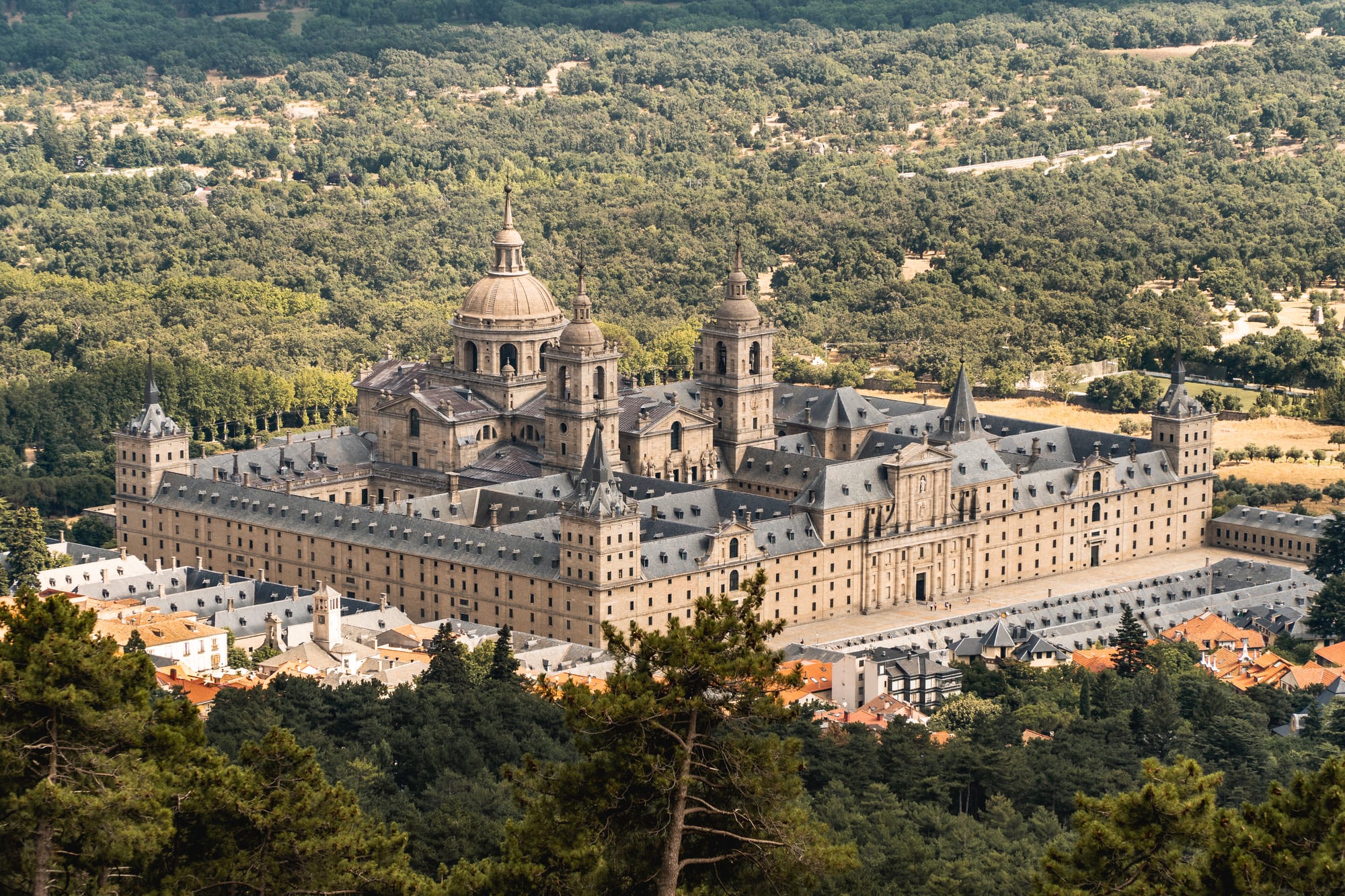
The vast grey-roofed granite monastery with a central dome and corner spires, seen from above among pine woods and town roofs

Madrid & Castile-La Mancha, Spain

San Lorenzo de El Escorial

The monastery of El Escorial and the town around it, seen from the slopes above San Lorenzo de El Escorial. (Zvonimir Stamenov / Wikimedia Commons · CC BY-SA 4.0)

A mountain town on the slopes of Mount Abantos in the Sierra de Guadarrama, north-west of Madrid, that grew up around Philip II's monastery-palace of El Escorial, built of grey granite between 1563 and 1584. The monastery, with its royal tombs and library, is a UNESCO World Heritage Site, and the town lives mainly from the visitors it draws.

Neighbourhoods

  • The historic centre
    • First-time visitors
    • Historic district
    • Close to the monastery

    The streets that grew up beside the monastery after Charles III allowed houses to be built there in 1767, including Calle de Floridablanca, one of the town's main streets. Shops, cafés and restaurants line the streets around the monastery's paved forecourt.

    Open in Maps
  • The slopes of Abantos
    • Quiet and residential
    • Walks

    Newer residential neighbourhoods climbing the south-eastern side of Mount Abantos, many built after a forest fire in 1999, with pine woods and mountain paths above them.

    Open in Maps
  • El Escorial de Abajo
    • Railway station
    • Local life

    The older village of El Escorial below the town, a separate municipality, where the railway station is; a local bus links it with San Lorenzo, and the Casita del Príncipe's gardens lie between the two.

    Open in Maps

Things to do

The royal site

  • Monastery of El Escoriallandmark

    Philip II's monastery, basilica, palace, pantheon and library, built of local grey granite in 1563–1584 and largely designed by Juan de Herrera; the Royal Pantheon holds most Spanish kings since Charles V.

    Open in Maps
  • Casita del Príncipelandmark

    An 18th-century neoclassical retreat designed by Juan de Villanueva for the future Charles IV, built without bedrooms, set in gardens whose trees include giant sequoias.

    Open in Maps
  • Casita del Infantelandmark

    A small late-18th-century residence built for Infante Gabriel, son of Charles III, as an informal hideaway above the town.

    Open in Maps
  • Real Coliseo de Carlos IIIattraction

    An 18th-century court theatre in the town, popularly known as La Bombonera, the chocolate box.

    Open in Maps

Mountains and woods

  • Mount Abantostrail

    The 1,753-metre peak of the Sierra de Guadarrama that rises behind the town, its pine forest protected since 1961.

    Open in Maps
  • Silla de Felipe IIviewpoint

    A granite seat in the La Herrería woods where, legend says, Philip II watched the monastery being built, though it is thought to have been a pre-Roman altar.

    Open in Maps
  • La Herreríapark

    A historic royal estate, once the meadow of the Fuentelámparas ironworks, with woods of oak, chestnut and ash, protected together with the Abantos pine forest.

    Open in Maps
  • Arboreto Luis Ceballospark

    An environmental education centre on the mountain with a collection of more than 200 species of trees and shrubs native to the Iberian Peninsula and the Balearic Islands.

    Open in Maps

Short trips from the town

  • Valley of Cuelgamuroslandmark

    The Civil War memorial and basilica built under Franco between 1940 and 1959, formerly called the Valley of the Fallen and officially renamed in 2022; Franco's remains were removed in 2019, and the site remains controversial.

    Open in Maps

Seasonal events

  • San Antón and San SebastiánJanuary

    The feasts of Saint Anthony on 17 January and Saint Sebastian on 20 January, the latter moved to the following weekend and shared with the village of El Escorial.

  • Fiestas de San Lorenzoaround 10 August

    The town's main festival, on the feast of Saint Lawrence, to whom Philip II dedicated the monastery after the Battle of Saint Quentin, fought on 10 August 1557.

Eat and drink

Long-standing places and food districts in San Lorenzo de El Escorial. Hours, ratings and directions come from your maps app, always current.

Food in the town

  • Around the monasteryneighborhood

    Restaurants and cafés with terraces face the monastery and its forecourt.

    Open in Maps
  • Calle de Floridablancaneighborhood

    One of the main streets of the old town, with bars and restaurants among its shops.

    Open in Maps

Experience San Lorenzo de El Escorial

History

The town exists because of the monastery. In 1558 Philip II appointed a commission of architects, doctors and quarrymen to find a site for a great royal foundation, and in 1561 they chose the hamlet of El Escorial at the foot of Mount Abantos for its forests, quarries, game, good water and position near the centre of Spain. The first stone was laid on 23 April 1563. Juan Bautista de Toledo designed the plan; after his death in 1567 his apprentice Juan de Herrera took over and finished the building in 1584, in a little under 21 years. Philip dedicated it to Saint Lawrence in thanks for the victory at Saint Quentin on 10 August 1557.

Around it Philip created a royal estate for farming, hunting and recreation, and in 1585–86 papal bulls removed the monastery from the authority of the Archbishop of Toledo. Building houses near the monastery was forbidden until 3 May 1767, when Charles III allowed homes beside its market; within a few years the new settlement had more than a thousand people. In the 18th century the two casitas and a court theatre were added, and on 26 September 1836 San Lorenzo became a municipality separate from the older village below.

In the Civil War the town stayed loyal to the Republic and briefly called itself El Escorial de la Sierra. Between 1940 and 1959 the Franco regime built its great memorial in the valley of Cuelgamuros, on the edge of the municipality. In 1984 UNESCO listed the monastery and its site as a World Heritage Site, and in recent decades new neighbourhoods have spread up the slopes of Abantos.

Culture & Customs

El Escorial is the clearest expression in stone of Philip II's Spain: built of grey local granite, square and sparsely ornamented, it looks more like a fortress than a palace. It is at once monastery, basilica, royal palace, pantheon, library and school. The Royal Pantheon beneath the basilica holds the tombs of most Spanish kings from Charles V onwards, and the Royal Library, its ceiling painted with frescoes, is among the monastery's most remarkable rooms. Herrera's plain, geometric design gave its name to the Herrerian style.

The town's culture has grown around the monastery and the court. The 18th-century Real Coliseo, a theatre known as La Bombonera, stands in the town, which has a professional music conservatory and a university centre, the Real Centro Universitario Escorial-María Cristina, where the Complutense University holds its summer courses.

Local tradition centres on the religious calendar. The town's feast falls on 10 August, the day of Saint Lawrence, and the romería, or pilgrimage, of Our Lady of Grace is described as its most important tradition. In January the feasts of San Antón and San Sebastián are shared with the neighbouring village of El Escorial. The Valley of Cuelgamuros, where Franco lay buried until 2019, remains a subject of political debate across Spain.

Daily Life

About 18,900 people lived in the municipality in 2025, on an area of about 56 square kilometres, much of it protected forest. The town has grown strongly in the 20th and 21st centuries, spreading from the streets around the monastery up the mountainside.

Tourism, hospitality and trade are the main economic activities. Most visitors come on day trips from Madrid, and the town has worked to draw longer stays through hotels, trade fairs, conferences and courses. The memorial at Cuelgamuros, on the outskirts, draws hundreds of thousands of visitors a year.

Daily life has a mountain-town rhythm: cooler summers than the city below, cold winters, and walks in the woods of La Herrería and on Abantos. Building has spread over the parts of the municipality without legal protection, especially on the south-eastern slope of the mountain after a fire in August 1999 burned about 1.8 square kilometres of pine forest.

Food

San Lorenzo's restaurants serve the cooking of the Madrid region and Castile. The cocido madrileño, a chickpea-based stew with meats and vegetables, is the classic dish of the region, and callos a la madrileña, usually made with cattle tripe, is a traditional winter speciality. The cocido is most popular in winter and is served in stages, beginning with its broth, to which noodles are added. Most of the people eating in the town are visitors on day trips from Madrid, the usual way the town is seen.

Most restaurants and cafés are in the historic centre, many of them on the streets facing the monastery and its broad forecourt, and a fixed-price menú del día is the usual lunch. Calle de Floridablanca, one of the main streets of the old town, has bars and restaurants among its shops.

As everywhere in Spain, meals run late: lunch is the main meal of the day. In summer the cooler mountain air makes outdoor dining more pleasant than in the capital.

Planning tools

Budget

Most visitors come for the day from Madrid, so costs are mainly the train or bus and the monastery ticket. Staying overnight is cheaper than in Madrid, and meals near the monastery cost more than those a few streets away.

Daily Budget Midrange
USD 130–240 (a night in town, restaurant dinners, entry to the monastery and the casitas)
Daily Budget Shoestring
USD 55–90 (train or bus from Madrid, monastery entry, a menú del día)

Come on a weekday to avoid the weekend crowds from Madrid, and leave time for a walk in La Herrería or up Abantos.

Best Time to Visit

Late spring to early autumn, when the mountain air is cooler than Madrid's and the woods are good for walking; the town festival is in August. Winters are cold, with frosty nights, but the monastery is quiet then.

Suggested Number of Days

A day is enough for the monastery and a short walk around the town. Two days allow the cottages, the mountain paths and the memorial in the next valley at an easier pace.

First Visit
1 day
With Surroundings
2 days

Transportation

The town is small enough to cover on foot. Local buses link it with the railway station in El Escorial, the village below, and fourteen bus lines in all serve the town and surrounding area. A car is needed for the memorial at Cuelgamuros, which is reached by a long park road through pine forest.

The walk up from the station is steep; take the local bus up and walk down.

Airport & Station Connections

Cercanías suburban trains run from Madrid's Chamartín and Atocha stations to El Escorial station in about an hour, with a local bus up to the town. Interurban buses run from the Moncloa bus station in Madrid. The nearest airport is Madrid–Barajas, on the far side of the capital.

Walkability

The centre is compact and walkable, with the monastery, the main streets and the shops all close together, but the town lies on a slope and some streets are steep. Paths lead from the edge of town into La Herrería and up Mount Abantos.

Safety

Spain is a safe country with low violent crime. The significant risk is pickpocketing and bag-snatching, which is persistent in tourist areas of Barcelona, Madrid, and Seville, on the metro, and at crowded sights. Summer heat and, increasingly, wildfires are seasonal hazards. San Lorenzo is a quiet town; the mountain is the place for care, where weather can change quickly and forest fires are a summer risk.

Carry water and warm layers on Abantos, check the weather before mountain walks, and respect fire restrictions in summer. Check current official travel advice before travelling.

Climate

At about 1,000 metres on the slopes of the Guadarrama, the town is cooler than Madrid, with a mean annual temperature a little under 13°C, a dry summer from late June to early September and cold winters.

Summer
warm and dry — July and August average about 24°C, with very little rain
Winter
cold — December and January average about 5°C, with nights around freezing

Local Customs

The monastery is a basilica and monastery as well as a museum, and visitors are expected to behave accordingly. Lunch is the main meal of the day, as everywhere in Spain. Tipping is neither mandatory nor considered customary in Spain.

Dress modestly for the basilica and keep voices down in the Royal Pantheon.

Common Payment Methods

The currency is the euro. Credit and debit cards are widely accepted, though shops may ask for photo ID.