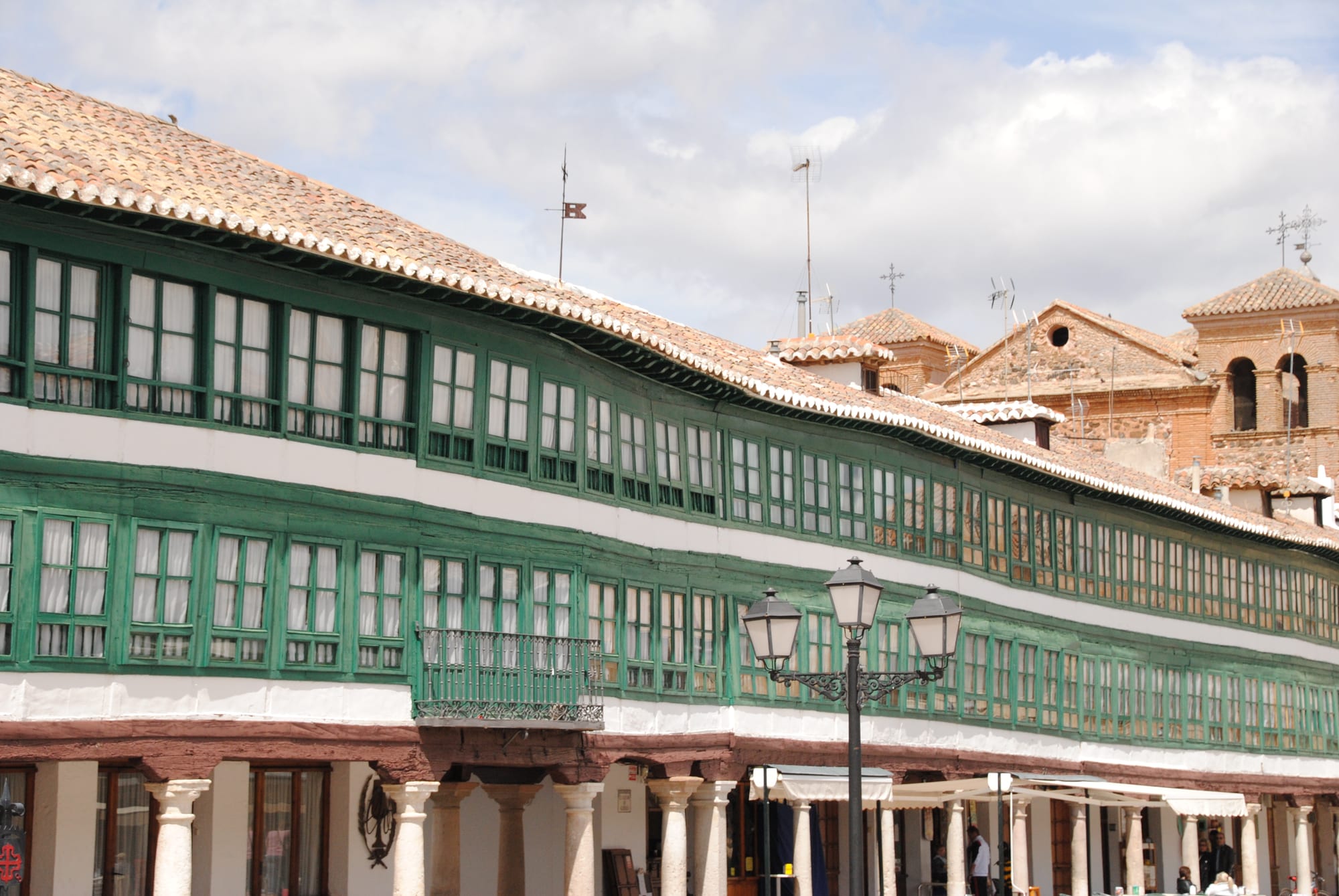
Two-storey green-framed glazed galleries over a white stone colonnade, with tiled roofs and a brick church tower behind

Madrid & Castile-La Mancha, Spain

Almagro

The glazed galleries of the Plaza Mayor in Almagro. (diego_cue / Wikimedia Commons · CC BY-SA 3.0)

A small town in the province of Ciudad Real, once the seat of the military Order of Calatrava and a base for the German banking family of the Fuggers. Its galleried Plaza Mayor, with green-painted woodwork, holds the best-preserved 17th-century open-air playhouse in Spain, and every July the town hosts an international festival of classical theatre.

Neighbourhoods

  • Plaza Mayor
    • First-time visitors
    • Historic district
    • Cafés

    The long, irregular square at the heart of the town, with stone columns below two storeys of green-framed glazed galleries along its long sides, the town hall at one end and the Corral de Comedias behind a doorway on the square. Terraces spill out under the arcades.

    Open in Maps
  • The historic centre
    • Architecture
    • Quiet and residential
    • Museums

    The lanes around the square, protected as a conjunto histórico, are lined with whitewashed houses and the carved stone doorways of noble mansions, including those of the Fuggers' German agents on Calle de las Nieves, along with convents, churches and the town's museums.

    Open in Maps
  • Around the station
    • Close to public transport
    • Local life

    The newer, everyday side of the town towards the railway station and the Paseo de la Estación, with shops, homes and services for residents, a short walk from the old centre.

    Open in Maps

Things to do

Theatre and the square

  • Corral de Comediaslandmark

    The best-preserved courtyard theatre of 17th-century Spain, rediscovered during work on the square in 1953 and reopened in 1954 with a play by Calderón de la Barca; it still stages performances.

    Open in Maps
  • Plaza Mayorlandmark

    The square took its present form under the influence of the Fuggers, with its distinctive galleries along two sides; it holds the town hall and the Corral de Comedias.

    Open in Maps
  • National Museum of Performing Artsmuseum

    One of Spain's national museums, called the National Museum of Theatre until 2024, when it was renamed to cover all the performing arts, with set designs and models, costumes, puppets, photographs and programmes.

    Open in Maps

Museums and the old town

  • Museo Etnográfico Campo de Calatravamuseum

    A folk museum in a restored 18th-century house near the Plaza Mayor, where around 40 trades once practised in the Campo de Calatrava are represented.

    Open in Maps
  • Museo del Encajemuseum

    The lace museum, opened in 2004, with lace and blonde lace made in the town and the surrounding district.

    Open in Maps
  • Iglesia de la Madre de Dioslandmark

    A parish church built during the town's growth in the 16th and 17th centuries, where the image of the town's patroness, the Virgen de las Nieves, is venerated at the high altar for part of the year.

    Open in Maps
  • Calle de las Nievesneighborhood

    A street of noble houses whose carved doorways include those of the Wessel and Xedler families, agents of the Fuggers.

    Open in Maps

Short trips from the town

  • Calatrava la Nuevalandmark

    The hilltop castle and convent to which the Order of Calatrava moved in 1217, near Almagro in the municipality of Aldea del Rey.

    Open in Maps
  • Campo de Calatrava volcanic fieldpark

    A field of more than 300 volcanic cones, lava domes and maars across the centre of the province, one of the few volcanic areas of inland Iberia.

    Open in Maps
  • Ciudad Realattraction

    The provincial capital, founded as Villa Real in 1255 as a royal town in the middle of the Order of Calatrava's lands, with high-speed trains to Madrid.

    Open in Maps
  • Tablas de Daimiel National Parkpark

    A wetland on the arid La Mancha plain, the smallest of Spain's national parks and a Ramsar site.

    Open in Maps

Seasonal events

  • International Festival of Classical TheatreJuly

    Held every year since 1978, with plays staged in the Corral de Comedias and in theatres, churches, courtyards and squares across the town.

  • Ferias de San Bartolomélate August

    The town's fair in honour of Saint Bartholomew.

Eat and drink

Long-standing places and food districts in Almagro. Hours, ratings and directions come from your maps app, always current.

Almagro classics

  • Terraces on the Plaza Mayorcafe

    Bars and cafés under the arcades of the square, the natural place for a drink and a plate of the town's dressed aubergines.

    Open in Maps
  • Restaurants in the old townneighborhood

    Mesones and tapas bars in the streets around the square serving the dishes of the Campo de Calatrava — pisto manchego, gachas and asadillo.

    Open in Maps

Experience Almagro

History

It is not known when people first settled here; finds in the Casas Maestrales and outside the centre point to a possible Bronze Age settlement, and Roman coins and a headstone have been found. The name comes from the Arabic al-magra, red clay, the local clay that is one of the materials of the Plaza Mayor. Almagro's rise came in the 13th century, when the military Order of Calatrava chose it as a residence and made it the centre of its government; tradition holds that a master of the order gave the town its charter in 1213. Alfonso X held the Castilian Cortes here in 1273, and in 1374 Henry II granted the town two fairs, which helped its trade.

In the 16th century the financial troubles of Charles V made the German Fugger bankers beneficiaries of the mines of Almadén, and their German administrators settled in Almagro; the Plaza Mayor took its galleried form under their influence, and some of their mansions survive. The population roughly doubled during the 16th century, new districts grew beyond the walls, and convents, churches and noble houses multiplied. In the 18th century the Conde de Valdeparaíso, a native of the town and finance minister, encouraged the textile trade, especially lace, and Almagro was the provincial capital of La Mancha from 1750 to 1761.

The 19th century brought decline, competition from Ciudad Real, the sale of church lands and the demolition of the walls in 1886, though the railway arrived in 1860. Revival came with the rediscovery of the Corral de Comedias in the 1950s, the restoration of the square, recognition as a historic-artistic zone in 1972 and the first classical theatre festival in 1978.

Culture & Customs

Almagro is Spain's theatre town. The Corral de Comedias, the only 17th-century playhouse of its kind to survive intact, was found during building work in 1953, reopened in 1954 with a play by Calderón de la Barca and declared a national monument in 1955. The International Festival of Classical Theatre has been held every year since 1978, now in July, using the Corral, theatres, churches, courtyards and squares, and the National Museum of Performing Arts, called the National Museum of Theatre until 2024, has its home in the town.

Lace is the other great tradition. Encaje de bolillos, or bobbin lace, and blonde lace were organised as an industry in the 18th century and became a mark of the town's identity; the encajeras who make it still work, and the lace museum keeps collections made in Almagro and the surrounding district.

The town's festivals mix the religious and the civic: the patroness, the Virgen de las Nieves, is venerated in the church of the Madre de Dios, and the fair in honour of Saint Bartholomew fills late August. The bullring of 1845 gave Spanish an expression — to end up "like Cagancho in Almagro" means to fail very publicly, after a bullfighter's disastrous afternoon there.

Daily Life

About 9,200 people lived in the municipality in 2025, according to the INE. The town lies on the plain of the Campo de Calatrava, a district of low hills and old volcanoes in the centre of Ciudad Real province, close to the provincial capital.

Most economic activity now turns on hospitality and tourism, built around the theatre festival, alongside farming — cereals, vines, olives and cotton — livestock, woodworking and construction. Basalt quarries and mines of manganese and plaster add to the local economy, the town's dressed aubergines are a well-known product, and lace-making survives as a traditional craft. In the 19th century Almagro faced competition from its neighbours Ciudad Real and Bolaños de Calatrava.

Life follows the rhythm of a Spanish country town: quiet midday hours in the heat, evenings out on the Plaza Mayor and the surrounding streets. July changes everything, when actors, companies and audiences arrive for the festival and the square stays busy late into the night.

Food

The town's most famous product is the berenjena de Almagro, a small aubergine pickled in a special traditional dressing, a way of preserving it that may go back to the cooking of al-Andalus; since 1994 it has been a protected geographical indication. It is usually eaten as a snack alongside other tapas such as banderillas, and green beans are sometimes prepared with the same dressing.

Other dishes of the district are those of La Mancha: duelos y quebrantos, gachas, asadillo manchego, tiznao and somallao, and pisto manchego, a warm dish of tomatoes, onions, courgettes or aubergine, peppers and olive oil, often served with a fried egg. Manchego, the firm cheese made from the milk of the Manchega breed of sheep, is protected by a designation of origin and has Protected Designation of Origin status in the European Union; it is aged between 60 days and two years.

The surrounding plain is wine country, with vines grown around the town, and the bars and terraces of the Plaza Mayor are the place to try local wine with a dish of aubergines.

Planning tools

Budget

Almagro is far cheaper than Madrid or Toledo, and a menú del día is good value. Prices for rooms rise sharply during the theatre festival in July, when the town fills up. Museum and theatre tickets are the other main costs, and a car helps for the castles and wetlands nearby.

Daily Budget Midrange
USD 120–220 (small hotel, restaurant meals, museum and theatre tickets, a hire car)
Daily Budget Shoestring
USD 60–95 (guesthouse, tapas and menú del día, regional trains and buses)

For the July festival, book accommodation and performances early; outside July the town is quiet and rooms are easy to find.

Best Time to Visit

Spring and autumn are the most comfortable. July brings the theatre festival and the town's busiest weeks, but also the heat of the La Mancha plain; late August has the town fair. Winters are cool to cold, quiet, and good for the museums.

Suggested Number of Days

The old town is small, and a single day or an overnight stay covers it. Allow two or three days, with a car, to add the surrounding castles, volcanic landscapes and wetlands, or to see several festival performances in July.

First Visit
1 day
With Surroundings
2–3 days

Transportation

Almagro has a railway station on a regional line, and buses link it with Ciudad Real, which has high-speed trains to Madrid. Within the town everything is walkable. A car is the practical way to reach the surrounding countryside, where public transport is sparse.

Trains to Almagro are less frequent than those to Ciudad Real, so many visitors take the high-speed train to Ciudad Real and continue by bus, taxi or hire car.

Airport & Station Connections

The usual route is by high-speed train from Madrid to Ciudad Real, then by bus or car. Madrid–Barajas is the practical airport; Ciudad Real's own airport has no scheduled passenger flights. Almagro also has its own station on a slower regional line.

Walkability

Very walkable: the old town is compact and flat, with the Plaza Mayor at its centre and most museums and churches a few minutes away. Shade is scarce on summer afternoons, and the cobbles can be uneven.

Safety

Spain is a safe country with low violent crime. Almagro is a quiet small town where crime against visitors is rare. The main hazard is the summer heat on the La Mancha plain.

Carry water and avoid walking in the midday heat in July and August. Check current official travel advice before travelling.

Climate

A cold semi-arid climate, with cool, sometimes cold winters and very hot summers. Rain is low and irregular, and summer is usually the driest season. The town has one of the widest annual temperature ranges in the Iberian Peninsula.

Summer
very hot and dry — temperatures above 40°C are not uncommon
Winter
cool to cold — it is not uncommon to record temperatures below −5°C

Local Customs

Daily life keeps the Spanish timetable of a late lunch and a late dinner, and during the July festival the town lives by the theatre, with evening performances and crowded terraces afterwards. Lace-making is a long-standing local craft and a point of pride.

Dress modestly in churches and convents and avoid visiting during services; keep phones silent during performances in the Corral de Comedias.

Common Payment Methods

The currency is the euro. Cards are widely accepted in restaurants, shops and museums, but a little cash is useful for small bars and market purchases.