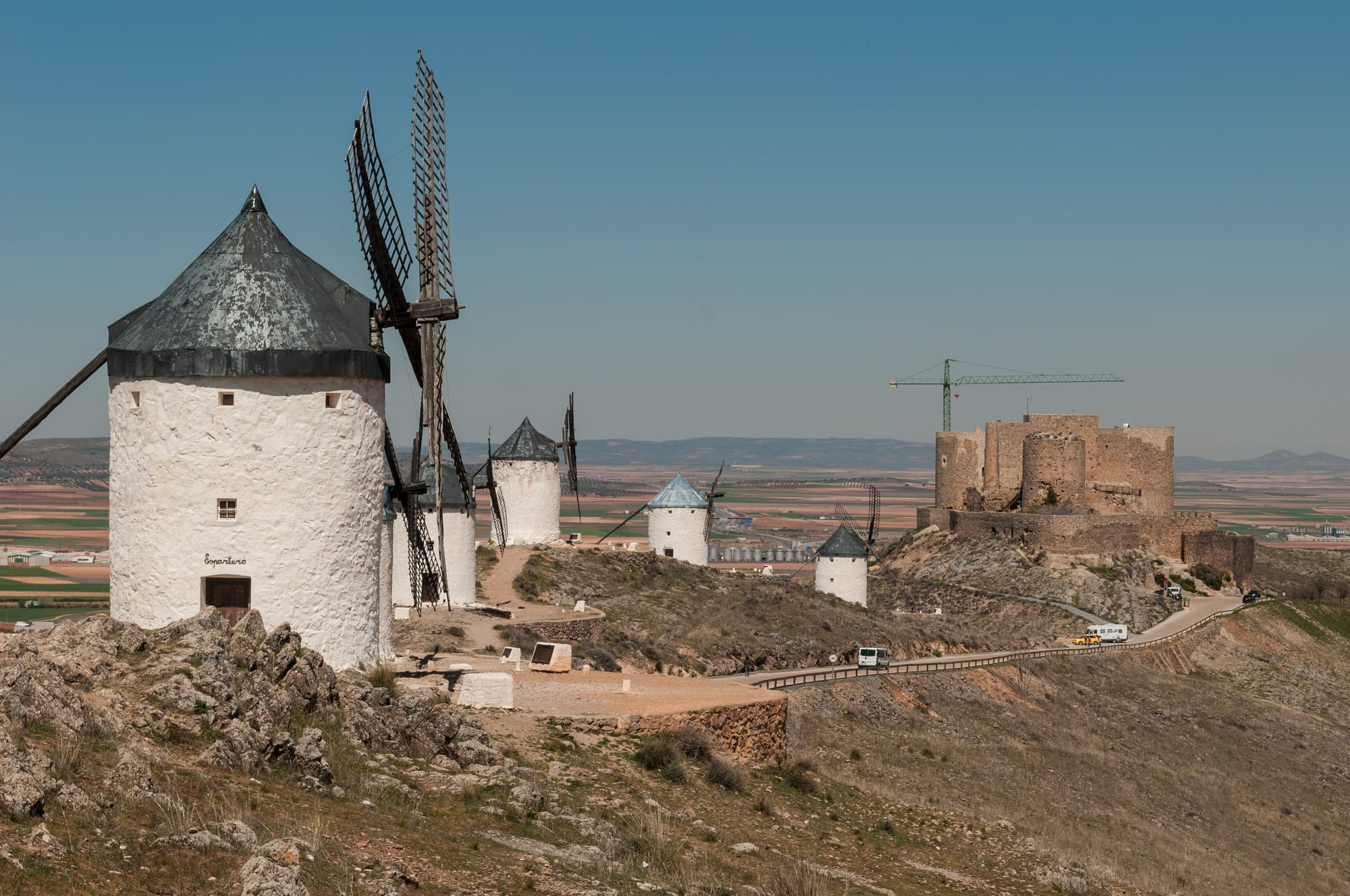
White windmills with dark conical caps along a rocky ridge, with a stone castle and the flat La Mancha plain beyond

Madrid & Castile-La Mancha, Spain

Consuegra

Windmills and the Castle of La Muela on the Cerro Calderico above Consuegra. (Michal Osmenda from Brussels, Belgium / Wikimedia Commons · CC BY 2.0)

A La Mancha town in the province of Toledo, below a ridge where a restored line of whitewashed windmills stands beside the Castle of La Muela. Founded as the Roman town of Consabura and later held by the Knights Hospitaller, it is now a farming town of under 10,000 people that celebrates the saffron harvest every October.

Neighbourhoods

  • Plaza de España and the town centre
    • First-time visitors
    • Historic district
    • Cafés

    The main square has been the heart of the town since Roman times, when it was the forum. On it stand the Renaissance town hall, built in 1670 as a public granary, with its clock tower, and the 17th-century Corredores building with its long wooden balcony, now home to the municipal museum. Bars and cafés open onto the square.

    Open in Maps
  • The Cerro Calderico
    • Viewpoints
    • Windmills

    The ridge south of the town, rising about 100 metres above the river, carries the castle, a stretch of the old town wall and the line of windmills. It is reached on foot by steep steps or by a road that has carried a toll for visiting vehicles since 2022.

    Open in Maps
  • Along the Amarguillo
    • Quiet and residential
    • Close to the bus station

    The seasonal river that runs through the town, whose flood of 1891 devastated Consuegra. The bus station, with a tourist office, stands beside it, near the park that hosts the town festival in September.

    Open in Maps

Things to do

The ridge

  • Castle of La Muelalandmark

    The castle on the Cerro Calderico, a medieval stronghold of the Knights Hospitaller, destroyed in 1813 during the Peninsular War and restored by the town since it took ownership in 1962.

    Open in Maps
  • The windmills of Consuegralandmark

    Twelve rebuilt windmills along the ridge, each with its own name — Bolero, Sancho, Rucio, Mambrino and others; they ground wheat until the early 1980s, and some still keep their machinery.

    Open in Maps

In the town

  • Plaza de Españalandmark

    The main square, with the town hall of 1670, its clock tower and the Corredores building, which holds the municipal museum.

    Open in Maps
  • Consuegra Damlandmark

    A ruined Roman buttress dam of the 3rd or 4th century AD on the Amarguillo upstream from the town, less than 5 metres high but more than 600 metres long.

    Open in Maps

Short trips from the town

  • Toledoattraction

    The former Visigothic capital in a bend of the Tagus, with its Gothic cathedral and a long history of making bladed weapons.

    Open in Maps
  • Campo de Criptanaattraction

    Another La Mancha town whose windmills on the Sierra de los Molinos are its signature view, long tied to the windmill chapter of Don Quixote.

    Open in Maps
  • Tablas de Daimiel National Parkpark

    A wetland on the arid La Mancha plain, the smallest of Spain's national parks and a Ramsar site.

    Open in Maps

Seasonal events

  • San AntónJanuary

    The feast of San Antón on 17 January, when animals are blessed.

  • Consuegra Medievalmid-August

    One of the town's best-known celebrations, a medieval day staged around the castle and the town.

  • Town festivallate September

    The town's own fiestas, held in the park beside the Amarguillo.

  • Fiesta de la Rosa del Azafránlast weekend of October

    The saffron festival held since 1963, with wheat ground in the Sancho windmill, the choice of a 'Dulcinea' and a cooking contest.

Eat and drink

Long-standing places and food districts in Consuegra. Hours, ratings and directions come from your maps app, always current.

Consuegra classics

  • Cafés on Plaza de Españacafe

    Bars and cafés with terraces on the main square, including one in the Corredores building, for coffee, tapas and a drink.

    Open in Maps
  • Restaurants in the town centreneighborhood

    Tapas bars and mesones serving migas, pisto, carcamusas and game, among the streets between the square and the foot of the ridge.

    Open in Maps
  • Saffron and marzipan shopsneighborhood

    Local shops sell La Mancha saffron, the town's pride, and marzipan, one of the main industries of the Toledo area.

    Open in Maps

Experience Consuegra

History

People have lived here since at least the 6th century BC, when the Carpetani built a hilltop settlement on the Cerro Calderico, the ridge above the modern town. After the Roman conquest the population moved down to the plain between the hill and the Amarguillo river, and the town, Consabura, became a municipium under the Flavian emperors. It was a key point on the roads to the north and south, and the Romans built bridges, a circus and a long dam upstream on the Amarguillo, whose remains survive. The town's name, which in Spanish means the relationship between two mothers-in-law, in fact grew out of Consabura.

Under Muslim rule much of the old population stayed, and a fortress was built on the ridge, traditionally credited to Almanzor. Castile took the area after the fall of Toledo in 1085, but in 1097 the Almoravids under Yusuf ibn Tashfin defeated a Castilian army at the Battle of Consuegra, where Diego, the son of El Cid, was killed. In 1183 the town and its lands were given to the Knights Hospitaller, who made the castle the centre of their Campo de San Juan. Juan José of Austria, son of Philip IV, later lived there.

French troops garrisoned the castle during the Peninsular War, it was destroyed in 1813, and the order's properties were expropriated in the 19th century. On 11 September 1891 the Amarguillo flooded and killed 359 people. Consuegra was declared a city in 1927. In 1976 it was the only municipality in Spain to report a majority "no" in the political reform referendum; residents alleged fraud, and the result was annulled. The castle passed to the town in 1962, and its restoration gained new impetus from 1985, while the windmills, which stopped working in the early 1980s, were rebuilt as the town's emblem.

Culture & Customs

Consuegra's image belongs to Don Quixote. The windmills became famous after Cervantes's novel appeared in the 17th century, with its scene of the knight charging at them, and the town has leaned into the connection: the twelve rebuilt mills carry names such as Sancho, Rucio, Mambrino and Caballero del Verde Gabán, taken mostly from the book, and the saffron festival crowns a "Dulcinea". The mills were introduced by the Hospitallers to grind wheat and were handed down from fathers to sons until they fell idle.

The Fiesta de la Rosa del Azafrán, held on the last weekend of October since 1963, celebrates the saffron harvest of this part of La Mancha with grain milled in the Sancho windmill and a cooking competition. Consuegra Medieval in August, Holy Week, the feast of San Antón in January, when animals are blessed, and the town's own fiestas from 20 to 25 September fill the rest of the calendar.

Crafts are a local tradition, with workshops making carved doors and furniture and stone workshops using local materials. The town also keeps friendly ties with the Order of Malta, the successor of the Hospitallers, more than a century and a half after the order lost its properties here.

Daily Life

About 9,800 people lived in the municipality in 2025, according to the INE, down from a peak of just over 11,000 in 2011. The town sits at about 700 metres on the edge of the La Mancha plain, near the eastern fringes of the Montes de Toledo.

Agriculture is the main sector of the economy, in a landscape of dry plains and vineyards, with textile and wood industries alongside. Tourism has become a new source of income this century, built on the ridge, the castle and the saffron festival, and much of it arrives in day trips. Consuegra has no railway and limited bus services, so most households rely on the car, and the CM-42 road gives quick access to Toledo.

Life centres on Plaza de España, its bars and its terraces, and on the streets between the river and the ridge. The rhythm is that of a Spanish country town: quiet during the heat of a summer afternoon, busy in the evening, and packed for the festivals.

Food

Consuegra eats the food of La Mancha and of Toledo province. Migas, first made by shepherds from stale bread and other ingredients, are the best-known dish, and gachas are made from flour with chorizo. Pisto manchego is a warm dish of tomatoes, onions, courgettes or aubergine, peppers and olive oil, often served with a fried egg or cured ham. Carcamusas, pork in a tomato sauce, game such as partridge, and huevos rotos, eggs fried in plenty of oil over chips with ham or chorizo, are common in local bars. Duelos y quebrantos, eggs with chorizo and bacon, is a dish mentioned in the opening paragraphs of Don Quixote.

Manchego, the firm sheep's-milk cheese of La Mancha made from the milk of the Manchega breed and protected by a designation of origin, is made in and around the town. Saffron is the local pride, and marzipan, one of the main industries of the Toledo area, is made here too, above all for Christmas.

The surrounding vineyards belong to the La Mancha wine designation, the largest continuous vine-growing area in the world, and the town has its own wineries.

Planning tools

Budget

Consuegra is cheaper than Madrid or Toledo, and a menú del día is good value. The main costs are a bed for the night, the castle ticket, which also covers the municipal museum, and a car for exploring the rest of La Mancha.

Daily Budget Midrange
USD 120–220 (rural hotel, restaurant meals, castle and windmill visits, a hire car)
Daily Budget Shoestring
USD 60–95 (guesthouse or rural flat, tapas and menú del día, regional buses)

Visitors who drive up the Calderico road pay a toll that can be redeemed for local goods in participating shops; spending more than that in town makes the road free.

Best Time to Visit

Spring and autumn. Late October brings the saffron festival, when the ridge and the square are at their busiest, and the plain is green in spring. High summer on the La Mancha plain is very hot and dry, and winter days can be cold.

Suggested Number of Days

Most visitors come for a day. An overnight stay gives the ridge at sunset and sunrise without the coach parties, and two or three days with a car allow other La Mancha towns and the wetlands as well.

First Visit
1 day
With Surroundings
2–3 days

Transportation

The town itself is small enough to walk. Consuegra has no railway; buses run from Toledo and from Madrid's Méndez Álvaro (Madrid Sur) station, and the bus station is beside the Amarguillo. A car is the practical way to combine Consuegra with other La Mancha towns, and the CM-42 road passes the town on its way between Toledo and Albacete.

Bus services are thin, with some routes running once a day on weekdays, so check the timetable before relying on them for a return trip.

Airport & Station Connections

Madrid–Barajas is the practical airport; from Madrid, buses leave from Méndez Álvaro (Madrid Sur). Toledo, about 60 kilometres away, has its own bus link and a high-speed train to Madrid. The nearest railway stations are in neighbouring towns such as Tembleque and Villacañas, and Alcázar de San Juan, with trains to Madrid and to eastern and southern Spain, has a weekday bus to Consuegra.

Walkability

The centre is compact and flat around Plaza de España. Reaching the windmills and castle means a steep climb by stepped street or a gentler road up the Cerro Calderico, with no shade on top. The ridge is exposed to wind and to the summer sun.

Safety

Spain is a safe country with low violent crime. Consuegra is a quiet rural town. The real hazards are the summer heat on the open ridge and, for walkers in the nearby hills, rough paths, private land and the winter hunting season.

Carry water and a hat on the Calderico in summer, keep to marked paths in the hills, and use 112 in an emergency. Check current official travel advice before travelling.

Climate

Dry, with less than 400 mm of rain a year and a summer drought typical of a Mediterranean climate. Toledo, about 55 kilometres away, has a cold semi-arid climate, with cool winters and hot, dry summers.

Summer
hot and dry — in Toledo the highest temperature on record is 44.2°C, reached in August 2021
Winter
cool to cold, with frost — Toledo has recorded −13.4°C, in January 2021

Local Customs

Daily life follows the Spanish rhythm of a late lunch and a later dinner, with the main square busiest in the evening. The town takes pride in its windmills, its saffron and its Don Quixote associations, and the Knights Hospitaller, who held the castle for centuries, are still remembered with friendly ties.

Dress modestly inside the churches and avoid visiting during services; ask before photographing people at festivals and religious processions.

Common Payment Methods

The currency is the euro. Cards are widely accepted in restaurants and shops, but a little cash is useful for small bars, souvenir stalls on the ridge and festival days.