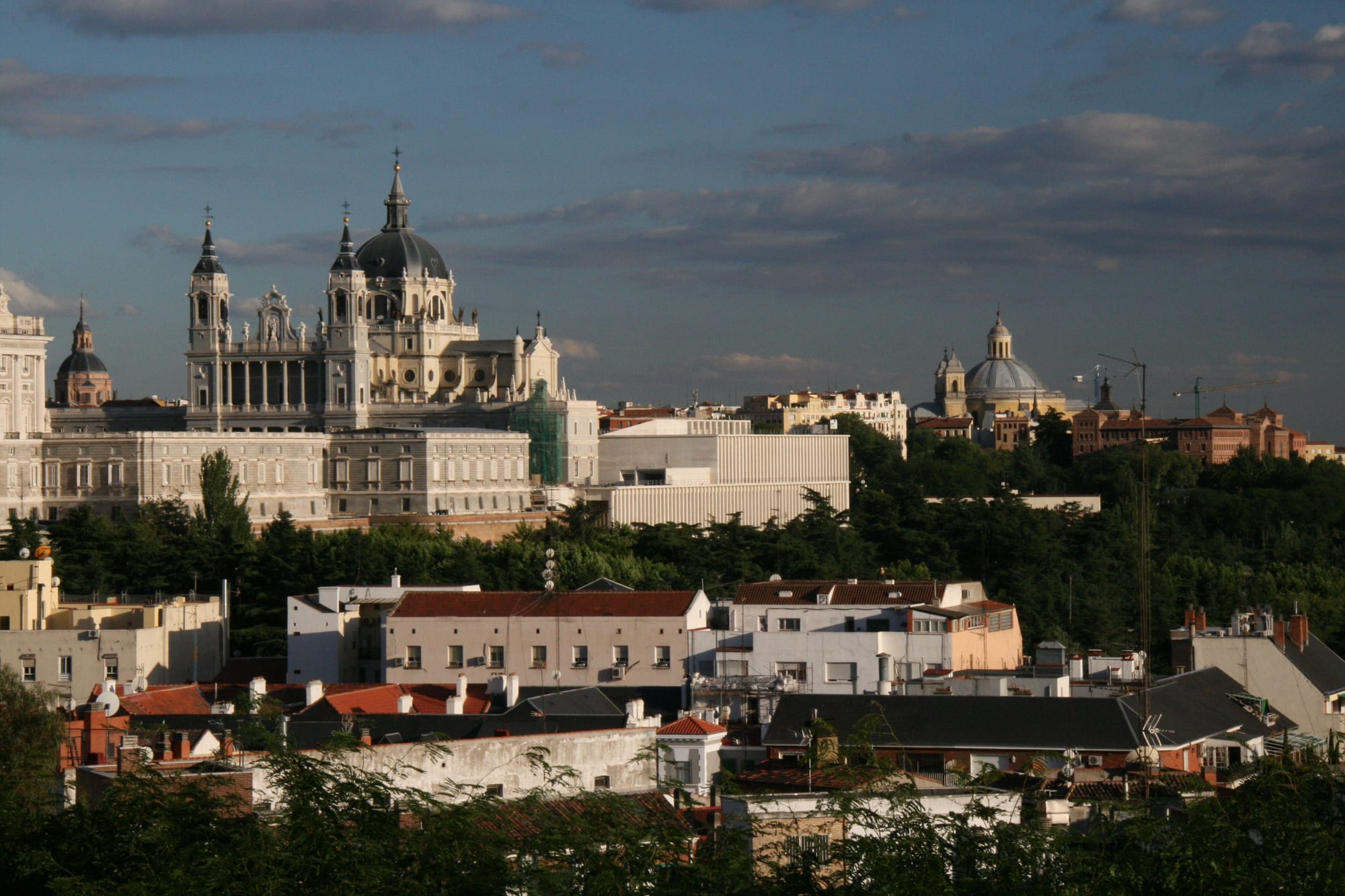
The domed Almudena Cathedral and the long white Royal Palace above trees and rooftops in evening light

Madrid & Castile-La Mancha, Spain

Madrid

The Almudena Cathedral and the Royal Palace seen from the Temple of Debod, Madrid. (Tamorlan / Wikimedia Commons · CC BY 3.0)

Spain's capital and largest city, on the Manzanares river in the middle of the central plateau. A 9th-century Muslim fortress, it became the permanent seat of the royal court in 1561 and grew into the capital of an empire. Today it is a city of more than 3.4 million, known for the Prado and its neighbours, the Retiro park, football and very late nights.

Neighbourhoods

  • Sol and the Austrias
    • First-time visitors
    • Historic district
    • Close to public transport

    The old core between Puerta del Sol, the Plaza Mayor and the Royal Palace, known as the Madrid of the Austrias after the Habsburg kings. Narrow streets of shops, churches and tapas bars run between the squares, and the metro is close at hand.

    Open in Maps
  • La Latina
    • Best for food
    • Nightlife
    • Sunday market

    Part of the oldest section of the city, bordering the Plaza Mayor, with narrow streets that follow the medieval layout, spacious squares and the tapas bars of Calle Cava Baja. On Sundays the Rastro flea market fills the streets just to the south.

    Open in Maps
  • Barrio de las Letras
    • Literary history
    • Close to the museums
    • Bars

    The literary quarter between Sol and the Paseo del Prado, where Cervantes, Lope de Vega and Quevedo lived, and where the first edition of Don Quixote was printed. Today its streets around Plaza de Santa Ana are full of bars, and the big museums are a few minutes' walk away.

    Open in Maps
  • Malasaña
    • Nightlife
    • Cafés
    • Alternative scene

    A compact quarter just north of Gran Vía, the centre of the Movida of the late 1970s and 1980s and still known for its younger, alternative feel, its cafés and its bars.

    Open in Maps
  • Chueca
    • Nightlife
    • LGBT scene
    • Shopping

    Malasaña's neighbour to the east, known as Madrid's gay neighbourhood and the centre of the city's Pride festival. Its streets are full of bars, cafés and shops.

    Open in Maps
  • Lavapiés
    • Local life
    • Cafés
    • Multicultural

    A quarter of steep streets south of the centre, home to many immigrant communities, with bohemian bars and cafés and the Reina Sofía museum close by.

    Open in Maps
  • Salamanca
    • Upmarket shopping
    • Quiet and residential

    The planned district north of the Retiro, one of the wealthiest areas of Madrid, where streets such as Serrano and Goya are among the most expensive in Spain.

    Open in Maps

Things to do

Famous landmarks

  • Royal Palace of Madridlandmark

    The official residence of the Spanish royal family, built in the 18th century on the site of the old alcázar, which burned down in 1734, with the Sabatini Gardens and the Campo del Moro gardens beside it.

    Open in Maps
  • Plaza Mayorlandmark

    The arcaded 17th-century square of the Habsburg city, enclosed by uniform buildings and once the stage for markets, bullfights and public ceremonies.

    Open in Maps
  • Puerta del Sollandmark

    The city's best-known square and meeting point, holding the Kilometre Zero plaque from which Spain's radial roads are measured.

    Open in Maps
  • Almudena Cathedrallandmark

    Madrid's neo-Gothic cathedral, begun in the 1880s and consecrated only in 1993, facing the Royal Palace across a square.

    Open in Maps
  • Temple of Debodlandmark

    An ancient Egyptian temple given to Spain by Egypt in 1968 and rebuilt in the Parque del Oeste near the Royal Palace, the only one of its kind in Spain.

    Open in Maps
  • Gran Víalandmark

    The early 20th-century avenue of shops and large cinemas, a showcase of revival architecture in styles from Vienna Secession and Neo-Mudéjar to Art Deco.

    Open in Maps

Museums

  • Museo del Pradomuseum

    The national art museum, built on the former royal collection, with European art from the 12th to the early 20th century, the single best collection of Spanish art, and Goya its most extensively represented artist.

    Open in Maps
  • Museo Reina Sofíamuseum

    Spain's national museum of 20th-century art, on the site of Madrid's first General Hospital, home to Picasso's Guernica.

    Open in Maps
  • Thyssen-Bornemisza Museummuseum

    The third museum of the Paseo del Prado, built on a private collection that fills many of the gaps in the other two.

    Open in Maps
  • National Archaeological Museummuseum

    Finds from prehistory to the 19th century, including Roman mosaics, Greek ceramics, Islamic and Romanesque art, over three floors.

    Open in Maps
  • Sorolla Museummuseum

    The house and studio of the Valencian painter Joaquín Sorolla, still furnished as in his lifetime and hung with his paintings.

    Open in Maps

Parks and the river

  • Buen Retiro Parkpark

    Founded in 1631 as a royal retreat, with a lake for rowing boats, gardens and the glass Palacio de Cristal.

    Open in Maps
  • Madrid Ríopark

    An urban park along the Manzanares, created after the stretch of the M-30 ring road beside the river was buried underground.

    Open in Maps
  • Casa de Campopark

    A vast former royal hunting estate on the western side of the city, the largest public park in Madrid, linked to the Parque del Oeste by a cable car.

    Open in Maps

Markets

  • El Rastromarket

    The open-air flea market held every Sunday and public holiday along the Ribera de Curtidores, just south of La Latina.

    Open in Maps
  • Mercado de San Miguelmarket

    An early 20th-century iron-and-glass market hall beside the Plaza Mayor, now given over to tapas and food stalls.

    Open in Maps

Football and nights out

  • Santiago Bernabéu Stadiumattraction

    Real Madrid's stadium on the Paseo de la Castellana, which hosted the 1982 World Cup final, with a club museum and stadium tour.

    Open in Maps
  • Metropolitano Stadiumattraction

    The home of Atlético Madrid in the east of the city, which hosted the 2019 Champions League final.

    Open in Maps
  • Teatro Realattraction

    The royal opera house facing the palace, with its restored 1850 auditorium.

    Open in Maps

Short trips from the city

  • Alcalá de Henaresattraction

    The birthplace of Cervantes, transformed into a college town by the university Cardinal Cisneros opened in 1500.

    Open in Maps
  • Sierra de Guadarrama National Parkpark

    The mountains north of Madrid, with forests of Scots pine, oak and juniper.

    Open in Maps

Seasonal events

  • San Isidromid-May

    The feast of Madrid's patron saint on 15 May, when crowds gather at the saint's hermitage and meadow by the Manzanares in chulapo dress, dance the chotis and eat rosquillas; a long bullfighting season runs alongside it.

  • Madrid Pridelate June to early July

    Europe's largest Pride event, held every year since 1978 except 1980 and centred on Chueca; the city hosted WorldPride in 2017.

  • New Year's Eve at Puerta del Sol31 December

    Crowds fill Puerta del Sol to eat twelve grapes on the twelve strokes of midnight from the clock on the Royal House of the Post Office, broadcast across Spain.

Eat and drink

Long-standing places and food districts in Madrid. Hours, ratings and directions come from your maps app, always current.

Madrid classics

  • Sobrino de Botínrestaurant

    A restaurant near the Plaza Mayor, listed by Guinness as the world's oldest; its 1725 founding date is a legend, and the restaurant opened in 1865. It is known for roast suckling pig.

    Open in Maps
  • Chocolatería San Ginéscafe

    A café in a passageway near San Ginés church, west of the Puerta del Sol, serving churros with hot chocolate since 1894.

    Open in Maps

Food districts and markets

  • Calle Cava Bajaneighborhood

    The La Latina street of tapas bars and taverns that is one of the city's classic places to eat and drink.

    Open in Maps
  • Mercado de San Miguelmarket

    The glass market hall beside the Plaza Mayor, now a busy hall of tapas, ham, seafood and wine counters.

    Open in Maps
  • Huertas and Plaza de Santa Ananeighborhood

    The bars and taverns of the literary quarter, among the most popular places for an evening out in the centre.

    Open in Maps

Experience Madrid

History

Madrid began in the second half of the 9th century, when the Umayyad emir Muhammad I built a fortress, Mayrit, on a headland above the Manzanares, one of a chain of strongholds protecting Toledo from the Christian kingdoms to the north. Alfonso VI of León and Castile took it in 1083 or 1085, and for nearly five centuries it remained a modest Castilian town, occasionally visited by the court. Everything changed in June 1561, when Philip II settled his court in the old alcázar. Apart from a short spell between 1601 and 1606, when the court moved to Valladolid, Madrid has been Spain's capital ever since, and its population leapt from about 18,000 in 1561 to 80,000 by 1598.

The Habsburgs gave it the Plaza Mayor and the Retiro; the Bourbons, after the alcázar burned in 1734, built the Royal Palace and the building on the Paseo del Prado that now houses the Prado. On 2 May 1808 the city rose against Napoleon's troops, the start of the Peninsular War. New districts such as Salamanca extended the city, and the population nearly doubled in the first third of the 20th century to more than 850,000, when Gran Vía was cut through the old streets.

In the Civil War Madrid held out against Franco's forces until 1939. Under the dictatorship mass migration from rural Spain swelled the outskirts, and neighbouring municipalities were annexed. From the late 1970s the city was the centre of La Movida, a burst of music, film and nightlife encouraged by the mayor Enrique Tierno Galván. On 11 March 2004 bombs on commuter trains killed 193 people. Today Madrid is the second-largest city in the European Union after Berlin.

Culture & Customs

Madrid's culture rests on its museums. The Prado, the Reina Sofía and the Thyssen-Bornemisza, along the Paseo del Prado, form what is called the Golden Triangle of Art, and the Paseo with the Retiro is listed by UNESCO as a World Heritage Site. The city was also Spain's literary capital in the Golden Age: the homes of Lope de Vega, Quevedo, Góngora and Cervantes still stand in the Barrio de las Letras, and the first edition of Don Quixote was printed on Calle de Atocha. Book publishing has long been one of the city's trades.

Old Madrid's castizo traditions live on at the fiestas. On 15 May, the feast of San Isidro, the city's patron saint, people gather at his hermitage across the river in the checked caps and kerchiefs of the chulapos and chulapas to dance the chotis and pasodoble. Madrid Pride, held every year since 1978 except 1980 and centred on Chueca, has grown into Europe's largest Pride event, and the city hosted WorldPride in 2017. Bullfights are still held at the Las Ventas ring during San Isidro and on Sundays in season.

Football divides the city: Real Madrid, founded in 1902, play at the Santiago Bernabéu, and Atlético Madrid, founded in 1903, at the Metropolitano, and their meetings are the city's great derby. Madrid has long drawn newcomers from rural Spain and from abroad, and Madrileños are known for staying out very late.

Daily Life

More than 3.4 million people lived in the city proper in 2025, and about 6.8 million in the wider metropolitan area. In 2020 about a quarter of residents had been born abroad, most of them in Latin America; Ecuadorians and Venezuelans are among the largest communities. The M-30 ring road encloses the inner city, the Almendra Central; much of the post-war growth took place beyond it, in new peripheral housing and annexed neighbouring municipalities.

Madrid is Spain's political and business capital, with the national government, parliament and the headquarters of companies such as Telefónica, Iberia and BBVA, and its universities include the UNED and the Complutense, the two largest in Spain. The city produces about two thirds of its region's output. Commuting runs on the metro and the Cercanías trains, and the airport is one of Europe's busiest. José Luis Martínez-Almeida of the People's Party has been mayor since 2019.

The day runs late. Lunch is the main meal, most people head to the bars at about 22:00 or 23:00, and Madrileños are known to stay out until 05:00 or later; La Latina, Malasaña and Chueca are among the favourite areas for bars.

Food

The cocido madrileño is the dish most associated with the city: a chickpea-based stew cooked with meats, sausages and vegetables and served in stages, with the broth and noodles eaten first. Callos a la madrileña, usually made with beef tripe, is another traditional winter speciality. Though Madrid is far from the sea, fried squid has become one of its specialities, usually eaten as a bocata de calamares, a sandwich of fried squid.

Churros, and the long, thick version called porras, are eaten with hot chocolate, and Chocolatería San Ginés, in a passageway west of the Puerta del Sol, has served them since 1894. Sobrino de Botín, near the Plaza Mayor, is known for its roast suckling pig. At San Isidro people eat rosquillas and barquillos.

Eating out is often a matter of tapas, moving from bar to bar for a drink and a small dish. Calle Cava Baja in La Latina and the streets around Plaza de Santa Ana are the classic places for it. The city's old market halls have been reborn as places to eat as well as shop, the Mercado de San Miguel beside the Plaza Mayor above all, now a gourmet tapas market of more than 30 stalls.

Planning tools

Budget

Hotels are the main cost: rooms in the centre cost most. Food, drink and public transport stay reasonable for a European capital, and a fixed-price menú del día at lunch is good value.

Daily Budget Midrange
USD 160–300 (central hotel, restaurant dinners, museum tickets, taxis now and then)
Daily Budget Shoestring
USD 70–110 (hostel bed, menú del día and tapas, metro and buses)

Expect hotel prices to rise for big football matches, Pride and trade fairs.

Best Time to Visit

April to June and late September to early November are the most comfortable months. May brings San Isidro, and late June or early July brings Pride. July and August are very hot. Winter is cold but often sunny, a good time for the museums.

Suggested Number of Days

Three or four days covers the main museums, the old centre and a few neighbourhoods at an easy pace. With the royal sites and historic towns around the city added as day trips, a week is more realistic. Summer heat slows sightseeing and stretches any visit.

First Visit
3–4 days
With Surroundings
6–7 days

Transportation

Madrid has the third-longest metro system in Europe, about 297 km long, which reaches almost every part of the city as well as the airport. Cercanías suburban trains, centred on Atocha and Chamartín stations, serve the suburbs and nearby towns. City buses fill the gaps, and there is a public bike-share scheme. Driving in the centre is slow, parking is scarce and the centre has low-emission restrictions.

A rechargeable transport card works across metro and buses and can be shared within a group; avoid bringing a hire car into the centre.

Airport & Station Connections

Adolfo Suárez Madrid–Barajas Airport, Spain's busiest, is within the city limits about 13 km north-east of Puerta del Sol and is linked to the centre by metro, suburban train, airport bus and taxi. Madrid is also the hub of Spain's high-speed rail network, with fast trains from Atocha and Chamartín bringing Seville and Barcelona within about two and a half hours.

Walkability

The historic centre is compact and best seen on foot: Sol, the Plaza Mayor, the Royal Palace, La Latina, Huertas and the Paseo del Prado museums are all within walking distance of each other. Some streets are steep, especially in La Latina and Lavapiés. Beyond the centre the metro is the easier way to get around, and summer afternoons are too hot for long walks.

Safety

Spain is a safe country with low violent crime. The significant risk is pickpocketing and bag-snatching, which is persistent in tourist areas of Barcelona, Madrid, and Seville, on the metro, and at crowded sights. Summer heat and, increasingly, wildfires are seasonal hazards. In Madrid pickpockets are rife on the metro and work the crowds at Puerta del Sol.

Wear bags across the body, keep phones off terrace tables, and carry water and keep out of the midday sun in summer. Check current official travel advice before travelling.

Climate

Madrid sits high on the central plateau and has hot, dry summers and cold winters. Winters are mostly sunny, with frequent frosts and occasional snow, as cold winds blow in from the surrounding mountains; in January 2021 between 50 and 60 cm of snow settled in the city.

Summer
hot and dry — average July daytime highs are 33–34°C, and the Retiro has recorded up to 40.7°C in heatwaves
Winter
moderately cold and mostly sunny — January, the coldest month, averages around 6°C, with frequent frosts and snow on a few days a year

Local Customs

Days run late: lunch is the main meal, most people head to the bars at about 22:00–23:00 and clubs open at about midnight. Tipping is neither mandatory nor considered customary in Spain. Churches expect covered shoulders and quiet during services.

Keep voices down in residential streets late at night, and dress a little more smartly for churches and smarter restaurants.

Common Payment Methods

The currency is the euro. Cards and contactless payment are accepted almost everywhere, including small bars, markets and the metro ticket machines, and cash machines are easy to find. A little cash is useful for the Rastro stalls.