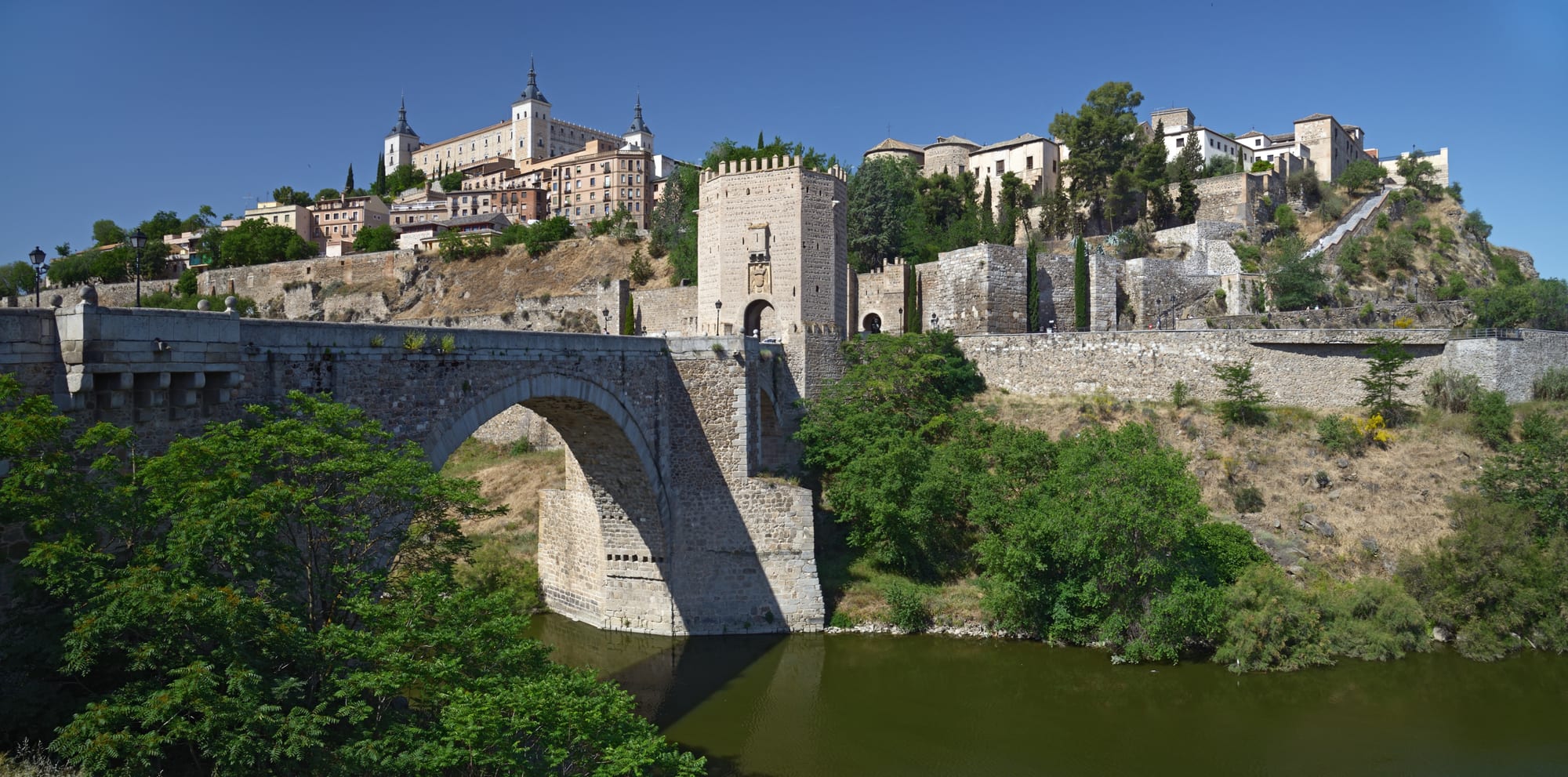
A stone arched bridge with a gate tower over the green Tagus, with walls and the square Alcázar on the hill above

Madrid & Castile-La Mancha, Spain

Toledo

The Alcántara Bridge over the Tagus, with the Alcázar above, Toledo. (Ввласенко / Wikimedia Commons · CC BY-SA 3.0)

A walled city on a hill wrapped on three sides by a bend of the Tagus, south of Madrid. Roman Toletum, capital of the Visigoths and then a rich Muslim and Castilian city of three faiths, it lost the royal court to Madrid in 1561. Today it is the capital of Castile-La Mancha and a UNESCO World Heritage city of churches, synagogues and El Greco paintings.

Neighbourhoods

  • The old city
    • First-time visitors
    • Historic district

    The walled hilltop inside the river bend, a maze of steep, narrow lanes between the cathedral, the Alcázar and Plaza de Zocodover, the central square. Most sights, shops and restaurants are here, and heading uphill usually leads back to Zocodover.

    Open in Maps
  • The Jewish quarter
    • Historic district
    • Quieter streets
    • Museums

    The western part of the old city, where the synagogues of Santa María la Blanca and El Tránsito, the monastery of San Juan de los Reyes and El Greco's Burial of the Count of Orgaz stand within a few minutes of each other, above the San Martín bridge.

    Open in Maps
  • Santa María de Benquerencia
    • Quiet and residential
    • Local life

    The modern residential district on the south bank of the Tagus, upstream of the old city, where most of Toledo's 21st-century population growth has taken place, with the city's new general hospital.

    Open in Maps

Things to do

Famous landmarks

  • Toledo Cathedrallandmark

    The Gothic primate cathedral of Spain, whose treasures include the baroque Transparente altarpiece in the ambulatory, the great monstrance of Enrique de Arfe and a sacristy displaying major works of art.

    Open in Maps
  • Alcázar of Toledolandmark

    The fortress on the highest part of the city, restored in the 1540s, besieged in 1936 and largely rebuilt between 1939 and 1957, now home to the Army Museum.

    Open in Maps
  • Plaza de Zocodoverlandmark

    The old market square at the centre of the old city, the meeting point and the stop for buses from the station.

    Open in Maps
  • Puerta de Bisagralandmark

    The 16th-century gate in the city walls, a gate of Moorish origin rebuilt by Alonso de Covarrubias.

    Open in Maps
  • Puente de Alcántaralandmark

    The Roman bridge across the Tagus below the Alcázar, with a fortified gate tower at one end.

    Open in Maps
  • Puente de San Martínlandmark

    The medieval bridge on the western side of the city, with towers at both ends, crossing the Tagus below the Jewish quarter.

    Open in Maps

Synagogues, mosque and churches

  • Santa María la Blancalandmark

    A former synagogue with rows of white horseshoe arches, turned into a church in the early 15th century and now a museum in the care of the archdiocese.

    Open in Maps
  • Synagogue of El Tránsitomuseum

    A synagogue built in 1357 in the Mudéjar style, known for its rich stucco decoration and home to the Sephardic Museum.

    Open in Maps
  • Mosque of Cristo de la Luzlandmark

    A small mosque built in 999, one of ten in the city under Muslim rule, given an apse when it became a church after 1085.

    Open in Maps
  • San Juan de los Reyeslandmark

    A Franciscan monastery built in 1477–1504 in the Isabelline Gothic style, whose upper cloisters carry Mudéjar ornament.

    Open in Maps
  • Church of Santo Tomélandmark

    A church with a Mudéjar tower that holds El Greco's The Burial of the Count of Orgaz.

    Open in Maps

Museums

  • El Greco Museummuseum

    A house-museum designed as a recreation of the painter's lost home, with works from his Toledo years.

    Open in Maps
  • Museo de Santa Cruzmuseum

    A Renaissance hospital of the 16th century turned museum of fine arts and archaeology, with paintings by El Greco.

    Open in Maps
  • Hospital de Taveramuseum

    A Renaissance hospital built outside the walls, now home to the Museo Fundación Lerma, part of the House of Medinaceli's collections.

    Open in Maps

Short trips from the city

  • Consuegra windmillsattraction

    Windmills and the castle of La Muela on the Cerro Calderico above the town, windmills that became famous with Don Quixote.

    Open in Maps

Seasonal events

  • Holy WeekMarch or April

    Processions of religious brotherhoods through the narrow streets of the old city.

  • Virgen del Valle pilgrimage1 May

    A pilgrimage to the hermitage of the Virgen del Valle across the river, a popular day out for local people.

  • Corpus ChristiMay or June

    One of Toledo's most important religious celebrations, a Fiesta of International Tourist Interest since 1980, when the cathedral's great monstrance is carried along about 2 km of streets hung with awnings.

Eat and drink

Long-standing places and food districts in Toledo. Hours, ratings and directions come from your maps app, always current.

Toledo classics

  • Confitería Santo Tomécafe

    Arguably the most famous maker of Toledo marzipan, particularly crowded before Christmas when buyers come from across Spain.

    Open in Maps
  • Carcamusas in the old cityneighborhood

    Restaurants in the old city serve carcamusas, a stew of lean pork in a moderately spicy tomato sauce with peas, along with partridge and roast lamb.

    Open in Maps

Food districts and markets

  • Around Plaza de Zocodoverneighborhood

    Bars, cafés and marzipan shops crowd the streets around the central square.

    Open in Maps

Experience Toledo

History

The hill in the bend of the Tagus was a town of the Carpetani people when the Roman historian Livy first mentioned it as Toletum. Under Rome it gained a circus, city walls, public baths and a water supply. In 546, or possibly earlier, the Visigoths made it the capital of their kingdom, and at the council of 589 King Reccared declared his conversion from Arianism to Catholicism, making the city the religious heart of Visigothic Spain. Tariq ibn Ziyad took it in 711 or 712 for the Umayyads, and as Tulaytulah it became a large, often rebellious city of al-Andalus, home to Muslims, Christians and a Jewish community of several thousand.

On 25 May 1085 Alfonso VI of León took Toledo, and for the next two centuries it remained open to Muslim and Jewish influences. Its School of Translators turned Arabic scholarship into Castilian and Latin, and synagogues and Mudéjar churches of these centuries still stand. The Jews were expelled in 1492, and in 1520 it was one of the first cities to join the Comuneros revolt against Charles V, holding out until 1522. When Philip II moved the court to Madrid in 1561, Toledo began a slow decline; silk kept its economy afloat for a while, but by the 1630s the decline was real, and by 1900 the population was about 23,000.

In July 1936 rebel officers under José Moscardó shut themselves in the Alcázar, which held out against Republican forces until Franco's army lifted the siege in September, and the two-month resistance became a core symbol of Francoist mythology. In 1983 Toledo became the seat of the parliament and government of Castile-La Mancha, and in 1986 UNESCO listed the old city as a World Heritage Site.

Culture & Customs

Toledo's identity rests on its past as a meeting place of Christians, Muslims and Jews. The city keeps reminders of all three: the synagogues of Santa María la Blanca and El Tránsito, the little mosque of Cristo de la Luz and the Mudéjar towers of its churches, one of them a converted minaret. The cathedral, the primate church of Spain, is the seat of a powerful archdiocese, and the councils of Toledo shaped the Visigothic church.

The Cretan-born painter El Greco spent the later part of his life here and painted the city several times; his Burial of the Count of Orgaz hangs in the church of Santo Tomé, and his works hang in the Santa Cruz museum and the El Greco Museum. Metalwork is the city's other great tradition. Toledo steel was regarded as the best in Europe between the 15th and 17th centuries, swordmaking was organised in a royal factory, and shops in the old city still sell swords, armour and damascene work, gold and silver thread inlaid into steel.

The religious calendar is the centre of public life. Holy Week processions pass through the narrow lanes, and the feast of Corpus Christi, declared of International Tourist Interest in 1980, is one of its most important religious celebrations, when the streets are hung with awnings and the cathedral's monstrance is carried in procession. On 1 May people go on pilgrimage to the hermitage of the Virgen del Valle across the river.

Daily Life

About 86,500 people lived in the municipality in January 2024. Since the mid-19th century the city has spread beyond its walls, and in the 21st century most growth has been in Santa María de Benquerencia, a district begun in the 1970s about 8 km east of the centre on the south bank, where the new University Hospital, begun in 2007, opened in 2020.

In 2007 services employed 86.5% of working people. As regional capital Toledo is home to the government of Castile-La Mancha, and the metal-working tradition of knives and swords continues alongside smaller industries. High-speed trains, running since 2005, put Madrid just under half an hour away.

The city is also home to the National Hospital for Paraplegics, a national centre for the treatment of spinal cord injuries, and to the Infantry Academy. The old city is busy with visitors by day, while the newer districts outside the walls carry most of the city's ordinary routine of school, work and shopping.

Food

Toledo's cooking draws on lamb and game such as partridge. Local specialities include roast or stewed lamb, cochifrito, alubias con perdiz (beans with partridge), perdiz estofada (partridge stew), migas, gachas manchegas and tortilla a la magra. Carcamusas is a stew of lean pork in a moderately spicy tomato sauce with peas, and there is a local version of the Madrid chickpea stew, cocido toledano.

The city's most famous product is mazapán, or marzipan, an almond sweet that holds a Protected Geographical Indication as mazapán de Toledo. Unlike most of Spain, Toledo eats it all year round, and the Confitería Santo Tomé is particularly crowded before Christmas, when buyers come from across Spain. Manchego cheese is the city's other famous food product.

Eating is mostly done in the old city's bars and taverns and around Plaza de Zocodover, with set lunches at midday and tapas in the evening. The wines of La Mancha, the largest continuous vine-growing area in the world, are widely poured.

Planning tools

Budget

Toledo is cheaper than Madrid for rooms and meals, but its old centre has day-tripper prices and many sights charge separate entry fees. Staying the night is good value and lets visitors see the lanes quiet in the evening. A menú del día at lunch is the economical way to eat.

Daily Budget Midrange
USD 140–260 (hotel in the old city, restaurant dinners, entry to several monuments)
Daily Budget Shoestring
USD 60–95 (hostel or simple pension, menú del día, city buses and walking)

Stay overnight to see the old city after the day visitors leave.

Best Time to Visit

Spring and autumn are the most comfortable seasons. Holy Week in spring and Corpus Christi in May or June are the great religious festivals and fill the city. July and August are very hot, and the steep streets make the heat harder; winter is cool, with frosty nights, but quiet.

Suggested Number of Days

Many visitors come for a single day from Madrid, but one or two nights allows the main monuments without rushing and the quiet evenings. Add a day or two for the windmill towns of La Mancha.

First Visit
1–2 days
With Surroundings
3–4 days

Transportation

The old city is best covered on foot. City buses link the railway station, the bus station and the outer districts with Plaza de Zocodover. Driving inside the old city is impractical; cars are best left in the car parks outside the walls.

Wear shoes with grip — the lanes are steep and the paving stones can be slippery.

Airport & Station Connections

High-speed trains from Madrid's Atocha station reach Toledo in a little over half an hour, arriving at a neo-Mudéjar station of 1919 below the old city, from where city buses climb to Plaza de Zocodover. Buses run frequently from Madrid's Plaza Elíptica. The nearest major airport is Madrid–Barajas, reached via Madrid.

Walkability

The old city is compact but steep, with narrow, winding lanes that are easy to get lost in; heading uphill usually leads back to Plaza de Zocodover. Pavements are narrow and cars squeeze through some streets. Walking up from the bus station takes about 20 minutes and is steep.

Safety

Spain is a safe country with low violent crime. The significant risk is pickpocketing and bag-snatching, which is persistent in tourist areas of Barcelona, Madrid, and Seville, on the metro, and at crowded sights. Summer heat and, increasingly, wildfires are seasonal hazards. In Toledo the same care applies in the crowded lanes of the old city.

Keep bags closed in crowded lanes, and carry water and avoid climbing the streets in the midday heat in summer. Check current official travel advice before travelling.

Climate

A cold semi-arid climate. Winters are cool, with frequent frosts, and summers are hot. In 2007 Toledo was the third-sunniest city in Spain.

Summer
hot, with highs occasionally passing 40°C; the record is 44.2°C, set in August 2021
Winter
cool, with frequent frosts; the record low is −13.4°C, set in January 2021

Local Customs

Toledo is the seat of Spain's primate archbishop and a strongly Catholic city, and its churches and synagogues are places of worship or memory as well as museums. Lunch is the main meal of the day. Tipping is neither mandatory nor considered customary in Spain.

Cover shoulders in churches and keep quiet during services; ask before photographing inside religious buildings.

Common Payment Methods

The currency is the euro. Credit and debit cards are widely accepted, though shops may ask for photo ID; city bus fares can be paid in cash to the driver.