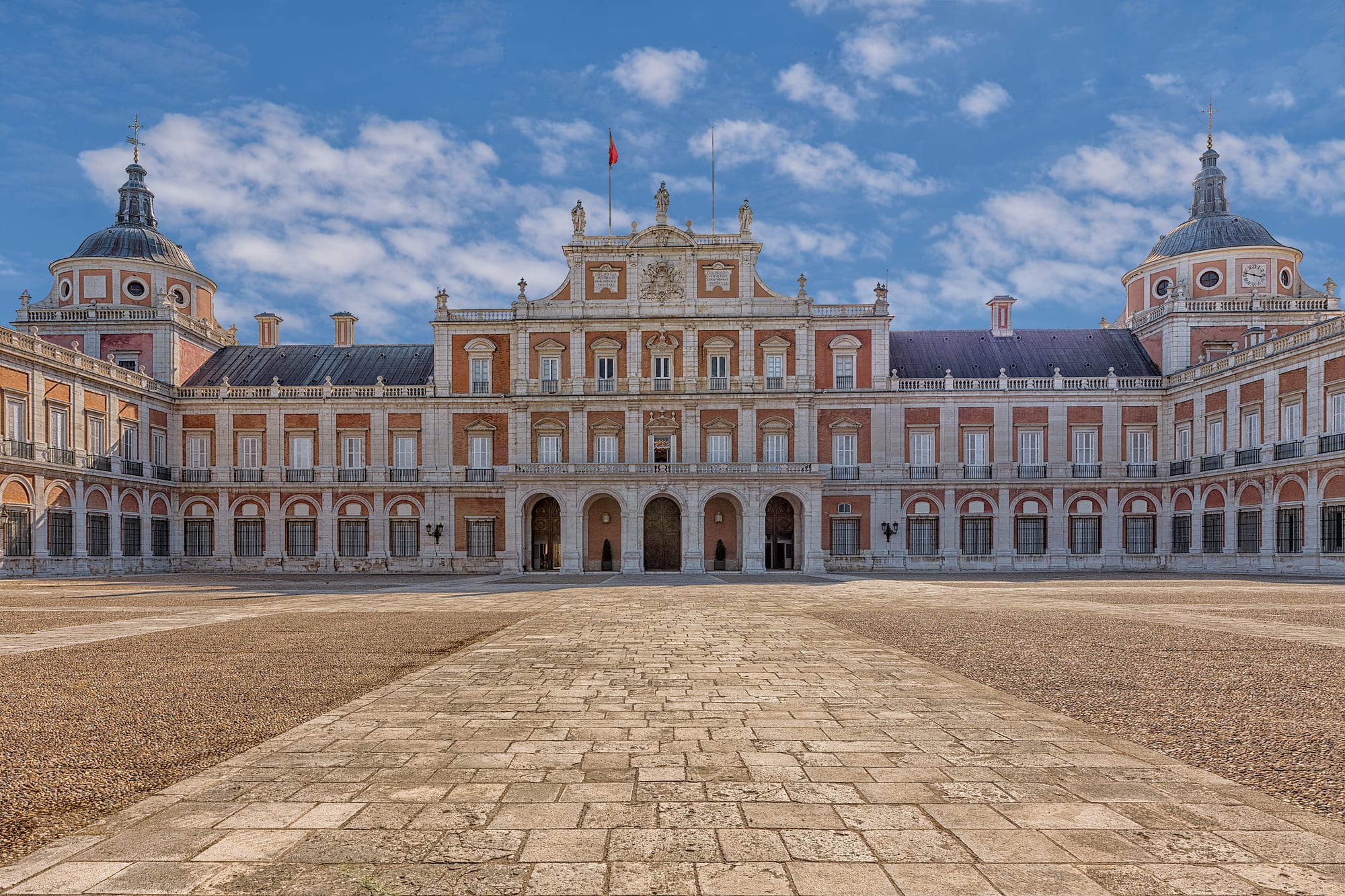
The brick and white-stone front of a royal palace with domed corner towers, behind a wide paved courtyard

Madrid & Castile-La Mancha, Spain

Aranjuez

The main front of the Royal Palace of Aranjuez on its parade ground. (Javier Montes / Wikimedia Commons · CC BY-SA 4.0)

A royal town on the left bank of the Tagus at the southern edge of the Community of Madrid, just upstream of where the Jarama joins it. Built around a 16th-century palace and laid out as a planned town in the 18th century, it is known for its gardens, the 1808 mutiny that toppled a king, Rodrigo's guitar concerto, and its strawberries and asparagus.

Neighbourhoods

  • Centro
    • First-time visitors
    • Historic district
    • Close to the gardens

    The planned 18th-century town of straight streets and squares beside the palace, including the royal buildings, the bullring and the historic centre with its central market and shops. Most visitors stay and eat here, within walking distance of the gardens.

    Open in Maps
  • Las Aves
    • Railway station
    • Quiet and residential

    The district to the west near the railway station, with housing, the Jardín Narváez and the town's industrial area beyond the tracks. It is the arrival point for visitors coming by train.

    Open in Maps
  • La Montaña
    • Modern housing
    • Car travellers

    A newer district about 3 km north of the centre on the road from the A-4 motorway, with housing, car dealerships and the route in to the palace for drivers.

    Open in Maps

Things to do

The royal site

  • Royal Palace of Aranjuezlandmark

    The royal palace built from the second half of the 16th century beside the Tagus and its palace weir of 1753.

    Open in Maps
  • Casa del Labradorlandmark

    A neoclassical palace first designed by Juan de Villanueva for Charles IV and completed by Isidro González Velázquez, set in protected historic gardens.

    Open in Maps
  • Prince's Gardenpark

    The great garden stretching east of the palace along the Tagus, bordered by Calle de la Reina.

    Open in Maps
  • Parterre Gardenpark

    The formal garden and fountains laid out in front of the palace.

    Open in Maps
  • Royal Barges Museummuseum

    The Museo de Falúas Reales, the royal site's collection of royal barges.

    Open in Maps

The town

  • Bullring and Bullfighting Museummuseum

    One of the earliest bullrings in Spain, opened in its refurbished form in 1797 and rebuilt after a fire in 1809, with a small museum inside.

    Open in Maps
  • Royal Theatreattraction

    Charles III's court theatre in the town centre, restored and reopened in 2014.

    Open in Maps
  • Long Bridge over the Jaramalandmark

    A bridge about 300 metres long built by Charles III over the Jarama in 1761.

    Open in Maps

Short trips from the town

  • Real Cortijo de San Isidroattraction

    A settlement about 6 km north of the town, where Charles III founded a model royal farm in the 1760s.

    Open in Maps

Seasonal events

  • AlfaranjuezMay

    A craft fair with a festival of traditional folk music.

  • San Fernandoaround 30 May

    The town's festival week, with parades and events.

  • Aranjuez Early Music FestivalMay or June

    A festival of early music in the royal town.

  • Mutiny of Aranjuez re-enactmentearly September

    A re-enactment of the uprising of March 1808, declared of National Tourist Interest, with a concert at the Royal Palace.

Eat and drink

Long-standing places and food districts in Aranjuez. Hours, ratings and directions come from your maps app, always current.

Aranjuez classics

  • Strawberries and asparagusmarket

    The town's two famous crops from the fertile Tagus plain; the central covered market is the place for fresh local produce.

    Open in Maps
  • Restaurants of the centreneighborhood

    The bars and restaurants of the historic centre near the palace, many of them opened in the early 2000s as tourism grew.

    Open in Maps
  • Riverside picnic areasneighborhood

    In summer it is a local tradition to eat dinner at the picnic areas beside the Tagus.

    Open in Maps

Experience Aranjuez

History

Alfonso VI took the lands along the Tagus, Aranjuez among them, after conquering the Taifa of Toledo in 1085. The kings of Castile later valued the well-watered river plain as a hunting ground and retreat, and in the second half of the 16th century a royal palace was built there; the enlarged settlement took the name Aranjuez in place of Alpajes. For almost two centuries the site was reserved for the royal family, the nobles of the court and palace servants.

The town as it stands is an 18th-century creation. In 1750 Ferdinand VI approved a plan for a new town and a scheme to bring drinking water from springs near Ocaña, and from 1752 visitors could stay overnight. A weir was built on the Tagus beside the palace in 1753 to drive a flour mill. Charles III built the Long Bridge over the Jarama in 1761 and a model farm north of the town, and a bullring was built. On 17 March 1808, with the court staying at Aranjuez as a French invasion loomed, a mutiny forced Charles IV to dismiss his minister Godoy, and two days later to abdicate in favour of his son, Ferdinand VII.

The railway arrived on 9 February 1851, with the Madrid–Aranjuez line, the second in the Iberian Peninsula. In the Civil War the battles of the Jarama and Seseña were fought not far away. A photographic film factory opened in 1950 and closed in 2001, the year UNESCO listed the Aranjuez Cultural Landscape as a World Heritage Site.

Culture & Customs

Aranjuez's fame owes much to music. Joaquín Rodrigo's Concierto de Aranjuez of 1939, for guitar and orchestra, was inspired by the royal gardens and became one of the best-known orchestral works of the 20th century; Rodrigo was later made Marquis of the Gardens of Aranjuez. The town keeps up the tradition with an early music festival, and the restored court theatre of Charles III reopened in 2014.

The town's identity is that of a royal site. Its palaces, the formal Parterre and the vast Prince's Garden along the Tagus, and the grid of streets laid out for the court, make up the cultural landscape UNESCO recognised in 2001, together with the river and its irrigated farmland. The bullring, opened in its refurbished form in 1797, is one of the oldest in Spain, and holds a small bullfighting museum.

The festival year starts with Alfaranjuez in May, a craft fair with traditional folk music, followed by the San Fernando festival week around 30 May. In the first week of September the town re-enacts the 1808 mutiny, an event of National Tourist Interest that ends with a concert at the Royal Palace. The river also shapes local life: canoeing, rowing and paddleboarding have a long tradition, and in summer families eat dinner at the picnic areas beside the Tagus.

Daily Life

About 63,000 people lived in the municipality in 2025. The population was only 4,226 in 1797 and about 12,670 at the start of the 20th century, when Aranjuez was the second town of the province after Madrid. It grew slowly until a boom in the 2000s and passed 50,000 for the first time in 2008. About 8,000 residents were foreign nationals in 2022, the largest groups from Romania and Morocco.

The economy mixes services, tourism and farming. In 2008 more than three quarters of local businesses were in services, and tourism grew strongly after the UNESCO listing until the 2008 recession; between 2001 and 2004 the number of pubs and restaurants rose by about a fifth. The fertile river plain suits wheat and other cereals, but farming now plays only a small part: labour-intensive crops such as strawberries and fruit trees have largely given way to crops that can be worked by machine. Industry lies west of the railway station and on an industrial estate to the south.

Daily life follows a slower rhythm than the capital's, with walks in the gardens and along the river and summer evenings outdoors.

Food

Aranjuez is best known for two crops of its fertile valley: strawberries and asparagus. The town's irrigated orchards and vegetable gardens beside the Tagus have been known for them since the 18th century, when they began to be sold beyond the town, and the large strawberry known as the fresón is among its traditional crops. The old railway carried them to Madrid, and the Strawberry Train, a heritage service often pulled by a steam locomotive, still runs from Madrid on spring and autumn weekends.

Beyond the town, the wider Vega del Tajo grows vines around Villaconejos, which is also known for extensive melon production, and wheat and other cereals on the plain. The cooking of the town is that of the Madrid region, and the restaurants and bars of the historic centre, many opened in the early 2000s as tourism grew, serve the regional dishes alongside the local produce.

The most local custom is a simple one: on summer evenings, people take their dinner to the picnic areas by the river and eat outdoors in the cool beside the water.

Planning tools

Budget

Aranjuez is an easy and inexpensive day trip from Madrid, and rooms and meals cost less than in the capital. The main costs are the train and the palace and Casa del Labrador tickets; the gardens are a pleasure in themselves.

Daily Budget Midrange
USD 120–220 (a night in town, restaurant dinners, palace entry)
Daily Budget Shoestring
USD 50–85 (suburban train from Madrid, a menú del día, the gardens)

Visit in spring for the gardens and the strawberry season, and set aside time to walk the Prince's Garden, which is very large.

Best Time to Visit

Spring is the classic season, when the gardens are at their best and the May festivals take place. September brings the mutiny re-enactment. High summer is hot, though the riverside shade helps; winters are cool and the gardens bare.

Suggested Number of Days

Most visitors come for a single day from Madrid. An overnight stay allows a slower pace and time for the whole length of the riverside gardens.

First Visit
1 day
With Surroundings
2 days

Transportation

The centre, the palace and the gardens are close together and best seen on foot or by bicycle. Four local bus routes and taxis link the railway station with the town, and six main-line bus routes use the bus station, Las Infantas. Drivers reach the town from the A-4 motorway.

The gardens are large; allow plenty of time and comfortable shoes for the walk to the Casa del Labrador.

Airport & Station Connections

The railway reached Aranjuez in 1851 on one of the first lines in the peninsula, and suburban trains still run from Madrid, arriving at a richly ornamented neo-Mudéjar station west of the centre. Buses link the town with Toledo, and by road the town is reached from the A-4 motorway. The nearest airport is Madrid–Barajas.

Walkability

Aranjuez is flat and laid out on a regular grid, which makes it easy to walk. The walk from the station to the palace takes in the town's tree-lined avenues, and the gardens along the river are made for walking, though they cover a large area.

Safety

Spain is a safe country with low violent crime. The significant risk is pickpocketing and bag-snatching, which is persistent in tourist areas of Barcelona, Madrid, and Seville, on the metro, and at crowded sights. Summer heat and, increasingly, wildfires are seasonal hazards. Aranjuez is a calm town; the usual care with bags is enough.

Carry water and use the shade of the gardens on hot summer days. Check current official travel advice before travelling.

Climate

A Mediterranean climate with hot summers, in a sheltered river valley; the mean annual temperature is about 14°C and rainfall is low. In January 2021 the storm Filomena left heavy snow that disrupted transport.

Summer
hot and dry — the warmest month averages above 22°C, and in Madrid, to the north, average July daytime highs are 33–34°C
Winter
cool, with frost possible from autumn to spring — in Madrid, to the north, January averages around 6°C

Local Customs

A small, relaxed royal town where summer evenings are spent outdoors, and families traditionally eat dinner at the picnic areas by the river. Lunch is the main meal of the day. Tipping is neither mandatory nor considered customary in Spain.

Respect the rules of the royal gardens — keep to paths and leave the fountains and statues alone.

Common Payment Methods

The currency is the euro. Credit and debit cards are widely accepted, though shops may ask for photo ID.