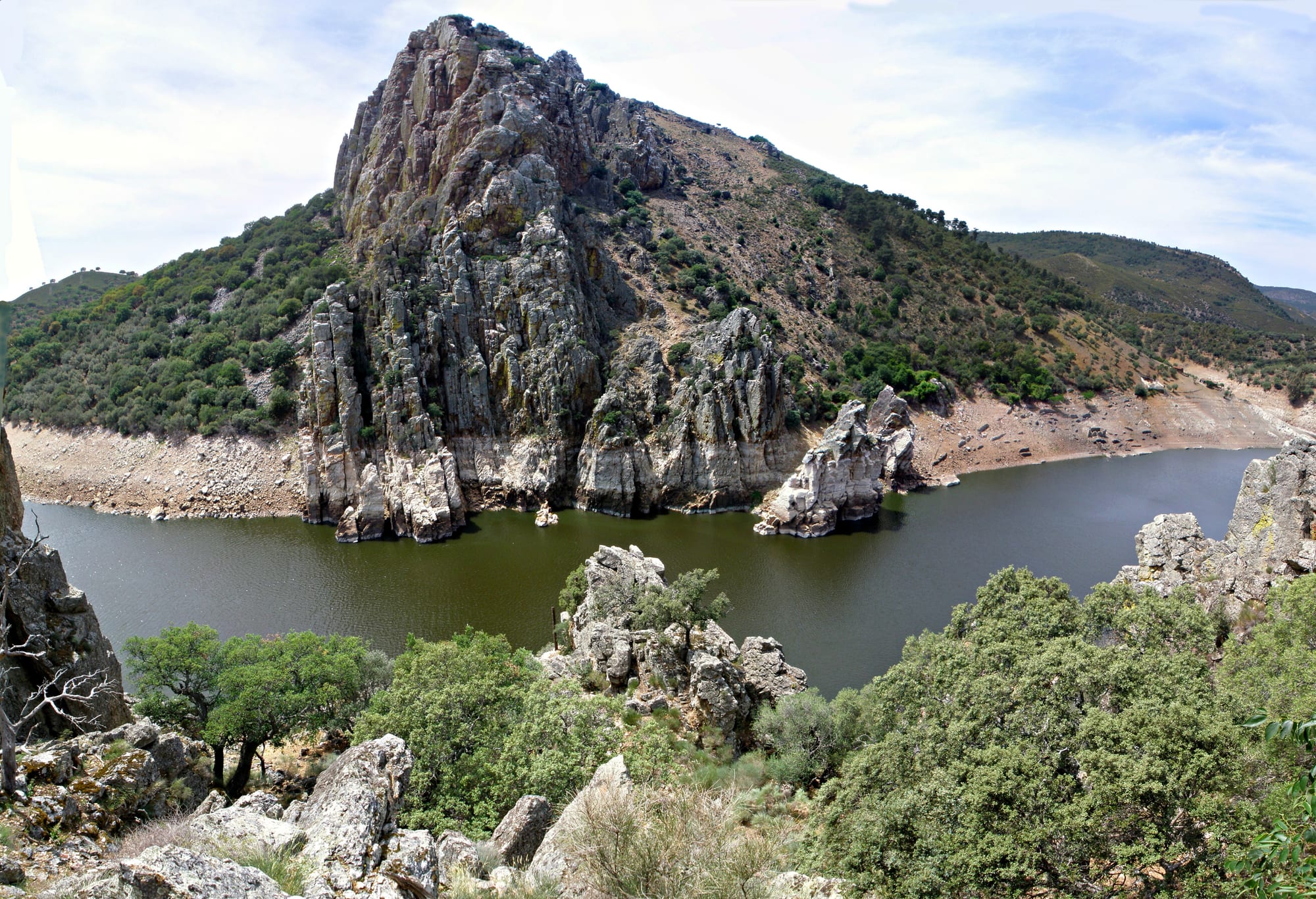
A steep quartzite crag rising above a still green river, with scrub-covered hills and rocks in the foreground

Spain

Extremadura

The Salto del Gitano crag above the Tagus in Monfragüe National Park, Cáceres province. (Alonso de Mendoza / Wikimedia Commons · CC BY-SA 3.0)

A thinly populated region of south-western Spain on the border with Portugal, made up of the provinces of Cáceres and Badajoz — a land of oak-studded dehesa pastures, storks on church towers, Roman Mérida, the walled old town of Cáceres and the home towns of the conquistadors, known for its acorn-fed Iberian ham.

Explore Extremadura

History

Extremadura's name is usually explained as the land at the "extremes" of the Duero, the frontier of the medieval Christian kingdoms. In antiquity it was home to the Lusitanians and Vettones, whose granite boar sculptures, the verracos, still stand in villages. Augustus founded Emerita Augusta, now Mérida, in 25 BC as a colony for retired legionaries, and it became the capital of the province of Lusitania, one of the grandest cities of Roman Hispania and later a Visigothic centre.

Under Muslim rule Badajoz became the seat of a taifa kingdom in the 11th century. The Christian conquest was completed in the 13th century: Alfonso IX of León took Cáceres in 1229 and Badajoz fell soon after. Much of the land was granted to the military orders of Alcántara and Santiago and to noble families, creating great estates that long shaped rural poverty.

The region's poverty and its warrior tradition sent many of its sons to the Americas. Francisco Pizarro and Francisco de Orellana came from Trujillo, Hernán Cortés from Medellín and Vasco Núñez de Balboa from Jerez de los Caballeros, and some returned rich enough to build palaces. The emperor Charles V retired to the monastery of Yuste in 1557 and died there. The border with Portugal saw repeated wars, and Olivenza passed from Portugal to Spain in 1801. In the Civil War, Nationalist troops took Badajoz in August 1936 and carried out mass killings. Emigration emptied the countryside in the 20th century, and Extremadura became an autonomous community in 1983.

Culture & Customs

Extremadura has a quieter regional identity than the Basque Country or Galicia, rooted in rural life, the dehesa and a long history of emigration. The local Castilian has a distinctive accent close to Andalusian speech, and in three villages of the Sierra de Gata people speak A Fala, a language related to Galician and Portuguese. Links with Portugal run deep, and in Olivenza the street names and Manueline architecture recall its Portuguese past.

White storks nest on bell towers and rooftops across the region. Transhumance and pig slaughter, the matanza, remain part of the rural calendar, and cork is stripped from the oaks in summer.

The most famous event is Mérida's International Festival of Classical Theatre, staged in the Roman theatre each summer since 1933. The Jerte valley celebrates its cherry blossom each spring, Badajoz is known for its carnival, and in January the village of Piornal pelts the costumed figure of Jarramplas with turnips. Holy Week processions fill Cáceres's old town.

Daily Life

Just over a million people live in Extremadura, an area larger than Switzerland, and the density is among the lowest in Spain. Badajoz is the largest city with about 150,000 people, Cáceres has about 95,000, and Mérida, the regional capital, about 60,000; Plasencia and Don Benito are the other sizeable towns.

The economy leans heavily on farming. The dehesa, open woodland of holm and cork oaks, supports Iberian pigs, sheep and cattle, while the irrigated Vegas del Guadiana grow tomatoes, rice and fruit, the Jerte valley cherries and La Vera paprika and tobacco. Solar farms have spread across the plains, and the future of the Almaraz nuclear power station, due for closure, is a local issue.

Extremadura is one of Spain's poorest regions, with high unemployment, an ageing population and a long history of young people leaving. Slow and unreliable rail links to Madrid have been a long-standing grievance. Daily life is unhurried: late lunches, evening walks in the plaza and summer nights spent outdoors.

Food

The dehesa gives Extremadura its most famous product: jamón ibérico de bellota, from Iberian pigs fattened on acorns in the autumn, protected under the Dehesa de Extremadura designation. Pork appears in countless forms, from chorizo and lomo to fresh cuts grilled over oak.

Cheese is the other great product. Torta del Casar, a sheep's-milk cheese from Casar de Cáceres, is so soft inside that the top is cut off and the centre scooped out with bread; Queso de La Serena is similar, and Ibores is a goat's cheese rubbed with paprika. Pimentón de la Vera, paprika dried over oak smoke, gives many Spanish dishes their smoky flavour.

Shepherds' dishes dominate: migas, fried breadcrumbs with garlic, pork and peppers; caldereta, a lamb stew; and frite, fried lamb with paprika. Tench is a prized river fish, and the Jerte valley's Picota cherries are eaten fresh and made into cherry liqueur. The main wine area is Ribera del Guadiana, especially Tierra de Barros around Almendralejo, and homemade vino de pitarra is served in villages. Sweets include perrunillas, crumbly lard biscuits.

Attractions & Natural Wonders

Cáceres's old town, a UNESCO World Heritage Site, is a walled maze of granite palaces, towers and churches, entered through the Arco de la Estrella from the Plaza Mayor; the Casa de las Veletas museum holds a Moorish cistern. Roman Mérida, also a UNESCO World Heritage Site, has its theatre and amphitheatre, the Temple of Diana, the Los Milagros aqueduct, a Roman bridge of some 60 arches over the Guadiana, the Alcazaba and the National Museum of Roman Art.

Trujillo's Plaza Mayor has an equestrian statue of Pizarro and palaces built with American gold, with a castle above. To the south-east, the Monastery of Guadalupe is a UNESCO World Heritage Site in the Villuercas hills.

Monfragüe National Park, between Trujillo and Plasencia, protects the gorges of the Tagus and Tiétar, where griffon and black vultures nest on the Salto del Gitano crag, with Monfragüe castle on the ridge to the east. To the north, the cherry blossom of the Jerte valley turns the slopes white in spring, and the Garganta de los Infiernos reserve has natural pools. Plasencia has two cathedrals, Hervás a Jewish quarter, La Vera the monastery of Yuste, and the Roman bridge at Alcántara still crosses the Tagus. Badajoz has its Moorish Alcazaba and Zafra its arcaded squares.

Cities in Extremadura

Planning basics

Budget

Extremadura is one of the cheapest regions of Spain. Hotels in Cáceres, Mérida and Trujillo cost well below national averages outside festival dates, the menú del día is generous, and a ración of Iberian ham costs less here than elsewhere. Rural houses are plentiful and inexpensive, though a car adds cost, and Cáceres and Mérida rise in price during their summer festivals.

Daily Budget Midrange
USD 100–210 (parador or mid-range hotel, restaurant dinners, a hire car, site tickets and a theatre night in Mérida)
Daily Budget Shoestring
USD 45–80 (hostel or pension, menú del día and tapas, buses)

Buy Mérida's combined ticket for the Roman monuments, and eat Iberian ham by the ración in local bars rather than in tourist restaurants.

Safety

Extremadura is very safe, with low crime and few tourist crowds. The real risks are extreme summer heat, forest fires in the northern sierras during dry spells, long stretches of road with few services, and deer and livestock on rural roads at dusk.

Avoid long walks in the midday heat of summer, carry water, and keep fuel topped up on rural roads. Check current official travel advice before travelling.

Climate

The region has a hot Mediterranean-continental climate, one of Spain's hottest in summer: the Guadiana valley around Badajoz and Mérida often passes 40°C in July and August. Winters are mild in the lowlands but frosty on clear nights, with most rain from autumn to spring. The northern mountains around the Jerte and La Vera are cooler and wetter, with snow on the peaks.

Summer
very hot and dry, 33–40°C or more by day in the lowlands; cooler in the northern valleys
Winter
mild by day, 10–15°C, with cold nights and fog; snow on the northern sierras

Transportation

Extremadura has poor rail links for Spain: trains from Madrid are slow, though a faster line between Badajoz, Mérida, Cáceres and Plasencia has opened in stages since 2022. Badajoz has a small airport, and buses link the main towns. Motorways cross the region, the A-5 from Madrid to Badajoz and the A-66 Ruta de la Plata, and a car is almost essential for Trujillo, Monfragüe, Guadalupe and the northern valleys.

Hire a car, ideally in Madrid or Seville, and plan a circuit of Cáceres, Trujillo, Mérida and Monfragüe.

Best Time to Visit

Spring is the best season: the dehesa is green and in flower, storks are nesting and the Jerte valley's cherry blossom peaks from mid-March to early April, depending on the year. Autumn, from late September to November, is also pleasant and brings the start of the acorn season for the pigs. July and August are very hot, though Mérida's classical theatre festival runs then, and winter is mild and quiet.