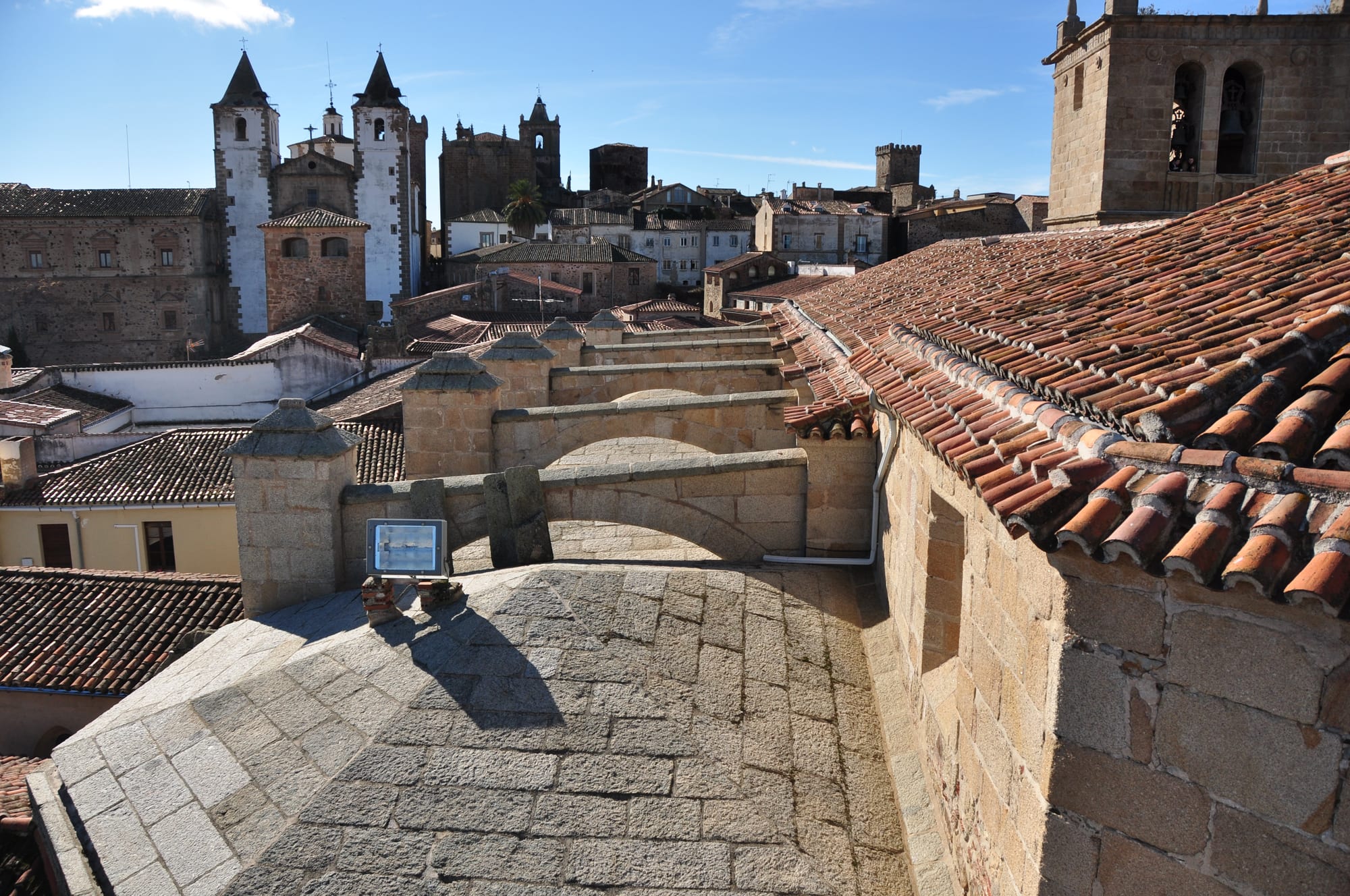
Tiled rooftops and granite walls of Cáceres old town, with the white twin towers of a baroque church against a blue sky

Extremadura, Spain

Cáceres

The roofs of the old town of Cáceres, seen from the tower of the Carvajal Palace. (Jesusccastillo / Wikimedia Commons · CC BY-SA 3.0 es)

The capital of the province of Cáceres, in the heart of Extremadura, built around a walled hilltop town of Roman, Moorish and medieval origins. Noble families enriched by the Reconquest and the Americas filled it with stone palaces and fortified towers; storks nest on the roofs, and the old town, a UNESCO World Heritage Site since 1986, has changed little in centuries.

Neighbourhoods

  • The old town
    • First-time visitors
    • Historic district
    • Architecture

    The walled upper town of granite palaces, churches and towers, with no outward sign of the modern world — which is why film crews, including Game of Thrones, have used it. It is quiet after dark, and storks nest on its towers and eaves.

    Open in Maps
  • Plaza Mayor and the streets outside the walls
    • Best for food
    • Nightlife
    • Close to public transport

    The long main square at the foot of the walls, with the town hall, the Bujaco tower and the Arco de la Estrella gate, holds most of the town's restaurants and terraces. The merchant streets that grew up outside the walls by the early 19th century, such as Pintores, lead off it towards the newer centre.

    Open in Maps
  • San Antonio, the old Jewish quarter
    • Historic district
    • Quiet and residential

    A small district of lanes beside the old town, where Cáceres's medieval Jewish community lived until the expulsion of 1492 and where traces of it can still be seen.

    Open in Maps
  • Paseo de Cánovas and the modern centre
    • Shopping
    • Local life

    The 19th- and 20th-century town below the old quarter, centred on the tree-lined Paseo de Cánovas, a favourite place to walk in the hot months, with shops, cafés and the medieval church of San Juan nearby.

    Open in Maps

Things to do

The walled town

  • Co-cathedral of Santa Maríalandmark

    A Gothic church of the 15th century, co-cathedral of the diocese of Coria-Cáceres since 1957, with a 16th-century main altarpiece of the Assumption carved in wood.

    Open in Maps
  • Arco de la Estrellalandmark

    The 18th-century gateway from the Plaza Mayor into the walled town, the main way into the old quarter.

    Open in Maps
  • Torre de Bujacolandmark

    The best known of the roughly thirty towers surviving from the Moorish walls, a 12th-century tower rising over the Plaza Mayor.

    Open in Maps
  • Arco del Cristolandmark

    A gateway surviving from the Roman walls, on the lower side of the old town.

    Open in Maps
  • Iglesia de San Mateolandmark

    A 15th-century church built on the site of a mosque, close to the Torre de las Cigüeñas and the Torre de Sande.

    Open in Maps
  • Palacio de los Golfines de Abajolandmark

    A noble palace in the old town where Isabella I and Ferdinand II stayed.

    Open in Maps

Museums

  • Museo de Cáceresmuseum

    The provincial museum in the Casa de las Veletas and the Casa de los Caballos, which keeps the Moorish cistern of the old Almohad fortress on the site.

    Open in Maps
  • Helga de Alvear Museum of Contemporary Artmuseum

    A museum built around the large collection of contemporary art assembled by the German-born collector Helga de Alvear.

    Open in Maps
  • Casa-Museo Árabemuseum

    A restored house between the Plaza de San Jorge and the Arco del Cristo, presented as the home of a wealthy Muslim of the 12th-century city.

    Open in Maps
  • Cave of Maltraviesoattraction

    A cave found in 1951 inside the city, where a 2018 study dated a hand stencil to 64,000 years ago, which would make it older than modern humans in Europe, though the dating is disputed; a visitor centre explains it.

    Open in Maps

Walks and viewpoints

  • Santuario de la Virgen de la Montañaviewpoint

    The sanctuary of the city's patron, the Virgin of the Mountain, on a hilltop at about 600 metres south of the town, a stiff walk up with views over the old town.

    Open in Maps

Short trips from the city

  • Los Barruecospark

    A natural monument of granite boulders and old wool-washing ponds at Malpartida de Cáceres, where white storks nest on the rocks, with the Vostell Malpartida museum of contemporary art in the old wool-washing buildings.

    Open in Maps
  • Casar de Cáceresattraction

    A small town north of the city on the Vía de la Plata, home of the soft sheep's-milk cheese Torta del Casar.

    Open in Maps
  • Monfragüe National Parkpark

    A national park of river gorges and Mediterranean woodland, one of Spain's best places to watch birds of prey, including black vultures and Spanish imperial eagles.

    Open in Maps

Seasonal events

  • Holy WeekMarch or April

    Processions wind through the narrow streets of the old town in the week before Easter Sunday.

  • San Jorge22–23 April

    The feast of the city's patron saint, when a dragon is burnt on a bonfire in the Plaza Mayor, with fireworks.

  • WOMAD Cáceresearly May

    A world music festival on stages inside the monumental old town, one of the WOMAD festivals held around the world.

  • Cáceres Classical Theatre FestivalJune

    One of the main classical theatre festivals of Extremadura, staged on June nights.

  • Medieval MarketNovember

    A large market inside the walls, with crafts, local products and food in a historical setting across the old town.

Eat and drink

Long-standing places and food districts in Cáceres. Hours, ratings and directions come from your maps app, always current.

Cáceres classics

  • Torta del Casarrestaurant

    The local sheep's-milk cheese, curdled with cardoon and so creamy when ripe that the top is sliced off and the inside scooped out; it is served in most restaurants.

    Open in Maps
  • Migasrestaurant

    A shepherds' dish made from stale bread, served in many Extremaduran kitchens alongside roast pork, lamb and game.

    Open in Maps

Food districts and markets

  • Plaza Mayorneighborhood

    The main square below the walls holds the largest group of restaurants and terraces in the town.

    Open in Maps
  • Convent sweetsneighborhood

    Convents in the old town sell pastries and sweets baked by the nuns, and small shops in the old streets sell local cheeses, hams and liqueurs.

    Open in Maps

Experience Cáceres

History

People lived around Cáceres long before the town existed. The Cave of Maltravieso, inside today's city, holds hand stencils, one of them dated in a 2018 study to 64,000 years ago, which would make it older than the arrival of modern humans in Europe and point to Neanderthal artists, though the dating is disputed. The Romans set up camps here in the 1st century BC, among them Castra Caecilia, and the colony of Norba Caesarina grew on the hill beside the road later called the Vía de la Plata; a gate of its walls, the Arco del Cristo, survives.

After the Visigoths the town faded, and it rose again as a Muslim frontier fortress. The Almohad caliph Abd al-Mumin refounded it in 1147, and its walls and towers, of which around thirty remain, date largely from this period. The Portuguese adventurer Geraldo Sempavor took it in the 1160s, León held it briefly, and the Almohads recovered it in 1174. Alfonso IX of León finally took it on 23 April 1229 after repeated sieges, and made it a royal town with its own council.

Noble families built houses and small palaces within the walls, many enriched by the Reconquest and, later, by fortunes made in the Americas. In the 15th century their quarrels tore the town apart, and in 1477 Isabella I, staying here during the War of the Castilian Succession, issued an ordinance to pacify them. The Jewish community, about 140 families in the 15th century, was expelled in 1492. In 1790 Charles IV made Cáceres the seat of the Royal Court of Extremadura, and in 1822 it became a provincial capital. In 1936 the garrison backed the military coup, more than 600 people were shot in the repression, and Franco made the city his headquarters before advancing on Madrid. The old town was named a UNESCO World Heritage Site in 1986.

Culture & Customs

The old town is the city's identity. Its blend of Roman, Moorish, Gothic and Renaissance building earned the Council of Europe's recognition in 1968 and UNESCO status in 1986, and its untouched streets have made it a film set, used by Game of Thrones and the Spanish series Isabel. The coats of arms carved over doorways record the noble families who built it.

The calendar is full. Holy Week processions squeeze through the steep lanes, and on the feast of San Jorge, the patron saint, in April, a dragon is burnt in the Plaza Mayor. WOMAD, the world music festival founded by Peter Gabriel, has an edition here that is unusual for taking place inside a monumental city, and there are festivals of early music, black music, pop art and Irish music, a classical theatre festival in June and a large medieval market in November. The Contemporary Ibero-American Art Fair in April and the Helga de Alvear museum give the city a strong contemporary art scene.

Storks are part of the city's image, nesting on towers, churches and eaves across the old town. The University of Extremadura, founded in 1973, has a campus here, and students bring the bars around the Plaza Mayor to life in term time. Sport means CP Cacereño in football and Cáceres Basket.

Daily Life

About 96,600 people lived in the municipality in 2025, nearly all in the city itself. The municipality is the largest in Spain by area, at 1,750 square kilometres, scattered with hamlets, castles and old farmhouses. The real population swings by thousands with the university term and the army training centre. About a fifth of residents are over 65, and around 7 per cent were born abroad, most often in Colombia, Honduras, Venezuela, Morocco or Peru.

The economy is one of services and administration. Cáceres is a provincial capital, seat of the region's high court and of several departments of the regional government, and a university city, and tourism, concentrated in the old town, is an important part of the economy.

The old town district has fewer than 6,000 residents. Most people live in the modern centre and in districts such as Mejostilla and Aldea Moret, a former mining village now absorbed into the city. Days follow the heat in summer, with life moving outdoors in the evening, and the Paseo de Cánovas and the Plaza Mayor are the places to walk.

Food

Cáceres cooks from the dehesa and the sheepfold. The province's famous cheese, Torta del Casar, comes from Casar de Cáceres just north of the city: made from the milk of Merino and Entrefina sheep and curdled with the dried pistils of the wild cardoon, it ripens until the centre is soft enough to spoon out once the top is cut away, with a slight bitterness under its richness. It holds a protected designation since 1999.

The city is known for its stews and roast meats, especially pork, lamb and game, and for migas, a dish made from stale bread that began as shepherds' food. Some places serve red peppers stuffed with fish, cornmeal or lamb, and trout, honey and pastries are other local strengths. Cheeses made with paprika, and the province's pimentón de la Vera, turn up in many dishes, along with cured hams and other pork products.

Convents in the old town sell sweets and pastries baked by the nuns. To drink, Extremadura's red wines are affordable and full-bodied, and the local designation is Ribera del Guadiana; liqueurs include cherry from the nearby Jerte valley, chestnut and blackberry. Small shops in the old streets sell fig cake, cheese and ham to take home.

Planning tools

Budget

Cáceres is inexpensive by Spanish standards. Hotels cost well below the national average outside festival dates, the menú del día is generous, and many of the best experiences — walking the old town, the views, the churches from outside — cost nothing. Rooms are dearer and scarcer during Holy Week, WOMAD and the November market.

Daily Budget Midrange
USD 100–210 (mid-range hotel in or near the old town, restaurant dinners, museum and tower tickets)
Daily Budget Shoestring
USD 45–80 (hostel or pension, menú del día and tapas, walking everywhere)

Walk the old town both by day and in the evening, when it is quiet; save the museums for the hottest part of a summer day.

Best Time to Visit

Spring, from March to early June, is the best season: mild, green and the storks are nesting, with Holy Week, San Jorge and WOMAD in quick succession. Late September to November is also pleasant. July and August are very hot. Winter is cool and quiet.

Suggested Number of Days

The walled town is small and one full day covers it, though a night lets the old streets be seen after the day visitors leave. Three or four days, with a car, allow time for the countryside and towns of the province.

First Visit
1–2 days
With Surroundings
3–4 days

Transportation

Cáceres is compact: every part of the city is within about half an hour's walk of the centre, and few visitors need public transport. City buses serve the outer districts, and taxis are easy to find. A car is needed for most trips into the countryside.

The railway and bus stations face each other on the edge of town, an easy walk from the centre along the Avenida de Alemania.

Airport & Station Connections

The city has no airport of its own; the nearest is Badajoz Airport, about 115 km away, with mainly domestic flights, while Madrid, Seville and Lisbon airports are each around 250–300 km away. Trains arrive from Madrid and Badajoz at the station about 1–2 km from the centre, opposite the bus station, and buses from Madrid take three and a half to four and a half hours. The A-66 motorway passes the city.

Walkability

Excellent in the centre. The Plaza Mayor, the old town and the modern shopping streets are a few minutes apart, though the old town is hilly, paved with uneven stone and hard work in summer heat. The station and bus station are an easy walk along the Avenida de Alemania.

Safety

Spain is a safe country with low violent crime. Cáceres is calm. The real hazard is the summer heat, felt most on the steep stone streets of the old town.

Carry water and avoid long walks at midday in summer; wear shoes with good grip on the polished stone streets. Check current official travel advice before travelling.

Climate

A hot-summer Mediterranean climate, tempered a little by the Atlantic. Summers are hot and dry; winters are mild by day, with some frost. Rain falls mainly in autumn and spring, from October to November and March to May, and is very intermittent.

Summer
hot, with average highs around 34°C and lows around 19°C
Winter
mild by day, with average highs no more than about 14°C and some frost

Local Customs

Life follows the Spanish rhythm of late lunches and late dinners, with the evening walk and drinks in the Plaza Mayor. The old town is a lived-in place as well as a monument: churches and convents are in use, and processions in Holy Week pass through its narrowest streets. A university population keeps the bars busy in term time.

Tipping is neither mandatory nor considered customary. Many churches and convents are places of worship as well as monuments, and processions in Holy Week have right of way in the narrow streets.

Common Payment Methods

The currency is the euro. Cards and contactless payment are accepted almost everywhere, including small bars; carry a little cash for small shops, convent sweets and tower entry.