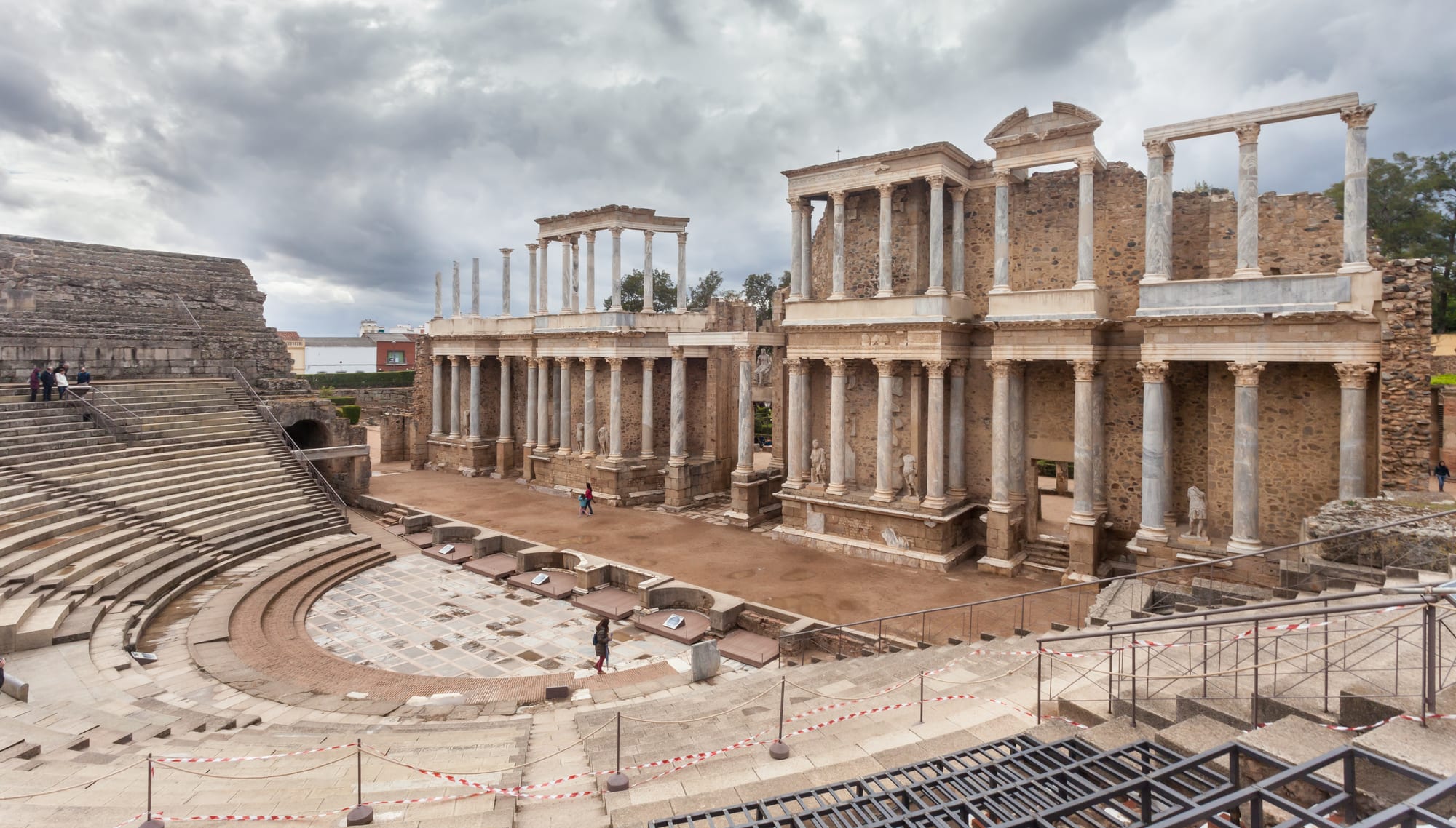
Curved stone seating of the Roman theatre of Mérida facing a two-storey stage front of marble columns under a cloudy sky

Extremadura, Spain

Mérida

The Roman theatre of Mérida, built in 16–15 BC and still used for performances every summer. (Lmbuga (Luis Miguel Bugallo Sánchez) / Wikimedia Commons · CC BY-SA 4.0)

The capital of Extremadura, on the Guadiana in the province of Badajoz, founded by Augustus in 25 BC as Augusta Emerita, a colony for veteran soldiers that became the capital of Roman Lusitania. Its Roman remains, one of the largest archaeological ensembles in Spain, include a theatre still used every summer, an amphitheatre, a circus and a long bridge, around a small, modern administrative capital.

Neighbourhoods

  • The historic centre
    • First-time visitors
    • Historic district
    • Close to public transport

    The compact core around the Plaza de España, with the town hall and the cathedral of Santa María, where the Temple of Diana stands among ordinary streets and the Arch of Trajan spans a public road. Shops, bars and most of the free Roman sites are here.

    Open in Maps
  • The theatre quarter
    • Museums
    • Roman sites

    The area around the theatre and amphitheatre, the city's main sight, with the National Museum of Roman Art across the street and the mosaics of the Casa del Mitreo nearby. It is busiest in the day and on summer festival nights.

    Open in Maps
  • The riverside and the Alcazaba
    • Walks
    • Views
    • Architecture

    The bank of the Guadiana where the Roman bridge, closed to traffic since 1991, leads into the walls of the Moorish Alcazaba. Riverside paths run past the bridge with views of the modern Lusitania Bridge downstream.

    Open in Maps
  • The left bank of the Guadiana
    • Quiet and residential
    • Local life

    The districts across the Guadiana, reached by the Lusitania Bridge, built as the city grew in the 20th century, with the bus station and everyday neighbourhood life rather than sights.

    Open in Maps

Things to do

Roman Mérida

  • Roman Theatrelandmark

    Built in 16–15 BC under the patronage of Agrippa, with its present stage front erected at the end of the 1st or early 2nd century; since 1933 it has hosted the International Festival of Classical Theatre.

    Open in Maps
  • Amphitheatrelandmark

    The arena beside the theatre, completed in 8 BC, where gladiators fought each other and wild beasts.

    Open in Maps
  • Puente Romanolandmark

    The longest surviving bridge from ancient times, with 60 arches across the Guadiana over more than 700 metres, open only to pedestrians since 1991.

    Open in Maps
  • Temple of Diana and the Forumlandmark

    The columns of a granite temple erected under Augustus in the main forum of the Roman town, later partly reused for a nobleman's palace, standing in the middle of the modern centre.

    Open in Maps
  • Provincial Forum and the Arch of Trajanlandmark

    The remains of the forum of the province of Lusitania, built in the 1st century AD, including the arch known as the Arch of Trajan, through which the forum was entered.

    Open in Maps
  • Roman circuslandmark

    A chariot-racing track more than 400 metres long that held up to 30,000 spectators, one of the best-preserved Roman circuses.

    Open in Maps
  • Acueducto de los Milagroslandmark

    The surviving arcade of the 1st-century aqueduct that brought water from the Proserpina reservoir, with superimposed arches carrying it across the valley of the Albarregas.

    Open in Maps
  • Casa del Mitreolandmark

    The remains of a Roman house with many of its original floor mosaics still in place.

    Open in Maps

Museums and later monuments

  • National Museum of Roman Artmuseum

    A national museum in a building by Rafael Moneo, holding collections built up from the excavations and finds of Augusta Emerita.

    Open in Maps
  • Alcazabalandmark

    The first Muslim alcazaba in Iberia, built by the emir Abd ar-Rahman II in 835 from reused Roman and Visigothic stone, with an underground cistern drawing water from the river.

    Open in Maps
  • Basilica of Santa Eulalialandmark

    The church of the city's patron saint, rebuilt in the 13th century by the Order of Santiago over the remains of the early Christian basilica built in her memory.

    Open in Maps
  • Morería archaeological sitelandmark

    An excavated archaeological area of the city, where Roman and later remains, including reinforcements of the city wall, can be seen.

    Open in Maps

Short trips from the city

  • Proserpina Dampark

    A Roman earth dam of the 1st–2nd century that supplied the city through the aqueduct and still holds back a reservoir.

    Open in Maps
  • Cornalvo Dampark

    Another Roman dam built to supply Augusta Emerita, still in use.

    Open in Maps

Seasonal events

  • Holy WeekMarch or April

    Processions declared of International Tourist Interest in 2018, passing Roman monuments as well as churches.

  • Emerita LvdicaJune

    A week of Roman re-enactment begun in 2010, with parades, costumed gladiators and mock battles in the amphitheatre.

  • International Festival of Classical TheatreJuly and August

    Greek and Roman plays, and modern works set in the ancient world, staged in the Roman theatre on summer nights, a tradition going back to 1933.

  • Feria de septiembrefirst week of September

    The city's main fiestas, close to Extremadura Day on 8 September, on whose eve the regional medals are presented in the Roman theatre.

  • Santa Eulalia10 December

    The feast of the city's patron, a young Christian martyred in Roman Mérida, marked with religious celebrations.

Eat and drink

Long-standing places and food districts in Mérida. Hours, ratings and directions come from your maps app, always current.

Mérida classics

  • Caldereta de corderorestaurant

    Lamb caldereta, one of the prestige dishes of Extremaduran cooking, served alongside rabbit, partridge, hare and peppered retinta veal.

    Open in Maps
  • Migas and Extremaduran classicsrestaurant

    Traditional dishes with very Extremaduran names — migas, cojondongo, zorongollo, jilimojas — alongside gazpacho and ajoblanco.

    Open in Maps

Food districts and markets

  • Tapas in the centreneighborhood

    The bars around the old centre serve the region's ham, cheeses and stews as tapas; the city holds a tapas fair followed by a tapas route.

    Open in Maps

Experience Mérida

History

Augustus founded the city in 25 BC as Augusta Emerita, a colony for veterans of the V Alaudae and X Gemina legions discharged after the Cantabrian Wars, at a crossing of the Guadiana. It became the capital of the province of Lusitania and, in the 4th century, of the whole Diocese of Hispania, and stood at the southern end of the Roman road later called the Vía de la Plata. Agrippa sponsored the theatre in 16–15 BC, the amphitheatre followed in 8 BC, and aqueducts brought water from reservoirs in the hills. In the late Roman period the young Christian Eulalia was martyred here, and a basilica in her honour was later built.

In 409 Mérida became the capital of the short-lived Kingdom of the Alans, then passed to the Vandals and, in 469, to the Visigoths, under whom it remained a metropolitan see. Musa ibn Nusayr took it in 713. After revolts, the emir Abd ar-Rahman II built the Alcazaba in 835 to control the city, and repeated rebellions by its Christian population in the 9th century hastened its decline. Its archbishopric was transferred to Santiago de Compostela in 1119, and in 1230 Alfonso IX of León conquered it and handed it to the Order of Santiago.

Mérida remained a modest town for centuries, near a contested border with Portugal. The Napoleonic wars damaged many monuments, and in 1812 arches of the Roman bridge were blown up. The railway then made it a junction and an industrial town. Drama returned to the Roman theatre in 1933. On 10 August 1936 Nationalist troops captured the city, followed by harsh repression. In 1983 Mérida became the capital of the new autonomous community, and in 1993 its Roman remains were inscribed as a UNESCO World Heritage Site.

Culture & Customs

The Roman past is not only a backdrop but part of the city's life. The International Festival of Classical Theatre, declared of international tourist interest, fills the Roman theatre on summer nights with Greek and Roman tragedy and comedy and modern plays on ancient themes, as it has with interruptions since 1933. The theatre also hosts a European youth festival of Greco-Latin drama in spring, music in September, and the regional government's ceremony on the eve of Extremadura Day. Emerita Lvdica, begun in 2010, turns the streets over to parades, gladiators and mock battles, and there is even a Roman carnival in February.

Religion runs alongside. Holy Week, declared of International Tourist Interest in 2018, sends processions past ancient monuments, and the feast of Santa Eulalia on 10 December honours the patron whose martyrdom made Mérida a Christian pilgrimage centre in late antiquity. The September fair is the main popular fiesta, and the Feria Chica in October is an important gathering of the Roma community.

The city also has a strong modern architectural profile, with the Roman art museum by Rafael Moneo and the Lusitania Bridge of 1991 by Santiago Calatrava. Football means AD Mérida, founded in 2013 as the latest successor to CP Mérida, which spent two seasons in La Liga in the 1990s; it plays at the Estadio Romano.

Daily Life

About 60,000 people lived in the municipality in 2025, making Mérida the third city of Extremadura, after Badajoz and Cáceres, though the capital. Its municipality is one of the largest in Spain by area, so the population density is low. Its population has grown in recent years, helped by a rise in births.

Services dominate the economy, above all tourism and government. The regional parliament and the departments of the Junta de Extremadura are here, many in modern buildings, and the city, a historic road and rail junction, also has a congress centre and a trade-fair ground. Industry plays a declining part in the economy, and farming has almost disappeared.

Most people live outside the old centre, in districts built from the mid-20th century onwards, including those across the river. Daily life follows the heat: in summer the streets are quiet in the afternoon and fill again in the evening, when terraces and the riverside come to life.

Food

Mérida's cooking is that of Extremadura, built on what the land provides: Iberian ham, cheeses, olive oil, vegetables, wild fruit, meat and spices. As the regional capital it serves the region's dishes in its bars and restaurants. The prestige dishes include gazpacho and ajoblanco, retinta veal seasoned with pepper, caldereta de cordero, made with lamb, and rabbit, partridge and hare.

Alongside them come traditional dishes with very local names: migas, made from bread; cojondongo; zorongollo; jilimojas; and cardincha. Zorongollo is a salad of tomato and roast peppers, and cojondongo is one of the local names for a chopped salad similar to Andalusian pipirrana. Paprika, garlic, bay leaves, pennyroyal and anise are the favourite seasonings of Extremaduran cooking, and pimentón de la Vera, a smoked paprika from the north-east of the region, is used widely. The region's cheeses include Torta del Casar, the soft sheep's cheese from Cáceres province.

The city holds a tapas fair, followed by a tapas route that combines food with a tour of the city. The local wine designation is Ribera del Guadiana, which takes its name from the river that runs through the town.

Planning tools

Budget

Mérida is inexpensive. Hotels cost well below the national average except on festival nights in July and August, the menú del día is generous, and several Roman sites, including the Temple of Diana, the Arch of Trajan, the bridge and the Milagros aqueduct, are free to see. A combined ticket covers the main paid sites, but not the National Museum of Roman Art.

Daily Budget Midrange
USD 100–210 (mid-range hotel, restaurant dinners, the combined monuments ticket and a theatre night)
Daily Budget Shoestring
USD 45–80 (hostel or pension, menú del día and tapas, free Roman sites, walking)

Buy the combined ticket at a smaller site rather than at the theatre, where queues are longest.

Best Time to Visit

Spring and autumn are the most comfortable seasons for walking between the ruins. July and August are very hot, sometimes over 40°C by day, but bring the classical theatre festival, when the Roman theatre is used for evening performances. Emerita Lvdica falls in June, and winter is mild and quiet.

Suggested Number of Days

Most visitors need one or two days for the Roman city and its museum; allow more to see the smaller sites at a slower pace, to catch a summer performance, or to add the reservoirs outside town and other towns of Extremadura.

First Visit
1–2 days
With Surroundings
2–3 days

Transportation

Mérida is small enough that all the main sites can be reached on foot; crossing the whole town takes about an hour. City buses cover almost every district. Ride-hailing apps do not operate, so taxis are called by phone.

Walk between the sites, and keep the long stretches between the circus, the aqueduct and the theatre for the cooler hours in summer.

Airport & Station Connections

Badajoz Airport, about 45 km west of Mérida, is the nearest, with mainly domestic flights; Madrid, Seville and Lisbon are the main international gateways. Trains link Mérida with Cáceres, Badajoz, Madrid and Seville. The bus station is across the Lusitania Bridge from the centre, with services to Seville, Madrid and towns across Extremadura.

Walkability

Very good. The theatre, the museum, the Temple of Diana, the Plaza de España and the Roman bridge are all within a few minutes of each other, and the Milagros aqueduct and the circus are a longer walk to the north and east. Summer heat, not distance, is the main limit.

Safety

Spain is a safe country with low violent crime. Mérida is quiet and low in crime. The main hazard is the heat: some summer days bring temperatures above 40°C, and many Roman sites have little shade.

Visit the open-air ruins early in the morning in summer, carry water and wear a hat. Check current official travel advice before travelling.

Climate

A Mediterranean climate with Atlantic influence. Winters are mild, with fog common in autumn and winter and snow almost unknown; summers are hot and dry, and droughts of several years are not unusual. Most rain falls in November and December, and autumn brings occasional storms.

Summer
hot and dry, with highs sometimes above 40°C; the regional record of 46.4°C was set here in August 2003
Winter
mild, with night-time lows that seldom fall below 0°C and frequent fog

Local Customs

People from Mérida are called emeritenses, after the city's Roman name, and the Roman past is part of daily life: the theatre hosts not just drama but the regional government's ceremony on the eve of Extremadura Day, and Roman festivals fill the calendar. Santa Eulalia, the city's patron, is honoured in December. Lunch and dinner are late, and summer life moves outdoors in the evening.

Tipping is neither mandatory nor considered customary.

Common Payment Methods

The currency is the euro. Cards and contactless payment are accepted almost everywhere, including small bars and taxis; carry a little cash for market stalls and small purchases.