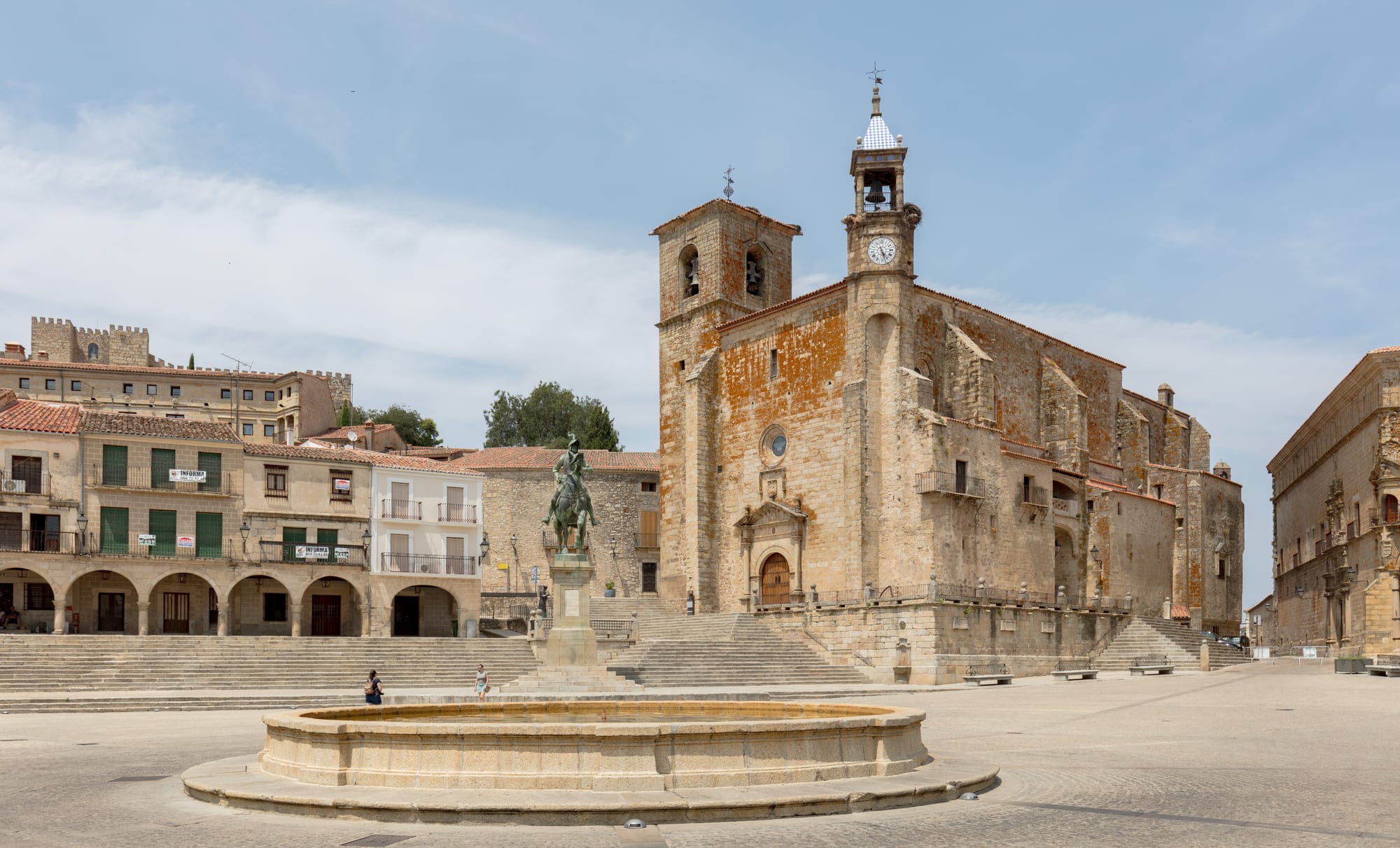
Trujillo's wide Plaza Mayor with a stone fountain, an equestrian bronze statue and the tall Gothic church of San Martín

Extremadura, Spain

Trujillo

The Plaza Mayor of Trujillo, with the church of San Martín and the equestrian statue of Francisco Pizarro. (Diego Delso / Wikimedia Commons · CC BY-SA 4.0)

A small hill town in the province of Cáceres, on a granite knoll above the dehesa, crowned by a castle built under Muslim rule. Its Renaissance Plaza Mayor, ringed by palaces and arcades, recalls the 16th century, when men born here — Francisco Pizarro among them — brought home wealth from the Americas. Today it lives from farming, tourism and a famous cheese fair.

Neighbourhoods

  • Plaza Mayor
    • First-time visitors
    • Best for food
    • Architecture

    The large, arcaded Renaissance square at the heart of the town, lined with palaces and noble houses built from the 16th century, with the church of San Martín and Pizarro's statue. Much of it is now given over to bars, restaurants and shops, and the tourist office is here.

    Open in Maps
  • The walled town
    • Historic district
    • Views
    • Quiet

    The old 'villa' inside the medieval walls, climbing from the square to the castle on the summit. Four of its seven gates survive, and its steep lanes hold the church of Santa María la Mayor, convents and quiet stone houses.

    Open in Maps
  • The arrabales
    • Quiet and residential
    • Local life

    The outlying villages within the municipality — Belén, Huertas de Ánimas, Huertas de la Magdalena and Pago de San Clemente — each with its own parish church, among the farms and dehesa that surround the town.

    Open in Maps

Things to do

Castle, walls and churches

  • Castle of Trujillolandmark

    A fortress built mostly under Muslim rule in the 9th and 10th centuries on the top of the hill, with a chapel of the town's patron, the Virgen de la Victoria.

    Open in Maps
  • Walls and gateslandmark

    Medieval walls of dressed stone and rubble with seventeen rectangular towers and four surviving gates — San Andrés, Santiago, Coria and the Triunfo — remodelled in the 15th and 16th centuries.

    Open in Maps
  • Church of Santa María la Mayorlandmark

    A 13th-century church in the upper town, one of the town's three parish churches and among its most important monuments.

    Open in Maps
  • Church of San Martínlandmark

    The parish church that closes one side of the Plaza Mayor, where the Virgen de la Victoria is brought for the town's late-summer fiestas.

    Open in Maps

Plaza Mayor and its palaces

  • Equestrian statue of Francisco Pizarrolandmark

    A bronze statue of the conqueror of Peru, armed and on horseback, by the American sculptor Charles Cary Rumsey — one of three casts, the others in Lima and Buffalo.

    Open in Maps
  • Palacio de la Conquistalandmark

    The Renaissance palace of the Marquises of the Conquest on the main square, also known as the palace of the coat of arms.

    Open in Maps
  • Palacio de Piedras Albaslandmark

    A palace built around 1530 by Pedro Suárez de Toledo, once owned by the family of the explorer Francisco de Orellana.

    Open in Maps

Museums

  • Pizarro's Housemuseum

    The house museum known as Pizarro's House, named after the family of the conqueror of Peru.

    Open in Maps
  • Museum of Cheese and Winemuseum

    A small museum of the cheeses and wines of the region, the produce behind the town's famous spring fair.

    Open in Maps
  • Monastery of San Francisco el Real de la Coriamuseum

    A 15th-century convent building that houses the Xavier de Salas Foundation.

    Open in Maps

Short trips from the town

  • Monfragüe National Parkpark

    A national park of river gorges and Mediterranean woodland in the triangle between Trujillo, Plasencia and Cáceres, famous for its birds of prey, including black vultures and Spanish imperial eagles.

    Open in Maps

Seasonal events

  • Holy Week and the ChíviriMarch or April

    Holy Week processions, of regional tourist interest, end on Easter Sunday with the Chíviri, when the Plaza Mayor fills with people in local costume who sing, dance, eat and drink; on Easter Monday locals head into the countryside for picnics.

  • National Cheese Fairlate April or early May

    The most important cheese competition in Spain, which fills the Plaza Mayor with hundreds of stands of cheeses from across the country, along with wine and beer stalls, and draws around 100,000 visitors.

  • Fiestas of the Virgen de la Victorialate August or early September

    The patron's fiestas, when her image is brought down from the castle chapel to San Martín, with capeas and a festival of music, dance and theatre in the castle.

Eat and drink

Long-standing places and food districts in Trujillo. Hours, ratings and directions come from your maps app, always current.

Trujillo classics

  • Migas and frite de cabritorestaurant

    Migas extremeñas and frite de cabrito, made with kid, head a list of local dishes that also includes moraga, prueba del cerdo and landrillas de ternera.

    Open in Maps
  • Spring dishes and soupsrestaurant

    Criadillas de la tierra with wild asparagus, sopa de obispo made with hen, and tomato soup are other traditional dishes of the town.

    Open in Maps

Food districts and markets

  • Plaza Mayorneighborhood

    Bars and restaurants with terraces fill much of the main square, and shops sell local cheeses and other produce.

    Open in Maps

Experience Trujillo

History

Trujillo is identified with Roman Turgalium, a dependency of Augusta Emerita, present-day Mérida. After the Islamic conquest it became one of the main towns of the region, known in Arabic as Targhālah, and its castle on the hilltop was built mostly in the 9th and 10th centuries. In the early 12th century the Almoravids launched raids from here against Talavera, and under the Almohads it changed hands repeatedly between Muslims, Portuguese, Castilians and Leonese; from 1188 to 1195 it was the headquarters of a military order named after the town.

Christian forces finally took Trujillo on 25 January 1232. Local legend says the attackers were faltering until they saw the Virgin Mary between the towers of the Arco del Triunfo, and she became the town's patron as the Virgen de la Victoria. Trujillo remained a royal town rather than a lordship; Alfonso X granted it a charter in 1256, John II made it a city in 1430, and a weekly market followed in 1465. It had a prosperous Mudéjar community of up to 400 people and a Jewish community with its own synagogue, until the expulsion of 1492.

The 16th century was its great age. Trujillo sided with the emperor in the Comuneros revolt, and fortunes from the Americas paid for palaces that spread the town beyond its walls. Francisco Pizarro, the conqueror of Peru, was born here, as was Francisco de Orellana, the explorer of the Amazon. From 1528 it headed a province of its own. Decline followed: Moriscos were expelled in 1610–11, French occupation drained the town in 1811, and in 1834 it became the seat of a judicial district.

Culture & Customs

Trujillo's identity is bound up with its square and its past. The Plaza Mayor has been the centre of town life since palaces and noble houses replaced the craftsmen's quarter there in the 16th century, and it is where the town gathers for every celebration. The whole urban ensemble has been protected as a heritage site since 1962, and the town rejoined the association of the Most Beautiful Villages of Spain in 2024.

Its calendar has two fiestas of regional tourist interest. Holy Week is followed on Easter Sunday by the Chíviri, when the square fills with people in local costume singing and dancing to the beat of the Chíviri, and the next day the whole town goes picnicking in the country. In late August or early September the Virgen de la Victoria comes down from her chapel in the castle to San Martín for the patron's fiestas, with capeas and a festival in the castle. The National Cheese Fair, held around the start of May, is the most important cheese competition in Spain.

The town has become a film location: the castle stood in for Casterly Rock in Game of Thrones and appeared in the second season of House of the Dragon. Storks nest on its old buildings, and lesser kestrels breed in the bullring and other buildings in town.

Daily Life

About 8,600 people lived in the municipality in 2025, making it the sixth most populous in the province of Cáceres. Most live in the town itself and the neighbouring Huertas de Ánimas; the rest are spread among the outlying villages of Belén, Huertas de la Magdalena and Pago de San Clemente and on the farms of the countryside. The municipality covers about 650 square kilometres, much of it dehesa and farmland.

Trujillo is the capital of its comarca and of a judicial district, and it serves the surrounding villages with schools, shops and services. Its history, setting, countryside and food have made it one of Extremadura's main tourist centres, and farming and livestock remain important, reflected in an agricultural and livestock fair as well as the cheese fair. In 2018 the small foreign population came mainly from Romania, Colombia and Morocco.

Daily life is unhurried. The square is the meeting place, with its bars and terraces busy in the evening; much of the business on it now serves visitors. A single urban bus line connects the outlying villages with the centre, aimed at older residents who need to reach shops and offices.

Food

Trujillo's cooking is that of the Extremaduran countryside. Among the typical dishes of the town are migas extremeñas, frite de cabrito, made with kid, moraga, prueba del cerdo, a dish from the pig, landrillas de ternera, made with veal, and criadillas de la tierra served with wild asparagus. Soups are a tradition too: sopa de obispo, made with hen, and tomato soup.

Cheese is the town's pride. Cheeses of the Queso Ibores designation are made in Trujillo, and the region's soft sheep's-milk Torta del Casar and Torta de la Serena and Los Ibores goat's cheese are well known. Many local cheese makers and farmers mature their own cheeses from the milk of their goats or sheep, and every spring the National Cheese Fair fills the Plaza Mayor with stands from across Spain.

Ibérico ham, from black Iberian pigs fed on acorns, is the other great product of the region. Trujillo also produces wine under the Ribera del Guadiana designation and the wider Vino de la Tierra de Extremadura label. In the Plaza Mayor, bars and restaurants serve these local products to visitors and residents alike.

Planning tools

Budget

Trujillo is cheap by Spanish standards outside the cheese-fair weekend and Easter, when rooms fill and prices rise. The menú del día is generous, and walking the walls, the lanes and the square costs nothing; the castle and some churches and museums charge small entry fees. A car is the main extra cost.

Daily Budget Midrange
USD 100–210 (mid-range hotel, restaurant dinners, a hire car and monument tickets)
Daily Budget Shoestring
USD 45–80 (pension or rural house, menú del día and tapas, walking)

Book well ahead for the National Cheese Fair and Easter, or stay in Cáceres and drive over for the day.

Best Time to Visit

Spring is the best season, when the countryside is green, the storks are nesting and the calendar brings Easter, the Chíviri and the cheese fair. Autumn is also pleasant. July and August are very hot, though the late-summer fiestas fall at the end of August, and winter is quiet and cool.

Suggested Number of Days

The town itself can be seen in a day, though staying overnight shows the square in the quiet of the evening. Allow two or three days to add the national park and the countryside of the province.

First Visit
1 day
With Surroundings
2–3 days

Transportation

The town is small and walked on foot, though the climb from the square to the castle is steep. A single urban bus line links the centre with the outlying villages. Trips into the countryside need a car.

A car is the practical way to reach Trujillo and to explore the countryside around it.

Airport & Station Connections

Trujillo lies on the A-5 motorway between Madrid and Badajoz, which makes it a common stop on the drive between Madrid and Extremadura or Portugal. The A-58 motorway links it with Cáceres, about 45 km away, and the EX-208 runs to Plasencia through Monfragüe. Buses on the Madrid–Mérida route call here; there is no airport nearby, and Madrid is the usual international gateway.

Walkability

Everything worth seeing is within walking distance of the Plaza Mayor, but the walled town rises steeply to the castle, with uneven cobbles and few level stretches. The walk is hard work in summer heat.

Safety

Spain is a safe country with low violent crime. Trujillo is a quiet town with little crime. The real risk is summer heat on the exposed climb to the castle.

Climb to the castle early or late in the day in summer and carry water. Check current official travel advice before travelling.

Climate

A hot-summer Mediterranean climate: dry, hot summers, mild winters with some frost, and most rain from autumn to spring. In nearby Cáceres, summer highs average about 34°C and winter highs no more than about 14°C.

Summer
hot and dry; in nearby Cáceres average highs are about 34°C and lows about 19°C
Winter
mild by day with some frost; in nearby Cáceres average highs are no more than about 14°C

Local Customs

Life centres on the Plaza Mayor, where people meet for drinks and the evening walk. Easter Sunday's Chíviri is the town's great day of celebration, and Easter Monday is a local holiday spent picnicking in the countryside. The patron, the Virgen de la Victoria, is honoured at the end of summer.

Tipping is neither mandatory nor considered customary. Churches and convents are places of worship as well as monuments; keep voices low inside.

Common Payment Methods

The currency is the euro. Cards and contactless payment are accepted almost everywhere, including small bars; a little cash is useful for small entry fees and fair stalls.