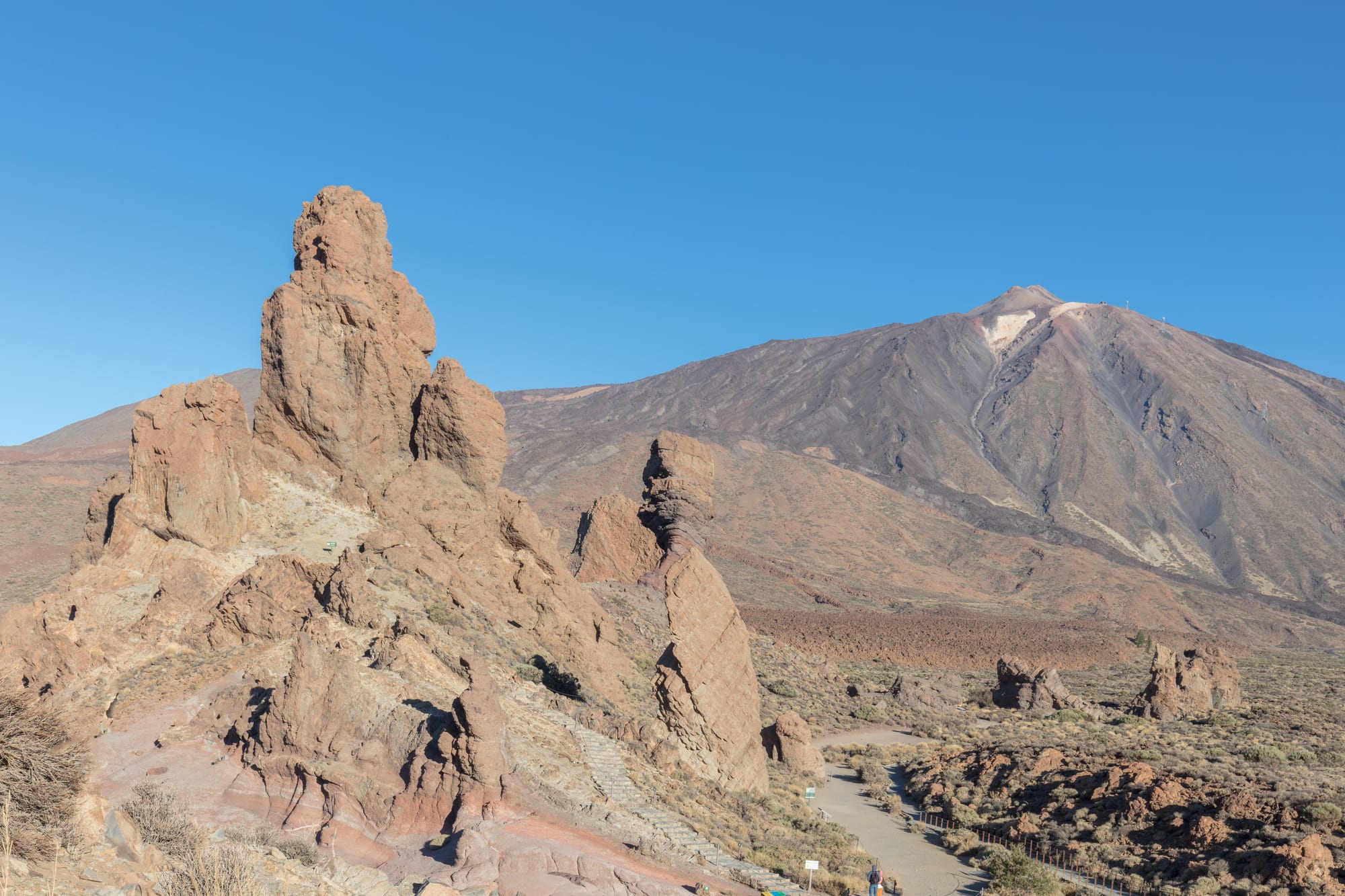
Tall reddish rock pillars in the foreground with the broad volcanic cone of Mount Teide rising against a clear blue sky

Spain

The Canary Islands

The Roques de García and Mount Teide in Teide National Park, Tenerife. (Diego Delso / Wikimedia Commons · CC BY-SA 4.0)

A chain of volcanic islands in the Atlantic off the coast of north-west Africa, far from mainland Spain — seven main islands from Lanzarote and Fuerteventura in the east to El Hierro in the west, with Spain's highest mountain, Mount Teide, a mild climate all year and one of Europe's largest winter-sun holiday economies.

Explore The Canary Islands

History

The islands were known to Roman writers as the Fortunate Isles, and their name comes from the Latin for dogs, canis. Before European conquest they were home to peoples of North African Berber origin, commonly called Guanches after the inhabitants of Tenerife, who kept goats, grew grain, lived partly in caves, mummified their dead (above all on Tenerife) and seem to have had little contact between islands. Their rock carvings and cave sites survive, notably at Risco Caído on Gran Canaria.

The Castilian conquest took almost a century. It began in 1402 with the Norman adventurer Jean de Béthencourt on Lanzarote and ended with Tenerife in 1496, after fierce resistance. Many islanders died or were enslaved, and the survivors mixed with settlers from Castile, Andalusia, Portugal and elsewhere. Christopher Columbus stopped at Las Palmas and at La Gomera on his first voyage in 1492, and the islands became a key port of call on Atlantic routes, growing sugar and later wine, famous in England as Canary sack.

Poverty drove waves of emigration to Cuba, Venezuela and elsewhere in Latin America, creating strong family ties across the Atlantic. In July 1936 Franco, then military commander of the Canaries, flew from here to Morocco to lead the uprising that began the Civil War. Tourism transformed the islands from the 1960s, and they became an autonomous community in 1982. The eruption on La Palma in 2021 destroyed homes, farms and roads, and in recent years the islands have been a main destination for migrant boats from West Africa.

Culture & Customs

Canarians speak a Spanish close to that of the Caribbean and Andalusia, with a softer "s", ustedes used instead of vosotros, and words such as guagua for bus and papa for potato. Identity mixes Spanish, Latin American and older island elements, and each island has its own character.

The carnivals of Santa Cruz de Tenerife and Las Palmas de Gran Canaria are among the largest in the world, with weeks of parades, costume contests and street parties, while La Palma's Los Indianos carnival fills Santa Cruz de La Palma with white clothes and clouds of talcum powder in memory of returning emigrants. Religious festivals include the pilgrimage to the Virgin of Candelaria, patron of the archipelago, on Tenerife, and La Palma's Bajada de la Virgen, held every five years. Village romerías bring out traditional dress, ox carts and folk music played on the timple, a small five-string guitar.

La Gomera's silbo gomero, a whistled form of Spanish once used to communicate across ravines, is UNESCO intangible heritage and taught in island schools. Lucha canaria, a form of wrestling, and juego del palo, stick-fighting, are traditional sports. Crafts include embroidery, basketry and pottery shaped by hand without a wheel.

Daily Life

About 2.2 million people live in the Canaries. Tenerife and Gran Canaria hold the great majority, and the two share the regional capital status: Las Palmas de Gran Canaria has about 380,000 people and Santa Cruz de Tenerife about 210,000, with the old university city of San Cristóbal de La Laguna next door. Lanzarote and Fuerteventura have grown fast with tourism, while La Gomera and El Hierro have populations of only about 20,000 and 11,000 respectively.

Tourism dominates the economy, with millions of visitors a year, many from Britain, Germany and Scandinavia, and it has brought wealth along with low wages, housing shortages and protests about overcrowding and the environment. Bananas remain the main export crop, alongside tomatoes, potatoes and wine. The islands have a special tax regime, and their distance from the mainland raises the cost of many goods. Water often comes from desalination plants, and El Hierro has pioneered wind and hydro power.

The pace of life is relaxed, with the Spanish meal times, and weekends often spent at the beach or at family gatherings in the hills.

Food

Canarian cooking is simple and built on local produce. Papas arrugadas, small potatoes boiled in their skins in very salty water until wrinkled, are served with mojo, a sauce that comes as mojo rojo, spicy with red pepper and paprika, or mojo verde, with coriander or parsley. Gofio, a flour of toasted grain, dates back to the islands' original inhabitants and is still stirred into soups, milk or dough. Sancocho is salted fish with potatoes and sweet potato, eaten with mojo, while puchero canario is a meat and vegetable stew and conejo en salmorejo is rabbit marinated in a garlic and pepper sauce.

Goat's-milk cheeses are highly regarded, above all queso majorero from Fuerteventura and queso palmero from La Palma, both with protected designations; La Gomera has almogrote, a spicy spread of hard cheese, garlic and pepper, and miel de palma, a syrup made from palm sap. Desserts include bienmesabe, an almond cream, and frangollo, a maize pudding. Plátanos de Canarias, small bananas, are grown on terraces across the western islands.

Lanzarote grows Malvasía grapes in hollows dug into volcanic ash, and La Palma and Tenerife also make wine. Gran Canaria distils rum, often drunk as ron miel, sweetened with honey, and Tenerife's barraquito is a layered coffee with condensed milk and liqueur.

Attractions & Natural Wonders

Tenerife is dominated by Mount Teide, at about 3,715 metres Spain's highest mountain, in Teide National Park, a UNESCO World Heritage Site; a cable car climbs close to the top. Elsewhere on the island are the old towns of La Laguna, also on the UNESCO list, and La Orotava, the ravine village of Masca, the Los Gigantes cliffs, the Anaga mountains and the beach resorts of the south.

Gran Canaria has the Maspalomas dunes, the peak of Roque Nublo, the cave landscape of Risco Caído and, in Las Palmas, the old Vegueta quarter and Las Canteras beach. Lanzarote has Timanfaya National Park, the La Geria vineyards and the works of the artist César Manrique, including the Jameos del Agua in a lava tube and the Mirador del Río. Fuerteventura has long beaches, the dunes of Corralejo and windsurfing coasts.

In the west, La Palma has the Caldera de Taburiente National Park, the observatories on Roque de los Muchachos, dark skies and the new volcanic landscape of 2021. La Gomera has Garajonay National Park's laurel forest, a UNESCO World Heritage Site, and the terraced valley of Valle Gran Rey. El Hierro, the smallest of the seven, is a UNESCO biosphere reserve known for diving at La Restinga and for its wind-twisted juniper trees.

Cities in The Canary Islands

Planning basics

Budget

The Canaries are generally good value, helped by package holidays and a lower sales tax than the mainland. Resort areas in southern Tenerife and Gran Canaria range from cheap apartments to luxury hotels, while La Gomera, La Palma and El Hierro have smaller, often rural guesthouses. Winter is the high season, and prices peak at Christmas and Easter.

Daily Budget Midrange
USD 130–250 (mid-range hotel or rural house, restaurant meals, hire car, inter-island ferry or flight)
Daily Budget Shoestring
USD 55–100 (hostel or apartment, local bars and markets, buses)

Hire a car to reach the mountains and the quieter coasts, and book the Teide summit permit well ahead if planning to climb to the crater.

Safety

The Canaries are safe. The main dangers are natural: strong Atlantic currents and waves on unguarded beaches cause drownings every year, and mountain paths can be steep, exposed and affected by sudden cloud. The altitude on Teide can cause breathlessness, and the islands are volcanic and monitored for activity. Petty theft from hire cars at trailheads and beaches occurs.

Swim only on guarded beaches when the sea is rough, carry warm clothes and water in the mountains, and leave nothing visible in parked cars. Check current official travel advice before travelling.

Climate

Subtropical and mild all year, cooled by the trade winds and the Atlantic. The north-facing slopes of the higher islands are greener and cloudier, the southern coasts sunnier and drier, and Lanzarote and Fuerteventura are dry and windy. The mountains are much colder: snow sometimes falls on Teide in winter. Hot dust-laden winds from the Sahara, called calima, occasionally bring haze and heat.

Summer
warm and sunny on the coasts, 25–30°C, cooler in the northern cloud belt; hot spells during calima
Winter
mild, 18–23°C on the coasts; cold at altitude, with occasional snow on Teide

Transportation

All seven main islands have airports, with Tenerife's two, Gran Canaria and Lanzarote the busiest; flights from Madrid take roughly two and a half to three hours. Inter-island flights and ferries link the islands, with La Gomera usually reached by ferry from southern Tenerife. Buses, called guaguas, serve the larger islands, and Tenerife has a tram between Santa Cruz and La Laguna, but a hire car is the practical way to explore the interiors and the smaller islands. The islands are an hour behind mainland Spain.

Hire a car on each island rather than taking one on the ferry, and allow extra time on steep, winding mountain roads.

Best Time to Visit

Any time of year. Winter is the main season for visitors from northern Europe, and February brings the large carnivals of Santa Cruz de Tenerife and Las Palmas. Spring and autumn are best for hiking in the mountains and forests, when the weather is clear and mild. Summer is popular with Spanish holidaymakers and is the windiest period on Fuerteventura and Lanzarote.