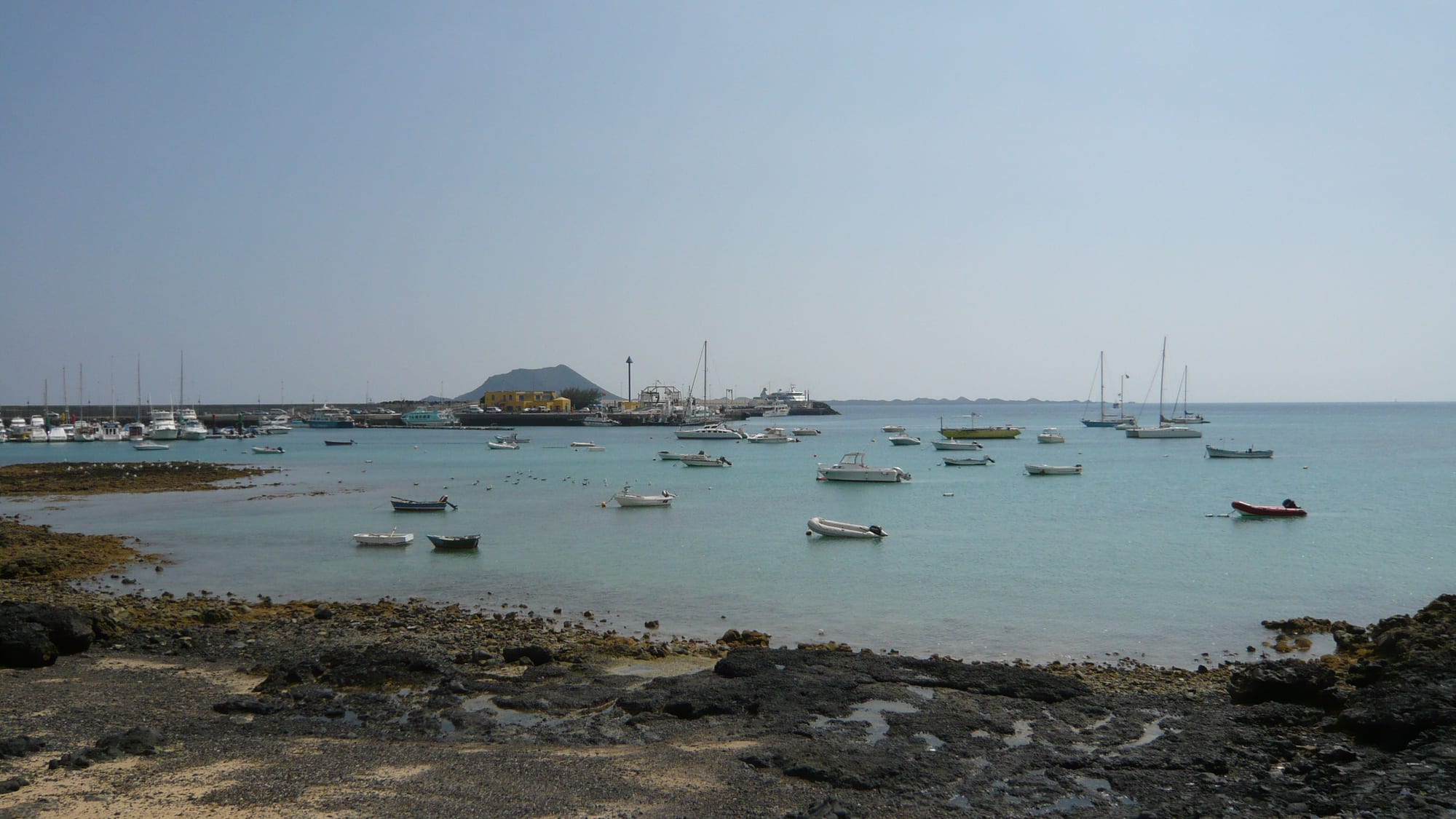
Small boats moored in calm turquoise water off a dark rocky shore, with the harbour wall and a cone-shaped hill behind

The Canary Islands, Spain

Corralejo

Boats moored in the bay at Corralejo harbour. (Andy Mitchell from Glasgow, UK / Wikimedia Commons · CC BY-SA 2.0)

A town and resort on the northern tip of Fuerteventura, facing the islet of Lobos across a narrow strait, with the sea on two sides and a protected field of sand dunes to the south. A small fishing village until the 1970s, it is now one of the island's two main tourist towns, known for its long beaches, its wind and its ferries.

Neighbourhoods

  • The old town and harbour
    • First-time visitors
    • Best for food
    • Close to the ferries

    The original fishing cove at the north end of town, where the port sends ferries to Lanzarote and Lobos. Its small streets hold most of the town's bars and restaurants, many serving tapas, along with small sheltered beaches edged by volcanic rock.

    Open in Maps
  • The town centre
    • Shopping
    • Nightlife

    The streets inland from the bay, built up since the 1970s, with souvenir shops, a small market area and the main street, pedestrianised from about 2017. Bars stay busy into the night.

    Open in Maps
  • The dunes beaches
    • Beaches
    • Windsurfing and kitesurfing

    South of town, about 11 kilometres of fine sand run beside the protected dunes, beginning a few kilometres outside the centre, and a base for wind and kite sports.

    Open in Maps

Things to do

Dunes and beaches

  • Corralejo dunespark

    Several kilometres of white, desert-like sand dunes along the coast south of town, protected as a nature reserve and open for walking.

    Open in Maps
  • Corralejo's dune beachesbeach

    The long sandy beaches beside the dunes; the water is clear but affected by strong currents.

    Open in Maps
  • Windsurfing and kitesurfingattraction

    Strong, near-constant winds make Corralejo one of the island's best-known spots for wind and kite sports, with rental shacks and schools around town.

    Open in Maps

Short trips from the town

  • Lobos Islandpark

    A small volcanic islet two kilometres off the coast, a nature reserve reached by a short ferry ride, with walking trails, snorkelling and a lighthouse at its north-eastern end.

    Open in Maps
  • El Cotilloattraction

    A small coastal town in the north-west of the island, known for its bays of clear water and fine sand beaches.

    Open in Maps
  • Casa de los Coronelesmuseum

    In the town of La Oliva, the historic house of the colonels who once governed the island, now an art gallery.

    Open in Maps
  • Betancuriaattraction

    A small mountain town and the smallest municipality on the island by population, which in 1424 briefly became the seat of a bishopric.

    Open in Maps

Eat and drink

Long-standing places and food districts in Corralejo. Hours, ratings and directions come from your maps app, always current.

Food districts and markets

  • Old town bars and restaurantsneighborhood

    The densest cluster of bars and restaurants in town, mostly serving Spanish food and tapas, close to the harbour.

    Open in Maps
  • El Campanario Sunday marketmarket

    A Canarian market held every Sunday at the town's large shopping centre.

    Open in Maps
  • Seafood restaurantsneighborhood

    Restaurants in town serving seafood, including large seafood paellas.

    Open in Maps

Experience Corralejo

History

The coast around Corralejo was where the Norman-French conquest of Fuerteventura began. In 1402 Jean de Béthencourt's expedition, which had already built a fort on neighbouring Lanzarote, sent Gadifer de la Salle and a small party across the strait; they landed in the arid, thinly populated north and explored for eight days. A second landing that October used the islet of Lobos, two kilometres offshore, as a base to hunt seals for food and skins, until a mutiny on Lanzarote left La Salle's men stranded there without water until they were rescued.

The town itself is young. Oral tradition says it was founded around 1810, though others date the first proper settlement to the 1850s; its first residents, from Lanzarote, Galicia and Portugal, built houses from local stone, and the name may come from the use of the area as a coastal cattle pen. For a century it remained a small fishing cove, dependent on La Oliva, with about a hundred people and only around eleven surnames as late as the 1950s. In 1925 the fishermen built a chapel to Our Lady of Mount Carmel together, each placing a piece; it was replaced by a modern church in the 1980s.

Tourism reached the north of the island in the early 1970s, drawn by the beaches and dunes, and the village became a building site; the writer John Mercer described it in 1973 as dust, noise and concrete mixers. Growth continued through the following decades and peaked in the 2000s, with many British and Irish visitors settling for good.

Culture & Customs

Corralejo is a resort with a fishing village at its heart, and its character comes from the mix of people who have settled there. Alongside Canarians, the town has large communities of Italians, Irish, British, Germans and Finns, which gives it an international feel alongside the Spanish tapas bars of the old town.

The sea and the wind shape local life. Fuerteventura's trade winds and winter swells make the exposed north coast popular with surfers all year, Corralejo is a well-known spot for windsurfing and kitesurfing, and schools and rental shacks line the town. The town is also home to the Onexe Fuerteventura paddleboarding club, the most successful stand-up paddleboarding club in Spain, and to the football club CD Corralejo.

The island's older traditions still surface. The fishermen's chapel of 1925 is remembered as a work the whole village built together, and the townspeople's link to the sea runs through their history, from the long days fishing the north coast to the queues at the windmills when calm days left them unable to grind gofio. Fuerteventurans are called majoreros, a word of indigenous origin also given to the island's famous cheese.

Daily Life

Corralejo had about 18,700 inhabitants in 2023, which makes it the second-largest town on Fuerteventura after the capital, Puerto del Rosario. It belongs to the municipality of La Oliva, whose population has grown from about 2,900 in 1975 to more than 29,000 in 2023, almost all of it because of tourism, and the town offers around 20,000 beds to visitors.

Tourism is the economy: hotels, apartments, villas, restaurants, bars, shops, water-sports schools and the ferries to Lanzarote and Lobos. Through the 2010s the town grew quickly, with new businesses constantly opening and closing. The main street was pedestrianised from about 2017, a change that drew criticism from some residents, and vandalism has become a concern; in 2019 the replica galleon of an abandoned theme park was burned down.

The pace follows the wind and the seasons. Winter brings northern European visitors and long-stay residents, summer the Spanish holidaymakers. Days revolve around the beaches and the dunes, evenings around the old town's bars and restaurants, and the ferries to Lanzarote keep the port busy through the day.

Food

Fuerteventura's cooking is simple, and like the other Canary Islands it relies heavily on fish. Papas arrugadas, wrinkly potatoes boiled in their skins in very salty water, come with mojo, a sauce of olive oil, local peppers, garlic and paprika, and puchero canario is a meat stew. Fish is prepared in traditional ways: pejines are salted fish, jareas sun-dried fish, and sancocho is salted fish such as grouper, corvina or sama, boiled and served with mojo, potatoes or gofio, the island's flour of roasted grain. Mussels and limpets gathered on the coast are popular.

Goat is the main meat, roasted or stewed, and goat's milk makes majorero, the island's best-known cheese. Firm and pale, sometimes with a little ewe's milk added, it is sold with a natural rind rubbed with oil, coated in paprika or rolled in roasted gofio, and holds a European protected designation of origin.

In town, most bars and restaurants are in the old town near the harbour and serve Spanish food and tapas, and some specialise in seafood and paella. Every Sunday a Canarian market is held at the El Campanario shopping centre.

Planning tools

Budget

Corralejo is a mid-priced resort with a wide spread of apartments, villas and beach hotels. Winter is the high season, peaking at Christmas and Easter. Eating out in the old town is good value; the main extra costs are the ferries, water-sports lessons and a hire car for the rest of the island.

Daily Budget Midrange
USD 130–250 (mid-range hotel, restaurant meals, a ferry trip or a hire car)
Daily Budget Shoestring
USD 55–100 (apartment, tapas and supermarket food, buses)

The beaches and dunes cost nothing; book water-sports lessons and the Lobos ferry for calm days.

Best Time to Visit

Any time of year. Winter is the main season for northern Europeans, with mild days, while summer is popular with Spanish holidaymakers. The summer trade winds and the winter swells keep the north coast busy with surfers, windsurfers and kitesurfers all year.

Suggested Number of Days

Three or four days cover the town, the dunes and a day on Lobos. Most visitors stay a week, and five to seven days leave time for the rest of Fuerteventura or a ferry crossing to Lanzarote; water-sports courses also add days.

First Visit
3–4 days
With Surroundings
5–7 days

Transportation

The town stretches around a bay and is small enough to walk. Local buses run around town, public buses connect with Puerto del Rosario, the island capital, and taxis run to the beaches and further afield. Bikes, scooters and shared e-scooters can be hired. A hire car is the practical way to explore the rest of the island.

Ferries to Lobos leave from the harbour; check the sea state, as crossings depend on the weather.

Airport & Station Connections

Fuerteventura Airport is at El Matorral, 5 kilometres south-west of Puerto del Rosario, with flights to more than 80 destinations; from there buses run via the bus station in Puerto del Rosario, or a taxi or hire car makes the trip direct. Ferries from Playa Blanca, in the south of Lanzarote, cross to Corralejo port in about half an hour.

Walkability

The centre, the old town and the harbour are compact and flat, and the main street has been pedestrianised. The dune beaches begin a few kilometres south of the centre, a long walk in the sun and wind, so many people take a bus, a bike or a taxi.

Safety

Spain is a safe country with low violent crime. In Corralejo the main danger is the sea: the water is clear but strong currents run off the beaches. Wind and sun are strong, and the dunes are fully exposed.

Swim only where it is guarded when the sea is rough, carry water and sun protection into the dunes, Check current official travel advice before travelling.

Climate

A hot desert climate, mild but mostly windy all year, with very little rain and some 3,000 hours of sunshine. Hot dust-laden winds from the Sahara, called calima, occasionally bring haze and heat.

Summer
warm and windy; on Fuerteventura summer highs average about 28°C and lows about 20°C
Winter
mild; on Fuerteventura winter highs average about 22°C and lows about 15°C

Local Customs

Corralejo is a mixed town where Spaniards live alongside settled Italians, Irish, British, Germans and Finns. Naked sunbathing is common on Corralejo's beaches, though none is designated as a nude beach. Some bars allow smoking indoors.

Keep swimwear to the beach, respect the protected dunes, and greet shop and bar staff with a 'hola' or 'buenos días'.

Common Payment Methods

The currency is the euro. Cards and contactless are accepted almost everywhere, including small bars, and cash machines are found in the town centre; a little cash is useful for markets.